
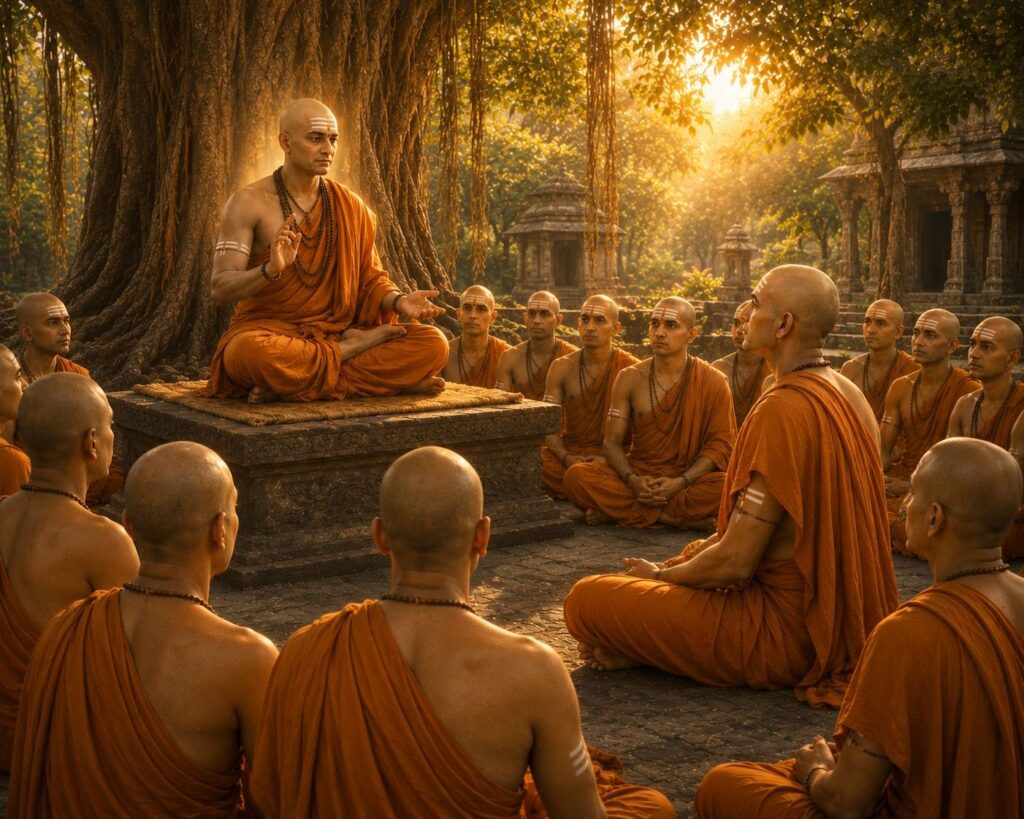
Previously in Adi Shankaracharya Series: A Quick Overview
- Part 1: Introduction to the extraordinary life and mission of Adi Shankaracharya, presenting a concise overview of his divine purpose as an Avatar of Bhagwan Shiva who descended to restore the authority of the Vedas. [Read Part 1 Here]
- Part 2: We explored Adi Shankaracharya’s divine birth, granted as a boon by Shiva to his deeply devoted parents, alongside the extraordinary signs, spiritual depth, and remarkable childhood incidents that marked his early life in Bharat. [Read Part 2 Here]
- Part 3: We followed Adi Shankaracharya’s journey to his Guru, Sri Govinda Bhagavatpada, his miracle of calming the flooding Narmada River, his travel to Kashi where he accepted his first disciple Sanandan (Padmapada), and his profound dialogue on Advaita with Bhagwan Shiva disguised as a Chandala. [Read Part 3 Here]
- Part 4: We detailed his creation of the Prasthanatrayi Bhashyas in Badrinath and his profound encounter with Maharshi Veda Vyasa, who tested his commentaries and blessed him with sixteen additional years to establish Advaita Vedanta. [Read Part 4 Here]
- Part 5: We explored the meeting between Adi Shankaracharya and Acharya Kumaril Bhatt at Teertharaja Prayag. We discussed the historical context of Buddhist influence on Vedic traditions, Kumaril Bhatt’s defense of the Vedas, the reasons behind his self-immolation in a chaff fire (Tushanala), his insightful dialogue with Adi Shankaracharya, and how he directed Adi Shankara toward his distinguished disciple, Mandan Mishra. [Read Part 5 Here]
- Part 6, Adi Shankaracharya’s first meeting with Acharya Mandan Mishra an avatar of Bhagwan Brahma (see in details in- Part 2). Even the pet birds outside Mandan Mishra’s home recite sacred Vedic chants. There was some unpleasant confrontation between Sri Shankara and Mandan Mishra before their historic spiritual debate (Shastrartha), but this confrontation, though sounded unpleasant, was also very insightful. [Read Part 6 Here]
- In Part 7 we discussed the Adi Shakaracharya and Acharya Mandan Mishra’s Historic Shastrartha in such details that have not been written on internet ever.[Read Part 7 Here]
- In Part 8 we explored Adi Shankaracharya’s debate with Devi Ubhaya Bharati (an avatar of Devi Saraswati), who challenged him on the nuances of householder life and worldly relationships (Kama Shastra). To answer her without breaking his vow of celibacy, Shankara performed the rare yogic miracle of Par-Kaya Pravesha (entering another physical body) by temporarily inhabiting the mortal frame of King Amaruka, mastering the science of worldly experience, and returning to win the debate before Ubhaya Bharati recognized him as Sadashiva Himself. [Read Part 8 Here]
- In Part 9, we will discuss the monumental moment when the great ritualist Acharya Mandan Mishra renounces the world to embrace Sanyas. We will dive deep into the ultimate Vedantic revelation of the Mahavakya “Tat Tvam Asi” (You Are That), and explore how Adi Shankaracharya used brilliant, everyday analogies—like a giant fish, a clay pot, and a roadside water stand—to prove that we are the eternal, witnessing Soul (Atman), completely untouched by the mortal body.
======================
Why Every Hindu Must Know and Understand the Epic Shastrartha?
There are moments in world history that quietly alter the destiny of civilizations. One such legendary moment was the Shastrartha between Adi Shankaracharya and Acharya Mandan Mishra. Spanning an astonishing 3 months and 17 days, this was not a mere academic argument or a display of intellectual vanity. It was a monumental spiritual summit between two divine incarnations—Bhagwaan Shiva Himself in the form of Adi Shankara, and Bhagwaan Brahma in the form of Mandan Mishra.
To understand why every seeker of Sanatana Dharma must comprehend this debate is to understand the very foundation of Vedic thought. At that historical juncture, our nation Bharat was navigating a profound philosophical dilemma. Although Acharya Kumarila Bhatta (the revered Guru of Shri Mandan Mishra) had successfully refuted anti-Vedic doctrines and restored the authority of the Ve
das, society’s understanding of Dharma had grown remarkably narrow.
Heavily influenced by Purva-Mimamsa (Karmkand), people had reduced the vast wisdom of the Vedas into a mechanical system of rituals, outward sacrifices (Yajnas), and the pursuit of earthly or heavenly desires. Religious life was confined to “what duties to perform,” while the ultimate question—“Who am I in truth?”—lay largely forgotten.
Had this debate not taken place, Sanatana Dharma risked remaining trapped in external ceremonialism, leaving the supreme Self-Knowledge (Jnana) of the Upanishads buried beneath ritualistic dust. This Shastrartha did not alter Sanatana Dharma, for eternal truth is immutable, timeless, and universal. Instead, through a sublime synthesis of action (Karma) and wisdom (Jnana), it re-established the core principles of faith. By illuminating the non-dual light of Advaita Vedanta, it established that while rituals refine and purify the mind (Chitta-Shuddhi), only direct Self-Knowledge can liberate the soul from spiritual ignorance (Avidya) and the endless cycle of birth and death.
Following Devi Ubhayabharati’s realization that Adi Shankaracharya was Sadashiva Himself, Acharya Mandan Mishra stepped forward to take Sanyas.
How Shri Mandan Mishra Took Sanyas
Mandan Mishra’s acceptance of Sanyas was a profound event. As one of the greatest scholars and householders of his era, his renunciation was complete:
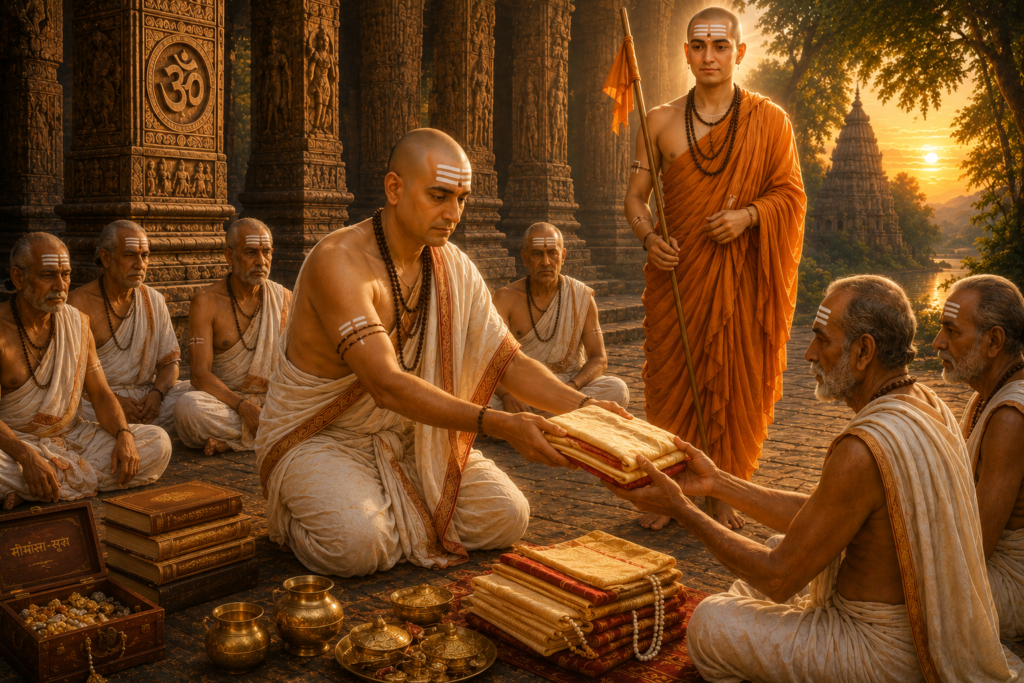
- The Final Yajna: He performed his final Vedic fire ritual. In the Vedic path, an ascetic does not discard the sacred fire; he performs a rite where he symbolically places the external sacrificial fire into his own heart, realizing that the real altar of divinity is his own inner Self.
- Giving Away All Wealth: He gave away his vast worldly riches, lands, and household possessions as Dakshina to Brahmins and scholars.
- Taking Alms (Bhiksha): Leaving behind his identity as a wealthy householder, he accepted the traditional wooden staff (Danda), water pot (Kamandalu), and ascetic clothes, stepping out to beg for his first alms (Bhiksha).
With a peaceful and disciplined mind, he surrendered at the holy feet of Adi Shankaracharya. Shankara then gave him the ultimate teaching from the Chandogya Upanishad (6.9.7)—the sacred Mahavakya: “Tat Tvam Asi” (You are That).
Understanding the Great Vedic Truth: “Tat Tvam Asi” (You Are That)
The core question is simple: How can a mortal human being with weaknesses and limitations be the exact same as God, who creates and runs the cosmos?
If you take the statement literally, it sounds like an impossibility. That is why Adi Shankaracharya uses a very specific logical method called discarding the outer covers to see the common truth (Bhaga-Tyaga Lakshana).
The Problem: Why It Confuses the Mind
Look at the two things being compared:
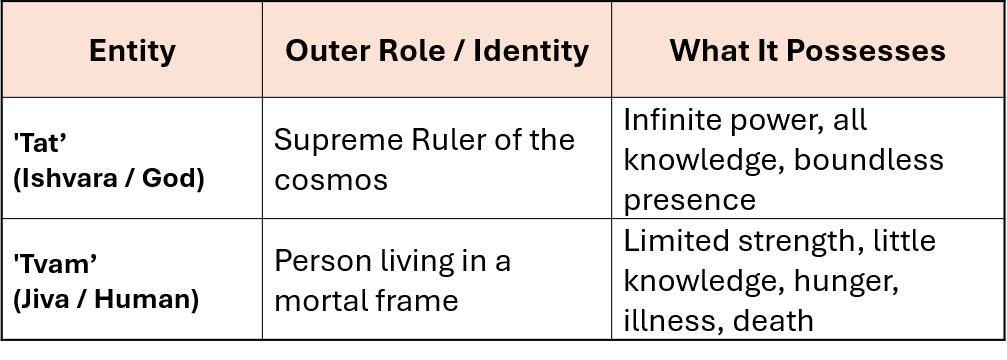
If you compare the outer roles, they can never be equal. A wave is not the ocean, and a small spark is not a forest fire.
So how does the Upanishad declare they are one?
The Three Simple Steps to Understand the Oneness
(I) The Ocean and the Drop (The Water Example)
- Look at a giant wave in the ocean. It has immense power, height, and speed.
- Look at a tiny drop of water in your palm. It has no power, no speed, and can evaporate in seconds.
- Are the forms equal? No. A drop cannot carry a ship, and a wave can sink one.
- But if you ask a scientist: “What is the essential nature of both?”
- The wave is (Water).
- The drop is (Water).
- The moment you look past the size and form and focus on the substance, the drop and the ocean are made of the exact same water.
(II) The Two Clay Pots (The Space Example)
- Imagine a massive temple hall and a tiny earthen tea cup (Kulhad).
- Inside the temple hall, the space is vast, cool, and grand.
- Inside the tiny cup, the space is small, cramped, and holds only a mouthful of tea.
- If you break the cup, where does the “cup space” go? It was never separate from the vast space outside.
- The space itself was never big or small, rich or poor; only the clay wall around it made it look small.
- Your physical body is that clay cup. The Supreme Divine is the vast sky. The conscious life inside you is the exact same space.
(III) Devadatta (The Old Friend Example Explained Step-by-Step)
This is the exact example from Indian logic (Nyaya/Vedanta) used in the text:
- Past Condition: You knew your friend Devadatta 20 years ago as a skinny, poor student in rags living in a village.
- Present Condition: You meet him today as a heavy, wealthy minister wearing gold robes in a royal palace.
- The Contradiction: “Poor student in a hut” is the exact opposite of “Wealthy minister in a palace”.
- The Recognition: When you see him, you say: “Oh! You are that same Devadatta!”
- How your mind did it: You instantly dropped the village hut and the rags (past covers), you dropped the palace and the gold robes (present covers), and you recognized the single conscious living person inside both situations.
The Final Vedantic Formula
When the Upanishad tells you “Tat Tvam Asi” (You Are That):
- When you strip away the universe from God, what is God? Pure, eternal Awareness.
- When you strip away the perishable flesh, bone, and wandering thoughts from yourself, what are you? Pure, eternal Awareness.
In that pure essence—beyond the body, beyond the mind, beyond the roles we play—you and the Divine are non-different. You are not a human being trying to find God; you are that divine consciousness experiencing a temporary human life.
How Adi Shankaracharya Explained Detachment Through Simple Examples
To help Mandan Mishra deeply feel and live this truth, Adi Shankaracharya explained how an enlightened person looks at life through beautiful, everyday examples:
These four examples address a fundamental question in Vedantic philosophy: If the world feels so real, why does Vedanta say we are fundamentally separate from our bodies, relationships, and external pleasures?
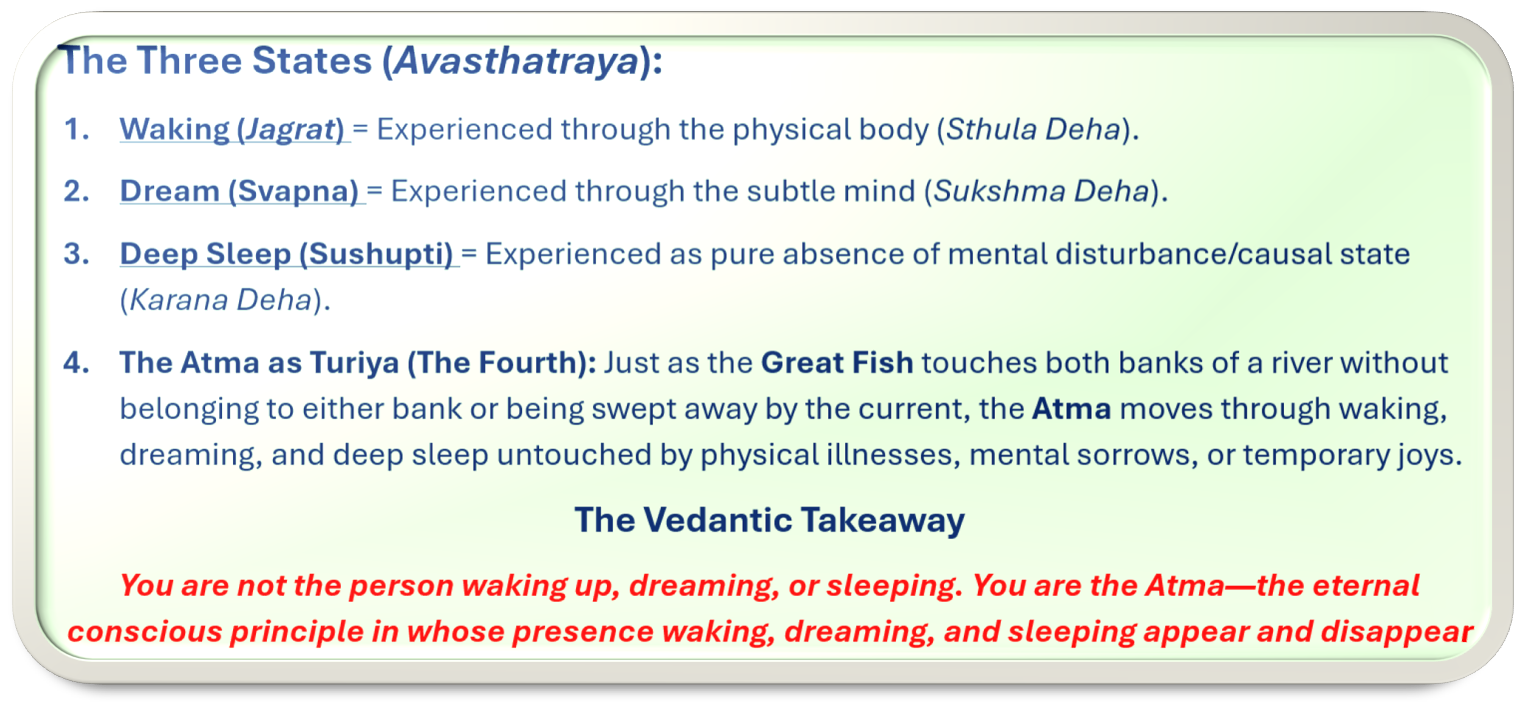
(I) The Great Fish (Maha-Matsya): Understanding Who You Are When You Sleep and Wake
- The Problem: We assume our daily waking life (our job, our body, our bank account, our family) is our total reality. But when we fall asleep, that entire world disappears, and our mind creates a dream world where we might be a king, a beggar, or flying in the sky.
- The Analogy: A giant fish swims across a massive river. It glides to the Eastern Bank (the waking world), touches it, and swims away. Then it swims to the Western Bank (the dream world), touches it, and swims away.
- Does the fish belong to the eastern shore? No.
- Does it belong to the western shore? No.
- Does the river water wash the fish away? No, the fish is independent of both shores.
- The Realization: You are that Great Fish.
- When awake, you act in the physical world.
- When asleep, you experience the dream world.
- In deep, dreamless sleep, both worlds disappear, yet you still exist (when you wake up, you say, “I slept peacefully”).
- This proves you are neither the physical body of the waking world nor the subtle body of the dream world; you are the underlying, unattached witness (Sakshi) experiencing all of them.
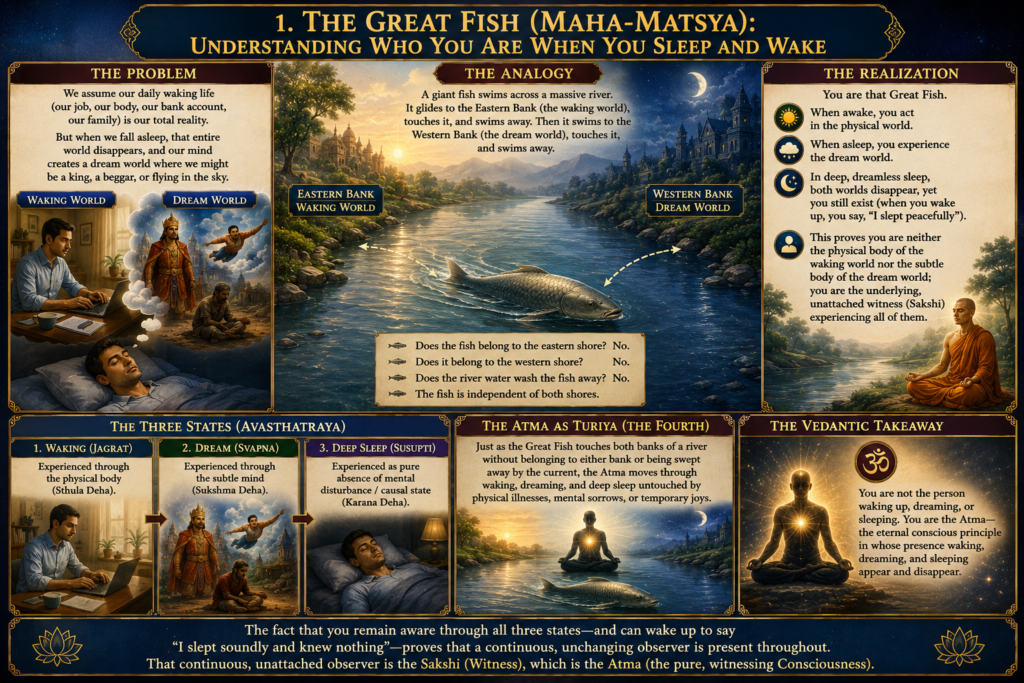
This is the core method the Upanishads and Adi Shankaracharya use to prove that your true identity is the Atma (the pure, witnessing Consciousness) rather than the changing body or mind.
In daily life, we mistakenly identify with the physical body during waking hours, and with our subtle mind during dreams. But because the waking world vanishes when you dream, and both the waking and dream worlds vanish in deep sleep, neither state can be your permanent nature.
The fact that you remain aware through all three states—and can wake up to say “I slept soundly and knew nothing”—proves that a continuous, unchanging observer is present throughout. That continuous, unattached observer is the Sakshi (Witness), which is the Atma.
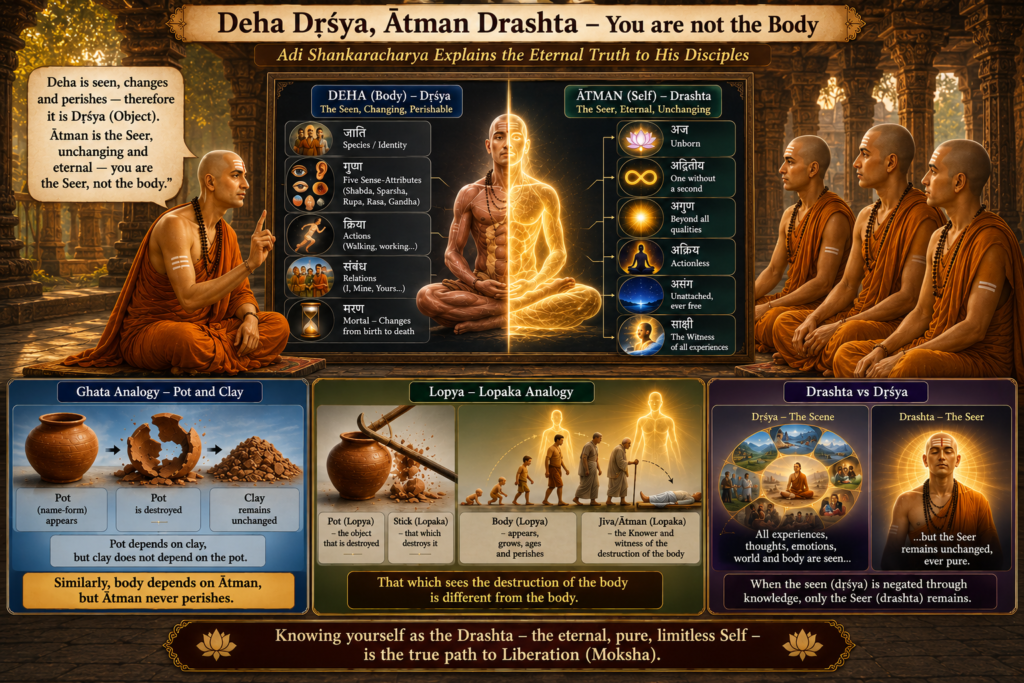
(II) The Clay and the Pot (Mrittika-Ghat): Why Death Does Not Destroy You
- The Problem: Fear of death is the greatest human anxiety. We believe that when the physical body dies, our entire existence ends.
- The Analogy: Consider a clay pot.
- Before it is made, it is clay.
- While it is used to hold water, it is still just clay shaped like a cylinder.
- When it falls and shatters, the shape (“pot”) is gone, but every single particle remains clay.
- The Realization: The word “pot” is just a temporary label for a particular form. The substance was always clay. Similarly, your physical body is merely a temporary shape given to five elements (earth, water, fire, air, space). When the body dies, the form dissolves, but the eternal Consciousness (Atman) that animated it is never damaged, cut, or destroyed.
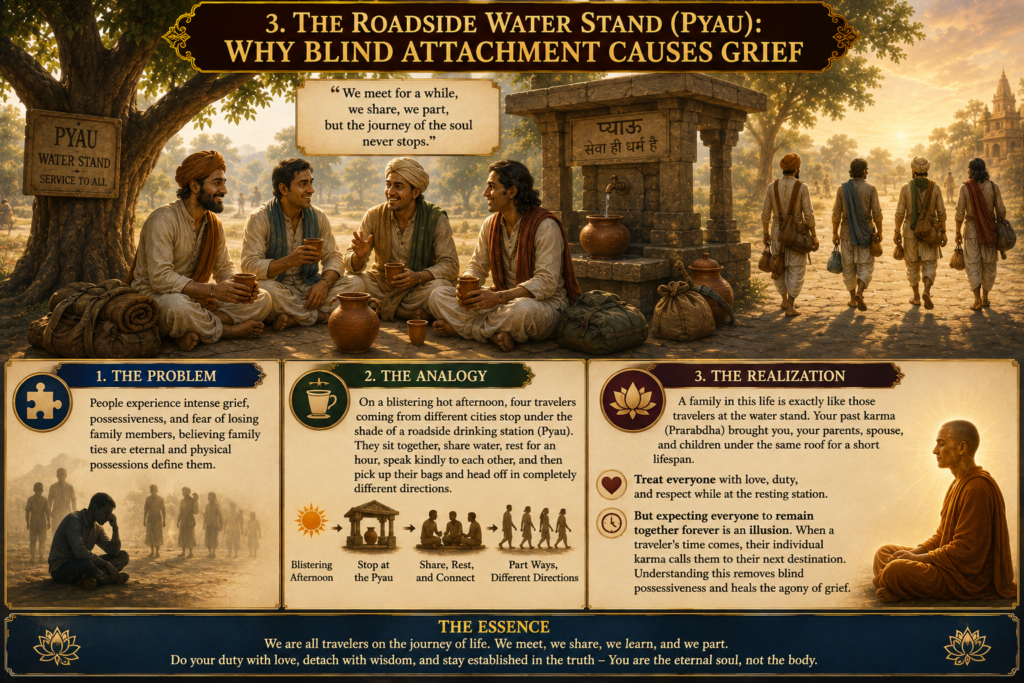
(III) The Roadside Water Stand (Pyau): Why Blind Attachment Causes Grief
- The Problem: People experience intense grief, possessiveness, and fear of losing family members, believing family ties are eternal and physical possessions define them.
- The Analogy: On a blistering hot afternoon, four travelers coming from different cities stop under the shade of a roadside drinking station (Pyau). They sit together, share water, rest for an hour, speak kindly to each other, and then pick up their bags and head off in completely different directions.
- The Realization: A family in this life is exactly like those travelers at the water stand. Your past karma (Prarabdha) brought you, your parents, spouse, and children under the same roof for a short lifespan.
- You should treat everyone with love, duty, and respect while at the resting station.
- But expecting everyone to remain together forever is an illusion. When a traveler’s time comes, their individual karma calls them to their next destination. Understanding this removes blind possessiveness and heals the agony of grief.
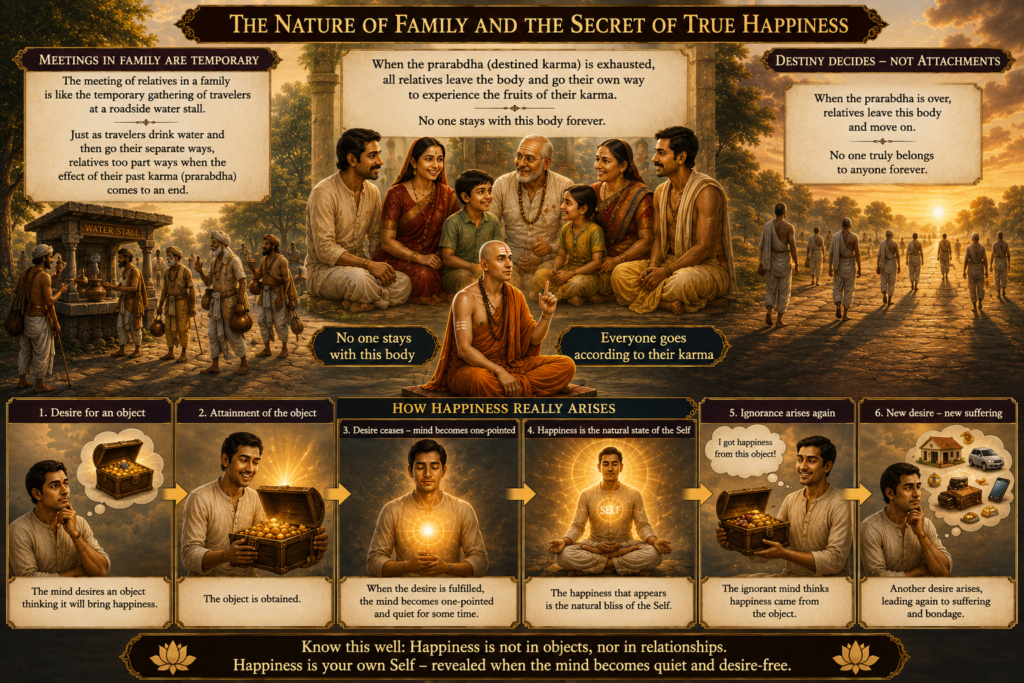
(IV) The Source of Pleasure: The Illusion of Material Joy
- The Problem: We spend our entire lives chasing money, status, food, and objects because we believe happiness is trapped inside the object.
- The Analogy/Psychology: Imagine you crave a specific sweet or a new house for months. Your mind is agitated, constantly restless with desire. The exact second you get it, you feel a wave of happiness.
- The Realization: Where did that happiness actually come from?
- If happiness were inside the sweet, eating 10 of them in a row should give 10 times the joy—instead, the 10th one causes nausea.
- What actually happened? The moment your craving was satisfied, your restless mind stopped running for a single second.
- In that brief moment of total mental silence, the natural, unburdened bliss of your own inner soul (Atman) shone through unobstructed.
- The external object was only a trigger that temporarily silenced your mind; the bliss was inside you all along.
The Rule of Guru-Bhakti: Why Respect for the Guru Remains Essential
Sometimes people studying Vedanta make a serious mistake by thinking: “If God is everywhere and I am divine, why should I bow to a Guru or pray to God?”
Adi Shankaracharya gave a clear warning on this:
“Advaitam bhavayed-bhaktya guror-devasya catmanah |
Nadvaitavadam kurvita guruna saha kutracit ||”
(Yogashikhopanishad 5.59)
- In Your Heart: Realize the divine oneness of your Self, the Guru, and God.
- In Your Behavior: Never act with equal familiarity or pretend equality with the Guru.
Just as a person without sight cannot cure their own eyes without a skilled physician, a seeker cannot overcome worldly illusion without the grace and guidance of a true Guru. Devotion and humility toward the Guru are the foundation that keeps spiritual knowledge pure.
Mandan Mishra Becomes Swami Sureshwaracharya
Hearing these teachings, every remaining doubt in Mandan Mishra’s mind disappeared. Bowing down with deep devotion, he said:
“O Bhagavan! Today my life has reached its true goal. By your compassionate grace, the darkness of ignorance has been removed forever.”
Adi Shankaracharya then gave him his monastic name: Swami Sureshwaracharya.
The great scholar who had spent his life championing ritual actions became one of the greatest masters and defenders of Advaita Vedanta. He retired to the serene banks of the Narmada River in the Magadha region to immerse himself in deep meditation, later authoring monumental commentaries on the Upanishads that continue to illuminate seekers across the world.
Frequently Asked Questions (FAQs)
Q1. Why did Mandan Mishra take Sanyas if he was already a master of the Vedas?
Book learning alone does not bring spiritual liberation. Mandan Mishra had mastered Karmkand, believing that performing rituals was the highest goal. Taking Sanyas marked his shift from seeking worldly or heavenly rewards to focusing entirely on direct Self-Knowledge (Jnana).
Q2. Does Advaita Vedanta tell people to stop doing rituals?
No. Daily duties and prayers are vital because they cleanse and steady the mind (Chitta-Shuddhi). However, rituals are the preparation, not the final destination. Once the mind is pure and detached, one must seek Self-inquiry, because physical actions cannot remove spiritual ignorance; only direct knowledge can.
Q3. What is the main lesson of the ‘Great Fish’ example?
It shows that you are the untouched observer of your life. Just as a big fish swims between two riverbanks without being stuck to either shore or carried away by the current, your true Self experiences both your daily waking life and your dream life without being bound by them.
=======================================
Anupam Trivedi has spent over three decades studying and reflecting upon Sanatan scriptures, including the Vedas, Upanisads, Itihāsa, and Purāṇas. He writes on cultural philosophy and ancient literature to present traditional insights with accuracy and clarity. Read full bio →
Too informative
Thanks Asmita Ji. These core Sanatan Dharma concepts often seem complex and out of reach today, largely because mainstream modern education leaves little room for our ancient philosophical traditions. My humble endeavor is to present the profound depth and timeless wisdom of our Vedic heritage in an authentic, structured, and accessible way for seekers across the world.
To serve this larger purpose, we run a dedicated network of educational initiatives:
Bhavam Bhavaani (bhavambhavaani.com): Dedicated to the life, commentaries, and non-dual philosophy (Advaita Vedanta) of Jagadguru Adi Shankaracharya.
Know Your Dharm (knowyourdharm.com): Focused on broader Vedic traditions, scriptural analysis, and foundational tenets of Dharma for contemporary readers.
Dharm Sanatan (dharmsanatan.com): Exploring the timeless principles, cultural depth, and spiritual foundations of Sanatana Dharma.
Dharm Sanatan – Ramayan (dharmsanatan.in): A deep dive into the ideals, characters, and dharmic teachings of the Valmiki Ramayana.
Dharm Sanatan – Mahabharat (dharmsanatan.net): Dedicated to unraveling the profound philosophical, ethical, and narrative complexities of the Mahabharata.
I am truly glad this article resonated with you. Part 10 is scheduled next, covering the intense episode at Srisailam and the protective grace of Bhagwan Narasimha. I hope you continue to find the series enriching!
Regards Anupam