
Previously in this Series: A Quick Overview….
Part 1: Introduction to the extraordinary life and mission of Adi Shankaracharya, presenting a concise overview of his divine purpose as an Avatar of Bhagwan Shiva who descended to restore the authority of the Vedas. [Read Part 1 Here]
Part 2: We explored Adi Shankaracharya’s divine birth, granted as a boon by Shiva to his deeply devoted parents, alongside the extraordinary signs, spiritual depth, and remarkable childhood incidents that marked his early life in Bharat. [Read Part 2 Here]
Part 3: We followed Adi Shankaracharya’s journey to his Guru, Sri Govinda Bhagavatpada, his miracle of calming the flooding Narmada River, his travel to Kashi where he accepted his first disciple Sanandan (Padmapada), and his profound dialogue on Advaita with Bhagwan Shiva disguised as a Chandala. [Read Part 3 Here]
Part 4: We detailed his creation of the Prasthanatrayi Bhashyas in Badrinath and his profound encounter with Maharshi Veda Vyasa, who tested his commentaries and blessed him with sixteen additional years to establish Advaita Vedanta [Read Part 4 Here]
In Part 5, we explore the meeting between Adi Shankaracharya and Acharya Kumaril Bhatt at Teertharaja Prayag. We discuss the historical context of Buddhist influence on Vedic traditions, Kumaril Bhatt’s defense of the Vedas, the reasons behind his self-immolation in a chaff fire (Tushanala), his insightful dialogue with Adi Shankaracharya, and how he directed Adi Shankara toward his distinguished disciple, Mandan Mishra.
============================================
Context: Acharya Sri Kumaril Bhatt once proved the authority of the Vedas by surviving the fall from a mountain cliff. He brought King Sudhanva, who had fallen under the influence of Buddhist scholars, back to the Vedic path, re-establishing a Vedic realm across the land. By reviving the performance of Yajnas in accordance with Vedic injunctions, he paved the way to satisfy the Devas and enriched the Mimamsa school of philosophy with foundational works like the ‘Vartika’. Eliminating the influence of those who held malice toward Vedic Dharma, he spread his glory across the three worlds.
Yateeshwara Adi Shankaracharya’s Arrival at Teertharaja Prayag
Carrying the deep grief of separation in his heart, yet sustained by meditating on the lotus feet of Sri Veda Vyasa residing within the lotus of his heart, the learned Sri Shankara resolved to embark upon his Digvijaya (spiritual conquest of all directions) in obedience to his Paramguru’s command. Driven by the desire to refute anti-Vedic doctrines, unfold the deepest secrets of Vedanta, cut through worldly attachments, and engage in debate with Sri Kumaril Bhatt, a master of the ritualistic karmic path. He set out to win his favor and have him write a Vartika (an authoritative explanatory commentary) on his Sutra Bhashya, which burns away the afflictions of worldly existence.
Journeying toward the southern direction along the sacred paths frequented by sages like Yama, Agastya, Unmucha, Vimucha, Swastyatreya, Pramucha, and Idhmavaha, he reached Teertharaja Prayag, the holy confluence (Triveni Sangam) of the Ganga and Yamuna, which destroys sins and liberates souls from worldly suffering.
There, he offered reverent prayers to the sacred Yamuna and Ganga rivers, the twin manifestations of Hari (Shri Vishnu) and Hara (Shiv Ji) that bestow worldly fulfillment, devotion, and liberation and took a ritualistic bath in the Sangam according to Vedic rites. Performing Tarpana with his sacred staff (Danda), he satisfied the Devas, the Ancestors (Pitrus), and all living beings.
Delighted by the gentle, lotus-scented breeze, he rested for a moment under the shade of a Tamala grove along the riverbank. There, he overheard an extraordinary conversation among a group of devout, noble scholars seated nearby. They were speaking among themselves:
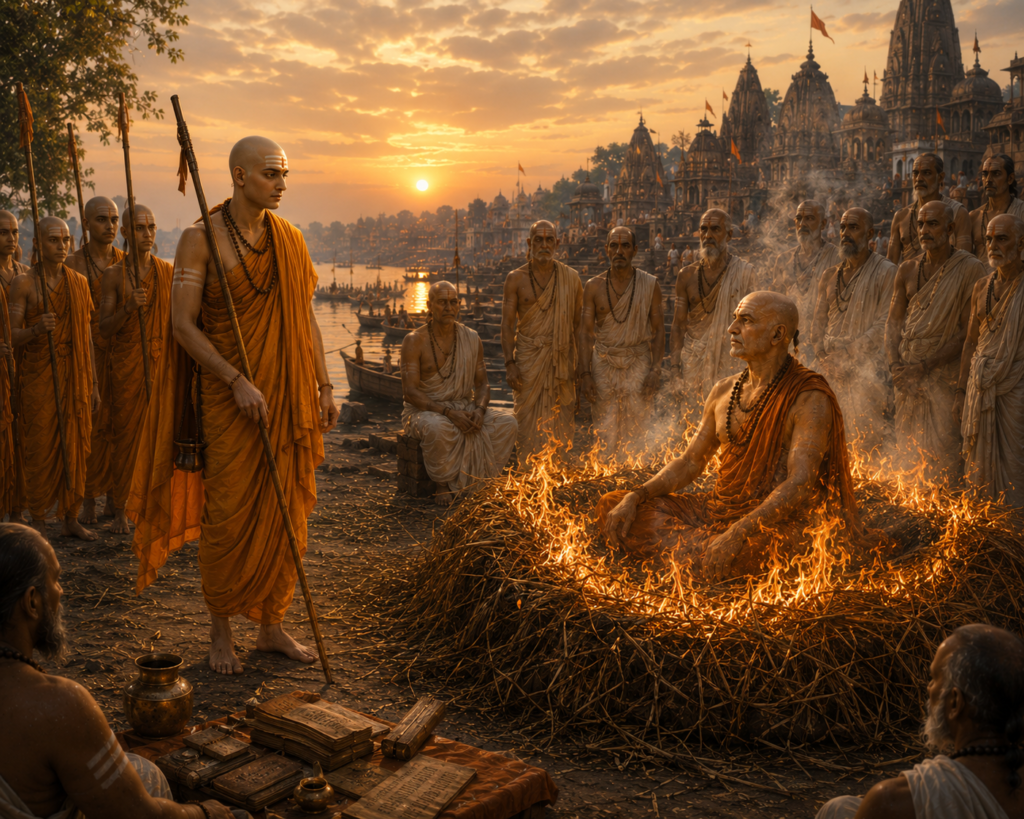
“Sri Kumaril Bhatt, the refuge of all noble followers of the Vedas, once leaped from a mountain cliff to establish the absolute authority of the Vedas. He brought King Sudhanva back to the Vedic fold and re-established the Vedic kingdom. He revived the performance of Yajnas to satisfy the Devas and enriched the Mimamsa philosophy through his ‘Vartika’ literature. He eradicated anti-Vedic malice and spread his fame across the three worlds. Yet, what a tragedy it is that this master of the Vedas, this epitome of patience and jewel among believers, is now burning his own body in a slow-burning chaff fire (Tushanala) as an act of penance! He seeks to purify himself of two severe sins: refuting his own Buddhist guru’s doctrines (which he learned in disguise) and denying the existence of Ishwara to defend the self-validating nature of Mimamsa.”
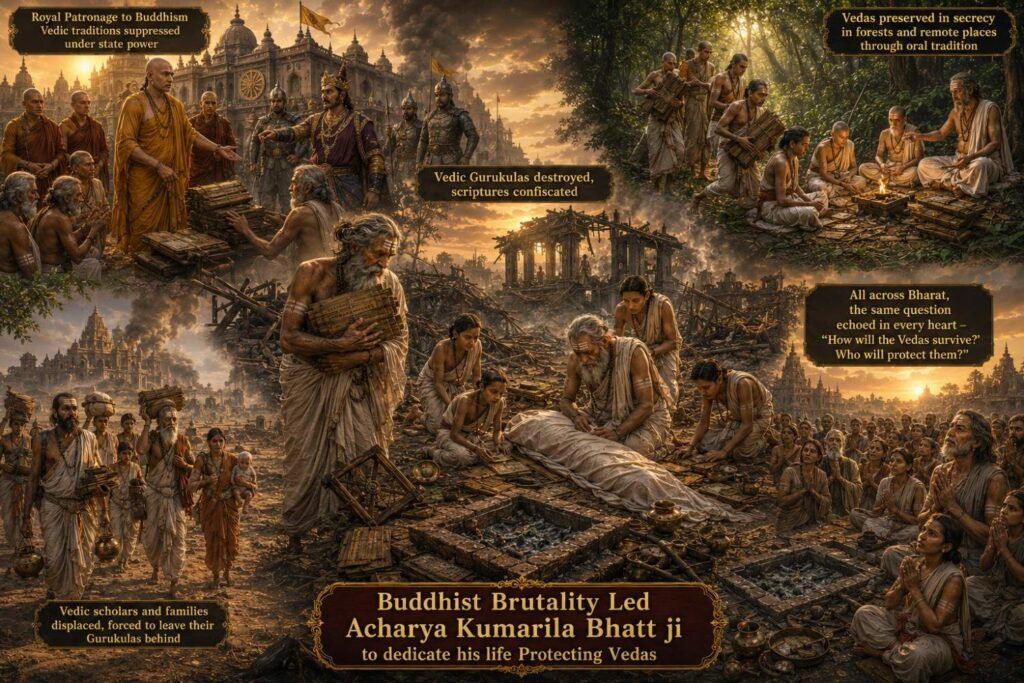
Hearing this, Sri Shankara immediately rushed toward Sri Bhattapada, who was seated inside the chaff fire, surrounded by his sorrowful and illustrious disciples, including Prabhakara. As Acharya Shankara approached the blazing mound of husk, the sight of Bhattapada’s scorching body brought the darkest era of history vividly before his eyes. It was a time when Sanatana culture was undergoing an unprecedented existential crisis. Buddhist scholars, propagating non-violence and Shunyavada (nihilism), had used their organizational power and intellectual ingenuity to bring the ruling kings under their ideological influence. Kings who were once the protectors of the Vedas and Yajnas had grown indifferent and hostile toward their own Vedic traditions.
Brutal Oppression of Vedic Sanatana Culture during the Buddhist Era
Throughout the long history of Vedic literature and Sanatana culture, many philosophical schools emerged and engaged in intellectual debate. However, the sacred land of Bharat experienced a dark period of transition that shook the very foundations of this eternal tradition. It was an age when non-Vedic doctrines and the excess of Shunyavada completely gripped the contemporary monarchy. Kings who had once shielded Vedic rituals became indifferent and aggressive toward their spiritual roots due to the flaws of the age, falling under the spell of Shunyavada and Kshanika-Vijnanavada (idealistic momentariness). Consequently, dark clouds of existential crisis hovered over Vedic Dharma throughout Aryavarta.
During that era, the continuous stream of Vedic karmic rituals, worship, and spiritual knowledge had turned feeble and was on the verge of extinction. Yajna and Svadhyaya (Vedic study)—the very backbone of Sanatana—were neglected and sinking into the abyss of oblivion. Buddhist scholars were making organized, relentless attempts to prove that the uncreated (Apaurusheya) Vedas were unauthoritative, self-contradictory, and full of impossible meanings. An anti-Vedic atmosphere was systematically engineered in society, causing the common people to stray from their fundamental duties and sink into the dense darkness of directionlessness.
Severe Persecution of Vedic Scholars and Graduates
History bears witness that during those terrifying times, chanting Vedic mantras aloud or offering oblations into a sacred fire had become an act tantamount to inviting a death sentence. Under the influence of Buddhist rulers, Vedic scholars and young celibates (Brahmacharis) were subjected to severe torture; Vedic scholars were even subjected to cruel state punishments, such as being crushed in oil presses. Gurukuls were systematically destroyed, and a calculated conspiracy was underway to dismantle the entire Vedic framework.
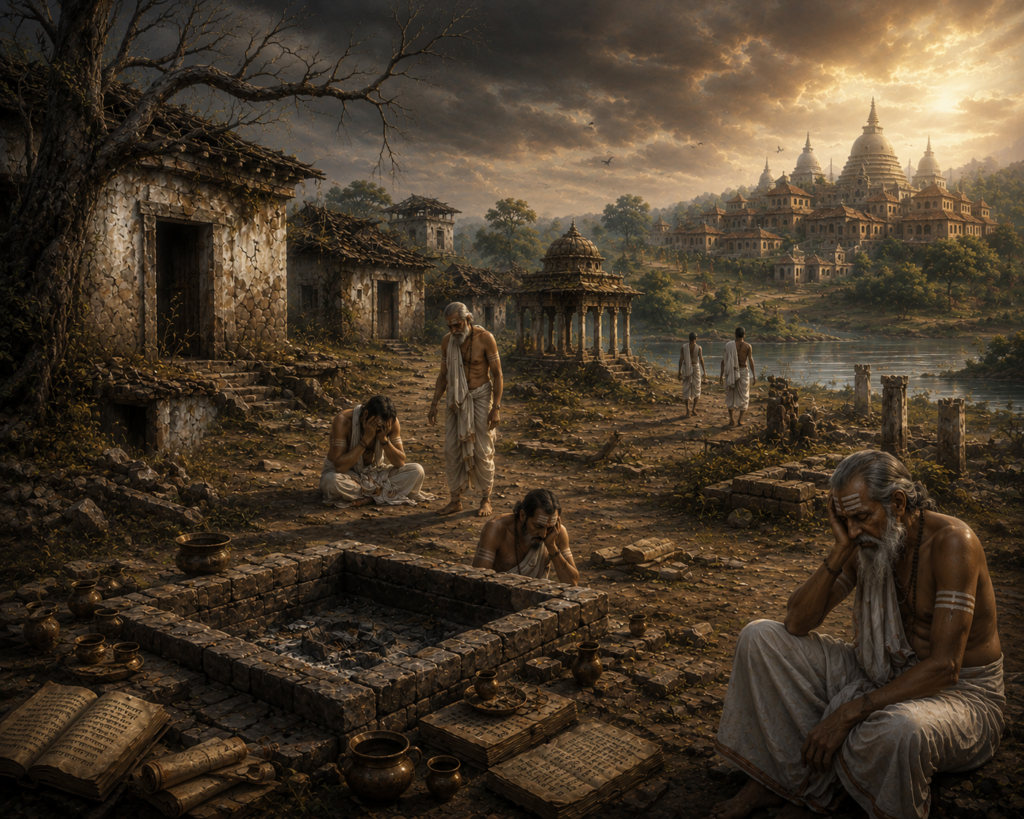
Yet, amidst this terrifying ideological tragedy, a few devoted guardians of Sanatana refused to let their courage shatter. Carrying their lives in their hands, those noble scholars retreated into dense forests, inaccessible caves, and lonely mountains. Hungry and thirsty, in the deep silence of the nights, they memorized the priceless mantras of the Vedas, keeping them alive through oral tradition. It was the silent struggle of those unsung ascetics that prevented the unbroken oral transmission of the Vedas from being completely wiped out. Still, conditions were worsening by the day, and a single agonizing question burned in the heart of every believer: How will the glory of Sanatana ever return, and who will be the true savior of the Vedas?
The Sacred Vow of Ved-Raksha at Teertharaja Prayag
Amidst this agonizing period, an event occurred on the holy banks of the Ganga at Teertharaja Prayag that permanently altered the course of India’s cultural and religious history. Acharya Kumaril Bhatta, master of Mimamsa and the foremost proponent of the self-validating authority of the Vedas was present there to take a holy dip in the Ganga. At that same moment, the young princess of Kashi was returning from her bath along with her companions. Seeing the destruction of Sanatana scattered all around, the desecrated deities, and the pitiful state of the Vedic path, her heart cried out in deep anguish. Filled with immense compassion and grief, she looked toward her companions and asked a heartbreaking question:
“Ko Vedan Uddharishyati!” (Is there no one left on this earth who will rise to rescue and protect our beloved Vedas?)
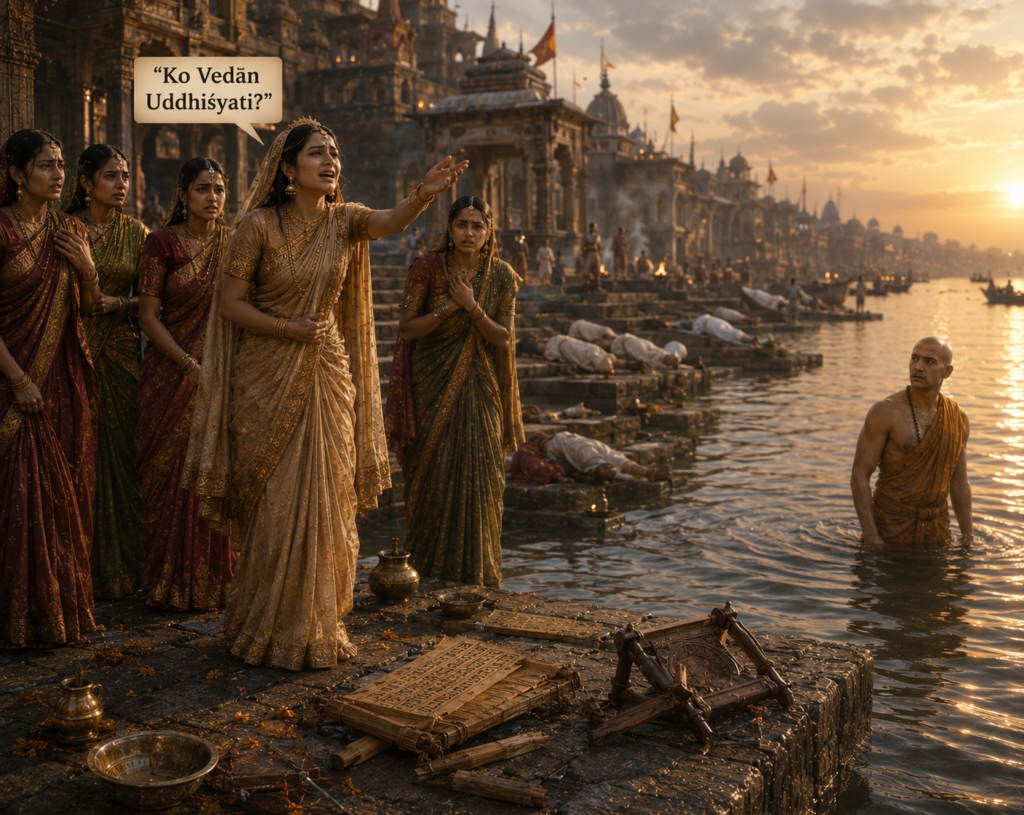
That sorrowful cry echoed across the quiet banks of the Ganga and pierced the ears of Acharya Kumaril Bhatt. Seeing such intense anguish for Dharma in the heart of a young woman, Bhattapada’s entire soul was deeply shakened. He immediately took holy Ganga water in his palm and made a resolute vow: “As long as life remains in this body, I shall sacrifice my entire existence solely for the protection of the Vedas and the revival of Sanatana!”
However, this path was by no means easy. Buddhist scholars were influencing society not merely through royal patronage, but through formidable logic and philosophical arguments. It is an established canon of Hindu debate that one cannot refute an opposing system without first gaining a comprehensive, deep understanding of its hidden tenets – “Nishedhya-bodhaddhi Nishedhya-badhah”. That is, refutation of a doctrine is impossible without first thoroughly comprehending what is to be refuted.
Kumaril Bhattapada’s Decision to Become a Disciple of the Renowned Buddhist Master Dharmapala
(“To understand the internal nuances and flaws of Buddhist philosophy, Bhattapada made the difficult decision to become a disciple of the renowned Buddhist master, Acharya Dharmapala. Disguising his identity, he entered the Buddhist monastery and enrolled under him to master their doctrines from within”).
To understand the internal nuances of Buddhist philosophy, Bhattapada chose a perilous and self-sacrificing route. Disguising his identity, he enrolled as a student under the renowned Buddhist master, Acharya Dharmapala. Living inside Buddhist monasteries and studying their texts night and day, Kumaril Bhatt absorbed every subtle aspect of Shunyavada and Kshanika-Vijnanavada with his razor-sharp intellect.
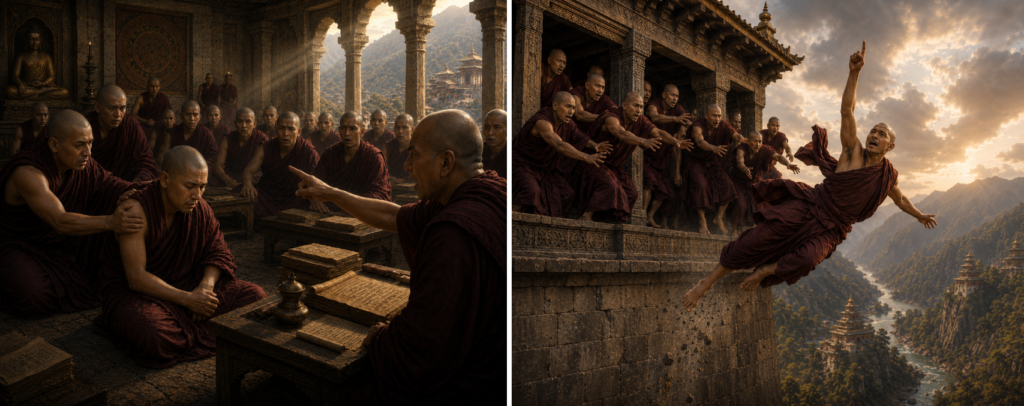
After years of this covert study, Bhattapada became a master of Buddhist philosophy. One day, during a assembly, his Buddhist teacher was denouncing the Vedic tradition and attempting to prove the invalidity of the Vedas. Unable to tolerate this mockery of his beloved Vedas, Kumaril Bhatt exercised immense self-control, but a single tear of deep devotion fell from his eye, betraying his true identity. His fellow students noticed it and raised an alarm that he was not a Buddhist, but a Vedic Brahmana in disguise.
Abandoning their professed non-violence, the enraged monks threw Kumaril Bhatt down from the high terrace of the palace with the intention of killing him. As he fell, Kumaril Bhatt proclaimed a declaration that echoed through the heavens: “If the Vedas are eternal, true, and the ultimate authority, may I survive this fall unharmed!” The divine power of the Vedas saved his life, but because he had included the conditional word ‘If’ (Yadi) in his proclamation, reflecting a moment of doubt, the immutable laws of nature caused one of his eyes to be damaged. Following this incident, he challenged the Buddhist scholars to open debates, defeated the nihilists with flawless logic, restored King Sudhanva to the Vedic path, and hoisted the flag of Vedic victory across the country.
The Dialogue Between Adi Shankaracharya and Kumaril Bhatt
When Acharya Shankara reached the spot described by the scholars, he beheld Sri Bhattapada seated inside the Tushanala (chaff fire), surrounded by his grief-stricken disciples, led by Prabhakara. His body was charred by the smoky fire, and only his radiant, luminous face remained visible.
Glowing like fire itself, Sri Kumaril Bhatt, the conqueror of philosophical adversaries and protector of the Vedic path, glanced out of the corners of his eyes and saw the sin-destroying Acharya Shankara standing before him. Having heard so much of Shankara’s glory and longing to meet him, Bhattapada felt immense joy at seeing the great master arrive unexpectedly at the moment of his departure. He instructed his disciples to worship Acharya Shankara, a homage that Shankara graciously accepted.
After accepting their hospitality, the joy-filled author of the commentaries (Bhashyakara) showed him his Sutra Bhashya. For no matter how flawless a work may be, it does not gain true renown in the world until it is reviewed by the truly great. Reading the commentary, Kumaril Bhatt was overcome with joy. He said to Sri Shankara: “In this world, only petty and envious minds harbor malice toward a pure work of scholarship; the wise and all-knowing always revere it.”
The Immortal Words of Bhattapada:
“O Learned One! Had I not been seated on the threshold of death today, I would have certainly composed a Vartika (a supreme logical commentary) on your Sutra Bhashya—a desire I have cherished for long—and attained everlasting glory. On your opening Adhyasa Bhashya alone, eight thousand Vartikas are surging in my mind!”
“It is surely the fruit of my meritorious deeds from past lives that a divine soul like you, whose sight is ever rare, has appeared so effortlessly before me in my final moments.”
“O Yatheeshwara! For human beings drowning in the ocean of this fleeting, meaningless worldly existence, the only means of salvation is the company of noble souls like you. There is no other way to cross over.”
“In my zeal to prove the self-validating authority of the Vedas, I went so far as to deny the existence of Ishwara, who is celebrated in the Vedas, proved by logic, and renowned throughout the world. By doing so, I inflicted a wound upon the natural devotion of my own heart. That Supreme Lord, without whom this life and creation are utterly dry, is worthy of worship and adoration, not rejection!”
“The whole of Bharat had fallen under the sway of Buddhist influence, causing our ancient and noble Vedic path to shrink. Seeing this, I fought to defeat them and protect the Vedamarga. Buddhist scholars used their organizational strength, mantra power, and deception to win over kings and enter the homes of Vedic people to mislead them. They tried to invalidate the Vedas by calling them false, meaningless, ambiguous, impossible, and self-contradictory.”
“I then demonstrated the limits of direct perception (Pratyaksha) and inference (Anumana), proving that truths transcending time and space can only be revealed by the Vedas. Thus, I defended the authority of the Vedic revelation.”
The Two Scriptural Sins Behind the Supreme Sacrifice
Kumaril Bhatt then revealed to Adi Shankaracharya the two specific transgressions for which he had undertaken the vow of self-immolation in fire:
- The Sin of Guru-Droha (Betrayal of the Teacher): “I received education from a Buddhist guru and then used that very knowledge to refute his doctrine. Studying under him and then dismantling his entire lineage of disciples was my first transgression.”
- The Sin of Ishwara-Nirakarana (Denial of God): “Second, by becoming excessively immersed in Maharshi Jaimini’s ritualistic Mimamsa, I denied the existence of the Supreme Almighty God.”
“It is to expiate these two sins that I entered this fire to sacrifice my body. However, by the infallible effect of beholding you and your lotus feet, those sins have been dissolved. By the divine sight of you, the incarnation of Shiva Himself, I stand completely liberated from both flaws.”
“I know you have incarnated for the welfare of the righteous and the protection of the Advaita path. Had I met you earlier, I would have been blessed then itself and would not have needed to choose this painful path of penance.”
Hearing these words, Sri Bhagavatpada (Shankara), master of the Vedas and filled with compassion, said: “I regard you as an incarnation of Lord Kartikeya Himself, descended to defeat those who strayed from the Vedic path. No sin can ever touch you; you are observing this vow of truth merely to set an example for the scholars of the world. Let me sprinkle a few drops of holy water from my hand to restore your body to health; then, write a beautiful Vartika commentary on my Bhashya.“
The humble Bhattapada replied: “O Shankara! You are capable of accomplishing anything. Yet, though your attempt to revive me accords with your compassionate nature, I do not consider it right for myself, as it would violate worldly and spiritual decorum (Loka-Maryada). O Venerable One! Great souls see virtue even in the most crooked person, just as a warrior mounts a bowstring on a curved bow.”
“With a mere glance of your grace, you can bring a dead body back to life or dissolve and recreate this entire universe. But now, you must go and win over my most beloved and accomplished disciple –Vishwaroopa Mandan Mishra, who is even more famous than I am, a master of all scriptures, detached from worldly desires yet steadfast in Vedic traditions. Through him, your divine mission will reach fulfillment. Defeat him in debate, making his wife Ubhayabharati the arbiter, and complete your remaining work without delay.”
“Having sat in this final vow of death, I do not wish to return to life and cast a stain upon my unblemished journey. Now, bless me by imparting the Taraka Brahma Jnana (the liberating knowledge of Supreme Consciousness) like Vishwanath Shiva Himself, so that I may leave my body before you and attain the Supreme Abode.”
Imparting the divine knowledge of the Eternal, Pure, Conscious, and Blissful (Sat-Chit-Ananda) Brahman to Bhattapada, freeing him from all delusion and granting him the supreme Vaishnava state, Acharya Shankara, the benefactor of the universe—prepared to travel through the skies toward the home of Mandan Mishra.
In the upcoming installment (PART 6), we will enter the magnificent city of Mahishmati, witness the scholarly starlings arguing Vedic philosophy at the doorstep, and experience the tense, sharp initial exchange between Adi Shankaracharya and Mandan Mishra.
==========================================
References:
- https://youtu.be/Z-_PWtdoN5o?si=HhUzIwAwN95B4yGE
Anupam Trivedi has spent over three decades studying and reflecting upon Sanatan scriptures, including the Vedas, Upanisads, Itihāsa, and Purāṇas. He writes on cultural philosophy and ancient literature to present traditional insights with accuracy and clarity. Read full bio →
Pingback:Adi Shankaracharya & Mandan Mishra: The Unpleasant Confrontation Before Shastrartha
Pingback:Adi Shankaracharya & Mandan Mishra: The Epic Shastrartha That Re-established Sanatana Dharma Core Principles - Part 7 - Bhavam Bhavaani
Pingback:Adi Shankaracharya Shastrartha with Devi Ubhay Bharati: which Led to Mysterious Yogic Act "Par Kaya Pravesh" (Part 8)
Pingback:Adi Shankaracharya-Part 9, Can Rituals Alone Lead to Moksha?