
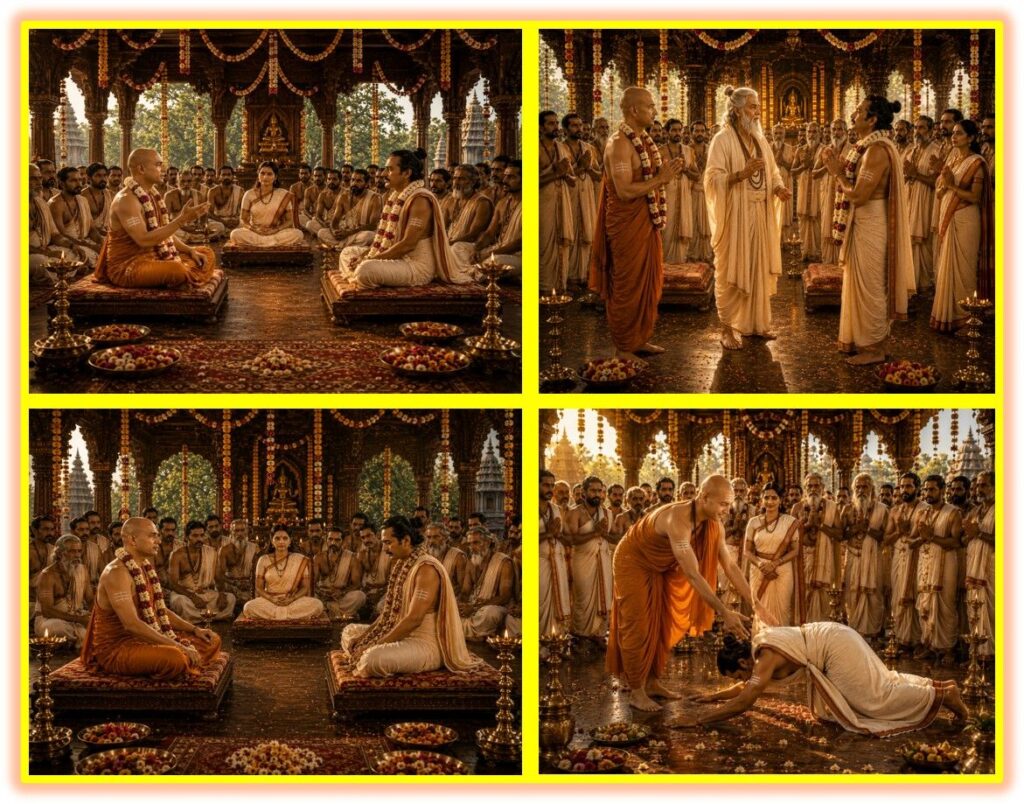
(Shastrartha is debate on sanatan Dharma-Shastras / Vedas).
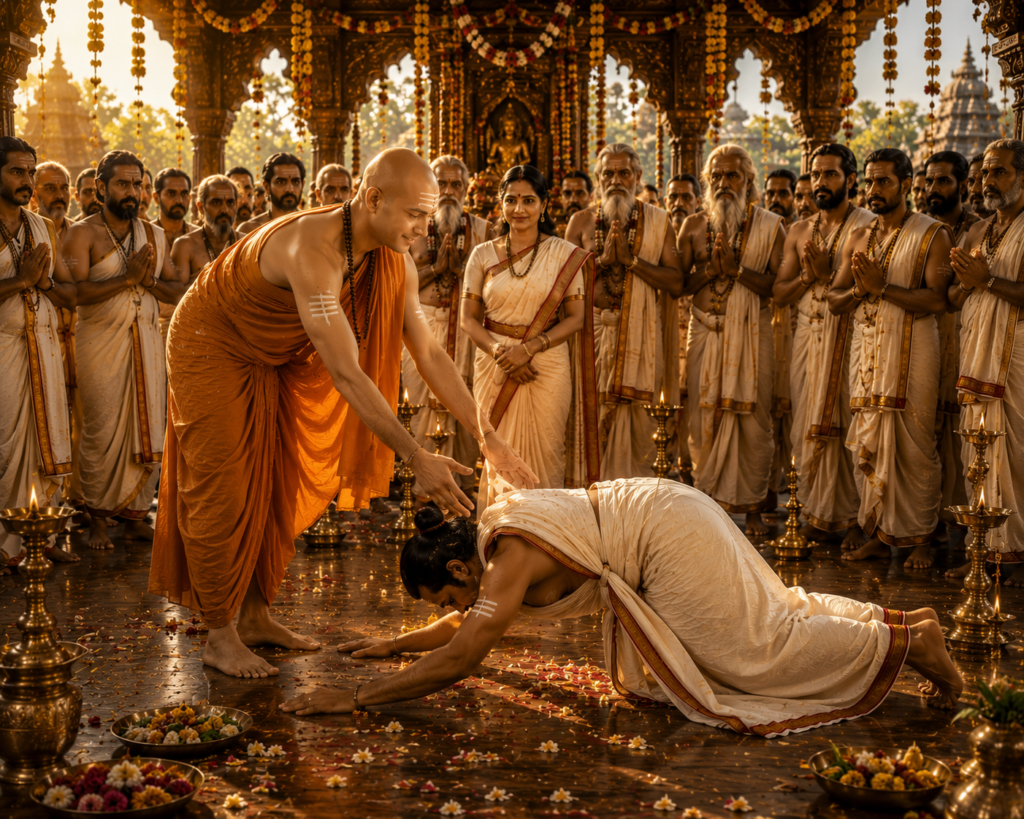
Previously in this Series: A Quick Overview
- Part 1: Introduction to the extraordinary life and mission of Adi Shankaracharya, presenting a concise overview of his divine purpose as an Avatar of Bhagwan Shiva who descended to restore the authority of the Vedas. [Read Part 1 Here]
- Part 2: We explored Adi Shankaracharya’s divine birth, granted as a boon by Shiva to his deeply devoted parents, alongside the extraordinary signs, spiritual depth, and remarkable childhood incidents that marked his early life in Bharat. [Read Part 2 Here]
- Part 3: We followed Adi Shankaracharya’s journey to his Guru, Sri Govinda Bhagavatpada, his miracle of calming the flooding Narmada River, his travel to Kashi where he accepted his first disciple Sanandan (Padmapada), and his profound dialogue on Advaita with Bhagwan Shiva disguised as a Chandala. [Read Part 3 Here]
- Part 4: We detailed his creation of the Prasthanatrayi Bhashyas in Badrinath and his profound encounter with Maharshi Veda Vyasa, who tested his commentaries and blessed him with sixteen additional years to establish Advaita Vedanta. [Read Part 4 Here]
- Part 5: We explored the meeting between Adi Shankaracharya and Acharya Kumaril Bhatt at Teertharaja Prayag. We discussed the historical context of Buddhist influence on Vedic traditions, Kumaril Bhatt’s defense of the Vedas, the reasons behind his self-immolation in a chaff fire (Tushanala), his insightful dialogue with Adi Shankaracharya, and how he directed Adi Shankara toward his distinguished disciple, Mandan Mishra. [Read Part 5 Here]
- Part 6, Adi Shankaracharya’s first meeting with Acharya Mandan Mishra an avatar of Bhagwan Brahma (see in details in- Part 2). Even the pet birds outside Mandan Mishra’s home recite sacred Vedic chants. There was some unpleasant confrontation between Sri Shankara and Mandan Mishra before their historic spiritual debate (Shastrartha), but this confrontation, though sounded unpleasant, was also very insightful. [Read Part 6 Here]
In Part 7 we will discuss the Adi Shakaracharya and Acharya Mandan Mishra’s Historic Shastrartha in such details that have not been written on internet ever.
Why Every Hindu Must know about and Understand This ‘Epic Shastrartha’?
There are moments in world history that quietly alter the destiny of civilizations, one such legendary Moment was the Shastrartha between Adi Shankaracharya and Acharya Mandan Mishra. Spanning an astonishing 3 months and 17 days, this was not a mere academic argument or a display of intellectual vanity. It was a monumental, high-stakes spiritual summit between two divine incarnations – Bhagwan Shiva Himself in the form of Adi Shankara, and Bhagwan Brahma in the form of Mandan Mishra.
To understand why every seeker of Sanatana Dharma must comprehend this debate is to understand the very eternal foundation of Vedic thought. At that historical juncture, our nation Bharat was navigating a profound philosophical dilemma. Although Acharya Kumaril Bhatt (revered Guru of Shri Mandan Mishra) had successfully refuted anti-Vedic doctrines and restored the authority of the Vedas, society’s understanding of Dharma had grown remarkably narrow. Heavily influenced by Purva-Mimamsa (Karmkand), people had reduced the vast wisdom of the Vedas into a mechanical system of rituals, outward sacrifices (Yajnas), and the pursuit of earthly or heavenly desires. Religious life was confined to “what duties to perform,” while the ultimate question -“Who am I in truth?” lay largely forgotten.
Had this debate not taken place, Sanatana Dharma risked remaining trapped in external ceremonialism, leaving the supreme Self-Knowledge (Jnana) of the Upanishads buried beneath ritualistic dust. This Shastrartha did not alter Sanatana Dharma, for eternal truth Sanatana Dharma is immutable, timeless, and universal. Instead, through a sublime synthesis of action (Karma) and wisdom (Jnana), it re-established the core principles of faith. By illuminating the non-dual light of Advaita Vedanta, it established that while rituals refine and purify the mind, only direct Self-Knowledge can liberate the soul from spiritual ignorance (Avidya) and the endless cycle of birth and death.
The Sacred Solemn Pledges Before the Debate by Adi Shankaracharya and Acharya Mandan Mishra
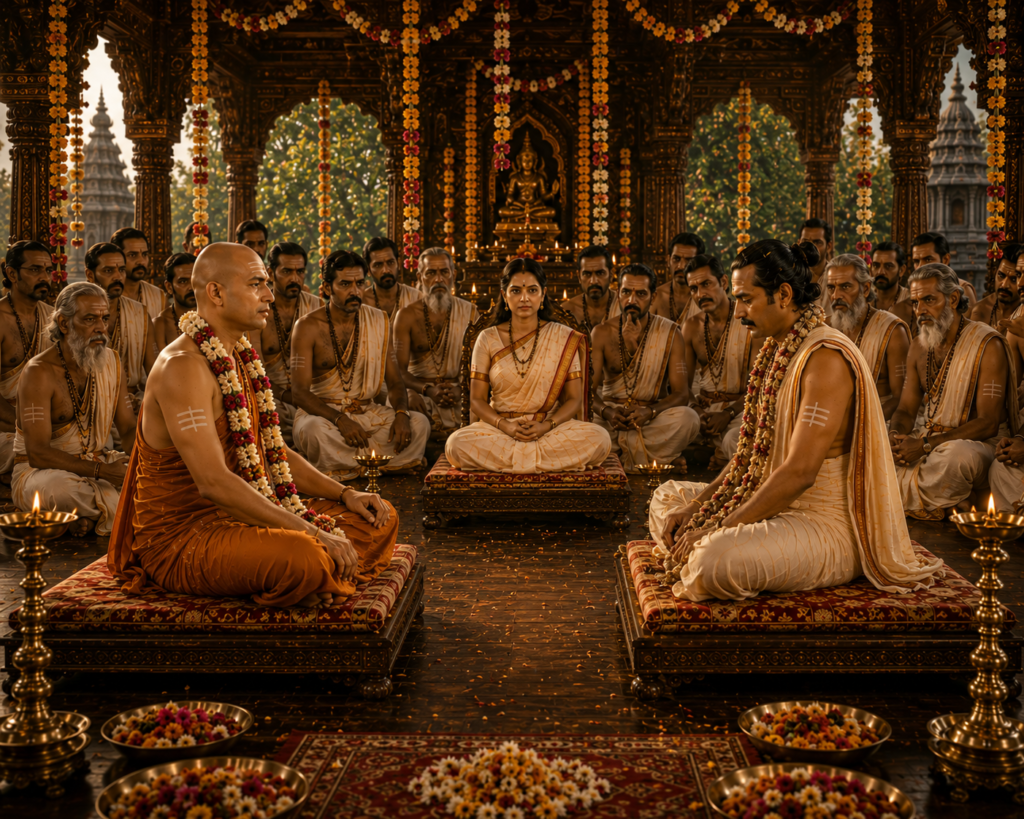
On the holy morning of Margashirsha Krishna Tritiya (Yudhishthira Samvat 2647), during the sacred Brahma-muhurta, Sri Shankara completed his morning ablutions and walked to the residence of Mandan Mishra accompanied by his disciples. A distinguished assembly of scholars had gathered to witness this monumental dialogue.
Recognizing Mandan Mishra’s profound eagerness for a truthful inquiry, the serene and radiant Sri Shankara made a historic declaration right at the outset:
“In this philosophical dialogue, our victory or defeat shall be decided solely by your revered consort, Devi Ubhayabharati, who is master of all branches of learning. If I am defeated in this Shastrartha, I shall renounce my saffron monastic robes and adopt the white garments of a householder.”
Mandan Mishra, deeply honoring the presence of his wife, who was an avatar of Maa Saraswati, accepted the condition with profound reverence, stating:
“I wholeheartedly accept your chosen judge, Ubhayabharati. Should I be defeated in this debate, I shall renounce the householder’s life and enter the sacred order of Sannyasa.”
Thereupon, both great masters articulated their solemn vows (Pratijna) based on the Vedas, establishing the foundational principles that would guide the entire debate:
Sri Shankara’s Vow (Advaita Vedanta Principle)
Establishing the ultimate oneness of the individual soul (Jiva) and the Supreme Being (Brahman), Sri Shankara proclaimed:
“Brahmaikaṁ paramārthasaccidamalaṁ viśvaprapañcātmanā
śuktau rūpyaparātmaneva bahulājñānāvṛtaṁ bhāsate |
tajjñānānnikhilaprapañcanilayā svātmavyavasthāparaṁ
nirvāṇaṁ janimuktamabhyupagataṁ mānaṁ śrutermastakam ||”
(Sri Shankara Digvijaya 8.61)
Essence:
Brahman alone is One—the supreme, absolute Reality, pure Consciousness (Chitt), taintless, and eternal Bliss (Sachidananda). Due to the veil of spiritual ignorance (Avidya), that Supreme Truth appears transformed as this vast universe, much like a piece of seashell mistakenly appears as silver, or a desert landscape appears as water. When this ignorance is dispelled by direct Self-Knowledge, the illusion of duality dissolves completely. The seeker abides in their true Nature, attaining ultimate Liberation (Nirvana) and becoming forever free from the cycle of birth and death. The crowning summit of the Vedas—the Upanishads (Vedanta)—stands as the paramount, independent proof of this Truth.
Elaboration: Sri Shankara clarified that the individual soul is in essence none other than Brahman, and the experienced universe appears real only due to Avidya. Identifying oneself with the body, senses, prana, and mind—which are non-Self—is the fundamental bondage. Just as clay forms the pot and gold forms the ornament, the distinction between soul and Supreme Reality is merely one of name and limiting adjuncts (Upadhis). Upon the dawn of Self-Knowledge, this sense of separation dissolves entirely.
Mandan Mishra’s Vow (Purva-Mimamsa / Ritualistic Principle (KarmKand))
Hearing the monk’s profound pledge, Mandan Mishra, the foremost among householders, articulated his stance rooted in Purva-Mimamsa:
“Vedāntā na pramāṇaṁ citivapuṣi pade tatra saṅgatyayogāt
pūrvo bhāgaḥ pramāṇaṁ padacayagamite kāryavastunyaśeṣe |
śabdānāṁ kāryamātraṁ prati samadhigatā śaktirabhyunnatānāṁ
karmebhyo muktiriṣṭā tadiha tanubhitā’āyuṣaḥ syāt samāpteḥ ||”
(Sri Shankara Digvijaya 8.64)
Essence:
The Upanishads cannot be considered primary authority in establishing an already existing, ever-peaceful Consciousness (Brahman), because the true intent of the Vedas is not merely to describe a pre-existing, inactive entity. The earlier portion of the Vedas (Karma-kanda) alone is the genuine authority, as its injunctions direct humanity toward duties, rituals, and sacrifices. The true power of words lies in impelling action (such as the command “bring a vessel”), not merely in describing a static reality. According to Vedic scriptures, liberation is attained solely through lifelong adherence to sacred rituals—as declared by the Sruti: “Perform the Agnihotra sacrifice as long as you live.”
Shastrartha’s Victory Condition : Whosoever’s Garland Withers First Loses
To ensure complete impartiality, Devi Ubhayabharati devised a subtle, divine indicator. Place a fresh garland of forest flowers around the neck of each master, she declared:
“Whosoever’s flower garland begins to wither and fade shall be recognized as the defeated.”
With these words, she quietly departed to fulfill her household duties and prepare sacred offerings for her husband, Sri Shankara, and the attending scholars. At noon, she would humbly invite them all to receive their meals and alms.
As day followed day, word of this intense intellectual exchange spread. Curious scholars, exalted sages, and divine beings gathered from all directions to listen to this unprecedented discussion, echoing across the realms.
Both masters remained seated upon their mats (Asanas), conversing with serene grace. Their discourse was completely devoid of mockery, sarcasm, anger, hesitation, or agitation. A gentle, calm smile rested upon their faces. Nurtured by lifelong Vedic study and the grace of Goddess Saraswati, their countenances radiated an extraordinary, self-luminous brilliance that required no external support.
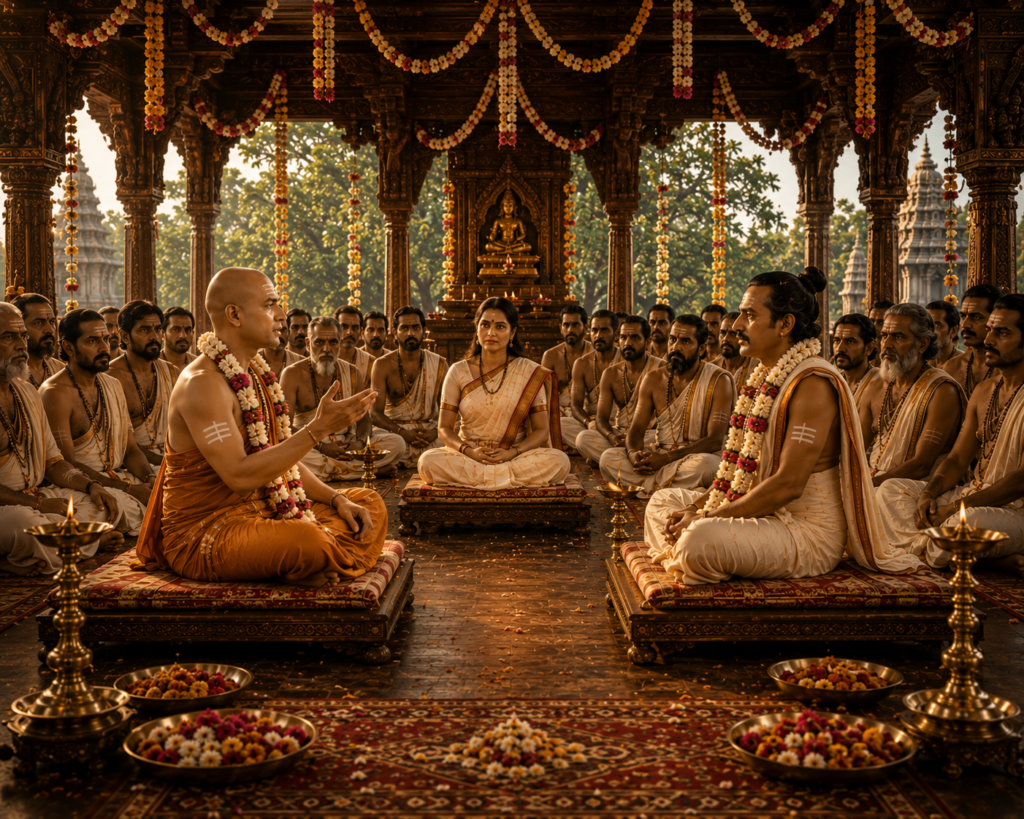
KarmKand and GyanKand: The Grand Synthesis
With their pledges established, the dialogue turned to the true heart of the Vedas. Mandan Mishra argued that the core aim of human existence is lifelong engagement in ritual duties (‘Yavajjivam Agnihotram Juhoti’), asserting that dedicated action alone yields spiritual fulfillment.
Sri Shankara, anchoring his response in the Upanishads, presented a foundational truth:
“Action (Karma) can never yield eternal Liberation (Moksha). Whatever fruit is produced through action, be it worldly wealth, pleasure, or celestial heavenly realms, is something created (Bhavya). And whatever is created is inherently subject to decay and destruction.”
Quoting the Kathopanishad, Sri Shankara Explained Three Simple Truths:
Karma Can Only Give Temporary Results (Bhavya):
Any reward you get from doing a ritual, whether it is wealth, power, or a place in heaven, is something that was created by your effort. Anything that has a beginning must also have an end. When the good merit runs out, you fall back into the cycle of birth and death.
Liberation Is Ever-Present, Not a New Product (Bhuta):
Moksha (liberation) is not a new item that you can manufacture or buy using rituals. Your Atman (true Self) is already free, pure, and eternal. You do not “create” liberation; you simply realize what is already yours.
The True Job of Rituals Is Mind Cleansing (Chitta Shuddhi):
Rituals and duties (KarmKand) are not meant to keep you trapped in an endless loop of doing sacrifices forever. Their real purpose is like soap, they wash away greed and mental impurities so your mind becomes quiet enough to receive Self-Knowledge (Jnana).
When Mandan Mishra contended that mere words cannot end suffering, Sri Shankara shared the poignant Analogy of the Forgotten Necklace:
“Consider a person who wears a gold necklace around their neck, yet forgets its presence and searches frantically throughout the house in deep distress. When a well-wisher points out, ‘The necklace is already around your neck,’ their suffering ends instantly. In the very same manner, the Supreme Being is eternally present within us. Due to spiritual ignorance, we seek Him outside. Self-Knowledge simply removes the veil of that ignorance.”
Key Takeaway:
Outward worship and ritual duties are essential stepping stones for mental purification, but they are not the ultimate destination. Until an individual dispels the inner veil of ignorance and recognizes their true Nature, external rituals alone cannot grant enduring peace or final Liberation.
What Does ‘Tat Tvam Asi’ Really Mean? (Literal Truth vs. Compliment)
After discussing rituals, the debate moved to the most famous line in the Upanishads: ‘Tat Tvam Asi’ (“That Thou Art” / “You Are That Supreme Reality”).
Mandan Mishra’s Objection (The “Compliment” Theory):
Mandan Mishra argued that a human being cannot literally be God. He claimed lines like ‘Tat Tvam Asi’ or ‘Aham Brahmasmi’ (“I am Brahm”) are just words of praise meant to boost the ego of the person doing the sacrifice.
His Example: “It is like praising a loyal servant of the king by saying, ‘You are just like the King!’ The servant doesn’t actually become the King; it is just a nice compliment to make him feel important.”
Sri Shankara’s Direct Answer (The “Literal Truth” Theory):
Sri Shankara rejected this idea completely, explaining three simple truths:
It Is a Statement of Fact, Not Flattery:
The Vedas are not lying or flattering you. They are revealing your actual identity. When the scripture says “You are That,” it means your true inner self (Atman) is made of the exact same Supreme Consciousness as Brahman.
Spiritual Ignorance (Avidya) Is the Only Confusion:
You feel small, weak, and separate from God only because of a misunderstanding. You mistake your body, mind, and thoughts (which are temporary) for who you truly are. That confusion is what we call Avidya (ignorance).
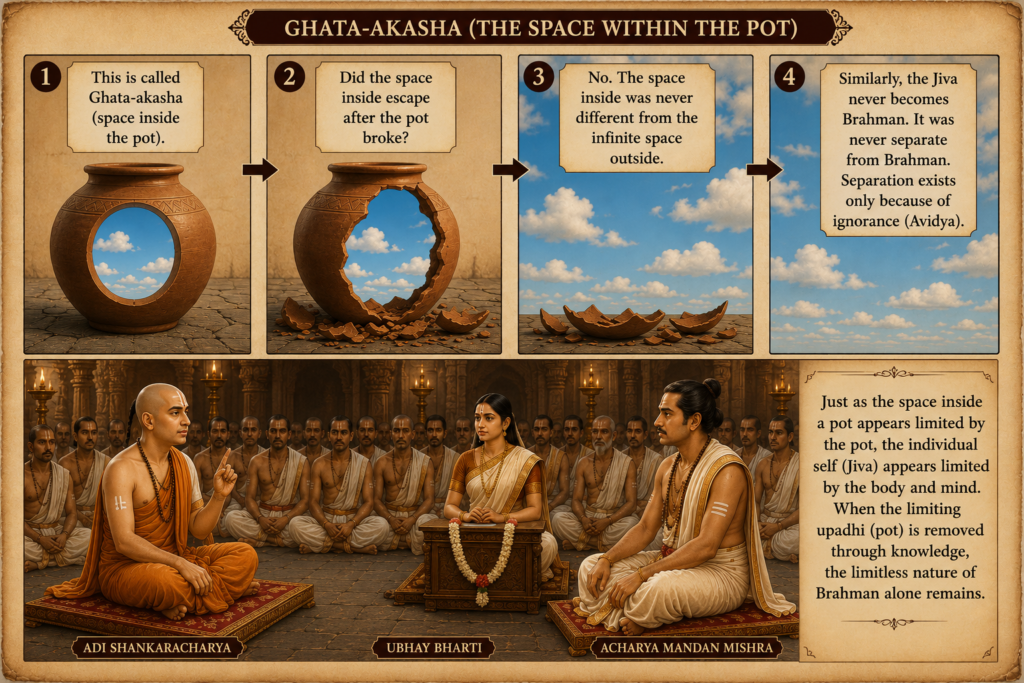
The Clay Pot Analogy (Space Is Always One):
Think of the space inside a clay pot. Is the space inside the pot different from the vast space outside? No. The pot merely surrounds a small portion of space. When the pot breaks, the “inside space” doesn’t have to travel anywhere—it was already part of the infinite space all along. In the same way, your body and mind are just like the pot. Once you realize you are the space (the Soul) and not the pot (the Body), all division disappears.
Key Takeaway:
Most of our fear and stress comes from believing we are just a weak, fragile body struggling against a tough world. The moment you understand that your inner awareness is an eternal spark of the Supreme Consciousness, fearlessness and peace dawn naturally.
Resolving ‘Dwa Suparna’: The Mind and the Witnessing Soul
Mandan Mishra presented his strongest scriptural argument from the Rigveda and Svetasvatara Upanishad:
“Dvā suparṇā sayujā sakhāyā samānaṁ vṛkṣaṁ pariṣasvajāte |
tayoranyaḥ pippalaṁ svādvattyanaśnannanyo abhicākaśīti ||”
“Two birds of beautiful plumage, inseparable companions, reside upon the self-same tree. One eats the sweet and sour fruits of the tree, while the other looks on silently without eating.”
Mandan Mishra argued that this verse explicitly proves that the individual soul (which tastes the fruits) and God (the silent witness) are two distinct entities.
Sri Shankara illuminated the verse’s inner depth:
“O learned master! This verse does not describe a division between God and the soul. It vividly describes the relationship between the mind (Buddhi) and the witnessing Atman within this very body.”
The First Bird (Mind/Intellect): The bird enjoying the fruits represents the mind. Due to ignorance, the mind becomes the doer and the enjoyer of worldly experiences.
The Second Bird (Witnessing Atman): The bird looking on silently represents the pure Consciousness within us—completely unattached to the fruits of action.
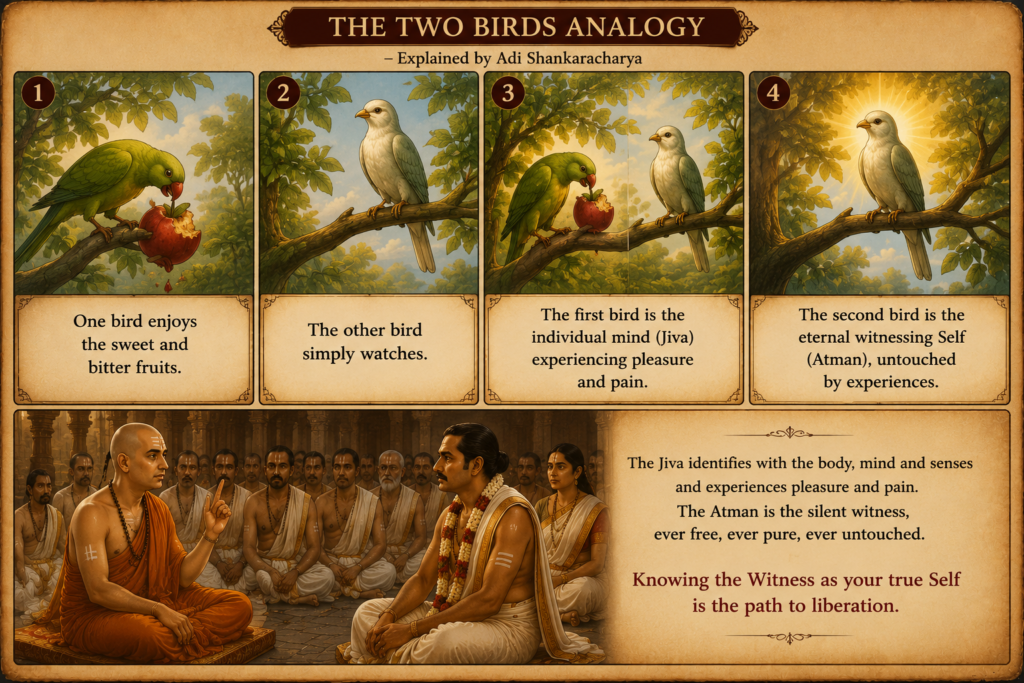
The Iron and Fire Analogy: Iron is naturally dark and cold, yet in contact with fire, it glows red-hot. Similarly, the inert mind, illumined by the light of the Atman, imagines itself to be happy or sorrowful. The true Atman never suffers nor undergoes change.
Key Takeaway:
All worldly pleasures, pains, and anxieties belong to the level of the mind (the first bird). By stepping back from mental turbulence and abiding as the calm, silent witness (the second bird), one attains unshakable inner poise.
The Withered Garland and Maharshi Jaimini’s Divine Appearance
As the days turned into weeks, the doubts surrounding Purva-Mimamsa dissolved one by one before Sri Shankara’s masterly expositions. After 3 months and 17 days of profound dialogue, the defining moment arrived: the fresh flowers around Mandan Mishra’s neck began to gently fade and wither!
Devi Ubhayabharati, with absolute fairness and grace, declared Sri Shankara victorious.
Even in defeat, Mandan Mishra harbored one lingering query:
“If Vedanta is indeed the supreme Truth, why did my revered Guru, Maharshi Jaimini, emphasize only ritualistic action in his Mimamsa Sutras? Did he reject God and the path of Knowledge?”
Sri Shankara revealed the actual meaning of Maharshi Jaimini:
“There is no flaw in Maharshi Jaimini’s Sutras. He emphasized ritual action to prevent people from reducing God to mere intellectual debate, guiding them to first purify their minds through selfless duty. Without a pure mind, one cannot become eligible for higher Self-Knowledge.”
At that moment, Maharshi Jaimini himself appeared before the assembly! Endorsing Sri Shankara’s words, he spoke to his disciple:
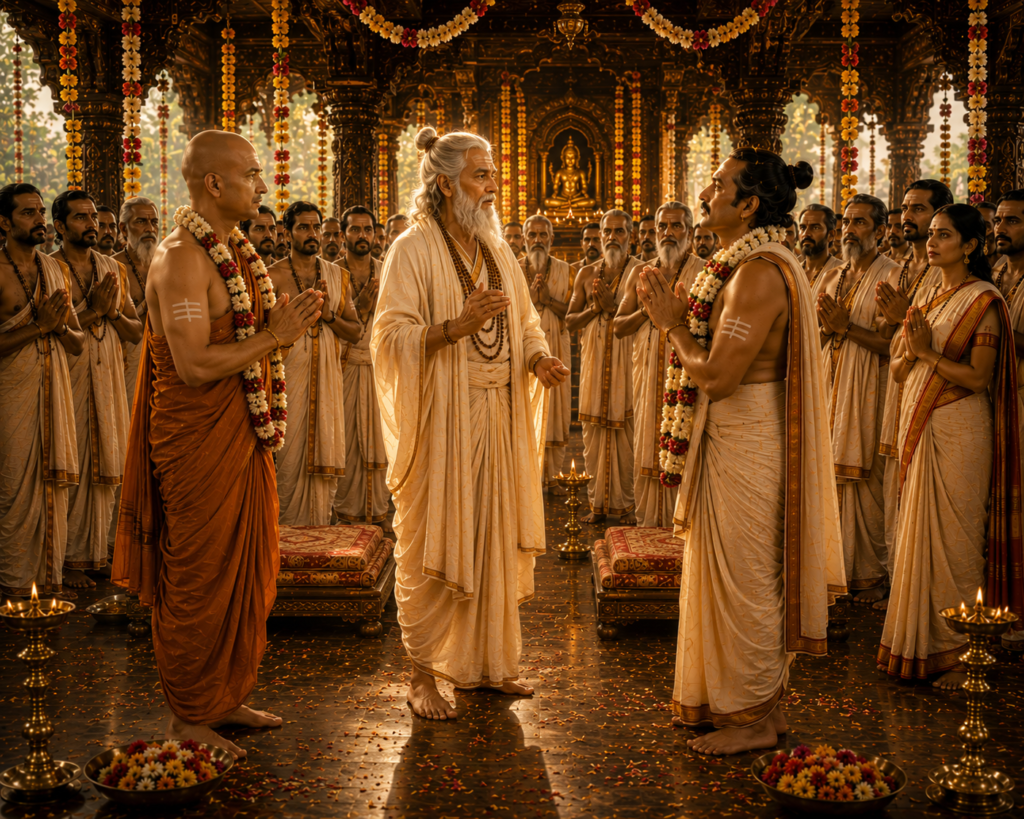
“O Mandan! Harbor not the slightest doubt regarding the words of Bhashyakara Shankara. His interpretation reveals my true intent. He is an avatar of Bhagwan Shiva Himself, descended in Kali Yuga to illuminate the path of Truth.”
With those divine words, Maharshi Jaimini disappeared.
The Ultimate Surrender and the Triumph of Advaita
All intellectual pride melted from Mandan Mishra’s heart. Bowing at Sri Shankara’s feet with deep humility, he expressed:
“O Ocean of Compassion! Unaware of your divine glory, I spoke inappropriate words at the beginning of our meeting. Pray forgive me! Renouncing my home, wealth, householder duties, and pride, I seek refuge at your sacred feet. Initiate me into that Supreme Truth!” (Sri Shankara Digvijaya 9.29, 9.43)
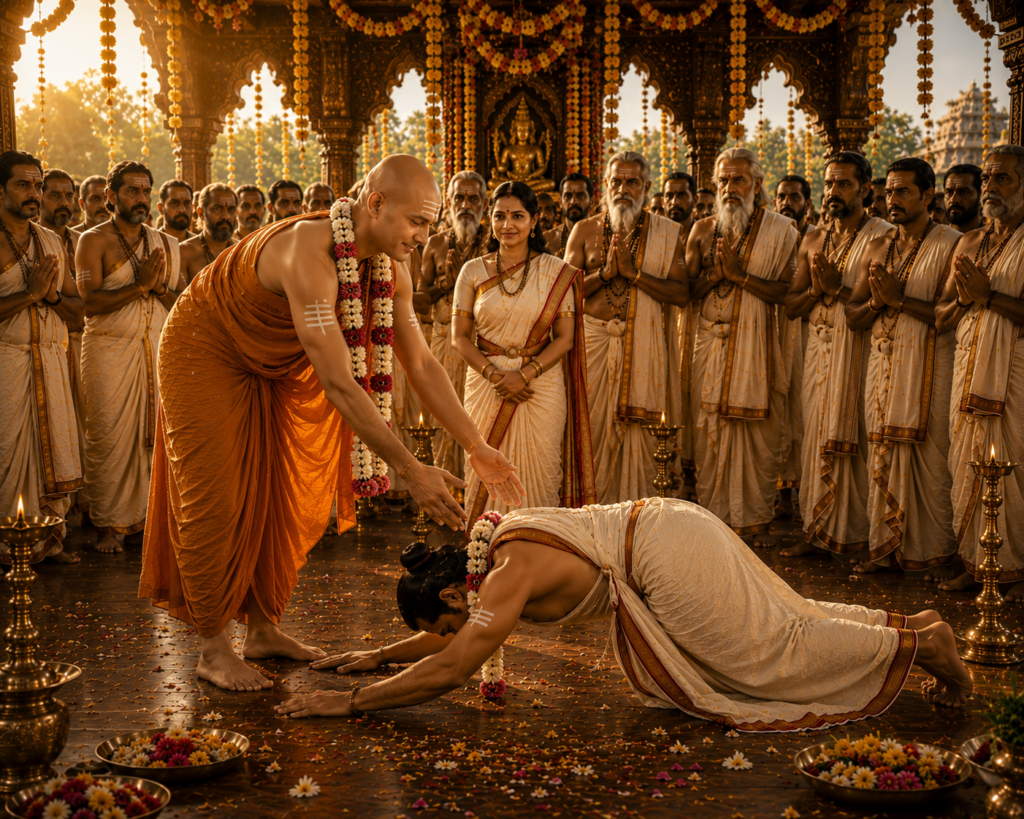
Sri Shankara initiated him into the monastic order of Sannyasa, bestowing upon him the name Sri Sureshwaracharya. He would later become the first head of the Sringeri Sharada Peetham, one of the four cardinal monastic seats established to safeguard Vedanta.
Conclusion: The Enduring Legacy on Sanatana Dharma
Concluding on Chaitra Shukla Chaturthi (Yudhishthira Samvat 2648), this historic debate was far more than an exchange between two scholars—it was a revitalization of Sanatana Dharma.
It permanently established three fundamental pillars:
Karma and Jnana are Complementary: Ritual duty is the initial step that purifies the mind, while Self-Knowledge is the ultimate destination that grants Liberation.
Dharma is Not Mere Outer Practice: Religion extends beyond ceremonial rites; its highest fulfillment lies in direct Self-realization.
The Unification of Vedic Thought: By establishing Advaita Vedanta, Sri Adi Shankaracharya united Bharat under a timeless spiritual realization, holding high the flag of Vedic wisdom for generations to come.
========================
Anupam Trivedi has spent over three decades studying and reflecting upon Sanatan scriptures, including the Vedas, Upanisads, Itihāsa, and Purāṇas. He writes on cultural philosophy and ancient literature to present traditional insights with accuracy and clarity. Read full bio →
Absolutely divine
Pingback:Adi Shankaracharya-Part 9, Can Rituals Alone Lead to Moksha?