Previously in this Series: A Quick Overview
- Part 1: Introduction to the extraordinary life and mission of Adi Shankaracharya, presenting a concise overview of his divine purpose as an Avatar of Bhagwan Shiva who descended to restore the authority of the Vedas. [Read Part 1 Here]
- Part 2: We explored Adi Shankaracharya’s divine birth, granted as a boon by Shiva to his deeply devoted parents, alongside the extraordinary signs, spiritual depth, and remarkable childhood incidents that marked his early life in Bharat. [Read Part 2 Here]
- Part 3: We followed Adi Shankaracharya’s journey to his Guru, Sri Govinda Bhagavatpada, his miracle of calming the flooding Narmada River, his travel to Kashi where he accepted his first disciple Sanandan (Padmapada), and his profound dialogue on Advaita with Bhagwan Shiva disguised as a Chandala. [Read Part 3 Here]
- Part 4: We detailed his creation of the Prasthanatrayi Bhashyas in Badrinath and his profound encounter with Maharshi Veda Vyasa, who tested his commentaries and blessed him with sixteen additional years to establish Advaita Vedanta. [Read Part 4 Here]
- Part 5: We explored the meeting between Adi Shankaracharya and Acharya Kumaril Bhatt at Teertharaja Prayag. We discussed the historical context of Buddhist influence on Vedic traditions, Kumaril Bhatt’s defense of the Vedas, the reasons behind his self-immolation in a chaff fire (Tushanala), his insightful dialogue with Adi Shankaracharya, and how he directed Adi Shankara toward his distinguished disciple, Mandan Mishra. [Read Part 5 Here]
- Part 6, Adi Shankaracharya’s first meeting with Acharya Mandan Mishra an avatar of Bhagwan Brahma (see in details in- Part 2). Even the pet birds outside Mandan Mishra’s home recite sacred Vedic chants. There was some unpleasant confrontation between Sri Shankara and Mandan Mishra before their historic spiritual debate (Shastrartha), but this confrontation, though sounded unpleasant, was also very insightful. [Read Part 6 Here]
- In Part 7 we discussed the Adi Shakaracharya and Acharya Mandan Mishra’s Historic Shastrartha in such details that have not been written on internet ever.[Read Part 7 Here]
In Part 8 before Acharya Mandan Mishra takes sanyas, becomes Adi Shankaracharya’s disciple, His consort devi UbhayBharati puts forward an unforeseen request to have a shastrartha with her also to achieve complete victory….
=============
The Shastrartha Was Not Yet Over, after Acharya Mandan Mishra’s defeat
While the garland around Jagadguru Adi Shankaracharya remained vibrant and fragrant, Mandan Mishra’s flowers slowly withered before the eyes of the gathered scholars. Without a single word being spoken, everyone understood that the historic Shastrartha had reached its decisive conclusion.
The assembled scholars looked toward Jagadguru Adi Shankaracharya with reverence. Mandan Mishra himself, a scholar whose brilliance was admired throughout Bharat, accepted the outcome with remarkable dignity. There was neither resentment nor disappointment upon his face.
Devi Ubhayabharati Breaks the Silence
“O Yati Sreshtha” (O Supreme Ascetic) ! I know the inner impulse of your mind. What is transpiring today fulfils the very truth I heard in my childhood from a radiant sage who visited my mother’s home.”
Devi Ubhayabharati’s Recount of The Childhood Prophecy of A Sage
“In my childhood, a magnificent ascetic, adorned with sacred white ash (Shweta Bhasma), unexpectedly visited our home. My mother worshiped him with devotional offerings, folded hands, and a bowed head, inquiring reverently about my future—my lifespan, marriage, wealth, progeny, and righteous deeds.”
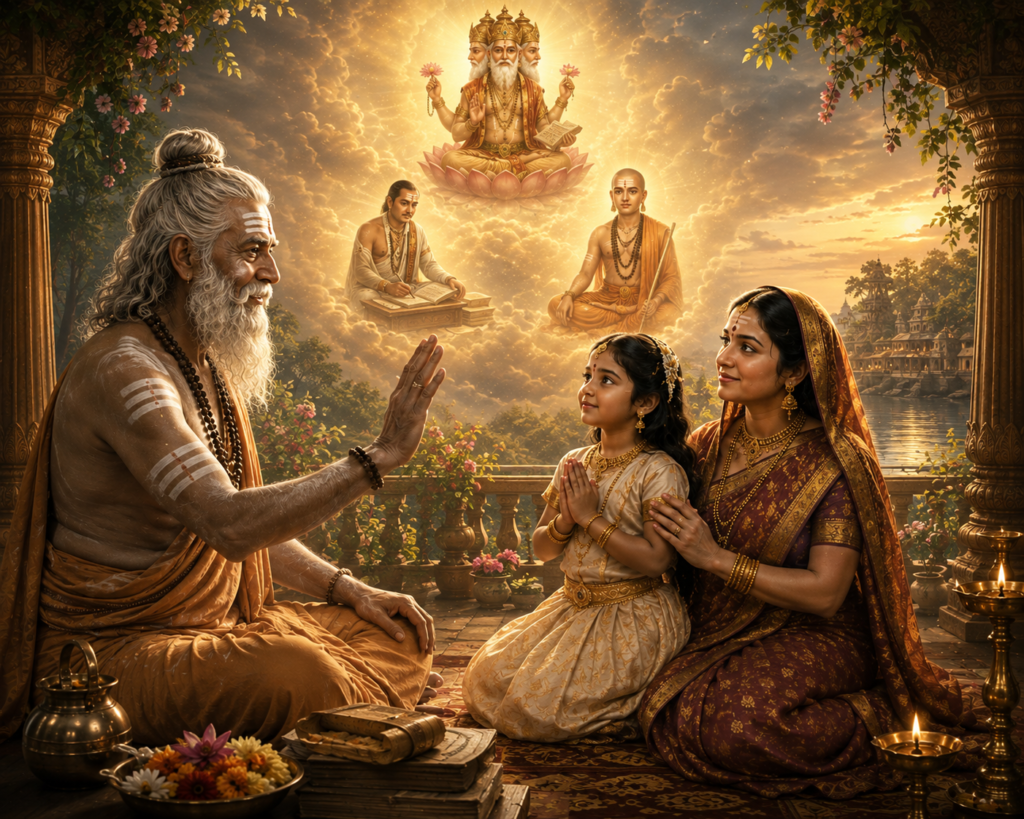
” the sage predicted my future: He said that when the eternal Vedic path becomes obscured on this earth by diverse anti-Vedic doctrines, Lord Brahma Himself shall take birth in the sacred land of Bharat as Mandan Pandit to restore the Vedic way. This maiden shall become his devoted wife, performing grand Yajnayagas by his side.”
“The sage further revealed that subsequently, to re-establish the ultimate purport of the Upanishads and Vedanta, Lord Shiva Himself shall descend upon earth bearing the name Shankara. A grand Shastrartha shall take place between Him and Mandan Pandit. Upon his defeat, Mandan shall renounce the householder order and take refuge at the feet of Sri Shankara as a Sannyasi.”
“That prophecy has proven true in every detail. Yet, as his sacred half (Ardhangini), until you defeat me in scriptural debate, your victory over Mandan Mishra cannot be declared complete. Defeat me also in Shastrartha, and accept him as your disciple.”
Shastrartha Commences: Adi Shankar’s Dilemma after a Question on Kam-Shastra!
Sri Shankara observed that ascetics do not traditionally engage in public debate with women. But Devi Ubhayabharati countered with sacred scriptural precedents:
- The legendary debate between Gargi Vachaknavi and Sage Yajnavalkya in the Brihadaranyaka Upanishad.
- The profound discourse between Sulabha and King Janaka in the Mahabharata.
Recognizing her flawless reasoning, Sri Shankara accepted the discourse.
For seventeen continuous days and nights, an unprecedented stream of razor-sharp logic, Vedic shlokas, and subtle philosophical argumentation flowed between them, leaving scholars, devas, and celestial beings in utter astonishment.
Seeing Sri Shankara’s absolute mastery over the Vedas, Nyaya, and all philosophical treatises, Devi Ubhayabharati realized He was completely invincible in scriptural lore. She reflected that since Sri Shankara had embraced lifelong celibacy (Naisthika Sannyasa) from early childhood, He had no exposure to the experiential science of human intimacy and marital life (Kamakala).
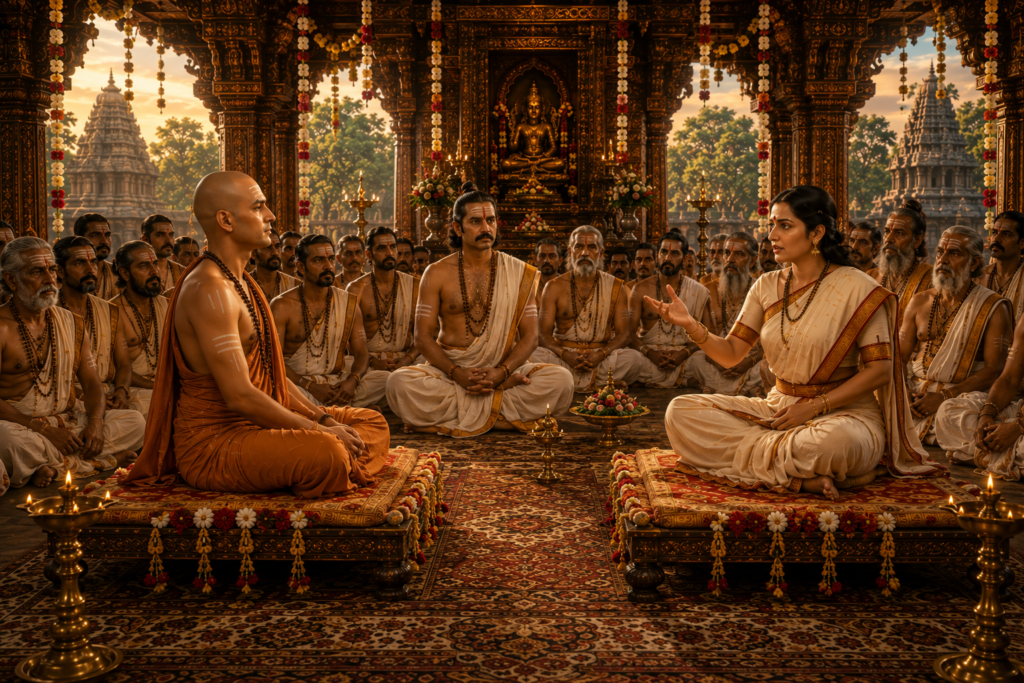
To test the absolute completeness of His omniscience (Sarvajnata), she posed subtle, intricate questions:
- What is the exact number and nature of Kamakalas?
- Where do they reside within the human body?
- How do their subtle flows shift between the waxing (Shukla) and waning (Krishna) lunar fortnights in men and women?
Sri Shankara stood at a sacred crossroads:
- To leave her questions unanswered would imply a limit to His omniscience (Sarvajnata).
- To discuss the details of marital intimacy while wearing the sacred robes of a monk would compromise the strict decorum and purity of monastic vows (Yati-dharma).
Maintaining the highest dignity of both omniscience and monastic purity, Sri Shankara requested a one-month period of grace (Masa-matra avadhi) to provide the definitive response. Devi Ubhayabharati accepted.
Adi Shankaracharya’s Parakaya Pravesha
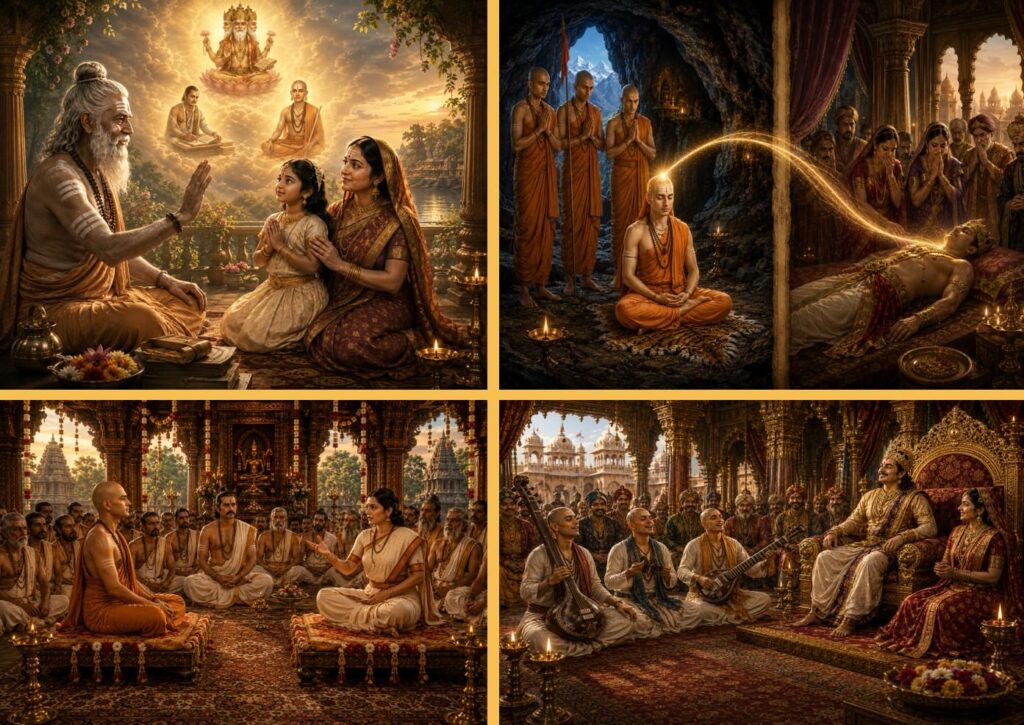
Traveling through the sky (Nabhomarga) with His disciples, Sri Shankara reached a secluded mountain cave beside a lake. Addressing His devoted disciple Padmapada (Sanandana), He disclosed His intent to utilize the yogic discipline of Parakaya Pravesha (entering another body).
When Padmapada expressed concern, Sri Shankara reminded him of the absolute detachment (Asangata) of King Janaka and Lord Krishna, assuring his disciples that pure Consciousness remains forever untainted.
Entering deep yoga-samadhi, Sri Shankara drew His vital forces (Pranas) and subtle body (Sukshma Sharira) up through the crown of His head (Brahmarandhra), leaving His monastic body in a preserved, inert state under the care of His disciples.
At that precise moment in a forest nearby, King Amaruk died, surrounded by grieving queens and ministers. Sri Shankara’s consciousness entered the deceased king’s body through the Brahmarandhra, reanimating the body. (This occurred on Chaitra Shukla Ashtami, Yudhishthira Samvat 2648, at the age of 17).
While living in the body of King Amaruk, Sri Shankara ruled the kingdom with exceptional wisdom and justice. At the same time, remaining completely detached in his mind, he studied the deeper principles of Kamakala (the science of human intimacy). He wrote a comprehensive work on this subject, drawing upon the Vatsyayana Kamasutra and scriptural definitions from the Mahabharata (Vanaparva). Through this work, he explained that human desire, when understood in its purest sense, is actually a physical reflection of the soul’s deep search for divine bliss (Paramananda).
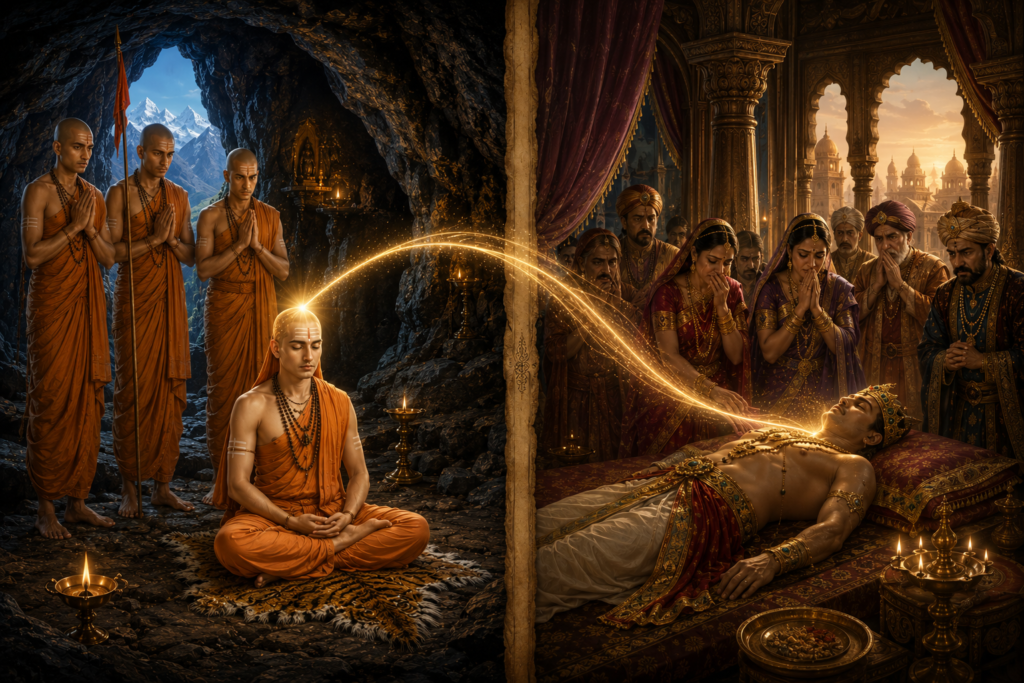
Meanwhile, the king’s ministers noticed a sudden, incredible change in King Amaruk’s intelligence, purity, and behavior. They quickly realized that a great yogi must have entered the deceased king’s body through spiritual powers. Fearing that the yogi would leave the king’s body and return to his own, causing the king to die again, the ministers secretly commanded their guards to search the entire country for any preserved, unburnt human body and burn it immediately.
The Disciples Intervened To Bring back Adi Shankaracharya in his body
As the one-month deadline approached, Sri Shankara remained deeply engrossed in his royal duties as King Amaruk. Worried that their Master might miss the deadline set by Devi Ubhayabharati, Padmapada and the other disciples disguised themselves as court musicians and entered the royal palace. Standing before the throne, they sang allegorical songs filled with Advaita Vedanta to remind Him of His true divine identity:
“O Master! You are the unattached, witnessing Consciousness—completely beyond the three physical bodies and the five sheaths (Pancha-koshas). Please leave this temporary attachment to the royal body and return to your sacred monastic form for the spiritual elevation of the world!”
Understanding the subtle message within his disciples’ song, Sri Shankara immediately withdrew his vital consciousness from King Amaruk’s body and traveled through the subtle realms back to the mountain cave.
However, the king’s guards had already tracked down Sri Shankara’s hidden monastic body and set it on fire! Entering his burning physical body, Sri Shankara instantly composed and chanted the Sri Lakshmi Nrisimha Karavalamba Stotram, praying to Lord Narasimha for protection:
“Srimatpayonidhiniketana cakrapane bhogindrabhogamaniranjitapunyamurte |
yogisa sasvata saranya bhavabdhipota laksminrsimha mama dehi karavalambam ||”
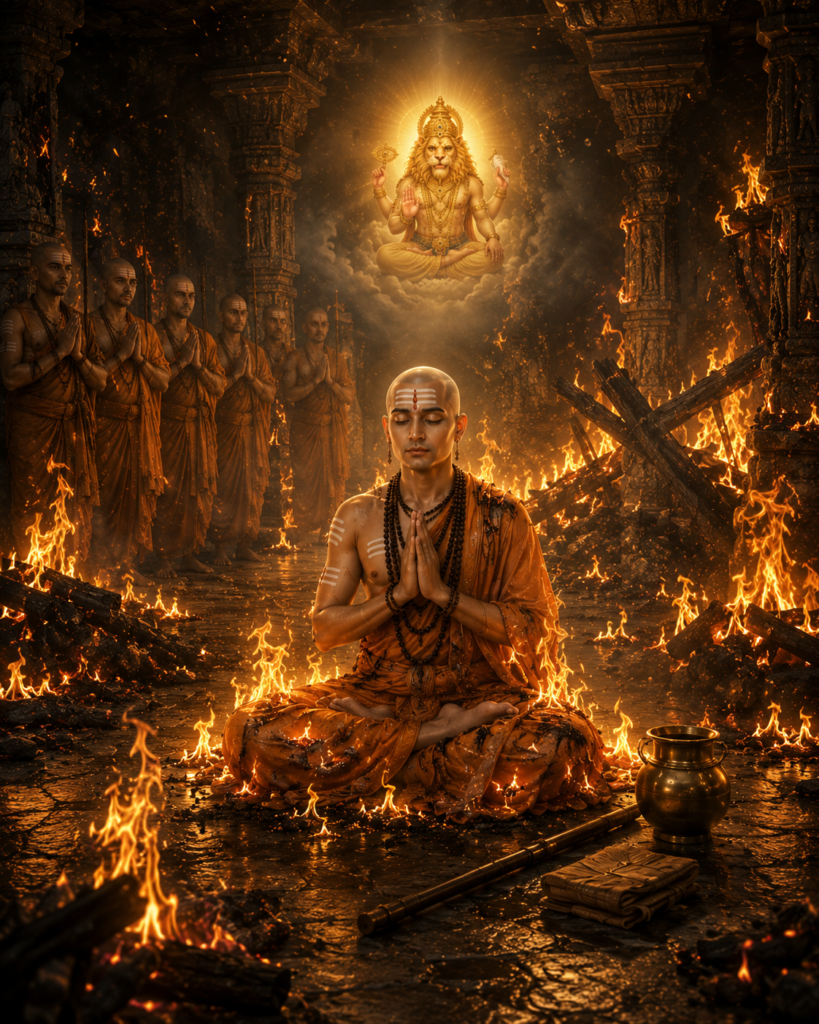
By the divine grace of Lord Narasimha, the fierce fire was instantly put out. On Kartik Shukla Trayodashi (Yudhishthira Samvat 2648), Sri Shankara emerged safely from the cave, glowing like the rising sun and completely unharmed by the flames.
Devi Ubhayabharati’s Surrender on Realizing that Adi Shankaracharya is Bhagwaan Sadashiva Himself
After emerging safely from the cave, Sri Shankara traveled through the sky (Nabhomarga) with his disciples and descended upon the abode of Acharya Mandan Mishra. Seeing Sri Shankara arrive through the sky by his yogic powers, Mandan Mishra bowed his head and offered his worship with deep affection, saying, “This life, wealth, and everything is Yours.”
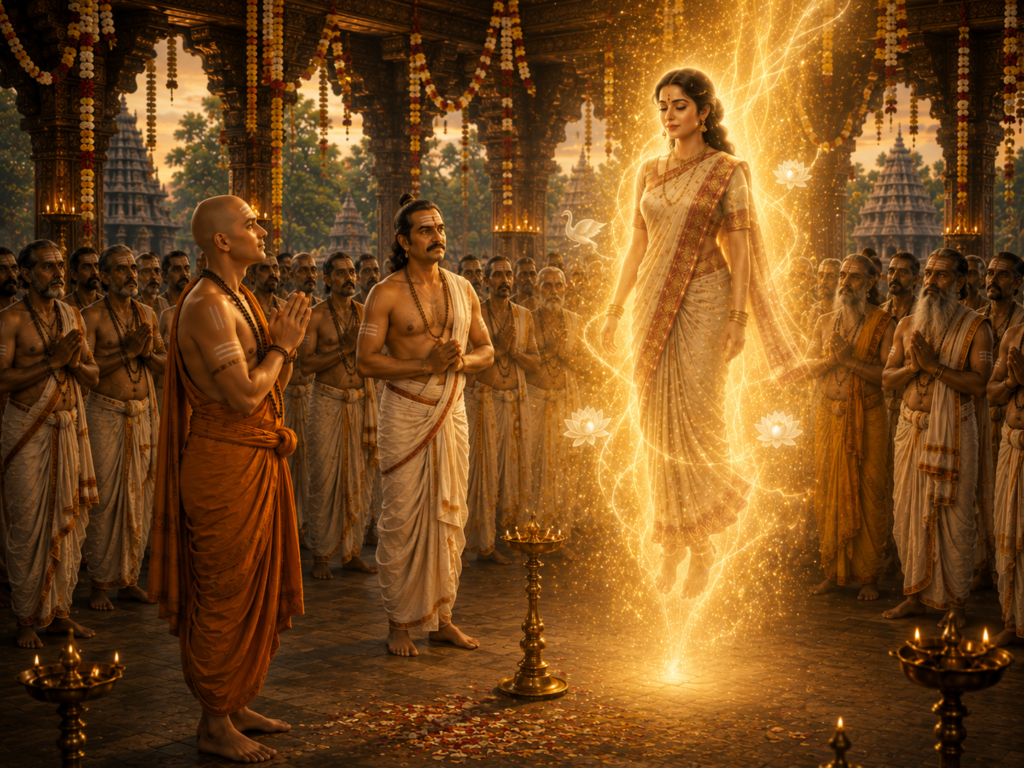
Seeing her husband bow, Devi Ubhayabharati recognized Sri Shankara’s true divine identity as साक्षात Lord Sadashiva. She offered her worship and spoke these immortal verses from the Shankara Digvijaya (Canto 10, Verses 66–68):
“Isanah brahmano’dhipatirbrahman sarvavidyanamisvarah sarvadehinam | bhavan saksat sadasivah ||”
“Sadasi mamavijitya tathaiva yanmadanasasanakamakalasvapi |
tadavabodhakrte krtimacarastadiha martyacaritravidambanam ||”
“Tvaya yadavam vijitau paratman na tattrapamavahati’dya sarvatha |
krta’bhibhutirna mayukhasalina nisakaraderapakirtaye khalu ||”
“Adatmyam dhama kamam prayasyamyarhasyaccham mamanujatumarhan ||”
Meaning:
“You are the Master of all learning, the Lord of all living beings, the Supreme Ruler of Brahma, and Saakshaat Lord Sadashiva Himself! The effort You made through Parakaya Pravesha to answer questions on Kamakala was merely a playful imitation of human behavior, for nothing in existence is unknown to You. Being defeated by You brings us no shame! does the bright sun outshining the moon bring disgrace upon the moon? Now, please grant me permission to return to my pure home in Brahmaloka.”
As she prepared to depart using her yogic power (Yogashakti), Sri Shankara requested her to remain accessible to humanity:
“O Devi! I know you to be the beloved consort of Brahma, the sister of Shiva, the primary goddess of speech, and pure Consciousness who takes the form of Lakshmi and Uma for the protection of the world. Therefore, reside in the temples established by us in holy lands like Rishyasringa, bearing the name ‘Sharada’, granting desired blessings and remaining near noble souls.”
Consenting with “Tatheti” (“So shall it be”), Devi Ubhayabharati gladdened Sri Shankara and vanished from everyone’s sight into Brahmaloka without touching the earth. The assembled audience was left in total wonder and awe, while Sri Shankara and Acharya Mandan Mishra were filled with supreme joy.
Anupam Trivedi has spent over three decades studying and reflecting upon Sanatan scriptures, including the Vedas, Upanisads, Itihāsa, and Purāṇas. He writes on cultural philosophy and ancient literature to present traditional insights with accuracy and clarity. Read full bio →
हर हर महादेव
A very intense and authentic write. Thank you
Pingback:Adi Shankaracharya-Part 9, Can Rituals Alone Lead to Moksha?