
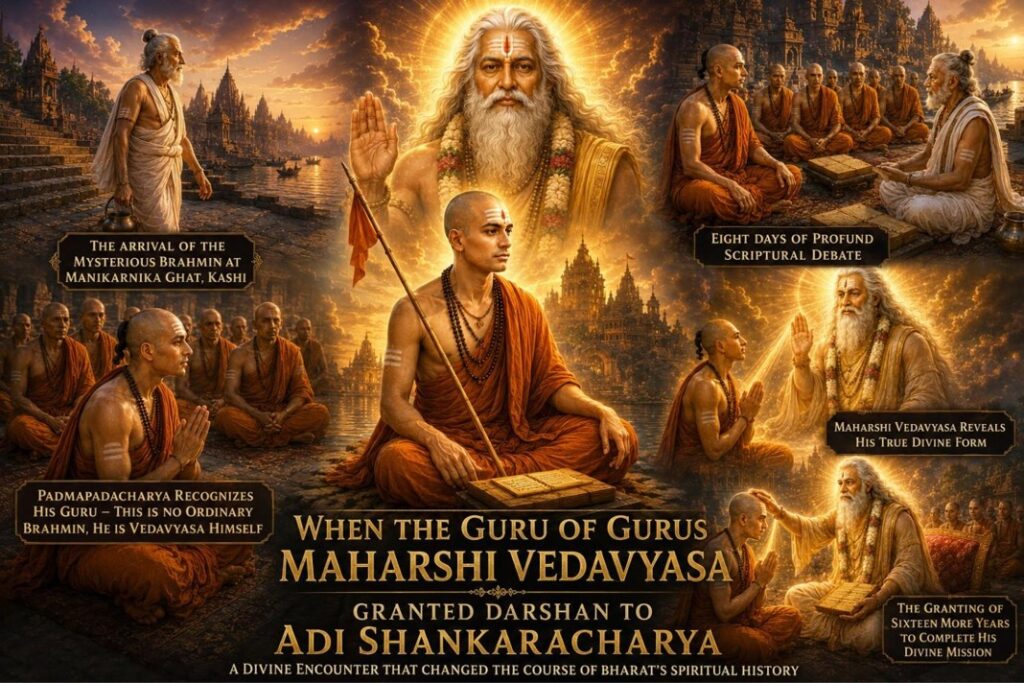
Previously in this Series: A Quick Overview
Part 1: We introduced the extraordinary life and mission of Adi Shankaracharya, presenting a concise overview of his divine purpose as an Avatar of Bhagwan Shiva who descended to restore the authority of the Vedas. [Read Part 1 Here]
Part 2: We explored his divine birth, granted as a boon by Shiva to his deeply devoted parents, alongside the extraordinary signs, spiritual depth, and remarkable childhood incidents that marked his early life in Bharat. [Read Part 2 Here]
Part 3: We followed his journey to his Guru, Sri Govinda Bhagavatpada, his miracle of calming the flooding Narmada River, his travel to Kashi where he accepted his first disciple Sanandan (Padmapada), and his profound dialogue on Advaita with Bhagwan Shiva disguised as a Chandala. [Read Part 3 Here]
Now, in this fourth part of the Aadi Shankaracharya Series, we discuss his divine work in Kashi, moving to the holy banks of the Ganga at Manikarnika Ghat, where a dramatic eight-day debate culminates in an extraordinary, cosmic encounter…
Arrival of the Brahmin on the Banks of the Ganga and Dialogue with the Shankaracharya and his Disciples
Bhagavatpada Sri Shankaracharya used to reside near the holy river Ganga. Sitting near Manikarnika Ghat, he would teach his self-composed Brahmasutra Bhashya (commentary on the Brahma Sutras) to his disciples. Every day until noon, he would answer the questions raised by his disciples, keeping the process of study and philosophical debate continuously active.
On the day of Kartik Shukla Ashtami in the year Yudhisthira Shaka 2647 (491 BCE), just as the disciples grew weary from their studies and the Acharya was about to rise, an old Brahmin approached them. He asked directly: “Who are you and what do you teach?”
The disciples respectfully replied:
“O Brahmin Dev! This is our revered Guru. He has deeply mastered all the Upanishads. 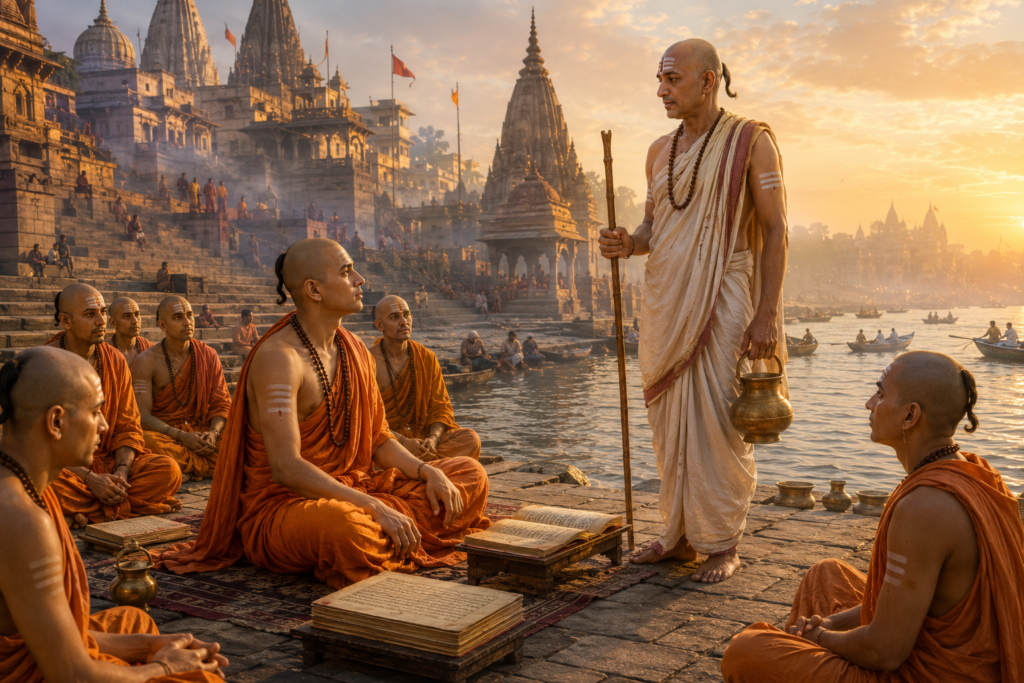 He has authored a commentary on the Brahma Sutras that thoroughly refutes the philosophy of Dualism (Bhedavada) and illuminates the true essence of the Upanishads. We, his disciples, are studying that very text under his guidance.”
Profound Discussion of Brahmin and Adi Shankaracharya on the Esoteric Essence of the Brahma Sutra
The Brahmin stated with solemn authority: “Your disciples hail you as a Bhashyakar (Master Expositor). However, I shall not accept this until I am fully convinced that you truly understand both the external and internal hidden meanings of the sutras composed by Maharishi Veda Vyasa. If you wish to satisfy my inquiry, explain the grammatical connection (Anvaya) and core intent (Tatparya) of this specific Brahma Sutra:
‘Tadanantarapratipattau Ramhati Samparishvaktah Prashnanirupanabhyam’ (Brahma Sutra 3.1.1)
Acharya Shankara replied with utmost humility: “I bow to the great Gurus who know the actual meaning of the sutras. I harbour no ego of being an all-knowing master of these texts. Nonetheless, at your command, I shall attempt to explain its meaning according to my intellect.”
Following this, he began explaining the core meaning of the sutra. He stated that the detailed dialogue of questions and answers contained in the Brihadaranyaka Upanishad (4.4.1–3) and Chandogya Upanishad (5.3.3 to 5.9.1) establishes a definitive fact. When the hour of death arrives, the individual soul (Jiva) conjoins with the subtle elements (Sukshma Bhuta) to acquire its next physical body. Thereafter, it journeys through paths like the smoke-path (Dhumadi Marga) to various higher or lower realms in strict accordance with its past karmas.
This cosmic transit is beautifully illustrated through several ancient philosophical principles/ doctrines (Nyayas) and analogies, such as:
- Trina-Jalauka-Nyaya (The Analogy of the Leech): Just like a leech moving on a blade of grass firmly grips the next spot before releasing its hold on the previous one, the soul grips its next destiny before leaving the old body.
- Pada-Vinyasa-Nyaya (The Analogy of Stepping): Just like a traveler firmly plants one foot forward on new ground before lifting the rear foot.
- Svapna-Manoratha-Nyaya (The Analogy of Dreams): Just as a mind in a semi-dream state, driven by the intense momentum of latent desires (Vasanas), completely forgets the waking body and creates an entirely new mental world and an active body to experience it.
In the exact same manner, the Jiva departs from one body and enters another based on its accumulated karmas and desires. The profound underlying truth behind this is that the Atman (Soul) is truly one, all-pervading, and is completely free from birth and death. Just as the space inside an earthen pot (Ghatakasha) and the vast space outside it (Mahakasha) are fundamentally identical, the true nature of the Jiva and Brahman is one and the same. Yet, due to beginningless ignorance (Avidya), desires (Kama), and actions (Karma), the pure Atman falsely identifies itself as a limited Jiva. Consequently, it appears bound to the worldly cycles of birth, death, pleasure, pain, heaven, and various celestial realms.
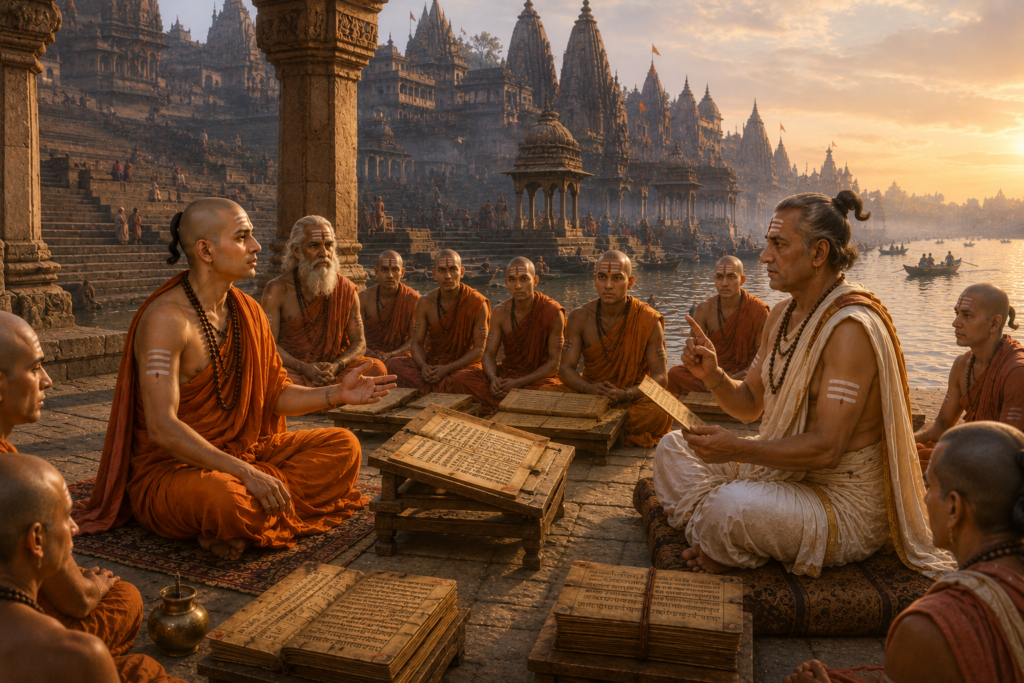
The Mystical Journey of the Soul After Death: Secret Doctrines and Sacred Analogies
Acharya Shankara further explained that although the Atman is fundamentally one, indivisible, all-pervading, and pure consciousness, it is called a Jiva since time immemorial due to the bondage of ignorance, desires, and actions. In absolute reality, the Atman undergoes no movement, birth, or death; however, due to its false identification with the physical body, the Jiva perceives itself as trapped in the wheel of birth and rebirth.
The ritualistic actions prescribed in the Vedas elevate the Jiva to excellent realms like heaven. One who methodically practices these Vedic karmas and worship (Upasana) progresses sequentially and attains higher states of existence. But the moment the soul gains the absolute realization of the Atman as propounded by Vedanta, it permanently reclaims its non-dual nature (Brahmarupata).
Even though an enlightened seer knows that the destruction of the body does not mean the destruction of the Atman, and changing bodies causes no change in the soul, ordinary beings, due to their intense bodily attachments, perform sacrifices (Yajnas), fire rituals (Homas), and other pious deeds according to their eligibility to secure a higher reals after death.
Just as copper inherently exists within a copper vessel, the subtle elements naturally reside within the life-forces, senses, and the inner mind. The actions performed by the Jiva (executed through the Vijnanamaya, Manomaya, and Pranamaya koshas) remain safely stored within its subtle subconscious until their fruits are fully exhausted through experience. Under the compelling influence of these very karmas, the soul transits to different realms after physical death.
The Acharya again highlighted the example of dreams, stating that during sleep, the inner mind constructs a completely alternative universe driven by past impressions. At that time, a person completely forgets the waking body and undergoes entirely different experiences. This serves as an excellent illustration of how the soul seamlessly steps from one state of consciousness into another.
Reiterating the analogies of the leech and the traveller, he emphasized that the Jiva, propelled by desires and karmas, links itself to a new body before detaching from the old one. The moment the ruling Prarabdha Karma (past action responsible for the current life) finishes, the soul abandons the old frame and steps into a newly generated body determined by its deeds.
When the accumulated merits (Punya) in heaven begin to exhaust, the sorrowful soul drops from the celestial heights, and its celestial, soma-infused body dissolves into a watery form. Carrying its remaining traces of merit, the soul gradually enters the physical bodies of a father and a mother through the medium of food, eventually taking human birth again. It then walks the earth blessed with form, wealth, character, high intellect, and physical strength.
Conversely, souls with heavy, dominant sins (Papa) slide into painful, torturous, hellish conditions known as ‘Rahukalpa’. Once the intense sins are exhausted in hell, they return to the mortal world, but due to residual negative karmas, they are forced into lower wombs such as grass, insects, fish, boars, or outcaste lives. Such births are heavily plagued by physical ugliness, ignorance, delusion, attachments, hatred, and deep misery.
Just as a frog, whose physical body had completely vanished by dissolving into the mud and water, reassumes a fresh body when the favourable season returns, every single soul continuously acquires an appropriate new body governed by its past deeds and cosmic destiny.
To validate this absolute truth, the Acharya quoted these sacred verses from the Paingala Upanishad:
“Atha jñānendriyapañcakaṁ karmendriyapañcakaṁ prāṇādipañcakaṁ viyadādipañcakamantaḥkaraṇacatuṣṭayaṁ kāmakarmatamāṁsyaṣṭapuram।।” (Paingala Upanishad 2.1)
And further:
“Karmendriya jñānendriyāṇi tattadviṣayānprāṇānsaṁhṛty kāmakarmānvita avidyābhūtaveṣṭito jīvo dehāntaraṁ prāpya lokāntaraṁ gacchati।।“ (Paingala Upanishad 2.1)
This signifies that the Jiva, accompanied by the five senses of perception, five organs of action, five vital pranas, the inner mind, along with ignorance, desires, and actions—collectively known as the Puriyashtaka (the city of eight elements)—departs the physical sheath to enter a new body and an entirely new world.
The Shastrarth (Scholarly Debate) Continued for Eight-Days
Even after listening to this incredibly detailed and scripturally sound exposition, the Brahmin raised numerous complex counter-arguments and intellectual objections. He presented highly intricate logic, surprising both Acharya Shankara and his disciples, and aggressively attempted to dismantle the commentary’s interpretation of the sutra.
However, Acharya Shankara, a mountain of patience and unparalleled genius, calmly restated each counter-argument (Purvapaksha) first with absolute precision, and then thoroughly demolished it using irrefutable logic and scriptural proofs.
Thus, a monumental and highly sophisticated debate over the true meaning of the Brahma Sutras commenced between these two intellectual titans. This dialectical duel did not end in a day or two, but raged continuously for eight long days. As the debate stretched on, no conclusion seemed in sight. On one side stood Yatiraja Adi Shankaracharya, and on the other was that mysterious Brahmin who wielded an absolute, supernatural mastery over every single syllable and esoteric meaning of the Brahma Sutras. All the disciples present watched this extraordinary clash of intellects with bated breath.
Finally, the highly realized disciple, Padmapadacharya, who was sitting close by, recognized the cosmic play. He turned to his Guru, Sri Shankaracharya, and uttered this immortal verse from the Shankara Digvijaya:
“Tvaṁ śaṅkaraḥ śaṅkara eva sākṣādvayāsastu nārāyaṇa eva nūnam ।
Tayorvivāde satataṁ prasakte kiṁ kiṅkaro’haṁ karavāṇi sadyaḥ ।। “ (Shankara Digvijaya 7.11)
“O Master! You are none other than saakshaat Lord Shiva (Shankara) Himself, and this Brahmin is definitely Lord Narayana manifested as Maharishi Veda Vyasa. When two such divine manifestations are locked in an eternal debate over the meaning of the Sutras, what can a humble servant like me possibly do?”
The Manifestation of Maharishi Veda Vyasa and Acharya Shankara’s Hymn of Praise
Hearing these revealing words from Padmapadacharya, Acharya Shankaracharya knew that this was no ordinary mortal Brahmin. A powerful desire to witness the true form of Sage Veda Vyasa flooded his heart. He reverently folded his hands, bowed his head, and began praising the Brahmin with deep devotion.
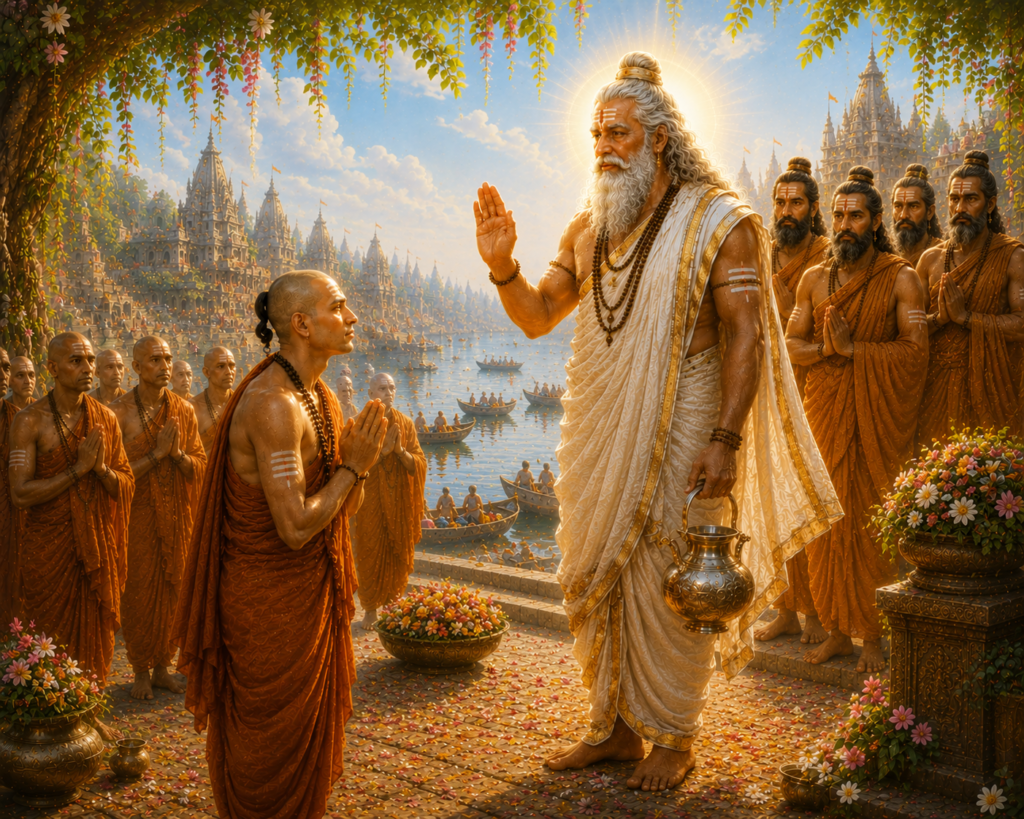
He prayed:
“Bhavāṁstaḍiccārujaṭākirīṭa-pravarṣukāmbhodarakāntikāntaḥ ।
Śubhropavītī dhṛtakṛṣṇacarmā kṛṣṇo hi sākṣātkalidoṣahantā ।। “ (Shankara Digvijaya 7.13)
“Your crown of Jata Jut (matted locks) shines with the brilliant beauty of lightning, and your majestic complexion matches the deep splendor of a rain-bearing cloud. Wearing the sacred white thread and the holy deer-skin, you are saakshaat Krishna Dvaipayana Veda Vyasa, the destroyer of the sins of Kali Yuga.”
The Acharya then pleaded with total humility:
“Bhavatkasūtrapratipādyatādṛk parāparārthapratipādakaṁ sat ।
Advaitabhāṣyaṁ tava sammataṁ cet soḍhā mamā’gaḥ purato bhavāśu । “ (Shankara Digvijaya 7.14)
“If this Advaita commentary, which faithfully brings forth the supreme and relative truths intended by your Brahma Sutras, meets your divine approval, then kindly forgive my audacities and reveal your true form before me.”
Moved by the gentle, devotion-filled words of Acharya Shankaracharya, Lord Veda Vyasa’s heart melted, and he began manifesting his true, cosmic form right before their eyes. His Jata Jut (matted hair) gleamed like clusters of golden creepers. His presence mirrored a massive rain cloud illuminated by flashes of lightning. Through his Jnana Mudra (hand gesture of wisdom), he silently transmitted the ultimate truth. His bodily radiance was so breathtaking that it easily outshone the beauty of the autumn full moon embraced by a loving night. His complexion was a deep, beautiful dark hue, resembling the Tamala tree. He wore a tiger-skin, holding a flawless water-pot (Kamandalu) crafted from Chandrakanta gem. Around his neck hung a sacred Rudraksha mala containing twenty-seven pearls, resembling a brilliant constellation of stars. His entire form radiated a fierce, divine energy, mirroring Lord Shiva Himself. Flanked by his own legendary disciples, Lord Vyasa showered a glance of pure nectar and grace upon Shankara and his entire assembly.
Beholding this magnificent, divine form of Lord Veda Vyasa, Acharya Shankaracharya’s heart overflowed with supreme bliss. Stepping forward with his disciples, he prostrated flat on the ground and began chanting a hymn of praise to the Guru of Gurus.
He said: “O Lord! You are the timeless Supreme Being, Sriman Narayana Himself. You are the crown jewel of all omniscient seers. Looking into the future and out of sheer compassion for the spiritually weakened human beings of the coming ages, you systematically divided the vast single Veda into four distinct parts—Rigveda, Yajurveda, Samaveda, and Atharveda. Your highly qualified, disciplined, and faithful disciples further branched these Vedas into numerous schools and sub-branches. This divine Vedic wishing-tree (Kalpavriksha), served lovingly by the liberated sage Sri Shukadeva, is fully capable of granting both material enjoyments (Bhoga) and ultimate liberation (Moksha). To unveil the deepest meanings of the Vedas, you composed the eighteen Puranas and the great epic Mahabharata. By structuring the Brahma Sutras, you resolved the most complex and tangled passages of the Upanishads and the Bhagavad Gita, forever establishing the absolute truth and bestowing the highest welfare upon all philosophers and seekers. You hold Lord Shiva eternally within your heart, protect the eternal Vedic speech through your mouth, and destroy the realms of hell with your merciful gaze. O wondrous Krishna! Who in this universe can fully describe your endless divine attributes?”
Following this, the Acharya said:
“Dvaipāyana svāgatamastu tubhyaṁ dṛṣṭvā bhavantaṁ caritā mayā’rthāḥ ।
Yuktaṁ tadetat tvayi sarvakālaṁ paropakāravratadīksitatvāt।। “ (Shankara Digvijaya 7.23)
“O Dvaipayana! A most reverent welcome to you. By gaining your divine vision, all my life’s purposes stand completely fulfilled. Being eternally consecrated to the vow of absolute benevolence, it is completely natural for you to possess the power to fulfill all noble endeavors.”
Maharshi Veda Vyasa Approves Adi Shankaracharya’s work
Deeply pleased by this profound hymn of praise, Sri Veda Vyasa seated himself upon the offered seat. As Acharya Shankara bowed deeply at his feet, the sage spoke in a voice filled with profound affection:
“Dear child! You have already reached my spiritual stature. I am fully aware of your unbroken, matchless scholarship. O learned one! You are as incredibly dear to me as my own son, Shukadeva. Continue to travel far and wide with your disciples just as before, spreading the truth of Sanatana Dharma and Vedanta. I learned about the creation of this spectacular commentary through the mouth of a realized master named Sabhakane, a companion of Lord Shiva. O tranquil soul! Driven by a pure joy to see your work and to see you in person, I have come to this place.”
Hearing these sweet words from the king of sages, Shankaracharya’s heart expanded with joy. He responded with deep modesty: “Sumanthu, Paila, Jaimini, Vaishampayana, and Shukadeva are your direct disciples. Compared to those spiritual giants, I am more insignificant than a blade of grass. Yet, you have showered your causeless mercy upon this humble servant.
O worshipful master of all seers! The all-revealing Brahma Sutras structured by you are like the blazing sun. By waving the tiny lamp of my commentary before that sun, I have certainly committed an act of immense audacity, yet I feel no shame. I am your grand-disciple. I have simply tried to comment on your sutras according to my limited capacity. Whether my words contain beautiful expressions (Sukti) or flawed statements (Durukti), only you possess the power to balance and correct them. Only through your divine grace can this commentary be proven completely flawless.”
Listening to the sincere prayer of the commentator Shankara, Sri Vyasa Dev took the commentary into his hands with deep respect. The text was beautifully embellished with clarity and depth, written in gentle words following the exact spirit of the sutras, rich with logical scriptural arguments, and masterful in stating and refuting the opposing viewpoints. He carefully read it from the very first page to the last, rejoicing in its perfection, and spoke with overwhelming satisfaction:
“Na sāhasaṁ tāta bhavānakārṣīd yatsūtrabhāṣyaṁ guruṇā vinītaḥ ।
Vicāryatāṁ sūktaduruktamatra-tyetanmahat sāhasamityavaimi।। ” (Shankara Digvijaya 7.41)
“Dear child! You have committed no audacity at all, for you have structured this commentary after receiving flawless, disciplined training from your Guru. In reality, your request to ‘please review and judge the good or bad statements within this text’—that statement alone is your true, beautiful audacity.”
“Mīmāṁsakānāmapi mukhyabhūto vetthākhilavyākaraṇāni vidvan ।
Viniḥsarette vadanād yatīndro govidaśiṣyasya kathaṁ duruktam।। ” (Shankara Digvijaya 7.42)
“O wise scholar! You are the foremost among the masters of Mimamsa and a complete master of all grammar. O king of ascetics! You are the direct disciple of the great Govindapada. How could a single flawed or incorrect word ever escape your lips?”
Sage Vyasa continued, “You are no ordinary mortal; you are an extraordinary, self-controlled master, established firmly in lifelong celibacy and the highest duties of Sannyasa, completely untouched by worldly desires. The internal and external hidden meanings of my sutras are naturally tough to crack, making it incredibly difficult to write a well-structured commentary over them. You have executed this nearly impossible task with breathtaking skill and efficiency. Free from anger, a treasure house of all arts, you are the indescribable, wondrous Lord Shiva Himself, adorned and embraced by Parvati in the form of Brahma-Vidya arising from the mountains of Vedanta.
In the past, many scholars have written commentaries on my sutras, and in the future too, others will attempt to do so; but they will certainly fail to capture the true, exact intent locked within my words. Who else but you could have completely internalized my vision to produce such a masterwork? Who else could have rescued Vedanta from the distortions introduced by the misinterpretations of the Samkhya and other dualistic schools?
“Bahvarthagabhāṇi laghūni yāni nigūḍhabhāvāni ca matkṛtāni ।
“Tvāmevamitthaṁ virahayya nāsti yastāni samyagvivarītumiṣṭe ।। “ (Shankara Digvijaya 7.44)
“My sutras are extremely brief, yet they are packed with deep, multi-layered, hidden meanings. Leaving you aside, there is absolutely no one in this universe who can accurately uncover and explain their true depth.”
“Nisargadurjñānatamāni ko vā sūtrāṇyalaṁ veditumarthataḥ san ।
Kleśastu tāvān vivaritureṣāṁ yāvān praṇeturvibudhā vadanti।। “ (Shankara Digvijaya 7.45)
“Who else but you can truly decode these sutras which are naturally hidden from common understanding? Wise masters state that a commentator undergoes the exact same intense intellectual labor and hardship as the original author of the text.”
Sage Vyasa then expressed his divine mandate: “It is my deepest wish that you compose more boon-giving explanatory texts over Vedanta for the ultimate benefit of all active seekers and liberation-desiring souls (Mumukshus). Defeat all the dualistic scholars in fair philosophical debates and pave a glorious path across the earth for the widespread propagation of your Brahma Sutra commentary and other texts. Now, I shall take my leave.”
Vyasa Ji Blesses 16 more years of Life to Adi Shankaracharya
Hearing these words, Acharya Shankara replied with profound renunciation: “By your grace alone, I have authored these commentaries and successfully taught them to highly competent disciples. Within those texts, I have systematically shattered all distorted views, contrary arguments, and false logics regarding the Vedas and Vedanta using powerful scriptural logic. My remaining tasks on earth can easily be completed by these brilliant disciples who enjoy your blessings. However, I have a deep prayer in my heart, and I pray that this golden opportunity does not slip away. O ocean of affection, O conqueror of death (Mrityunjaya)! My lifespan, originally fixed by cosmic destiny and later extended by the grace of the sages, has officially come to an end today. I beg you to stay here at Manikarnika Ghat for a few moments, so that I may peacefully cast away this mortal frame right before your eyes.”
Maharishi Veda Vyasa instantly interjected: “Dear child, do not speak like this. There are still many proud scholars walking this earth, possessing vast knowledge and massive intellectual pride, whom you have not yet faced and conquered in scriptural debates. O steadfast Shankara! For their ultimate correction, you must remain on this earth for some more time. If you depart right now, the path to liberation will become incredibly rare across the globe, just as a young infant becomes completely helpless and miserable without its mother. O crown jewel of self-realized sages! I am deeply pleased by your beautiful and profound commentary, and I am ready to grant you a supreme boon.
By cosmic destiny, you were originally granted only eight years of life. By the blessings of the ancient rishis, you received another eight years, bringing you to your current age of sixteen. Today, by the supreme command of Lord Shiva (Mrityunjaya), I grant you another sixteen years of life! Use this extended life to completely uproot the pride of opposing schools with pure methods, and liberate the Vedic followers from the shackles of dualistic thinking. May your commentary endure flawlessly on this earth for as long as the sun, the moon, and the stars continue to shine in the sky!”
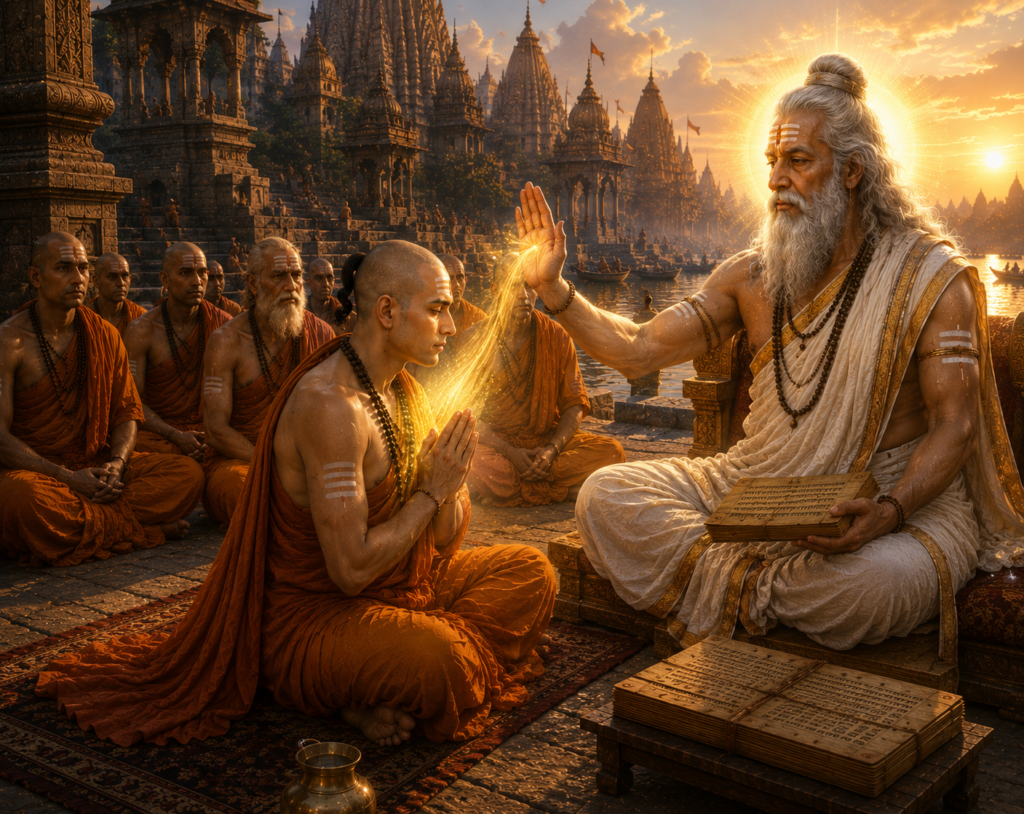
The grand-disciple Shankara bowed low and said: “O giver of boons! By your ultimate grace, may my commentary become universally renowned across the entire globe in connection with your holy sutras.”
Lord Veda Vyasa, the supreme bestower of boons, vanished from sight with a deeply satisfied heart. Even though Acharya Shankara was an unshakeable ocean of absolute wisdom, he found himself deeply overwhelmed and emotional upon the sage’s departure. Gaining the deep affection of such pure, saintly souls is rare, and enduring the sudden separation from such oceans of causeless mercy is naturally painful for the heart.
“Viṣṇave vyāsarūpāya brahmasūtrakṛte namaḥ । Maheśāya ca tadbhāṣyakṛte śaṅkararūpiṇe ।।”
=======================================
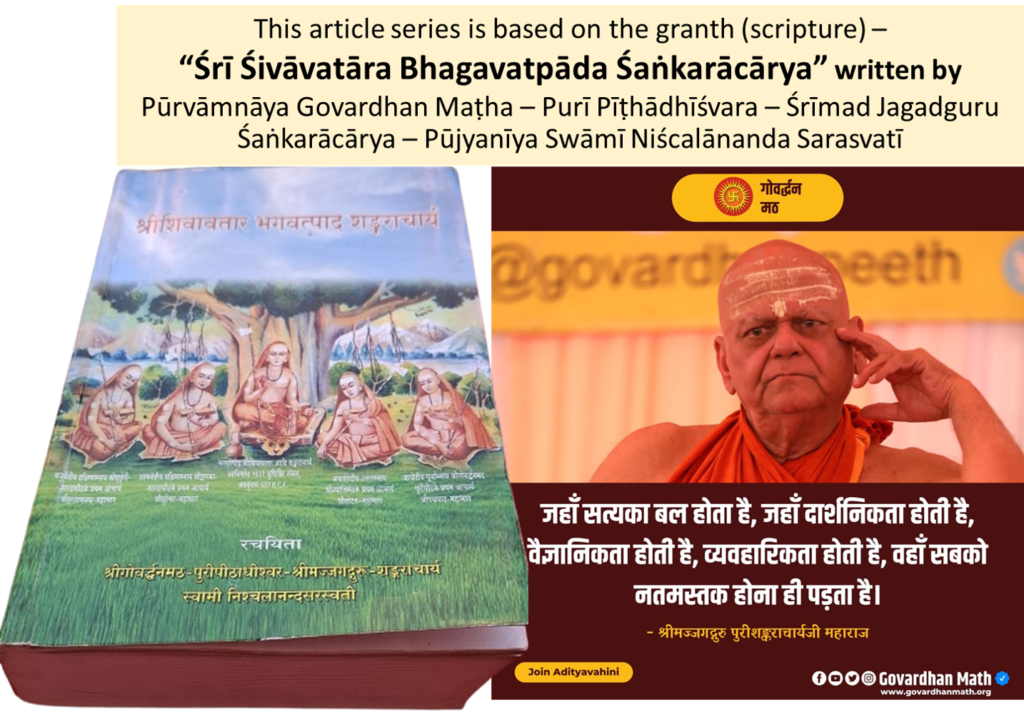
Reference:
Anupam Trivedi has spent over three decades studying and reflecting upon Sanatan scriptures, including the Vedas, Upanisads, Itihāsa, and Purāṇas. He writes on cultural philosophy and ancient literature to present traditional insights with accuracy and clarity. Read full bio →
Pingback:Adi Shankaracharya: Kumaril Bhatt's Sacrifice & Path to Mandan Mishra (Part 5)
Pingback:Adi Shankaracharya & Mandan Mishra: The Unpleasant Confrontation Before Shastrartha
Pingback:Adi Shankaracharya & Mandan Mishra: The Epic Shastrartha That Re-established Sanatana Dharma Core Principles - Part 7 - Bhavam Bhavaani
Pingback:Adi Shankaracharya Shastrartha with Devi Ubhay Bharati: which Led to Mysterious Yogic Act "Par Kaya Pravesh" (Part 8)
Pingback:Adi Shankaracharya-Part 9, Can Rituals Alone Lead to Moksha?