
Previously in this Series: A Quick Overview
- Part 1: Introduction to the extraordinary life and mission of Adi Shankaracharya, presenting a concise overview of his divine purpose as an Avatar of Bhagwan Shiva who descended to restore the authority of the Vedas. [Read Part 1 Here]
- Part 2: We explored Adi Shankaracharya’s divine birth, granted as a boon by Shiva to his deeply devoted parents, alongside the extraordinary signs, spiritual depth, and remarkable childhood incidents that marked his early life in Bharat. [Read Part 2 Here]
- Part 3: We followed Adi Shankaracharya’s journey to his Guru, Sri Govinda Bhagavatpada, his miracle of calming the flooding Narmada River, his travel to Kashi where he accepted his first disciple Sanandan (Padmapada), and his profound dialogue on Advaita with Bhagwan Shiva disguised as a Chandala. [Read Part 3 Here]
- Part 4: We detailed his creation of the Prasthanatrayi Bhashyas in Badrinath and his profound encounter with Maharshi Veda Vyasa, who tested his commentaries and blessed him with sixteen additional years to establish Advaita Vedanta. [Read Part 4 Here]
- Part 5: We discussed the meeting between Adi Shankaracharya and Acharya Kumaril Bhatt at Teertharaja Prayag. We discussed the historical context of Buddhist influence on Vedic traditions, Kumaril Bhatt’s defense of the Vedas, the reasons behind his self-immolation in a chaff fire (Tushanala), his insightful dialogue with Adi Shankaracharya, and how he directed Adi Shankara toward his distinguished disciple, Mandan Mishra. [Read Part 5 Here]
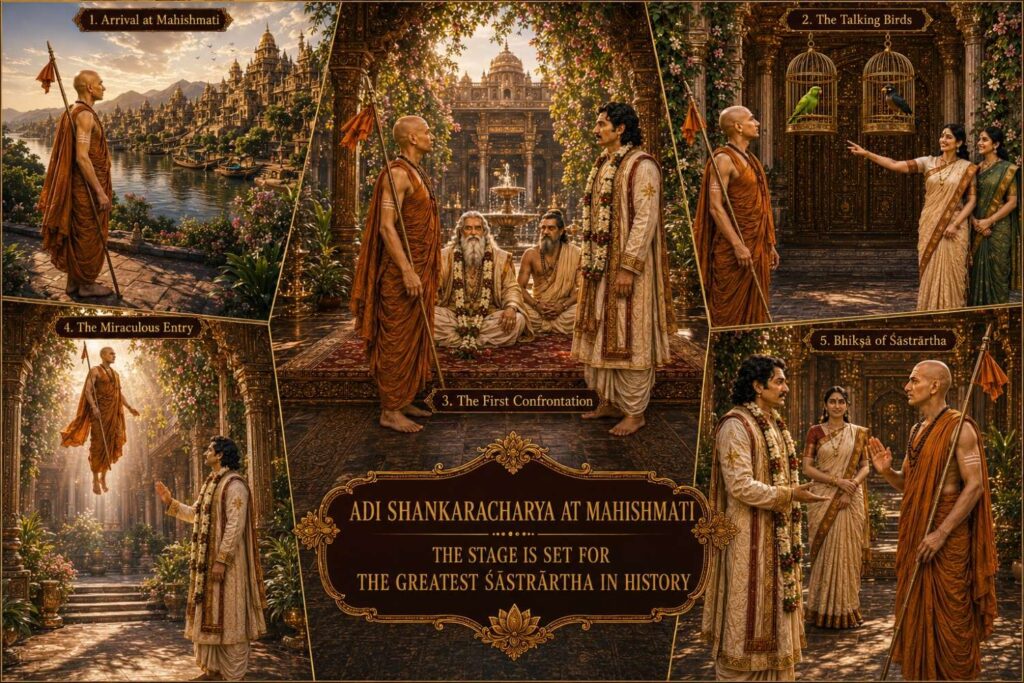
In Part 6, we follow Adi Shankaracharya to Mahishmati city to meet Acharya Mandan Mishra an avatar of Bhagwan Brahma and a very famous disciple of Shri Kumaril Bhatt. Read how even the pet birds outside Mandan Mishra’s home recite sacred Vedic chants, the unexpected meeting of ancient sages, and the unpleasant confrontation between Sri Shankara and Mandan Mishra before their historic spiritual debate (Shastrartha).
Bhagavat pada Adi Shankaracharya’s Arrival at Mahishmati
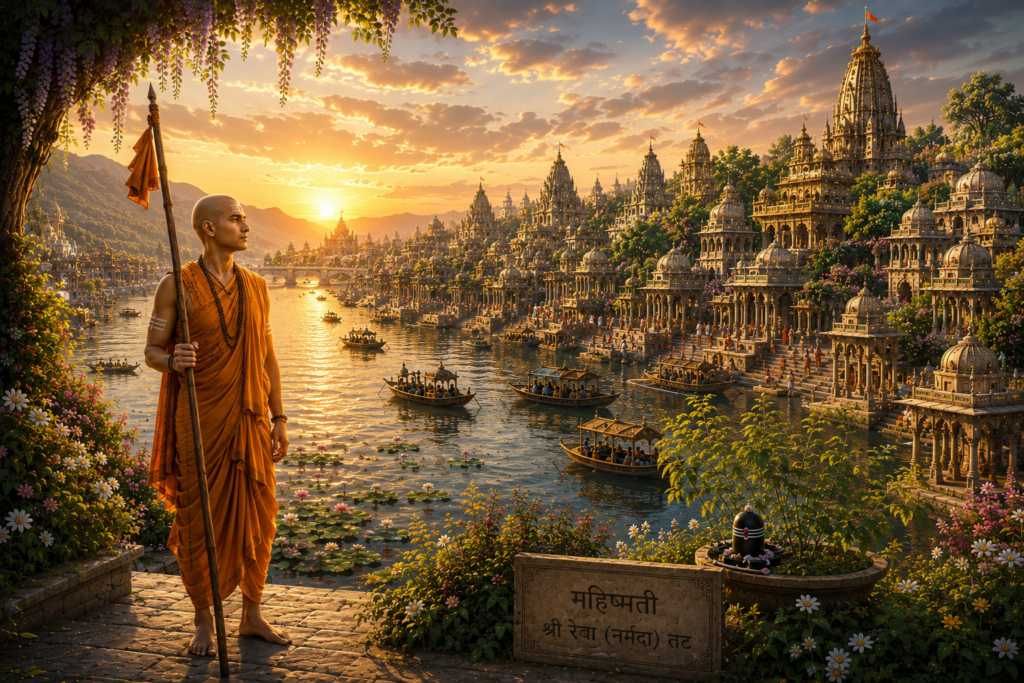
Using his yogic powers, Bhagavatpada Sri Shankara travelled through the sky and reached Mahishmati, a beautiful city on the banks of the sacred Narmada River. He was heading toward the home of Pandit Mandan Mishra, an eminent scholar of Mimamsa who, as noted earlier in Part 2 of our series, was an avatar of Bhagwan Brahma Himself. Adi Shankaracharya was happy to see the lovely city, filled with grand houses, gemstone-adorned buildings, and peaceful gardens of sandalwood, bael, rudraksha, tulsi, and lotus flowers.
To refresh himself after the journey, he bathed in the Narmada and finished his daily prayers. Then, he walked toward the house of Pandit Mandan Mishra.
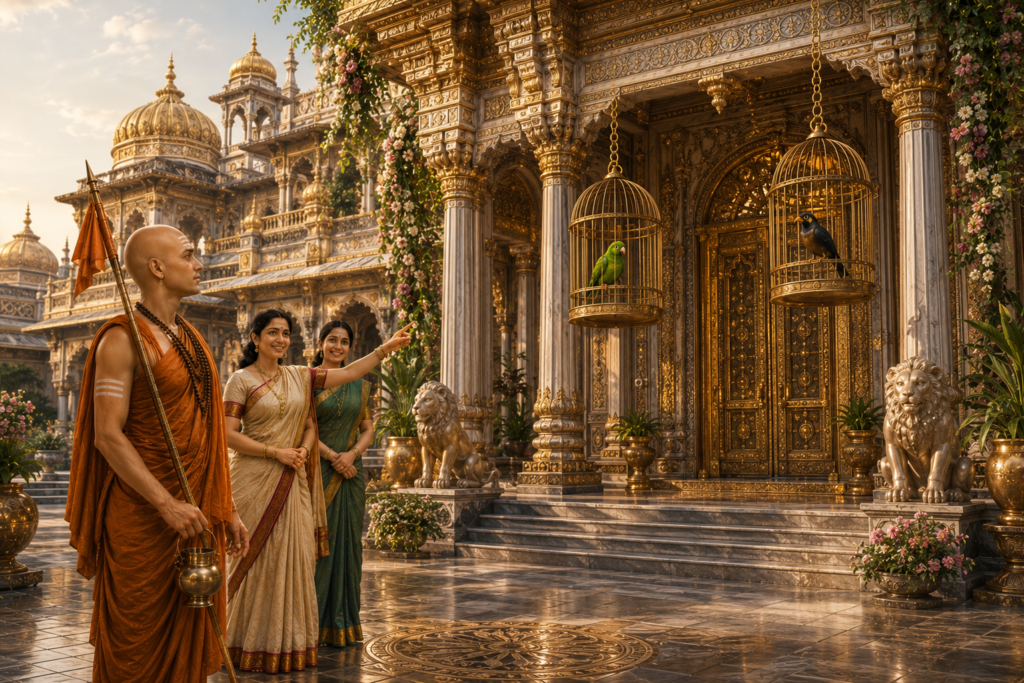
On the way, he met the female housemaids who were carrying water for Mandan Mishra’s home. Seeing the peaceful monk, the women were filled with joy. Sri Shankara asked them:
“Kutra’ālayo Mandana-Panditasya?“ (Where is the house of Pandit Mandan Mishra?)
The housemaids, who lived in an environment steeped in Vedic knowledge, answered him in poetic Sanskrit verses:
Svataḥ pramāṇaṁ parataḥ pramāṇaṁ keerāṅganā yatra giraṁ giranti।
Dvārasthaneeḍāntarasanniruddhā jānīhi tanmandanapaṇḍitaukaḥ॥
Phalapradaṁ karmaphalaprado’jaḥ keerāṅganā yatra giraṁ giranti।
Dvārasthaneeḍāntarasanniruddhā jānīhi tanmandanapaṇḍitaukaḥ॥
Jagad dhruvaṁ syājjagadadhruvaṁ syāt keerāṅganā yatra giraṁ giranti।
Dvārasthaneeḍāntarasanniruddhā jānīhi tanmandanapaṇḍitaukaḥ॥ (Sri Shankara Digvijaya 8.6–8)
“Where caged female parrots and mainas (Keerangana) hanging at the doorway are busy arguing among themselves:
- Are the Vedas self-proven true, or do they need external proof?
- Do our actions (Karma) give results on their own, or does God give the results?
- Is this universe eternal, or will it be destroyed one day?
Know that place alone to be the house of Pandit Mandan Mishra.”*
Hearing these verses from simple housemaids, Sri Shankara walked happily toward Mandan Mishra’s home. The arguments of those birds clearly reflected Mandan Mishra’s philosophy: that the Vedas are self-evident truth, that actions give their own results without needing God, and that the world has existed forever…
Entering Mandan Mishra’s House
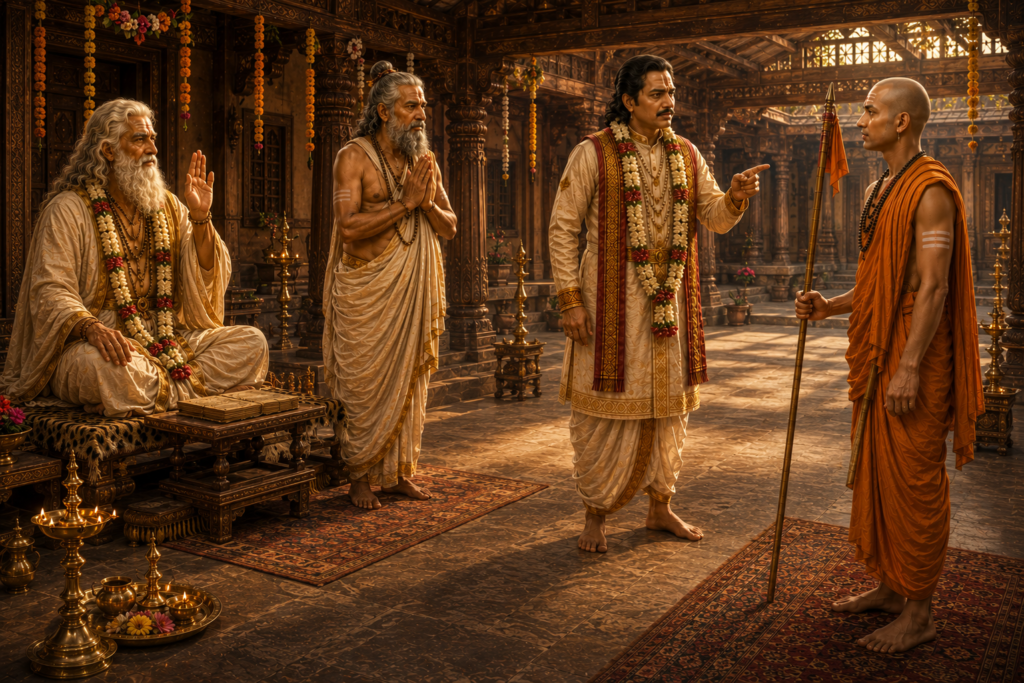
When Adi Shakaracharya arrived, Mandan Mishra was performing the annual Shraddha ceremony for his ancestors. Through his spiritual powers, Mandan Mishra had invited two legendary sages: Shishya of Maharshi Veda Vyasa – Maharshi Jaimini (creator of Purva Mimamsa) and Maharshi Veda Vyasa (creator of Uttar Mimaansa). Mandan Mishra was respectfully washing their feet as Sri Shankara arrived.
Because the main door was closed for the ritual, Sri Shankara used his yogic power to land directly into the inner courtyard from the sky. The grand house looked as beautiful as the palace of King Indra.
There, Sri Shankara saw Mandan Mishra, who looked bright with knowledge and as pure as a white lotus. He seemed like the living embodiment of Vedic rituals.
Sri Shankara bowed respectfully to Maharshi Jaimini and Maharshi Veda Vyasa. Both great sages welcomed Sri Shankara with love and respect. This should have been a clear sign for Mandan Mishra to respect the young monk.
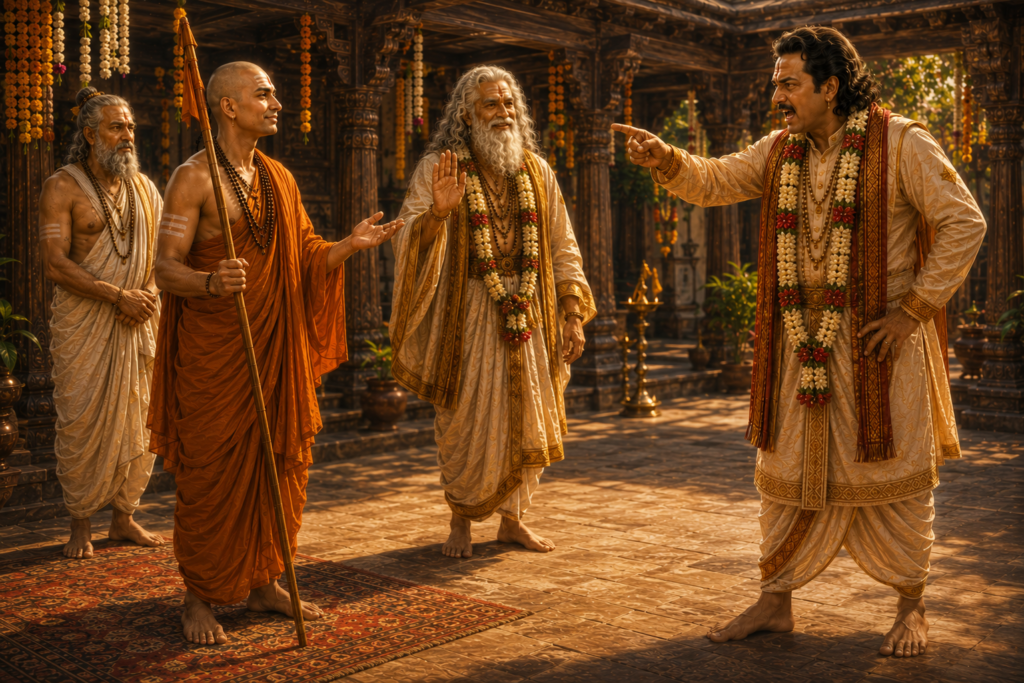
However, Mandan Mishra was proud of his ritualistic beliefs. He believed that seeing a monk (Sannyasi) during an ancestral ceremony is inauspicious. He thought that giving up work to become a monk was a sign of weakness. Blinded by anger and pride, Mandan Mishra ignored the presence of the great sages and started hurling angry insults at Sri Shankara.
The Witty & Heated arguments between Mandan Mishra And Shri Shankara
Sri Shankara did not get angry. Instead, he replied to each insult with clever, humorous, and grammatically brilliant answers:
Mandan Mishra taunted:
“Kuto Mundee?“ (Where did this bald-headed monk come from?)
Sri Shankara answered playfully using the literal grammar:
“Āgalānmundee.” (I am shaved down to my neck.)
(Meaning: I have shaved my head according to monastic rules, not as a unregulated / undisciplined wanderer)
Mandan Mishra got irritated and said:
“Panthāste pṛcchyate mayā.“ (I am asking you about your path/route!)
In Sanskrit grammar, this sentence could also mean “The path is asking you.” So Sri Shankara smiled and asked:
“Kimāha panthāḥ?” (When the path asked you, what did you reply?)
Losing his temper, Mandan Mishra shouted:
“Tvanmātā muṇḍetyāha.“ (The path said your mother is bald/a widow!)
Sri Shankara replied with sharp logic:
“Tathaiva hi. Panthānaṁ tvamapṛcchastvāṁ panthāḥ pratyāha maṇḍana।
Tvanmātetyatra śabdo’yaṁ na māṁ brūyādapṛcchakam॥”
(Exactly! Since you asked the path, its answer is meant for you. The words ‘your mother’ apply to you, because I never asked the path anything!)
Mandan Mishra tried another insult:
“Aho peetā kimu surā?” (Have you drunk liquor that you talk such nonsense?)
In Sanskrit, the word Peeta also means the colour Yellow. Sri Shankara replied:
“Naiva śvetā yataḥ smara.” (No, liquor is white, not yellow—remember that!)
Mandan Mishra mocked:
“Kiṁ tvaṁ jānāsi tadvarṇam?” (Oh, so you even know the colour of liquor?)
Sri Shankara gave a crushing reply:
“Ahaṁ varṇaṁ bhavān rasam.” (I only know its colour from scriptures, but you know its taste! So, you are the one violating the rules by drinking it, not me!)
Mandan Mishra said angrily:
“Matto jātaḥ kalañjāśee viparītāni bhāṣate.”
(Having gone mad by eating stale poisonous meat, you talk nonsense!)
In grammar, ‘Mattah’ also means “born from me” (my son). Sri Shankara replied:
“Satyaṁ braveeti pitṛvat tvatto jātaḥ kalañjabhouk.”
(You speak the truth! Just like his father, a son born from you would indeed eat forbidden things!)
Debating Monastic Life and Vows
Mandan Mishra then made fun of Adi Shankaracharya for abandoning the sacred thread (Yajnopavita) and topknot (Shikha):
Kanthāṁ vahasi durbuddhe gardhabhenāpi durvahām।
Śikhāyajnopaveetābhyāṁ kaste bhāro bhaviṣyati॥ (Sri Shankara Digvijaya 8.20)
(You foolish man! You carry a heavy, tattered blanket on your shoulder that even a donkey would find heavy. Was the lightweight sacred thread (Janeu) and topknot (Shikha) too heavy for you that you threw them away?)
Adi Shankara replied:
Kanthāṁ vahāmi durbuddhe tava pitrā’pi durbharām।
Śikhāyajnopaveetābhyāṁ śruterbhāro bhaviṣyati॥ (Sri Shankara Digvijaya 8.21)
(You fool! I carry a blanket that even your father could not carry. But if a monk does not give up the sacred thread, he violates the holy scriptures. Is the heavy burden of ritual duties less than this blanket? It is much heavier!)
Mandan Mishra then attacked Shankara for not getting married:
Tyaktvā pāṇigṛheeteeṁ svāmāśaktyā parirakṣaṇe।
Śiṣyapustakabhārecchorvyākhyātā brahmaniṣṭhatā॥ (Sri Shankara Digvijaya 8.22)
(Unable to take care of a wife, you ran away from marriage, and now you carry books and disciples! Is this your great devotion to God?)
Sri Shankara answered:
Guruśuśreeṣaṇālasyāt samāvartya guroḥ kulāt।
Striyaḥ śuśreeṣamāṇasya vyākhyātā karmaniṣṭhatā॥ (Sri Shankara Digvijaya 8.23)
(Look at yourself! Too lazy to serve your Guru, you left the Gurukul early to serve a wife at home! Is this your great devotion to work?)
Mandan Mishra argued:
“You were born from a woman’s womb and raised by a woman, yet you speak against family life?”
Sri Shankara turned it back:
“A mother’s milk nurtured you, yet you spend your life enjoying worldly pleasures with women like an animal! Have you no shame?”
Mandan Mishra said:
“By putting out your household sacrificial fires, you have committed a great sin.”
Sri Shankara replied:
“By ignoring the Supreme Soul (Atman) within you, you are committing the worst sin, the spiritual destruction of your own soul.”
The Heated Argument Continues
Mandan Mishra asked:
“How did you sneak into my house like a thief, hiding from my guards?”
Sri Shankara replied:
“How are you eating your meal like a thief without sharing it with holy monks?”
Mandan Mishra snapped:
“Karmakāle na sambhāṣya ahaṁ meerkheṇa samprati.”
(I do not want to talk to a fool during this sacred ritual.)
Hearing this, Sri Shankara laughed and immediately exposed the grammatical disaster in Mandan Mishra’s words:
“Aho prakaṭitaṁ jnānaṁ yatibhaṅgena bhāṣiṇā!”
(What great knowledge you have! In Sanskrit, “Sambhāṣyaḥ” means “worthy of conversation” and “Aham” means “I”. Joined correctly by Visarga Sandhi, it should be “Sambhāṣyo’ham” (“I am worthy of conversation”). By dropping the Visarga and saying “Sambhāṣya ahaṁ”, you broke the grammar so badly that your sentence literally translates to “I am a fool who is talking!” You have shown everyone how learned you really are!)
Realizing that his own broken grammar made him look foolish, Mandan Mishra tried to cover up his mistake with a play on words:
“Yatibhaṅge pravṛttasya yatibhaṅgo na doṣabhāk.“
(Since my main focus right now is to defeat (Bhanga) a monk (Yati), making a small break or error in poetic meter/grammar (Yatibhanga) is not a flaw!)
Sri Shankara again caught the double meaning in Sanskrit grammar instantly and turned it right back on him:
“Yatibhaṅge pravṛttasya pancamyantaṁ samasyatām.“
(Grammatically, your phrase also translates as “Defeat FROM a monk.” So by your own words, your defeat at the hands of a monk is now guaranteed!)
Mandan Mishra sneered:
“You have taken the robes of a monk just to get delicious free food!”
Sri Shankara answered back:
“And you have taken the robes of a householder just to enjoy worldly pleasures!”
Maharshi Veda Vyasa Intervenes and Mandan Mishra Calms Down
Seeing Sri Shankara answer Mandan Mishra’s anger with calm humor, Maharshi Jaimini smiled gently. Then, Maharshi Veda Vyasa spoke to Mandan Mishra:
“My son! Why are you speaking harshly to this holy monk? He is a great soul who has conquered all desires. Do not disrespect him. Know that Lord Narayana Himself has come to your house in this form. Invite him respectfully for food (Bhiksha).”
Respecting Veda Vyasa’s command, Mandan Mishra calmed down and invited Sri Shankara for food.
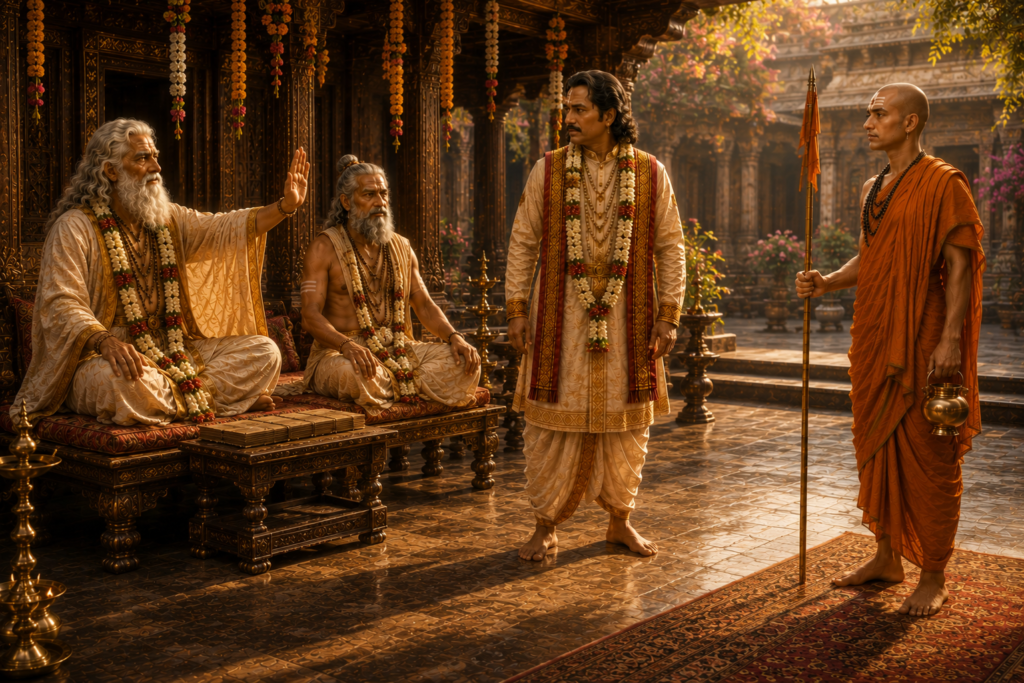
Sri Shankara replied peacefully:
“I have not come here for cooked food. I have come for the Bhiksha of Debate (Shastrartha). Let us hold a formal debate. The rule shall be simple: whoever loses will become the disciple of the winner.”
Mandan Mishra proudly accepted:
“Even if Lord Sheshanaga himself comes to debate me, I am ready! I will not back down.”
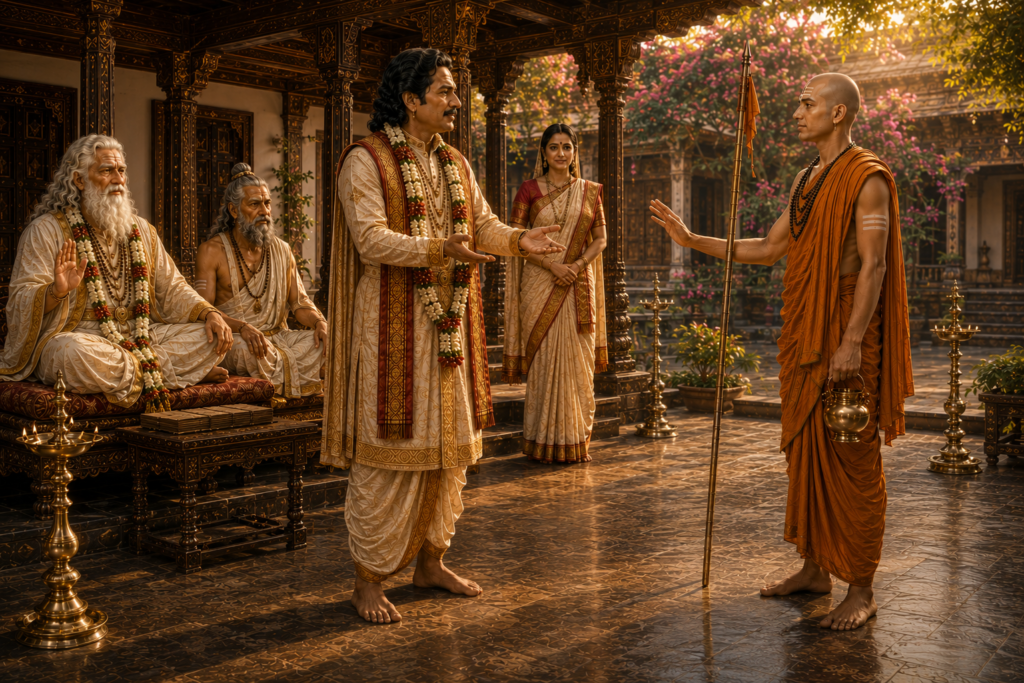
Both agreed that Mandan Mishra’s wife, Ubhayabharati (an avatar of Goddess Saraswati) would act as the neutral judge (Madhyastha).
They decided that the Shastrartha (debate) would begin the next morning. Sage Vyasa and Sage Jaimini then also took leave and departed. Adi Shankaracharya happily walked with his disciples to a quiet temple on the banks of the Narmada, where he rested for the night.
In Part 7, we will discuss the historic and famous shastrarth between Adi Shankaracharya and Mandan Mishra in a way that’s never been documented in such detail anywhere on the internet!
=================================
Refererence:
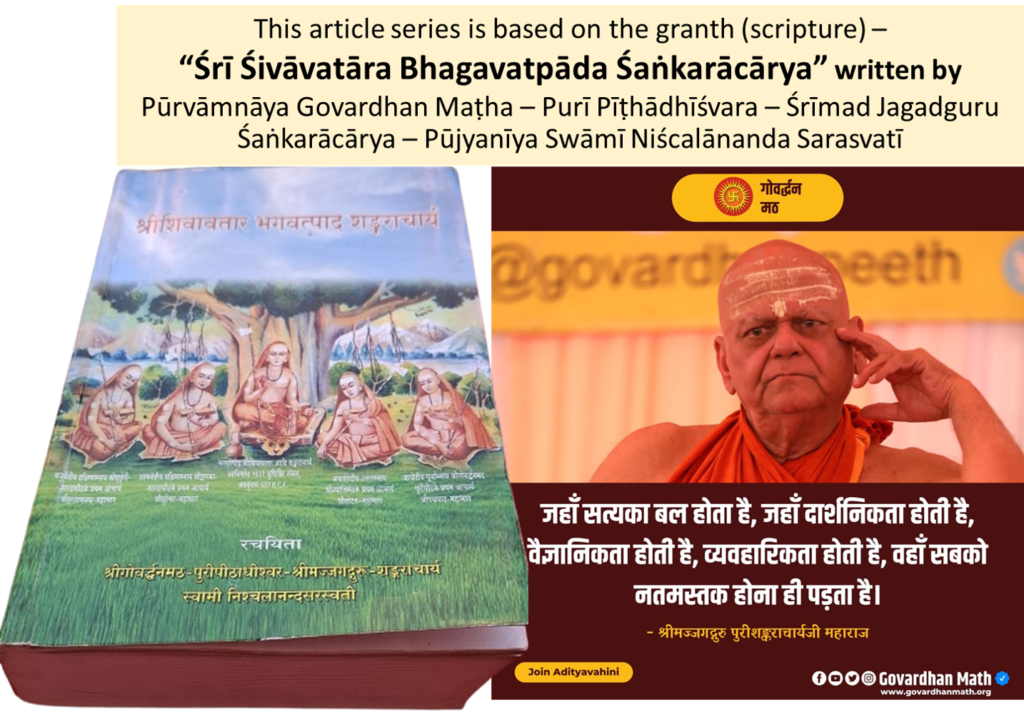
Anupam Trivedi has spent over three decades studying and reflecting upon Sanatan scriptures, including the Vedas, Upanisads, Itihāsa, and Purāṇas. He writes on cultural philosophy and ancient literature to present traditional insights with accuracy and clarity. Read full bio →
Pingback:Adi Shankaracharya & Mandan Mishra: The Epic Shastrartha That Re-established Sanatana Dharma Core Principles - Part 7 - Bhavam Bhavaani
Pingback:Adi Shankaracharya Shastrartha with Devi Ubhay Bharati: which Led to Mysterious Yogic Act "Par Kaya Pravesh" (Part 8)
Pingback:Adi Shankaracharya-Part 9, Can Rituals Alone Lead to Moksha?