
Previously in Adi Shankaracharya Series: A Quick Overview
- Part 1: Introduction to the extraordinary life and mission of Adi Shankaracharya, presenting a concise overview of his divine purpose as an Avatar of Bhagwan Shiva who descended to restore the authority of the Vedas. [Read Part 1 Here]
- Part 2: We explored Adi Shankaracharya’s divine birth, granted as a boon by Shiva to his deeply devoted parents, alongside the extraordinary signs, spiritual depth, and remarkable childhood incidents that marked his early life in Bharat. [Read Part 2 Here]
- Part 3: We followed Adi Shankaracharya’s journey to his Guru, Sri Govinda Bhagavatpada, his miracle of calming the flooding Narmada River, his travel to Kashi where he accepted his first disciple Sanandan (Padmapada), and his profound dialogue on Advaita with Bhagwan Shiva disguised as a Chandala. [Read Part 3 Here]
- Part 4: We detailed his creation of the Prasthanatrayi Bhashyas in Badrinath and his profound encounter with Maharshi Veda Vyasa, who tested his commentaries and blessed him with sixteen additional years to establish Advaita Vedanta. [Read Part 4 Here]
- Part 5: We explored the meeting between Adi Shankaracharya and Acharya Kumaril Bhatt at Teertharaja Prayag. We discussed the historical context of Buddhist influence on Vedic traditions, Kumaril Bhatt’s defense of the Vedas, the reasons behind his self-immolation in a chaff fire (Tushanala), his insightful dialogue with Adi Shankaracharya, and how he directed Adi Shankara toward his distinguished disciple, Mandan Mishra. [Read Part 5 Here]
- Part 6, Adi Shankaracharya’s first meeting with Acharya Mandan Mishra an avatar of Bhagwan Brahma (see in details in- Part 2). Even the pet birds outside Mandan Mishra’s home recite sacred Vedic chants. There was some unpleasant confrontation between Sri Shankara and Mandan Mishra before their historic spiritual debate (Shastrartha), but this confrontation, though sounded unpleasant, was also very insightful. [Read Part 6 Here]
- In Part 7 we discussed the Adi Shakaracharya and Acharya Mandan Mishra’s Historic Shastrartha in such details that have not been written on internet ever.[Read Part 7 Here]
- In Part 8 we explored Adi Shankaracharya’s debate with Devi Ubhaya Bharati (an avatar of Devi Saraswati), who challenged him on the nuances of householder life and worldly relationships (Kama Shastra). To answer her without breaking his vow of celibacy, Shankara performed the rare yogic miracle of Par-Kaya Pravesha (entering another physical body) by temporarily inhabiting the mortal frame of King Amaruka, mastering the science of worldly experience, and returning to win the debate before Ubhaya Bharati recognized him as Sadashiva Himself. [Read Part 8 Here]
- In Part 9, we discussed the monumental moment when the great ritualist Acharya Mandan Mishra renounces the world to embrace Sanyas. We understood the ultimate Vedantic revelation of the Mahavakya “Tat Tvam Asi” (You Are That), and explored how Adi Shankaracharya used brilliant, everyday analogies—like a giant fish, a clay pot, and a roadside water stand—to prove that we are the eternal, witnessing Soul (Atman), completely untouched by the mortal body. [Read Part 9 Here]
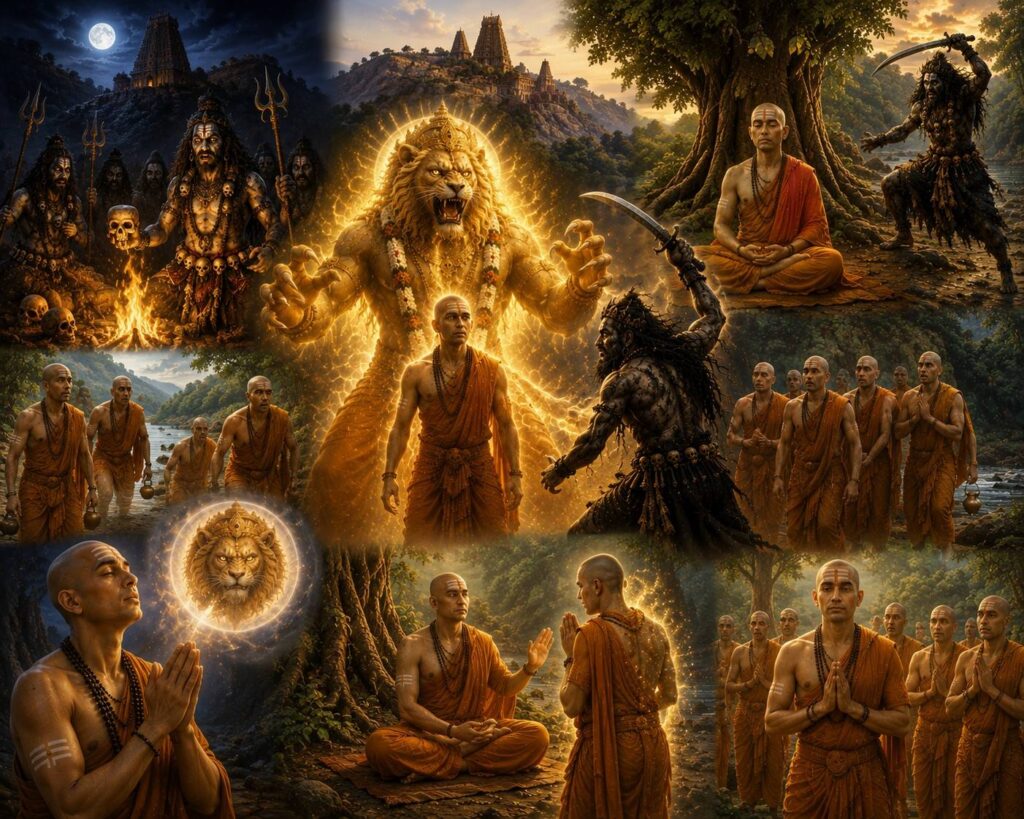
- In Part 10, we explore an intense, lesser-known episode in Adi Shankaracharya’s journey: a sinister plot by an evil Kapalika to take the Acharya’s life, and how his devoted disciple Padmapada invoked the ferocious grace of Lord Narasimha to protect his Guru.
=================================
Adi Shankaracharya’s Arrival at Srisailam and the Worship of Mallikarjuna Jyotirlinga
After initiating Acharya Mandan Mishra as Swami Sureshwaracharya, Jagadguru Adi Shankaracharya turned his steps toward South Bharat. His mission was clear and urgent: to revive ancient pilgrimage sites, restore forgotten ashrams, and establish the sacred unity of Sanatana Dharma across the entire land.
Accompanied by his devoted disciples, Sri Shankara travelled through Maharashtra, sharing his Vedic commentaries and teaching seekers the pure vision of Advaita Vedanta. He soon arrived at Srisailam, an ancient holy mountain sacred to Siddhas and sages.
- First, he took a holy bath in the sacred Patalaganga (the Krishna River).
- He then entered the magnificent 660-foot by 510-foot temple complex to offer deep worship at the Mallikarjuna Jyotirlinga, alongside Maa Bhramaramba Devi (an incarnation of Goddess Parvati).
Staying along the cool, serene banks of the Krishna River, Shankara began teaching his commentaries to eager local scholars. Various sects that had wandered away from the true meaning of the Vedas came forward to challenge him. Disciples like Padmapada and Sureshwaracharya answered their objections with razor-sharp logic, bringing sincere seekers back to the eternal Vedic fold.
The Dark Menace of the Kapalikas at Srisailam
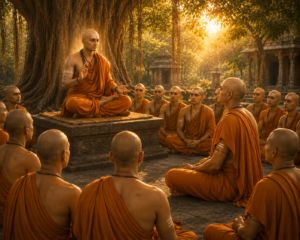
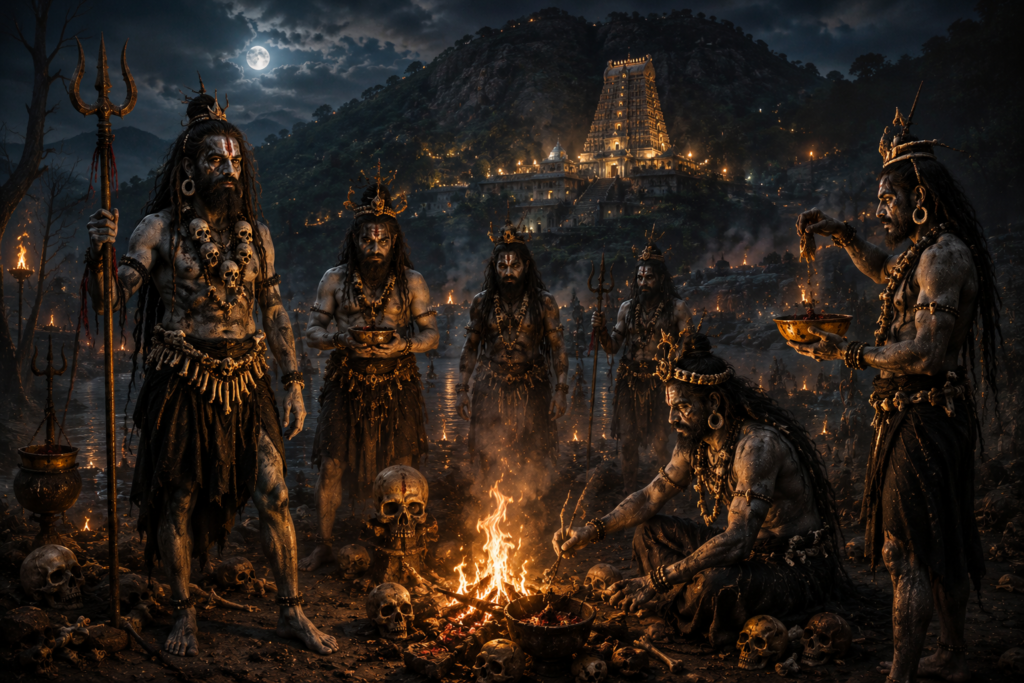
During that era, Srisailam was also the stronghold of an extreme, fierce sect of evil Tantrics known as Kapalikas. These practitioners followed terrifying, violent rituals in cremation grounds. They adorned themselves with six specific marks: carrying iron tridents, wearing bone ornaments, ear rings, crest jewels, smearing cremation ash, and wearing sacred threads made of human bones.
They believed that offering human flesh, blood, and marrow in fire rituals was the only way to win boons from Mahabhairava:
“Mastiṣkāntravasābhipūritamahāmāṁsāhutīr juhvatāṁ
vahnau brahmakapālakalpitasurāpānena naḥ pāraṇā |
sadyaḥ kṛttakaṭhorakaṇṭhavigalatkīlāladhārojjvalair
arcyo naḥ puruṣopahārabalibhirdevo mahābhairavaḥ ||”
(Prabodhachandrodaya 3.13)
Meaning:
“The verse describes the extreme rites associated with this tradition, including offerings made in fire, the use of human skulls, and human sacrifice as an offering to Mahabhairava.”
Among them was a cruel, highly skilled Kapalika named Ugra-Bhairava.
Ugra-Bhairava’s Sinister Request
Stripping away his ash and bone ornaments, Ugra-Bhairava donned the unassuming saffron cloth of a gentle, seeking mendicant. Approaching the solitary tree where Shankara sat in quiet contemplation, the Kapalika fell flat upon the earth, weeping and clutching the Master’s feet.
When Shankara gently asked the cause of his distress, Ugra-Bhairava unleashed a well-rehearsed, philosophical plea:
“O Ocean of Mercy! For one hundred unbroken years, I have undergone extreme austerities in desolate cremation grounds to attain the supreme siddhi of entering Kailasa in this living physical body. At long last, Bhagwan Mahabhairava appeared before me in a terrifying vision and pronounced a condition:
‘Your mortal body can enter the immortal realm of Kailasa only if you offer into the sacrificial fire the severed head of either an anointed Emperor (Chakravarti Raja) or an all-knowing, pure Sage (Sarvajna Rishi).’
O Mahamuni! Kings are guarded day and night by armed armies; approaching them is impossible. But you—the crown jewel of renunciation, the protector of the distressed—walk freely among us. You teach that this physical body is unreal, a heap of perishable flesh. I beg you to donate your head so my hundred years of penance do not go in vain!”
To compel the Acharya’s conscience, Ugra-Bhairava began citing the supreme instances of selfless sacrifice preserved in sacred tradition:
Maharshi Dadhichi: Who joyfully discarded his physical frame so the Devas could fashion the thunderbolt (Vajra) from his spinal column to slay the demon Vritrasura.
King Jimutavahana: The prince of the Vidyadharas, who offered his own living flesh to Garuda on the sacrificial rock to spare the lives of the serpent race (Nagas).
King Shibi: Who unhesitatingly sliced chunks of his own body to balance the scale and protect a single dove from a hawk.
“If these noble souls gave their mortal flesh for birds, snakes, and heavenly gods, will a great teacher of Advaita deny an earnest seeker a head that is doomed to turn to ash anyway?” challenged Ugra-Bhairava.
The Supreme Detachment of a Jivanmukta: Why Adi Shankara Consented
An ordinary mind would have detected the menace and fled, called disciples for protection, or had the charlatan driven away. But Adi Shankaracharya was an authentic Jivanmukta, an avatar of bhagwan Shiva.
Shankara observed the man before him and thought within himself:
“This physical casing is merely a bag of five elements—bones, bile, flesh, and blood. At the end of its appointed span, it will be consumed by funeral fire, gnawed by worms in the ground, or torn apart by jackals and birds. It is fleeting; the Atman alone is immortal. If this insentient lump of clay can fulfill a seeker’s long-cherished ambition, what loss is it to the unattached Spirit?”
Looking steadily at the deceitful practitioner with boundless compassion, Shankara replied:
“I harbor no objection to your request. If my head can grant you your spiritual objective, take it willingly. But hear this: my disciples revere this physical form with fierce loyalty. Were they to catch the slightest hint of your purpose, they would strike you down immediately. Therefore, wait until they disperse to the Patalaganga for their evening baths. When you see me sitting alone in the deep woods, come without a sound and take what you desire.”
Ugra-Bhairava bowed with folded hands, his mind rejoicing at the success of his trap.
Entering Nirvikalpa Samadhi: Adi Shankara Transcends the Pancha Koshas
As the sun cast long amber shadows over the hills, the disciples departed toward the river. Finding a sheltered spot beneath a banyan tree, Shankara sat down to abandon all connection with the physical realm.
He drew his legs into the firm posture of Siddhasana, stabilized his spine, and locked the subtle channels through Jalandhara Bandha (chin lock) and Shambhavi Mudra (inward gaze). Then, chanting the sacred monosyllable OM (Pranava), he began the systematic withdrawal of his life energies (Pratyahara).
Ascending through the Pancha Koshas (the five sheaths):
He dissociated from the Annamaya Kosha (the gross physical frame of flesh and bone).
He stilled the Pranamaya Kosha (withdrawing the ten vital airs into the heart center).
He pacified the Manomaya Kosha (eradicating all mental concepts, doubts, and emotions).
He transcended the Vijnanamaya Kosha (the discriminating intellect and subtle ego).
Passing beyond the Anandamaya Kosha (the veil of causal bliss), he dissolved his individual awareness entirely into the boundless, changeless silence of Nirvikalpa Samadhi.
He sat as motionless as a carved pillar of black granite, dead to the world, established as pure, untouchable Consciousness.
The Imminent Attack and Disciple Padmapada’s Yogic Vision (Pashyanti Vak)
Creeping through the thickets, Ugra-Bhairava arrived. Seeing the Acharya sitting stone-still, his breathing barely perceptible, the Kapalika let out a cruel sneer. Drawing a broad, razor-sharp scimitar and planting his heavy trident into the earth, he crept behind the meditating Master. He raised the heavy steel high above Shankara’s exposed neck, drawing back his shoulders to sever the head in a single sweeping stroke.
At that precise instant, several miles away at the water’s edge, Shankara’s foremost disciple Padmapada (Sanandana) felt an agonizing pain pierce his chest.
Endowed with the yogic sight of subtle perception (Pashyanti Vak), the inner eye of his heart opened in terror. He saw the banyan tree, he saw his defenseless Guru locked in deep Samadhi, and he saw the glint of the cold steel blade hanging mere inches above Shankara’s neck!
Physical intervention was impossible; running the distance would take half an hour, and the sword was falling that very second. Padmapada possessed only one weapon: an absolute, unbroken devotion to Bhagwan Narasimha the fierce Avatar of Lord Vishnu.
Closing his eyes, Padmapada focused his entire being into a desperate, roaring prayer of protection.
Nrisimha-Avesha: Bhagwan Narasimha Manifests Through Disciple Padmapada
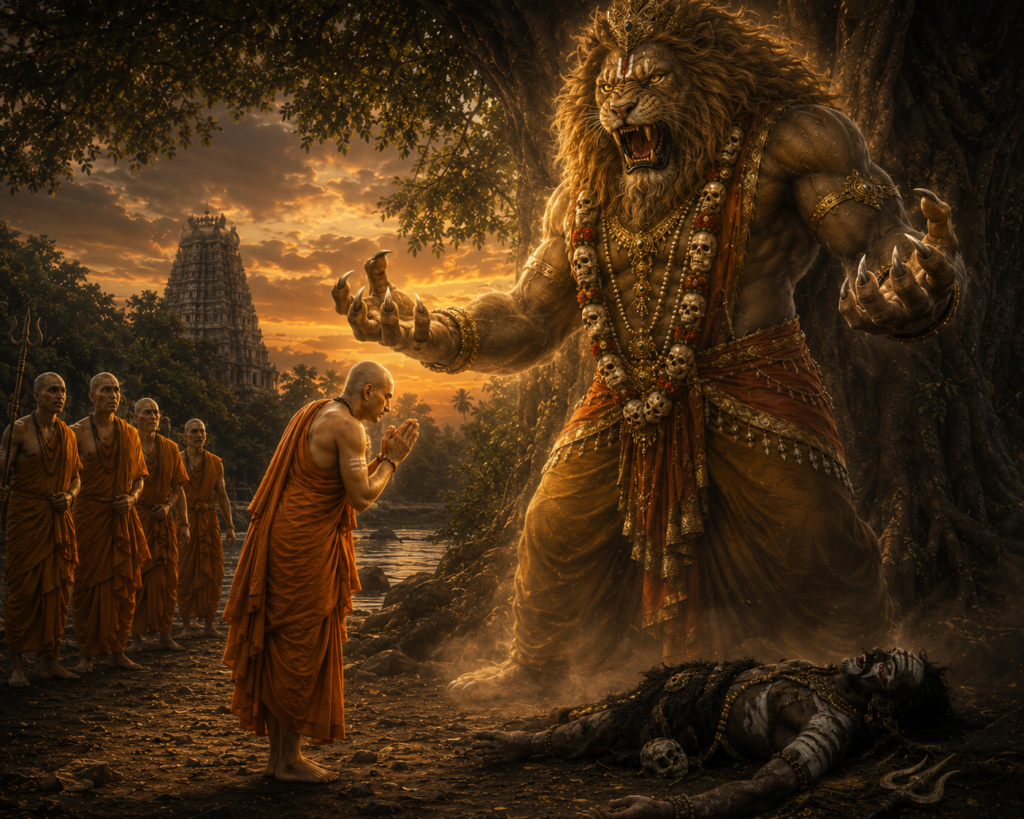
What followed was a cosmic rupture. In an instant, the divine form of Lord Narasimha took direct, total possession of Padmapada’s physical body (Nrisimha-Avesha)!
Padmapada’s physical form transformed. His eyes turned into globes of blazing cosmic fire, his fingers hardened into curved, razor-tipped steel claws, and from his throat burst a roar so terrible that the rocks of Srisailam split asunder and wild beasts collapsed in fear.
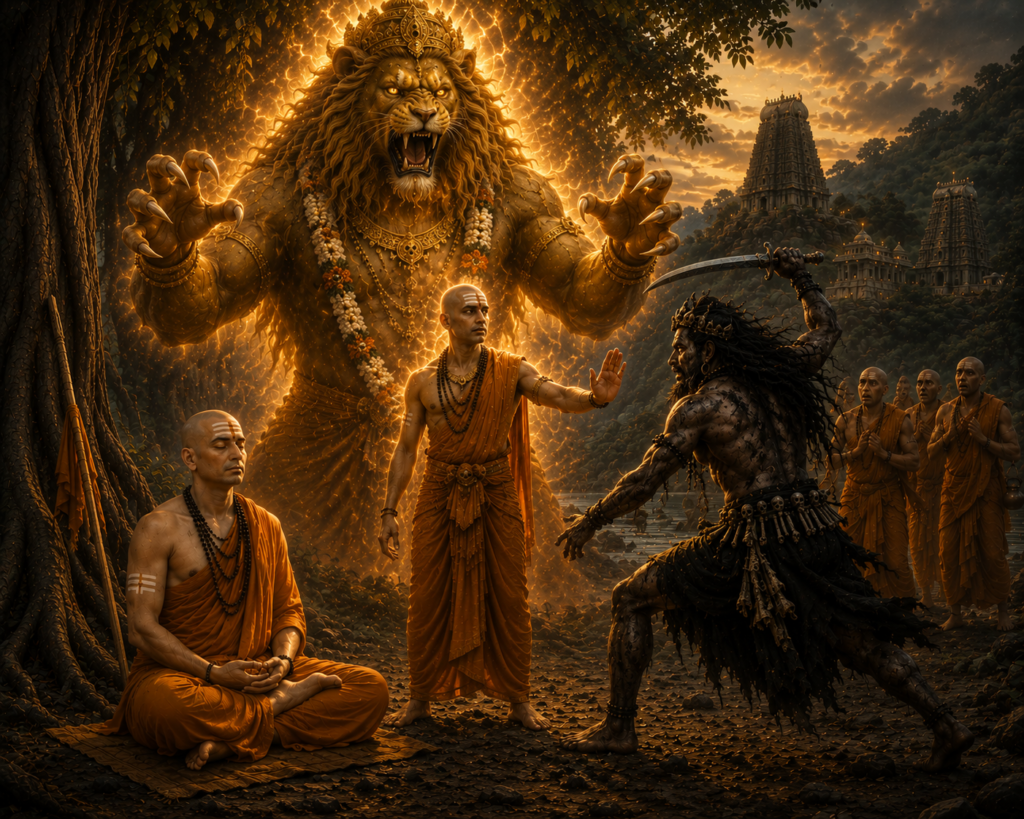
Covering the distance of miles in a single cosmic leap, the Narasimha-possessed disciple materialized directly beneath the banyan tree. Just as Ugra-Bhairava brought his sword down, the divine form intercepted the blow with bare claws, snapping the heavy steel blade into iron splinters!
Before the stunned Kapalika could comprehend what had happened, Narasimha seized the heavy iron trident, drove it deep through the attacker’s chest, pinned him to the forest floor, and tore his torso open with his bare claws. With a laugh that echoed into the heavens, the fierce deity ended the dark reign of Ugra-Bhairava on the spot.
Pacifying the Divine Fury: Adi Shankaracharya Recites the Sacred Stuti
The deafening roar pulled Adi Shankaracharya out of the depths of Nirvikalpa Samadhi.
Opening his eyes, Shankara beheld an astounding sight: the mutilated body of the Kapalika lay in the grass, while standing directly over it was the towering, ferocious form of Lord Narasimha, his chest adorned with the divine Shrivatsa, a gory garland of entrails draped across his shoulders, and divine flames pouring from his roaring jaws.
The disciples, led by Sureshwaracharya, came running up from the river in utter panic, only to freeze in their tracks, paralyzed by the divine fury radiating from the scene.
Recognizing that the terrifying entity before him was both his beloved disciple Padmapada and the Supreme Protector of the universe, Adi Shankaracharya rose, folded his palms with serene devotion, and began chanting impromptu verses of unmatched poetic grace to cool the deity’s wrath:
“Mātā nṛsiṁhaśca pitā nṛsiṁho bhrātā nṛsiṁhaśca sakhā nṛsiṁhaḥ |
Vidyā nṛsiṁho draviṇaṁ nṛsiṁhaḥ svāmī nṛsiṁhaḥ sakalaṁ nṛsiṁhaḥ ||”
“Narasimha is my mother, Narasimha is my father; Narasimha is my brother, Narasimha is my friend. Narasimha is all knowledge, Narasimha is all wealth; the Lord is my Master, Narasimha is my all.”
Shankara prayed gently:
“O Supreme Hari! You are the very essence of peace and protection. Why do you assume this terrifying wrath of Rudra? By the sanctifying touch of Your divine claws, even this wicked practitioner has been liberated from the bondage of sin and given mukti. Just as You burst through a stone pillar to defend the child Prahlada, You have descended today to shield this mortal instrument. Withdraw Your blazing fury, O Lord, and grant peace to the trembling worlds!”
Hearing the sweet, tranquil nectar of Shankara’s stuti, the blazing fire in the deity’s eyes softened into compassion. The fierce energy gently withdrew from the physical vessel.
Within moments, the terrible apparition dissolved. Standing in its place was only the young, humble disciple Padmapada, his hands trembling, blinking as if shaking off a strange dream. Seeing his Guru unhurt, Padmapada collapsed to the ground, weeping and washing Shankara’s feet with tears of relief and reverence.
The Secret of Padmapada’s Upasana: How a Simple Tribal Hunter Bound Bhagwan Narasimha
The Secret Behind the Miracle: How Padmapada Pleased Lord Narasimha
When the disciples gathered around in deep wonder, Sureshwaracharya questioned Padmapada:
“Brother! Even great Munis perform severe tapasya for thousands of years without receiving a single glimpse of Lord Narasimha. How did you attain such devotion that Lord Narasimha Himself answered your call in an instant?” to defend our Guru?”
Padmapada smiled humbly and recounted an extraordinary episode from his early youth:
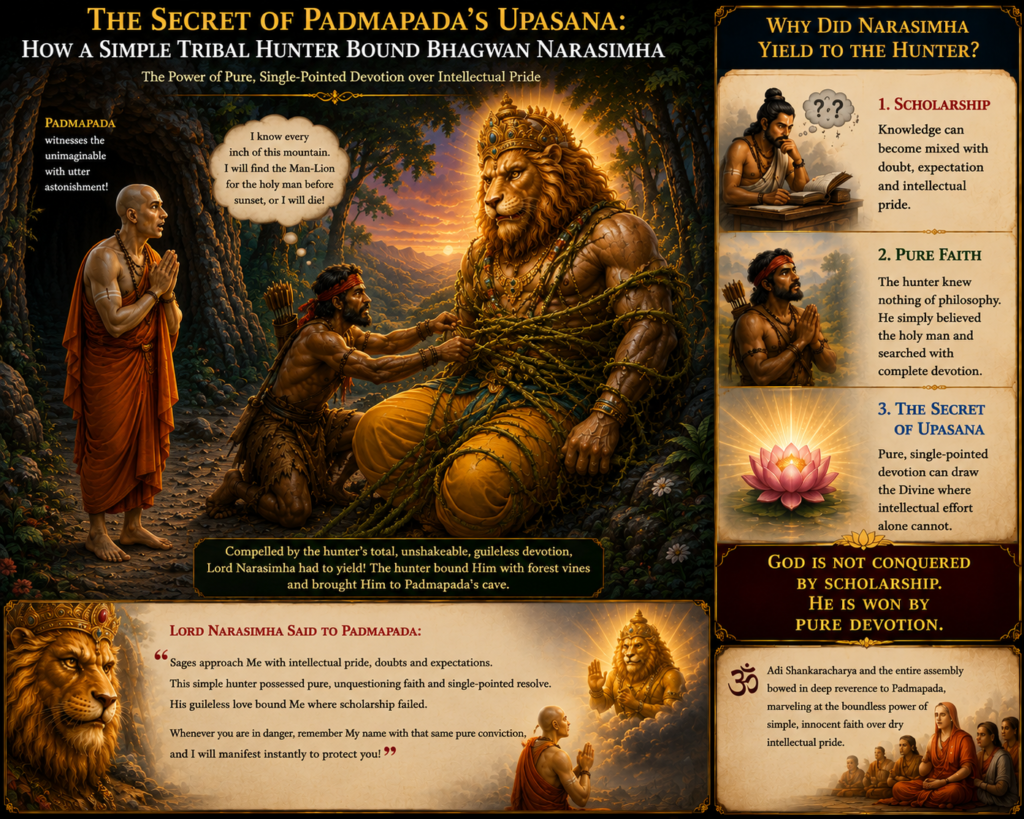
“Years before I met our Master, I retreated to a solitary cave on Mount Bala in the dense forests of the South, performing intense penance to attain a direct vision (Darshana) of Lord Narasimha.
One morning, an illiterate tribal hunter (Kirata), carrying a bow and arrows, walked past my cave. Seeing me sitting with closed eyes, he asked with simple curiosity: ‘Swami, what animal are you tracking in this thick forest that keeps you sitting so still day after day?’
To avoid complicated philosophical jargon, I replied simply: ‘Brother, I am hunting a very rare creature whose torso is that of a powerful man, but whose head and mane are that of a roaring lion.’
The simple-hearted hunter took my words literally. Filled with sympathy for my search, he declared: ‘I know every inch of this mountain. If such a creature exists, I will capture it for you before the sun sets today; if I fail, I shall leap from the cliff to my death!’
The hunter vanished into the jungle. With intense, unwavering determination, leaping from crag to crag, he searched every ravine without food or water. His mind held only one single-pointed thought: ‘I must find the Man-Lion for the holy man.’
Compelled by this total, unshakeable, guileless devotion, Lord Narasimha had to yield! As twilight fell, the hunter spotted the divine form. Unaware of the Lord’s terrifying majesty, the hunter casually threw thick forest vines around the deity, tied Him securely, and dragged Him through the brush directly to my cave!
I opened my eyes and stood frozen in utter shock. Great rishis could not glimpse Him after lifetimes of meditation, yet here was a wild hunter who had bound the Supreme Lord of the Cosmos with jungle creepers!
Weeping, I fell to my knees and asked: ‘O Lord! How could an unlettered hunter capture You when all my Vedic austerities failed?’
The Lord smiled and answered: ‘O Sanandana! Sages approach Me with intellectual pride, doubts, and expectations. This simple hunter possessed pure, unquestioning faith and single-pointed resolve. His guileless love bound Me where scholarship failed. Because of his devotion, I reveal Myself to you today.’
Before dissolving from sight, the Lord granted me a boon: ‘Whenever you find yourself or your noble mission in mortal danger, remember My name with that same pure conviction, and I will manifest instantly to protect you!'”
Hearing this, Adi Shankara and the entire assembly bowed in deep reverence to Padmapada, marveling at the boundless power of simple, innocent faith over dry intellectual pride.
Q2. How did Padmapada know that his Guru was in danger from miles away?
Through the yogic power of Pashyanti Vak (subtle intuitive vision). Deep spiritual purification and intense devotion allow a yogi’s consciousness to perceive events happening far beyond physical sight.
Q3. What is the spiritual lesson of the tribal hunter (Kirata) story?
It proves that God is won not through complicated intellectual pride or bookish scholarship, but through pure, simple-hearted, and unshakeable faith.
==================================
Anupam Trivedi has spent over three decades studying and reflecting upon Sanatan scriptures, including the Vedas, Upanisads, Itihāsa, and Purāṇas. He writes on cultural philosophy and ancient literature to present traditional insights with accuracy and clarity. Read full bio →