
What Most People Believe About Rudraksha—and What the Shastras Say!
- Rudraksha is among the most revered sacred objects in Sanatana Dharma. It is traditionally regarded not merely as the seed of a sacred tree, but as a manifestation of Bhagwan Shiva’s compassion and grace. Yet, despite its widespread use, there is considerable confusion surrounding Rudraksha today. Questions about who may wear it, what one should or should not do while wearing it, how it should be worn, which Rudraksha are genuine, how many mukhis are actually described in the Shastras, and what different forms of Rudraksha signify are often answered through hearsay, commercial claims, or popular belief rather than through the traditional sources themselves.
- This article therefore approaches Rudraksha from a different perspective. Instead of beginning with modern claims about its benefits, we will first examine what the traditional sources and the discourses in the modern times say about Rudraksha and how much is factual about it. In Present Part -1 of this Article, we discuss Rudraksha origin, its sacred nature, the rules associated with wearing it, its different forms, the characteristics of an acceptable bead, and several misconceptions that have become widespread in the marketplace.
Must Know Facts About Rudraksha
Mandatory Rules of Food and Dietary Purity While Wearing Rudraksha:
Most people believe that no dietary rules apply when wearing Rudraksha; however, the Shiva Mahapurana (Vidyeshvara Samhita, Chapter 25, Verse 43) and the Shrimad Devi Bhagavata Mahapurana clearly instruct that a practitioner wearing Rudraksha must completely abstain from alcohol, meat, garlic, onion (Palandu), drumstick (Shigru), Lisoda (Shleshmantaka), and contaminated or impure food.

Wearing Rudraksha During Toilet Use and States of Impurity Is Prohibited:
Unlike a Tulasi neck bead, Rudraksha should not be kept on the body while one is in a state of impurity or while using the toilet. According to Pujya Swami Karpatri Ji Maharaj and Puri’s Shankaracharya, Swami Nischalananda Saraswati Ji, the Shastric maryada is to remove the Rudraksha during toilet use and other states of bodily impurity.
Unlike Tulsi Rudraksha Is Not Cremated Along with the Body:
According to Pujya Shankaracharya Ji, if the body is to undergo cremation after death, the Rudraksha should be removed from the body. Burning Rudraksha in the fire is prohibited according to the Shastras; only in the case of Jala-Samadhi or Bhu-Samadhi (for Sannyasis) is it offered along with the body.
Following the Prescribed Method of Wearing Rudraksha Is Mandatory:
The Shiva Mahapurana describes severe consequences for wearing Rudraksha without Mantra-Nyasa, Panchakshara Japa, or consecration by a Guru or Brahmana; it states that a person who wears Rudraksha without mantra remains in a terrible hell for the duration of the reigns of fourteen Indras.
The Mystery of the Round One-Mukhi Rudraksha and the Marketplace Deception:
A genuine round One-Mukhi Rudraksha is extremely rare on Earth. According to the saints, only three One-Mukhi Rudraksha appear during the lifetime of a single tree: one goes to Svargaloka, one to Nagaloka, and only one remains on Earth to be obtained by an exceptionally fortunate person. The round One-Mukhi Rudraksha sold in commercial markets are entirely factory-made, carved, or artificially produced beads.
The Truth About the Crescent-Shaped (Cashew-Shaped) One-Mukhi Rudraksha:
The cashew-shaped or flattened beads sold in the market as “One-Mukhi” are not the One-Mukhi Rudraksha described in the Shastras. According to the Shastras, a round, amla-sized bead is considered excellent; these cashew-shaped beads are sold merely as decorative pendants or ornaments and do not provide spiritual benefits.
Rudraksha Exists Only Up to Fourteen Mukhi:
In authoritative texts such as the Shrimad Devi Bhagavata Mahapurana and the Shiva Mahapurana, descriptions of Rudraksha and their mantras are found only up to fourteen mukhis (14 Faces). Most beads sold as having more than fourteen mukhis (15 to 21+ mukhi) are prepared by artisans through carving at home or manufactured in Chinese factories using plastic, resin, and moulding.
The Authenticity of Wearing Tulasi and Rudraksha Together:
The Padma Purana and the authentic examples associated with Thakur Shri Vijay Krishna Goswami Ji establish that devotees of Bhagwan Vishnu may also wear Rudraksha, and there is no Shastric prohibition against wearing a Tulasi mala and Rudraksha mala together.
Men and Women of All Varnas and Ashramas May Wear Rudraksha:
According to the Shastras, men and women belonging to all four varnas—Brahmana, Kshatriya, Vaishya and Shudra—and all four ashramas are equally entitled to wear Rudraksha.
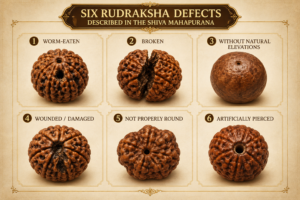
Identifying the Six Defects — Rudraksha That Should Not Be Worn:
According to the Shiva Mahapurana, six types of Rudraksha are completely prohibited from being worn: those eaten by worms (Krimiduṣṭa), broken or fragmented (Chinna-bhinna), lacking natural elevations or formations, wounded or damaged (Vraṇayukta), not properly round (Avṛtta), and those whose holes have been made through human effort.
The Origin of Rudraksha
In ancient times, there was an extremely powerful and terrifying demon named Tripurasura. Through the power of his abilities, he defeated the Devas, the Rishis, and even Brahma and Bhagwan Vishnu. Troubled by his atrocities, all the Devas approached Bhagwan Shiva and sought His protection.
To end the suffering of the Devas and destroy Tripurasura, Bhagwan Shiva created an infallible and fiery divine weapon known as the Aghora weapon. All the cosmic divine powers were contained within this extraordinary weapon.
Having resolved to destroy Tripurasura and bring welfare to the worlds, Bhagwan Shiva became absorbed in deep meditation and samadhi. He remained in meditation for one thousand divine years, keeping His eyes open without blinking.
After performing this intense austerity for one thousand divine years without blinking, all three of Bhagwan Shiva’s eyes began to ache. At that very moment, overcome by an intense feeling of love and a powerful desire for the welfare of the world, His eyes filled with tears.
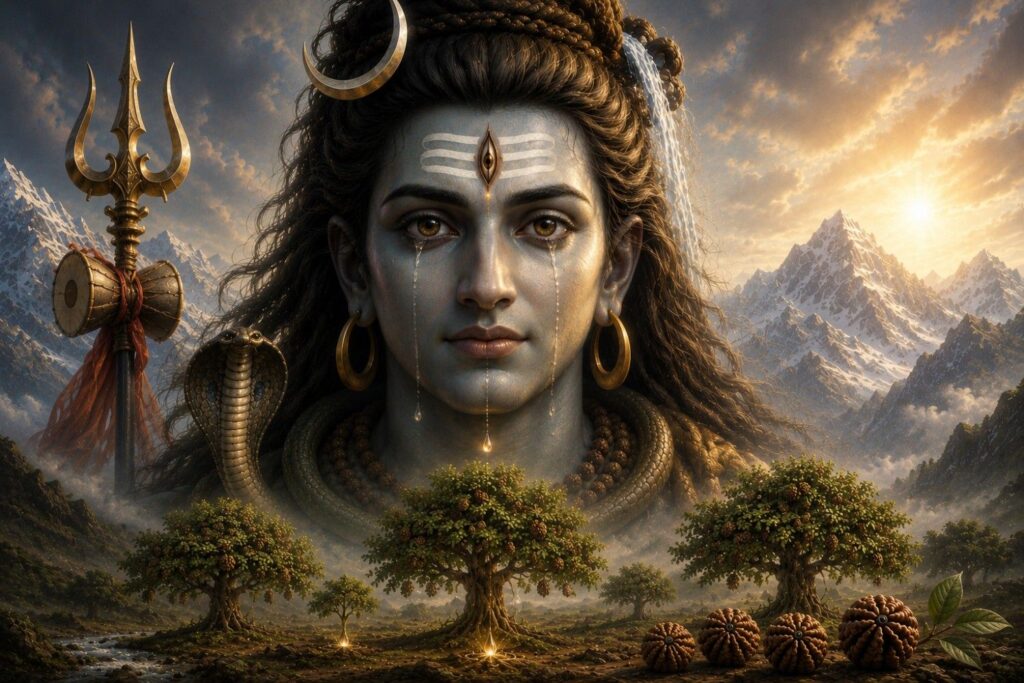
The tears of love and compassion began to fall from Shiva’s eyes onto the Earth. From these tear-drops that fell from the eyes of Bhagwan Rudra, emerged the Rudraksha trees.
Bhagwan Shiva’s tears which formed Rudraksha trees on Earth were for the grace and welfare of His devotees. The Shastras mention that Shiva manifested Rudraksha in sacred regions such as Gauda Desha (Bengal), Mathura, Ayodhya, Lanka, Malaya Mountain, Sahyadri Mountain and Kashi. Rudraksha trees are mentioned as having appeared in places such as Mathura and Ayodhya as well. However, with the influence of Kali Yuga, as sin increased upon the Earth and sattvic qualities declined, these rare and sattvic trees gradually disappeared from many of these places.
The word ‘Rudra’ refers to Bhagwan Shiva, while ‘Aksha ‘ means His eyes, Hence the Name Rudraksha.
Bhagwan Shiva tells Mata Parvati:
“Sthāvaratvam anuprāpya bhaktānugraha-kāraṇāt te dattā Viṣṇu-bhaktebhyaś caturvarṇebhya eva ca.”
This means that His tear-drops transformed into immovable forms, that is, trees, for the purpose of blessing His devotees, and He bestowed them for the welfare of the devotees of Bhagwan Vishnu and people belonging to all four varnas.
Rudraksha Is the Very Form of Shiva
Because Rudraksha emerged from the tears of Bhagwan Shiva, every Rudraksha seed is regarded as the very form of Shiva. According to revered saints, if a Shiva Linga is not available somewhere for worship, even a single Rudraksha bead can be consecrated and worshipped as Bhagwan Shiva Himself.
The Types of Rudraksha
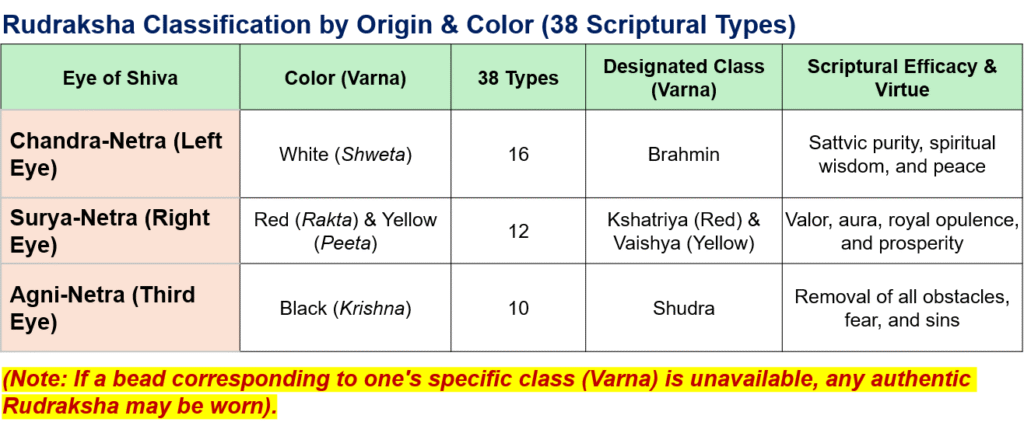
Thirty-Eight Types of Rudraksha from the Three Eyes of Bhagwan Shiva
The tears that fell from the three eyes of Bhagwan Shiva gave rise to 38 types of Rudraksha trees. From His right eye, which represents the Sun, 12 types of yellow and red Rudraksha emerged. From His left eye, which represents the Moon, 16 types of sacred white Rudraksha emerged. From His third eye, which represents Agni, 10 types of black Rudraksha emerged.
Rudraksha Classification According to Size
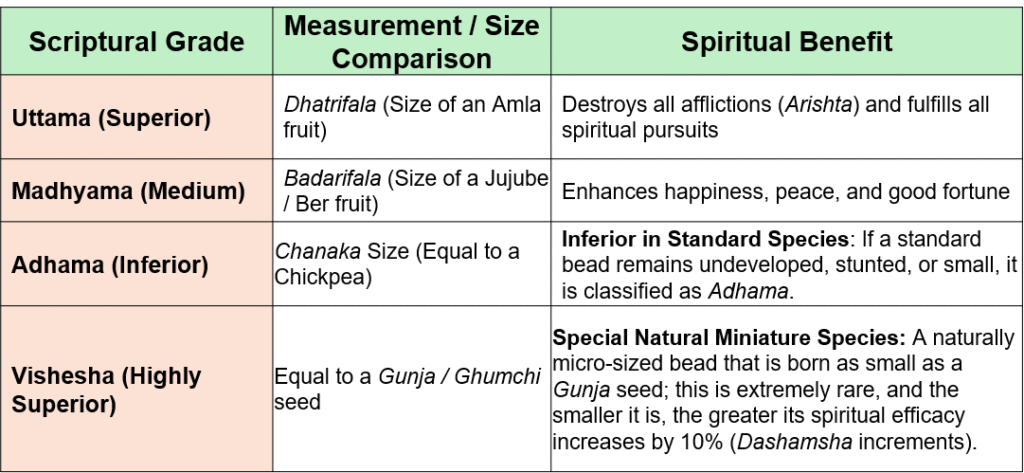
When Rudraksha beads of the same general species are compared, the Shastras classify them according to their natural size. A fully developed, well-grown and large bead resembling an amla fruit is described as Uttama, or excellent. A medium-sized bead resembling a ber fruit is described as Madhyama, or moderate. If a bead belonging to the normal species remains small because it has become stunted or underdeveloped, resembling a chickpea, it is placed in the Adhama, or lower, category.
The excellent Dhatriphala, or amla-sized Rudraksha, is described as capable of removing all misfortunes and fulfilling all purposes. The medium Badariphala, or ber-sized Rudraksha, is associated with happiness and good fortune. The underdeveloped chickpea-sized Rudraksha belongs to the lower category when it is simply a normally larger species that has remained small or underdeveloped.
There is also a special and extremely rare naturally small variety resembling a Gunja or Ghumchi.
This is a naturally small species that grows to that size on the tree itself. The smaller this naturally occurring variety is, the greater its fruit is said to become, increasing by ten percent for each successive reduction in size.
The Shiva Mahapurana states:
“Yathā yathā laghuḥ syād vai tathādhika-phalapradaḥ; ekaikataḥ phalaṁ proktaṁ daśāṁśair adhikaṁ budhaiḥ.”
That is, as the bead becomes smaller, its benefits increase by 10% successively.
Pujya Shri Rajendra Das Ji Maharaj explains this Shastric principle in His discourse (Ref. 1 and 2) A naturally small variety, resembling a Gunja or Ghumchi, is a distinct species of Rudraksha that grows naturally to a very small size on the tree itself. This naturally small variety is extremely rare and is regarded in the Shastras as increasingly fruitful and capable of fulfilling all desires.
However, beads that are plucked prematurely are prohibited. People sometimes pick large Rudraksha beads from the tree while they are still immature and small so that they can be sold as “small beads.” Maharaj Ji clearly states that taking a naturally large bead prematurely and making it small in this manner is completely prohibited in the Shastras.
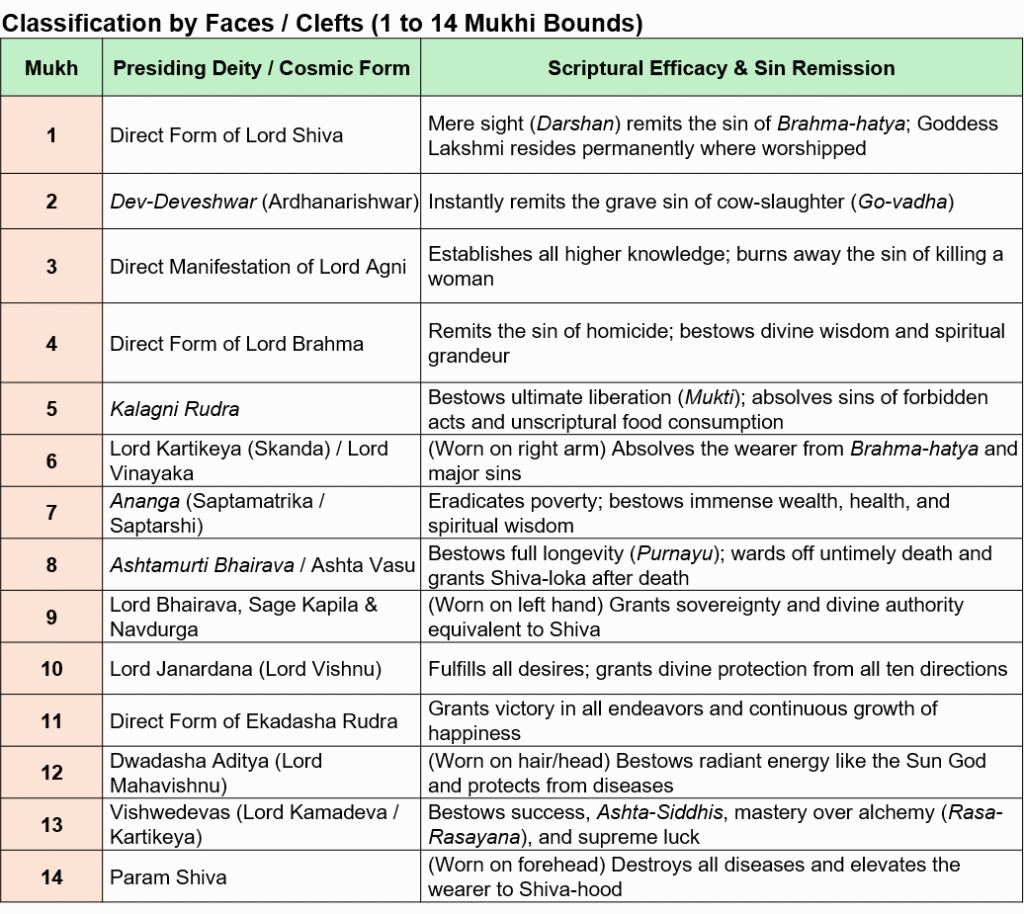
Classification based on Rudraksha Mukhas (Faces) : 1-14 Mukhi Rudraksha
The Shastras, including the Shiva Mahapurana and the Shrimad Devi Bhagavata Mahapurana, describe Rudraksha from one Mukhi to fourteen Mukhi. Rudraksha with more than fourteen mukh are not described.
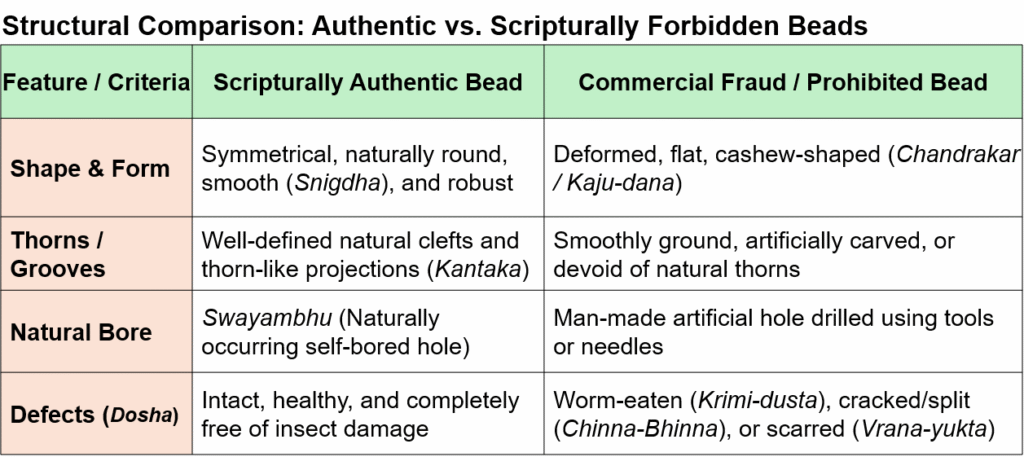
Authentic Rudraksha vs. Prohibited and Artificial Forms
A genuine Rudraksha should be naturally even, round, smooth and firm. Its natural lines and elevations should be clearly raised and intact. Its opening should be naturally formed rather than created with a needle or machine. It should be completely intact and free from damage or worm infestation. Rudraksha that is irregular, flattened or cashew-shaped, artificially smoothed, rubbed down, lacking natural elevations, artificially pierced, worm-eaten, broken or wounded is not suitable for wearing.
Rules for Wearing Rudraksha on Different Parts of the Body
According to the Shiva Mahapurana, Rudraksha is not meant to be worn only around the neck. Specific rules are described for wearing Rudraksha on different parts of the body and energy centres. These detailed arrangements are prescribed for practitioners undertaking specific spiritual practices and rituals.
On the head, 30 or 40 beads may be worn, while one or three beads may be worn in the Shikha. Around the neck, 32 or 50 beads may be worn, while a mala of 108, 50 or 54 beads may be worn over the heart. Sixteen beads may be worn on each arm and twelve beads on each wrist. Six beads may be worn in each ear, while three or 108 beads may be worn on the Yajnopavita.
The Shastras state that a practitioner who wears a total of 1,100 or 100–1,000 Rudraksha beads over the various parts of the body in this manner and chants Shiva mantras becomes the very form of Rudra.
A Simple Guideline for Ordinary Readers and Household Life
For ordinary readers, working people and householders living in modern circumstances, wearing such large numbers of Rudraksha beads over every part of the body is practically difficult. Therefore, according to revered saints, householders need not become confused about this.
In ordinary daily life, wearing one Rudraksha bead, three Rudraksha beads, or an authentic mala of 108 Rudraksha beads around the neck is fully sufficient for overall welfare, mental peace and spiritual progress, and is in accordance with the Shastric tradition.
Rudraksha for Purification of the Aura and Protection from Negative Energies
Rudraksha is described as a remarkable source of natural electromagnetic and subtle bio-energy.
Purification of the Aura
Every human being has a subtle energy field surrounding the body. When a person enters a stressful, polluted or negative environment, this aura is affected, resulting in mental disturbance and physical fatigue. Wearing Rudraksha continuously purifies the person’s aura.
Protective Shield
Rudraksha creates a subtle energy shield around the person wearing it. This shield prevents external negative vibrations, the effects of others’ jealousy, mental agitation and harmful environmental influences from entering the individual.
Natural Balance
According to the Shiva Mahapurana, when a practitioner wearing Rudraksha comes near, harmful emotions, negative thoughts and subtle mental disturbances begin to become शांत, allowing the mind of the wearer to remain stable and peaceful.
Rudraksha Facts in Shastra- Part 2
Rudraksha is not only the seed of a sacred tree but also a living symbol of the immeasurable compassion of Bhagwan Shiva. In Part 1, we have explored the origin of Rudraksha, its various types, the rules for wearing it, and the truth behind the fraud and misconceptions surrounding Rudraksha in the marketplace.
In Part 2 of The Shastric Mystery of Rudraksha, we have discussed the practical applications of Rudraksha that are directly connected with daily life, health and solutions to various problems.
In Part 2 we discussed –
- brief Shastric procedure for worshipping Rudraksha before wearing it is discussed
- The use of different types of Rudraksha in various physical, mental and medical problems
- Authentic Shastric remedies for different difficulties in life, planetary obstacles and practical problems and
- The special spiritual significance of Gauri-Shankar, Ganesh Rudraksha and other forms of Rudraksha, along with their proper use in life.
To understand the authentic knowledge of Rudraksha and its proper application and to make life more meaningful through that knowledge, do read Part 2 of this article link is as follows:
Part 2 Link – Rudraksha Facts in Shastra Part 2
=============================
References:
- Rajendra Das Ji Maharaj — Rudraksha
https://www.youtube.com/watch?v=3hFLwdl8sGU
(Detailed discourse on Rudraksha, its origin, types, colours, mukhi, rules and Shastric significance.) - Rajendra Das Ji Maharaj — Tripund and Rudraksha
https://www.youtube.com/watch?v=0MDaq7bJGHA
(Discussion on Tripund and Rudraksha and their religious significance.) - Puri Shankaracharya Ji — Rudraksha
https://www.youtube.com/watch?v=LqhOYGS4UAg
(Wearing Rudraksha during impurity, removal before cremation, and its treatment during Jala-Samadhi and Bhu-Samadhi.) - Shankaracharya Ji — Can Women Wear Rudraksha?
https://www.youtube.com/watch?v=TyXDWh1Helk
(Discussion on women wearing Rudraksha and the Aksha Mala.) - Sadhguru — Rudraksha
https://www.youtube.com/watch?v=VWILAiUZGaA
(Shiva’s meditation, tears of ecstasy and the origin and spiritual significance of Rudraksha.) - Sadhguru — Rudraksha
https://www.youtube.com/watch?v=cNaOCE5jQ6E&t=25s
(The subtle protective influence associated with wearing Rudraksha.) - Shiva Mahapurana — Vidyeshvara Samhita, Chapter 25, Verses 43 and 62.
- Shiva Mahapurana — Vidyeshvara Samhita, Chapter 25 — Rudraksha characteristics, varieties, Mukhi classification, mantras and rules of wearing.
- Shiva Mahapurana — Verse beginning “Yathā yathā laghuḥ syād vai tathādhika-phalapradaḥ…” — regarding the naturally small Rudraksha variety.
- Shrimad Devi Bhagavata Mahapurana — Ekadasha Skandha, Chapters 4–7.
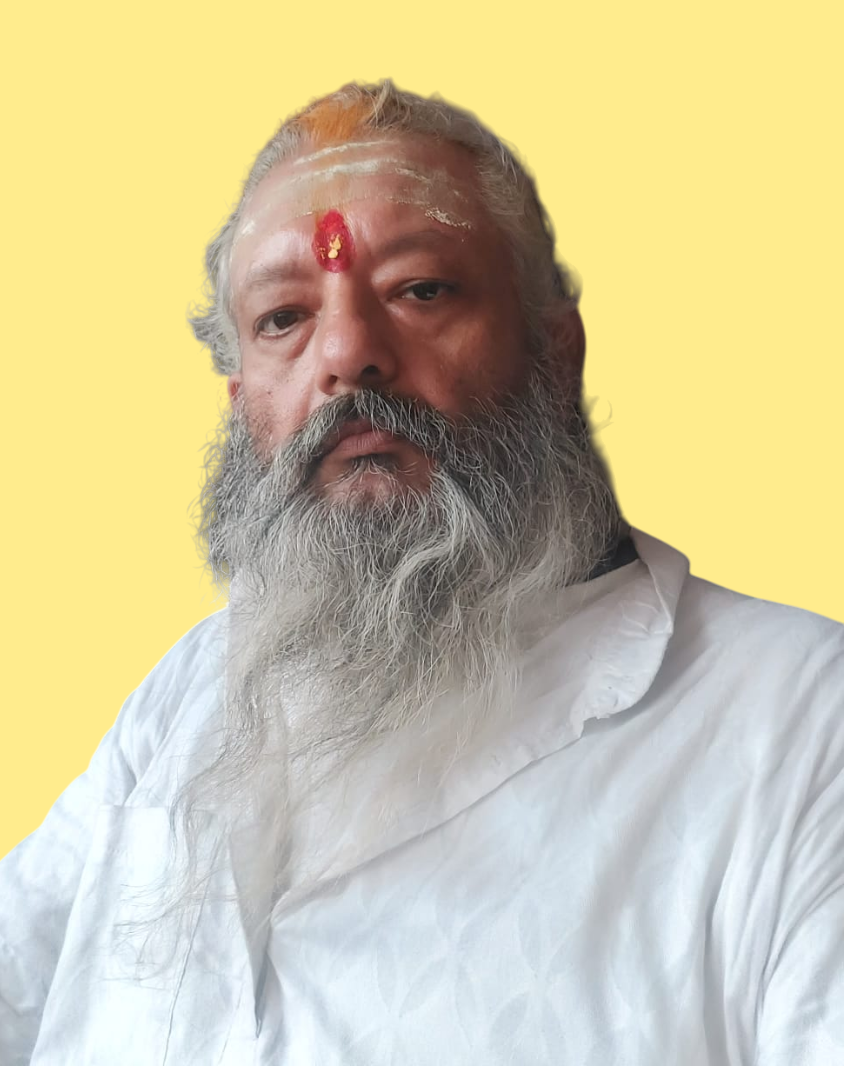
Anupam Trivedi has spent over three decades studying and reflecting upon Sanatan scriptures, including the Vedas, Upanisads, Itihāsa, and Purāṇas. He writes on cultural philosophy and ancient literature to present traditional insights with accuracy and clarity. Read full bio →
Pingback:Rudraksha Facts in Shastra