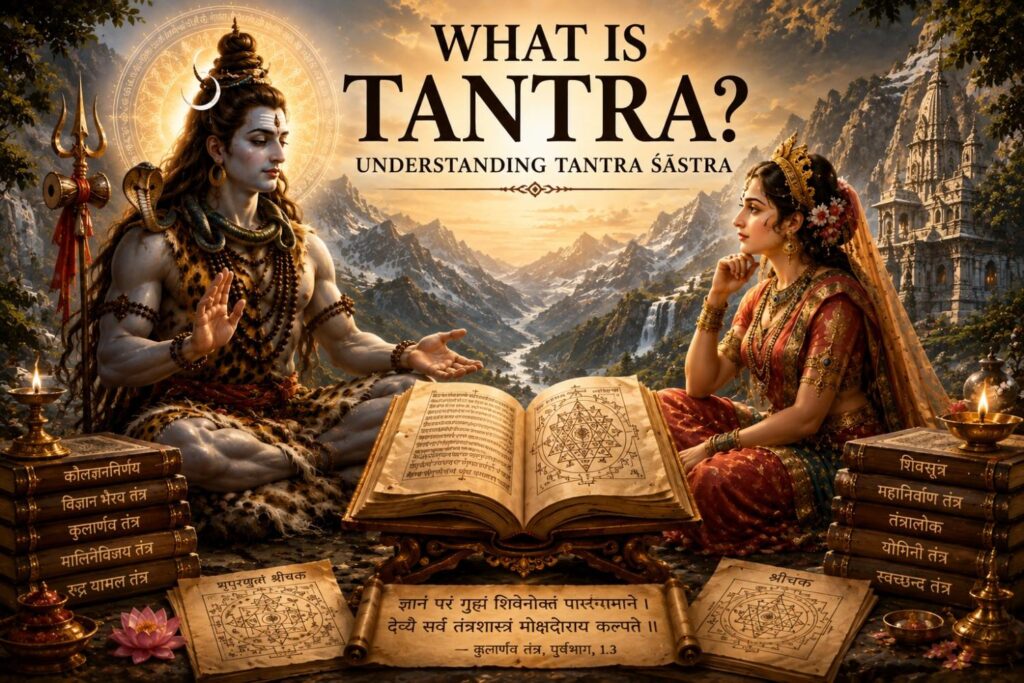
What Is Tantra ? Part -1
In the Indian knowledge tradition and the vast corpus of Sanātana Dharma, “Tantra” is perhaps one of the most misunderstood and misconception-ridden subjects. In modern society, the moment people hear the words “Tantra” or “Tantric,” many immediately imagine fear, cremation grounds, black magic, vaśīkaraṇa, māraṇa-uchāṭana, and frightening or immoral practices.
In reality, this perception does grave injustice to a profound body of knowledge that our Āchāryas and Ṛiṣhis revealed for the development of human consciousness, the expansion of inner energy, and the welfare of human life.
The renowned Western Indologist Dr. Herbert V. Guenther, while examining the prejudices surrounding Tantra in his work Yug Naddha, observed that:
“There is perhaps hardly any other body of literature in the world that has been condemned so extensively by people who have never seriously read even a single page of it. The second category consists of those who, on the basis of hearsay and misleading accounts, came to regard Tantra merely as a means for the gratification of physical desires and sensual passions.”
Tantra is neither an anti-social practice nor a collection of tamasic activities. It is a practical dimension of Sanātana spirituality that, rather than confining the seeker to an intellectual discussion of principles, provides a path toward their direct inner experience.
The understanding of Tantra should therefore begin not with these popular perceptions, but with its fundamental meaning.
First, It Is Necessary to Understand “Mantra, Tantra and Yantra” and Their Relationship
The revered Jagadguru Śaṅkarācārya, Govardhan Maṭha, Puri Pīṭhādhiśvara, while explaining the relationship between Mantra, Tantra and Yantra, points toward the fundamental principle that provides the simplest key to understanding this entire subject.
Mantra — Principle.
Tantra — Expansion of that Principle.
Yantra — The Medium of that Expansion.
Here, one point is especially important to understand. Mantra is not a principle created by a human being through intellectual reasoning. The Ṛiṣhis are called Mantra-druṣhṭā—those who saw or perceived the Mantra. From the scriptural perspective, the knowledge of Mantra manifested within the inner illumination of the Ṛiṣhis; therefore, the Ṛiṣhis are not regarded as the creators of Mantra, but as its seers (Drushta).
Let Us Understand This Through a Single Example
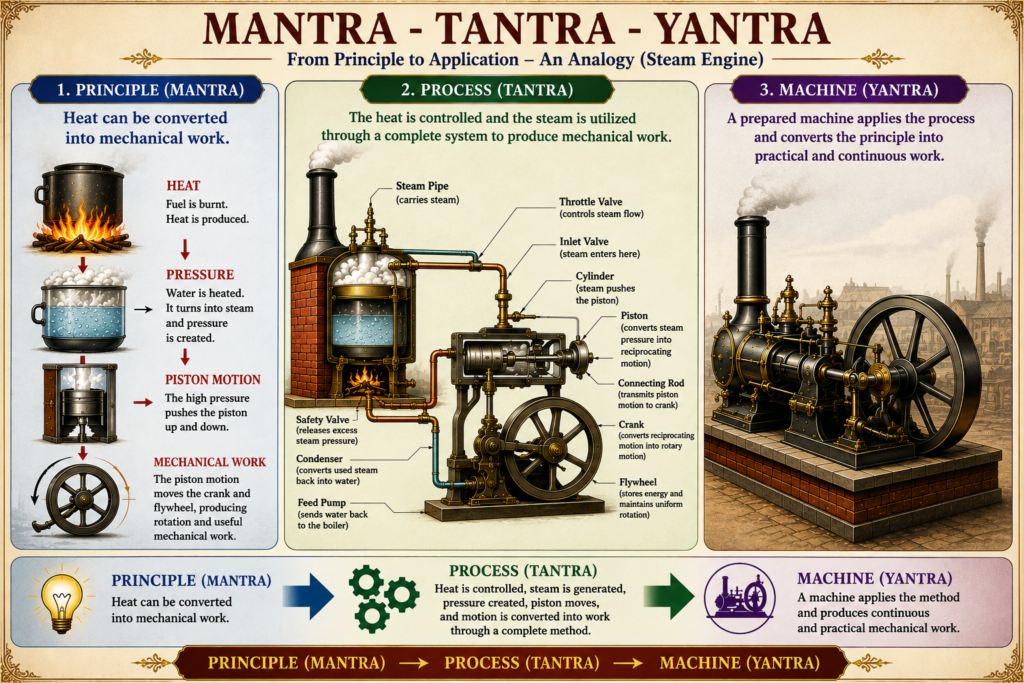
Suppose we consider the construction of a steam engine.
Before an engine can be built, knowledge of a fundamental scientific principle is necessary – that “energy produced from heat can be converted into mechanical work” (the Mantra, the Siddhant). This fundamental principle is not itself the engine.
After that, one must understand how heat will produce pressure, how that pressure will move the piston, how that movement will be converted into mechanical motion, and in what sequence the entire arrangement will function. In other words, in order to bring the fundamental principle into operation, knowledge of its detailed application, process and arrangement is necessary- this is Tantra the process.
Finally, when an actual machine is constructed on the basis of this entire arrangement, the steam engine becomes the medium through which that application takes practical form.
“In the same way, Mantra is the fundamental principle; Tantra is the expansion of that principle, its working process and its systematic application; and Yantra is the medium that holds and expresses that working process.”
There is therefore a sequence among Mantra, Tantra and Yantra—the principle, its expansion and the medium of that expansion.
There is, however, an important caution necessary when understanding this example. When we say that “Tantra is the expansion of the principle,” we are speaking about the philosophical relationship between Mantra, Tantra and Yantra. This does not mean that every Mantra must necessarily have one and the same Tantric method associated with it.
Different Mantras, deities, traditions and spiritual practices may have their own respective methods and prescriptions. Within Tantra Śāstra, the application of a Mantra is understood in the broader context of its corresponding principle, spiritual practice and method.
Mantra — Principle
The well-known explanation “Mananāt trāyate iti mantraḥ” understands Mantra as that power through whose contemplation and spiritual practice the seeker’s inner being moves toward freedom from bondage.
Tantric literature contains extensive discussions concerning the relationship between the letters of Mantras, nāda, bīja and Śhakti. The “Mantra Mahodadhi” scipture describes Mantras as both varṇātmaka and śaktyātmaka.
Tantra — The Practical Expansion of the Principle
Tantric practice presents many components as an organised system—the seeker’s inner disposition, preparation of the mind, Guru-dīkṣhā, prāṇāyāma, practices relating to the body and consciousness, Mantra-sādhana and other inner processes.
In this sense, Tantra is not the name of a single act or practice; rather, it is a comprehensive system through which the principle is expanded into the field of spiritual practice.
Yantra — The Medium
The general meaning of the word Yantra is associated with an instrument or means.
In Tantric traditions, Yantra particularly appears as a design or medium through which the adhiṣṭhāna- the established locus of a deity, Śhakti or spiritual principle is established.
The ‘Śhrī chakra’ is a well-known example of such a Yantra.
A Yantra is not merely a geometric figure; it is a medium connected with its associated Mantra, deity and prescribed spiritual practice.
Thus:
Mantra — Principle.
Tantra — Expansion of the Principle.
Yantra — The Medium of that Expansion.
But now another major question arises.
Tantra Is Not Merely a “Method”!
In the relationship between Mantra, Tantra and Yantra, the meaning of Tantra is connected with the expansion of the principle and its practical manifestation. But in the Indian scriptural tradition, the word Tantra has also been used in a much broader sense.
When we speak of “Tantra Śhāstra,” we are not referring merely to the method associated with one particular Mantra or one particular form of worship.
It encompasses an enormous body of literature and traditions dealing with philosophy, spiritual practice, Yoga, worship, Mantra, Yantra, initiation, Guru, conduct, practices relating to the body and consciousness, the principles associated with deities, regulations concerning temples and images, and many other subjects.
Therefore, understanding the dictionary meaning of the word Tantra alone is not sufficient. We must also examine its scriptural literature and its living traditions.
Modern Misconceptions Surrounding Tantra: How Did Distortions Arise?
After the Vedic period, when the difficult paths of renunciation and detachment came to be regarded as the only means of spiritual pursuit, spiritual progress became exceedingly difficult for ordinary householders. It was in such a context that Tantra expanded widely as a practical path through which a person could remain within household life while pursuing spiritual welfare and the attainment of higher spiritual power.
Over time, however, two major factors contributed to the accumulation of superstition and aversion around this sacred śhāstra.
Literal and distorted interpretation of esoteric symbols:
Tantric practice contains many inner spiritual processes expressed symbolically, including terms such as madya, māṁsa and maithuna. In their inner yogic interpretation, madya refers to the divine nectar associated with the higher state of consciousness, while maithuna refers to the union of Kuṇḍalinī Śakti with Śhiva-tattva at the Sahasrāra. However, people driven by sensuality and lack of restraint began interpreting such symbols as instruments for physical pleasure and gratification of desire.
Interpolation and fabricated literature by self-serving elements: Certain unqualified practitioners began frightening society and using the name of Tantra to gain money and influence, presenting māraṇa, mohana, uchāṭana and other lower practices as though they constituted the central subject of Tantra.
In the Kularnava Tantra, Lord Shiva explicitly refutes such misconceptions:
Madyapānena manujo yadi siddhiṃ labheta vai। Madyapānaratāḥ sarve siddhiṃ gacchantu pāmarāḥ॥
Māṃsabhakṣaṇamātreṇa yadi puṇyā gatirbhavet। Loke māṃsāśinaḥ sarve puṇyabhājo bhavanti hi॥
Meaning: if merely drinking wine were sufficient to attain siddhi and liberation, then every drunkard in the world would have attained siddhi. And if merely eating meat were sufficient to attain the highest spiritual state, then everyone who eats meat would already have attained supreme merit.
Thus, the śhāstra itself makes it clear that tamasic conduct is not the goal of Tantra; its distortion is.
Why Does Tantra Exist? Its Purpose in Human Life
Every entity, science, and mechanism in creation exists for a defined purpose. Revered Jagadguru Shankaracharya Swami Nishchalananda Saraswati Ji of Puri crystallizes this principle concisely:
“The rightful use of anything lies solely in fulfilling the exact purpose for which it was created. To know that true purpose, guidance from the Vedas and Shastras is essential. When a person constructs a machine or instrument (Yantra), it must be utilized for its intended objective. The entire science of Tantra rests upon understanding and applying each entity according to the true purpose of its origin.”
The existence of Tantra Śāstra and its indispensable utility rest upon the following foundations:
Integration of Practical Life and Spirituality
Where other paths may emphasise withdrawal from the material world or renunciation, Tantra, rather than abandoning the world by considering it unreal, accepts it as divine energy. It enables the householder to fulfil the responsibilities of work and family while also possessing the capacity to pursue Self-realisation.
Awakening of Inner Energy and Kuṇḍalinī
The human body is a subtle replica of the universe. Tantra presents a scientific technique for awakening the subtle prāṇa, the nāḍīs—Iḍā, Piṅgalā and Suṣhumnā and the Ṣhaṭcakras, raising consciousness from lower tendencies toward higher levels.
Complete Spiritual Eligibility for All Varṇas and Recognition of Feminine Power
While certain rules and restrictions existed within Vedic rituals, Āgama (Tantra) opened the doors of spiritual practice to every human being without distinctions of gender, caste or varṇa. Tantra recognises woman as the very embodiment of Śhakti and accords her the highest spiritual status.
Alleviation of Natural Calamities and Diseases
Tantra is not merely transcendental; it is also a science concerned with worldly welfare. It contains principles relating to Āyurveda, rasa-chikitsā, Mantra-chikitsā and the removal of poison, which help human beings remain healthy and attain longevity.
Tantra and Āgama — Are They Both the Same?
The words Āgama and Tantra have both been used for an extremely broad body of scriptural literature, and in many places their fields are deeply interconnected. The scope of these terms has also varied across different traditions and historical periods.
In different sects and textual traditions, words such as Āgama, Tantra and Saṁhitā have been used in specific contexts.
Therefore, the safest and most useful way to understand this subject is to regard Āgama and Tantra as interconnected, vast and multilayered traditions within Indian scriptural literature, in which different sects (Baudha, Jain..) developed their own texts and systems.
The available material on Tantric literature refers within the Āgamas to different dimensions such as Jñāna, Yoga, Kriyā and Charyā. This itself demonstrates that this literature was not limited to one particular form of worship or one particular ritual.
The Vast Ocean of Tantric Literature: The Agama Tradition
The knowledge tradition of Sanātana Dharma has been divided into two equally revered streams—
Nigama (Veda) and Āgama (Tantra).
Kullūka Bhaṭṭa, the renowned commentator on the Manusmṛti, quoting the scriptural statement of Sage Hārīta, wrote:
Śhrutiśca dvividhā—vaidikī tāntrikī cha।
Revealed sacred knowledge is twofold: Vedic and Tantric
Highlighting the stature of Tantra Shastra, the Matsya Sukta states:
Viṣṇurvariṣṭho devānāṃ hradānāmudadhistathā।
Nadīnāṃ ca yathā gaṅgā parvatānāṃ himālayaḥ॥
Tathā samastaśāstrāṇāṃ tantraśāstramanuttamam।
Meaning: Just as Vishnu is supreme among deities, the ocean among bodies of water, the Ganga among rivers, and the Himalayas among mountains, so is Tantra Shastra supreme among practical spiritual sciences.
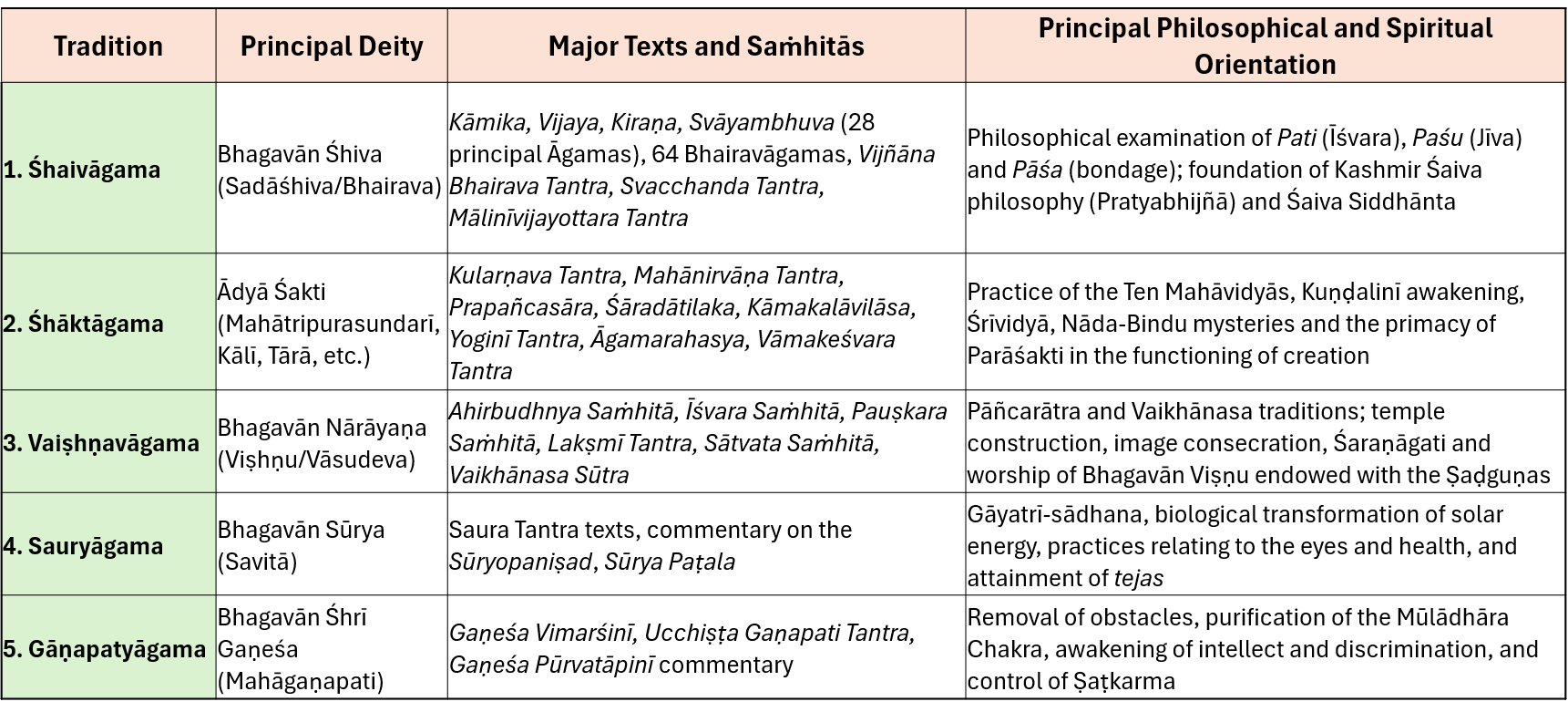
Authentic Classification of Tantra Śāstras
In ancient times, the number of Tantra texts was said to be in the hundreds of thousands. The literature
International Influence of Tantra and Historical Evidence
The utility and influence of Tantra Śāstra did not remain confined to the geographical boundaries of India. History and archaeology bear witness to the fact that this practical science had spread throughout the world in ancient times:
Tibet and China
Ācārya Padmasaṃbhava and Ācārya Dīpaṅkara Śrījñāna of Vikramaśilā translated Indian Tantra texts into the Bhota (Tibetan) language. In Tibet, Tantra is called “Gyud,” under which a vast collection of thousands of texts has been preserved.
Southeast Asia — Java, Sumatra, Bali and Cambodia
The inscriptions of the magnificent temples of Angkor Wat and Prambanan demonstrate that worship and consecration there were performed through the Tantric methods of Śhaivāgama and Vaiṣhṇavāgama. The Śhiva-Buddha Tantric tradition continues to survive in Bali even today.
Archaeological and Numismatic Evidence
Mother Goddess and Yoni forms discovered during excavations at Mohenjo-daro and Harappa, together with depictions of lion-riding Durgā and Gajalakṣmī on the coins of rulers of the Kuṣāṇa and Gupta periods, demonstrate that the Āgama tradition has continued to flow from prehistoric times.
Tantra is truly the backbone of Sanātana Dharma, without which Hinduism’s daily worship, temple architecture, image consecration, festivals and inner spiritual practice cannot even be imagined. It is the royal path for directing every energy of life toward Śhivatva—the Supreme Consciousness.
What Is the Difference Between Vedic Worship and Tantric Practice?
A Classical Comparison
- Difference in Eligibility and Adhikāra
Vedic Karmakāṇḍa: Vedic Yajñas, Śrauta-Smārta rituals and Sandhyopāsanā are primarily prescribed for the Traivarṇika—Brāhmaṇa, Kṣhatriya and Vaiśhya—and for men initiated through Vedic Saṁskāras. Yajñopavīta, Śhākhā-specific rules and strict requirements concerning pronunciation are integral.
Tantric Method: In the Āgamic system, there is no restriction based on varṇa, caste or gender. Women, men and all sections of society have equal entitlement to spiritual practice and initiation:
““Sarva-varna-sadharanah” / “Strinaam api cha dikshaayaam adhikaarah””
- Difference in Materials and Altar
Vedic Karmakāṇḍa: The Vedic process is Agni-centred (Yajñīya). Through offerings, altar construction, Kuṇḍa, Samidhā, Ghṛta, Caru and Havis, the Devas are invoked directly into the sacred fire.
Tantric Method: The Tantric process is Yantra-Pīṭha and Mūrti-centred. Instead of fire, special geometric Yantras, Maṇḍalas, Śālagrāma/Śivaliṅga or consecrated images are used, with Āvaraṇa-pūjā and Ṣoḍaśopacāra worship as the principal practices.
- Purification of the Body and Direction of Prāṇa: “Nyāsa” and “Bhūtaśuddhi”
Vedic Karmakāṇḍa: External purification—Snāna, Ācamana, Mārjana, Pavitrīkaraṇa—and outwardly directed Saṅkalpa-Mantras have prominence.
Tantric Method: The foundation of the Tantric process is Bhūtaśuddhi and Nyāsa.
Bhūtaśuddhi: The seeker meditatively purifies the five elements within the body—Earth, Water, Fire, Air and Ākāśha—and contemplates a divine body.
Aṅganyāsa and Karanyāsa: According to the Mantra Mahodadhi, the letters of the Mantra and the Deities are established in different parts of one’s own body—the heart, head, Śhikhā, eyes and so forth.
The Tantric principle states:
“Devo bhootvaa devam yajet”
“Only after becoming the Deity-like oneself can one worship the Deity.”
- Mantric Sound and Vocal Structure
Vedic Karmakāṇḍa: Vedic Mantras have strict rules of intonation such as Udātta, Anudātta and Svarita. If the intonation is broken, the Mantra is considered ineffective or capable of producing an adverse result.
Tantric Method: Tantric Mantras are primarily Bīja-akṣhara-oriented—Hrīṁ, Klīṁ, Aiṁ, Śrīṁ, Krīṁ, etc. Here, rather than emphasis on rules of intonation, greater importance is given to inner concentration, Nāda-Spandana, prescribed repetition (Puraścaraṇa) and mental absorption.
- Upacāra, Mudrā and Āvaraṇa Pūjā
Vedic Karmakāṇḍa: Offerings and worship are performed through Pañcopacāra or Vedic Ṛichas and sacrificial offerings.
Tantric Method:
Mudrā-Vijñāna: Specific configurations of the fingers and hands—Āvāhinī, Sthāpinī, Sannidhāpinī, Dhenu-Mudrā, Yoni-Mudrā, etc.—are necessarily employed for invoking and pleasing the Deity.
Āvaraṇa-Pūjā: The Āvaraṇa-Deities, Yoginīs and Dikpālas residing within the different circles, angles and petals of the Yantra are worshipped in a prescribed sequence.
Tarpaṇa and Mārjana: Not merely offerings into the fire, but also the Tarpaṇa and Mārjana of the Yantra and image with specific substances form an essential part of the practice.
- Guru-Dīkṣā and Śaktipāta
Vedic Karmakāṇḍa: Upanayana Saṁskāra and Vedic study form the principal foundations.
Tantric Method: Performing Tantric Mantras or Tantric practices without Dīkṣhā (Guru-Dīkṣhā) is completely prohibited. The implantation of the Mantra-saṁskāra by the Guru into the inner being of the disciple and Śhaktipāta constitute the first essential stage of the Tantric process.
Comparative Overview: Vedic Karmakanda vs. Tantric Sadhana
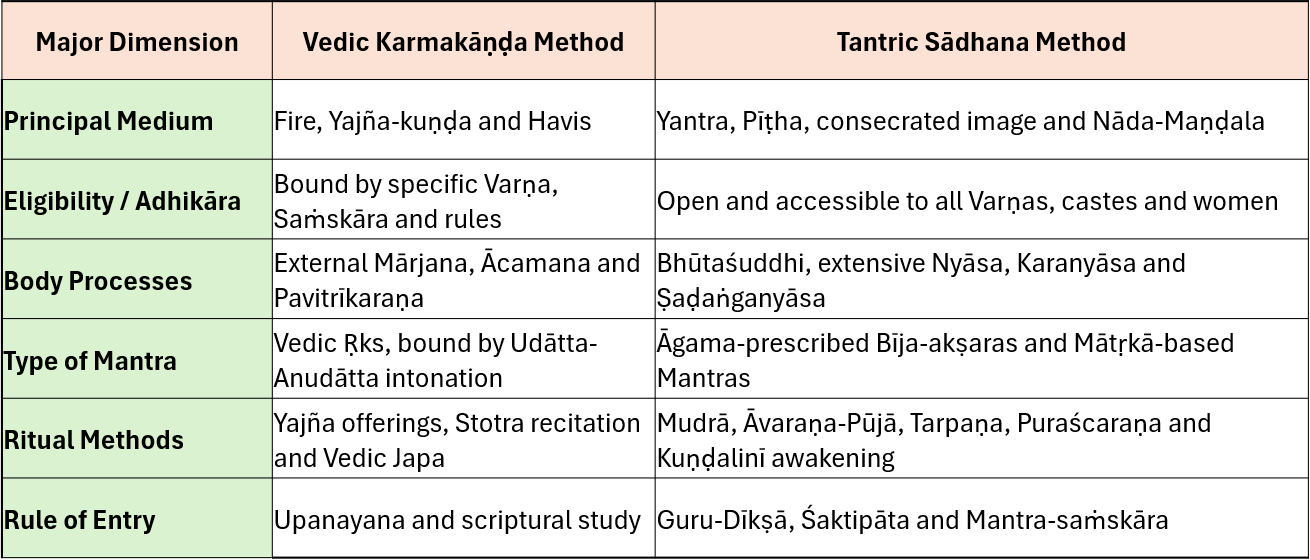
An Important Note on differences between Vedic and Tantric methods
Although these differences between Vedic and Tantric methods are described from the perspective of study and understanding, this division is not a rigid or absolute one. In reality, there is deep integration and mutual incorporation between these two streams:
- Many Tantric rituals and Āgamic systems necessarily employ Vedic Ṛichas, the Gāyatrī Mantra, Agni-Havana and Vedic Saṅkalpa.
- Similarly, in the present age, Tantric Nyāsa, Mudrā and Āvaraṇa-Vidhāna are naturally incorporated into the consecration of images, Mūrti-Pūjā, Ṣhoḍaśopacāra worship, daily Āratī and festivals in Vedic temples.
- The Pañchāgni-Vidyā of the Bṛhadāraṇyaka and Chāndogya Upaniṣhads, together with numerous Sūktas of the Atharvaveda, make it clear that both streams, complementing one another, together provide completeness to the Sanātana system of worship.
In Part 2 of this series, we will explore the major Tantra scriptures that have come down to us, understand the traditions to which they belong, and examine what these scriptures actually teach. The larger purpose of this series is to understand the vast body of Sanātana Dharma’s scriptural tradition—its Vedic, Āgamic and Tantric literature—in its proper context, and to distinguish what the scriptures actually say from the many misconceptions, assumptions and doubts that have accumulated around them over time.
What is Tantra part 2 article Link – What is Tantra part 2
==================
References:
Pt. Shriram Sharma Acharya & Dr. Chamanlal Gautam. Tantra-Mahavijñāna (Vol. 1). Sanskriti Sansthan, Bareilly, 1969.
Mahīdhara (Comm. ‘Nauka’ & ‘Aruna’ by Dr. Sudhakar Malaviya). Mantramahodadhi. Chaukhamba Sanskrit Pratishthan, Delhi/Varanasi.
Paramahamsa Sri Saryuprasad Dwiwedi (Ed. & Comm. Dr. Sudhakar Malaviya). Āgamarahasyam (Part 1). Chowkhamba Sanskrit Series Office, Varanasi.
Gita Press. Kalyan: Dharma-Shastra Ank (pp. 200–201). Gita Press, Gorakhpur.
Jagadguru Puri Shankaracharya Swami Nishchalananda Saraswati Ji. The Triad of Mantra, Tantra, and Yantra. YouTube: https://www.youtube.com/watch?v=78pTWr9tJqg
Jagadguru Puri Shankaracharya Swami Nishchalananda Saraswati Ji. The Secret & Purpose of Tantra Shastra. YouTube: https://www.youtube.com/watch?v=qT9yDcTdQhg
- Jagadguru Puri Shankaracharya Swami Nishchalananda Saraswati Ji. Marak Mantra Prayog and Subtle Energy Dynamics. YouTube: https://www.youtube.com/watch?v=RJgMxVDvGOo
Anupam Trivedi has spent over three decades studying and reflecting upon Sanatan scriptures, including the Vedas, Upanisads, Itihāsa, and Purāṇas. He writes on cultural philosophy and ancient literature to present traditional insights with accuracy and clarity. Read full bio →
Pingback:What is Tantra? Part 2: The Vast Literature of Tantras & Tantric Rituals
Pingback:What is Tantra? Part 3: Sacred Science or Spiritual Trap?
Pingback:What Is Tantra? Part 4: Mudras, Samputa and Yajna-Havana Connection with Tantra - Bhavam Bhavaani