If you have not read the earlier articles of What is Tantra? series, here is a brief overview of what was covered:
What Is Tantra? Part 1: Mantra, Tantra and Yantra
We explored the foundational meaning of Tantra Shastra and the relationship between Mantra, Tantra and Yantra.
What Is Tantra? Part 2: Common applied Tantric procedures
We examined the Agama literature of the Shaiva, Shakta and Vaishnava traditions, along with Jnana, Yoga, Kriya and Charya and their connection with practical Tantric worship.
What Is Tantra? Part 3: Mantra, Devata and Sadhana
We explored the relationship between Mantra, Devata and Sadhana through traditional accounts and practices associated with the Tantric tradition.
What Is Tantra? Part 4: Mudra, Samputa and Yajna-Havana
We examined practical elements of Tantric worship, including Mudra, Nyasa, Digbandhana, Samputa and Yajna-Havana.
In What Is Tantra? Part 5: We discuss Panchamakara: Madya, Mamsa, Matsya, Mudra and Maithuna, one of the most misunderstood subjects associated with Tantra.
The Misconceptions and Malicious Distortions Surrounding Tantra: But the Truth Is…
When the history of the deeper disciplines of Sanatana culture is examined, it becomes clear that the Tantra and Agama traditions had a vast presence in ancient India. The Eleventh Skandha of the Srimad Bhagavata also contains references to worship performed according to Tantric methods. Puranic narratives describe Lord Ramachandra, before the slaying of Ravana, worshipping Bhagavati Durga according to a Tantric method and receiving her blessing. This is presented as evidence of the antiquity of this tradition, as old as the Vedas. Tantra was was accorded a status comparable to that of the Vedas and is regarded as the ‘Fifth Veda’.
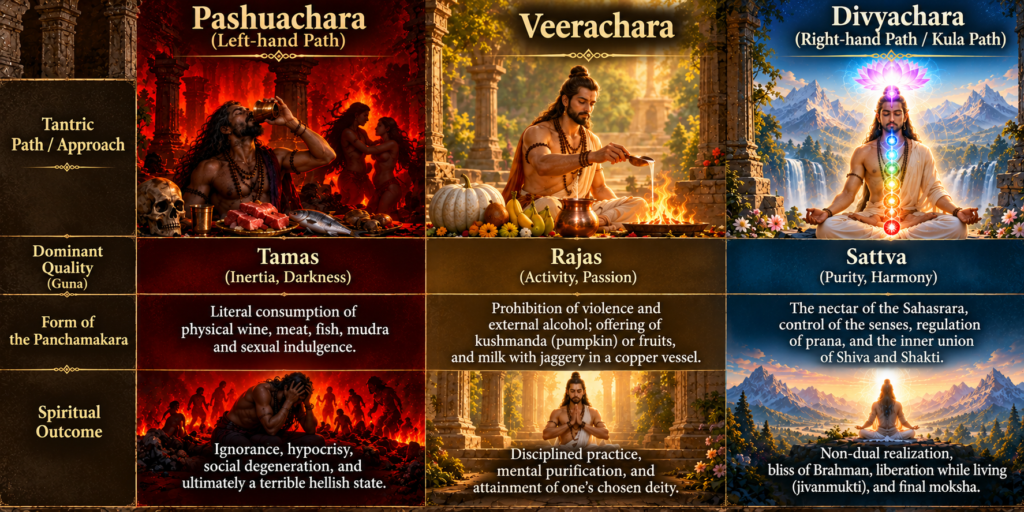
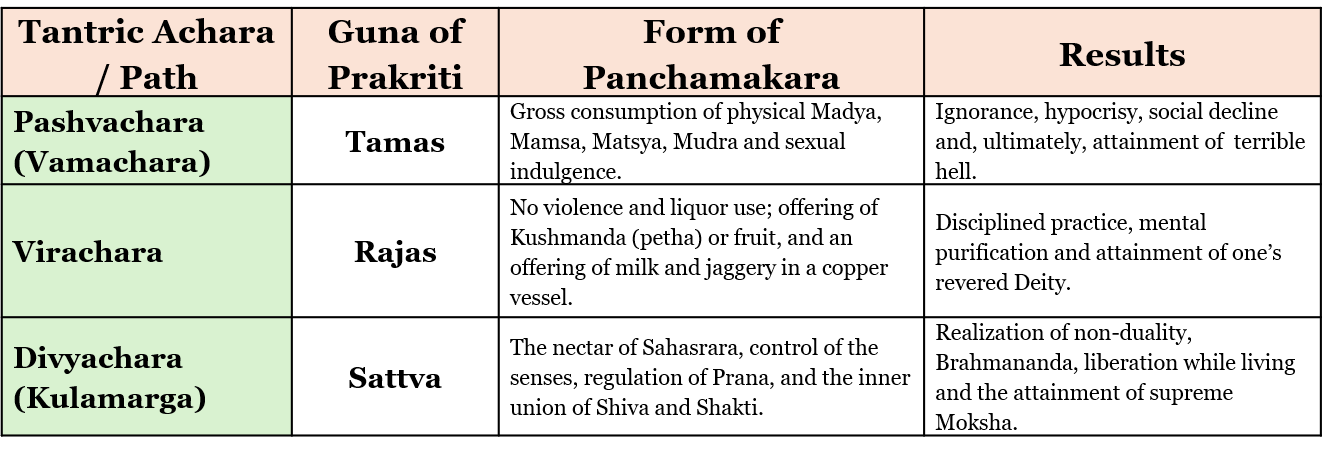
With the passage of time, however, unauthorized, immature and materially driven people began entering this profound field, and the coded language of Tantra (Sandhya-bhasha) came to be interpreted in deeply distorted ways. Those familiar with the Agama texts know that, on the basis of the three gunas of Prakriti – Sattva, Rajas and Tamas, The three modes of Tantric practice are described as : Divyachara, Virachara and Pashvachara.
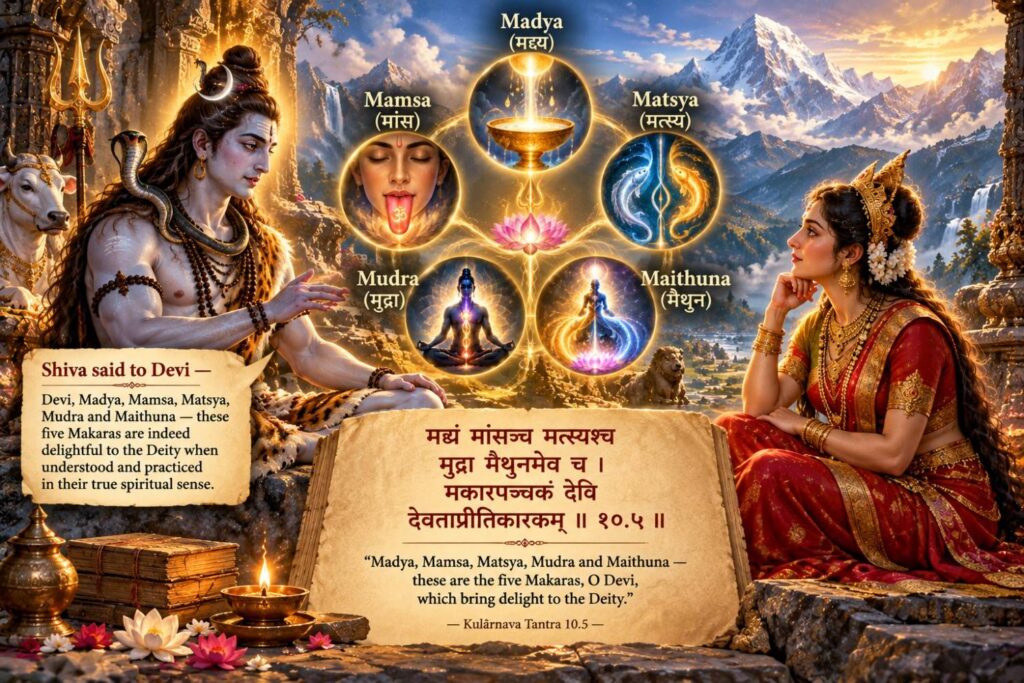
In the vast world of Sanatana Dharma and the Agama-Nigama traditions, the very word ‘Tantra’ often evokes both curiosity and confusion. At the centre of many of these misconceptions stands Panchamakara – the five Makaras: Madya, Mamsa, Matsya, Mudra and Maithuna.
A widespread belief has persisted for centuries that Tantra or Vamachara opens the way to indulgence, material addictions and immoral conduct. This view, however, arises from unfamiliarity with the language of Tantra and its Sandhya-bhasha—the ‘Twilight Language’ or coded language.
Panchamakara in the Kularnava Tantra
In the Tenth Ullasa of the Kularnava Tantra, these five essential elements, known as Panchamakara, are referred to in verse:
Madya mamsancha matsyancha, mudra maithunam eva cha.
Makara panchamam Devi, devata priti karanam.॥
This single verse has been the source of some of the greatest distortions surrounding Tantra. Those following a gross, tamasic interpretation under the influence of Tamas took its words literally and assumed that consuming physical liquor, meat and fish, along with sensual indulgence, was the way to please the Deity. In its name, hypocrisy, immorality and even criminal acts arose in society, casting a shadow over Tantra as a profound experimental spiritual science.
In his work Mahayoga Vigyan, Mahayogi Yogendra Vijnani, while analysing the Kularnava Tantra, brings forward a clear warning attributed to Lord Shiva regarding the misuse of the Panchamakara. Those who seek Siddhi merely through physical drinking or eating meat do not attain liberation; rather, they are said to move towards a terrible downfall. The Shiva and Shakta Agamas describe these expressions through Sandhya-bhasha, so that their deeper significance may be understood by the seeker who proceeds through initiation and higher yogic consciousness.
The five Makaras therefore open into a deeper understanding in which the seeker’s own body becomes the field of spiritual practice and the temple of transformation.
Pashvachara and Divyachara: The Fundamental Difference in Approach
Tantra describes three distinct modes of Achara, or modes of spiritual practice. Understanding this distinction provides the framework for the discussion of Panchamakara
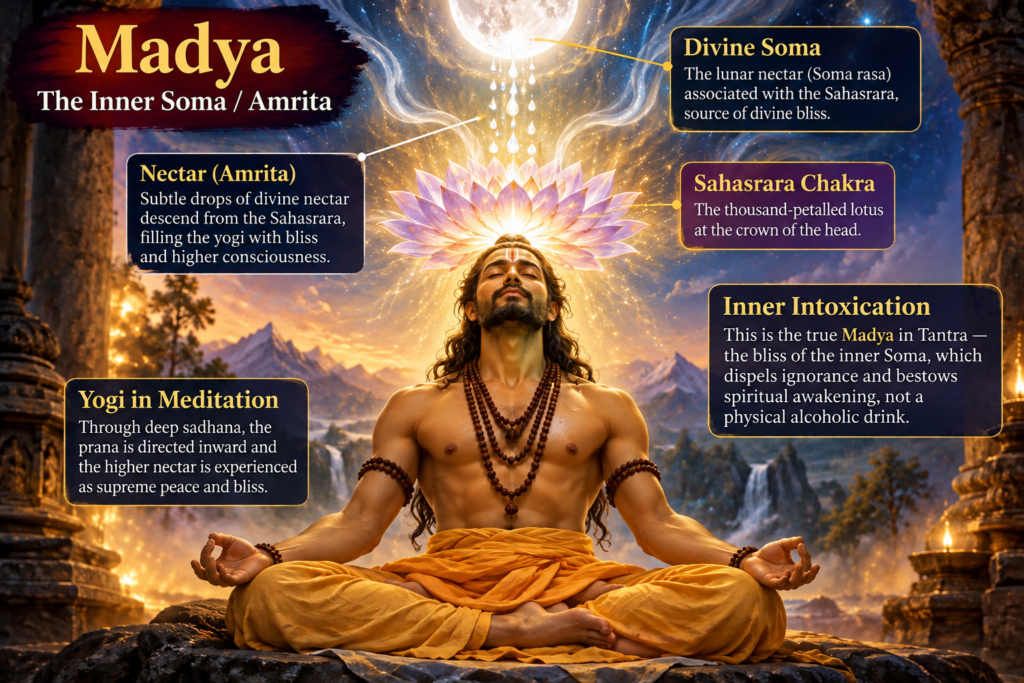
The First Makara: Madya – Drinking the Soma Rasa of Sahasrara
In ordinary usage, the word ‘Madya’ immediately brings to mind liquor or alcohol—something that can cloud discrimination and lead a person towards decline. In the body-science of Tantra and the Divya Kulachara tradition, however, its meaning is presented as entirely inner and divine.
According to Yoga and Tantra, the human body is a microcosm. At the highest point of the body, the Sahasrara Chakra, described as the centre at the crown of the head, is regarded as the abode of Shiva or the ‘Hall of Nectar’ (Amrita Mandapa).
When an advanced yogi, through prolonged Pranayama, Nadi-shodhana and the awakening of Kundalini, directs the Prana upward through the Sushumna pathway, an extremely subtle, cooling and blissful nectar is described as flowing from the lunar region within the head. This nectar, referred to as Soma Rasa, is associated with the experience of divine bliss.
Drawing on the Kularnava Tantra and Yogini Tantra, Mahayogi Yogendra Vijnani writes that when the yogi turns the tongue upward through Khechari Mudra and tastes the Sudha-rasa said to descend from Sahasrara, he becomes detached from the attractions, aversions and disturbances of the material world. He becomes absorbed in a state of non-dual bliss in which no external intoxicant is needed. In this understanding, the drinking of the wine of Brahmananda is the true Madya.
Historical and Puranic Illustrations
The lives of great Advaita saints and Siddha Yogis of earlier times are presented as containing many examples of this inner ‘drinking’ of Madya. When Adi Shankaracharya or the Tantric Siddha Aghoreshwar Baba entered deep Samadhi, they became completely indifferent to the distractions of the material world. When their disciples asked the reason, the answer attributed to such saints was that once a person has tasted Soma Rasa—the inner bliss at the highest level of consciousness, the pleasures of the world lose their attraction. In the Second Ullasa of the Kularnava Tantra, Mahadeva states:
Madyapānena manujo yadi siddhiṃ labhate vai. Madyapāna ratāḥ sarve siddhiṃ gacchantu pāmarāḥ॥
In other words, if merely drinking liquor could grant Siddhi, then all drunkards and deluded people in the world would automatically attain liberation. The verse therefore points away from a merely physical interpretation of Madya and towards its inner yogic meaning.
The Second Makara: Mamsa — Mastery of the Tongue, Speech and the Senses
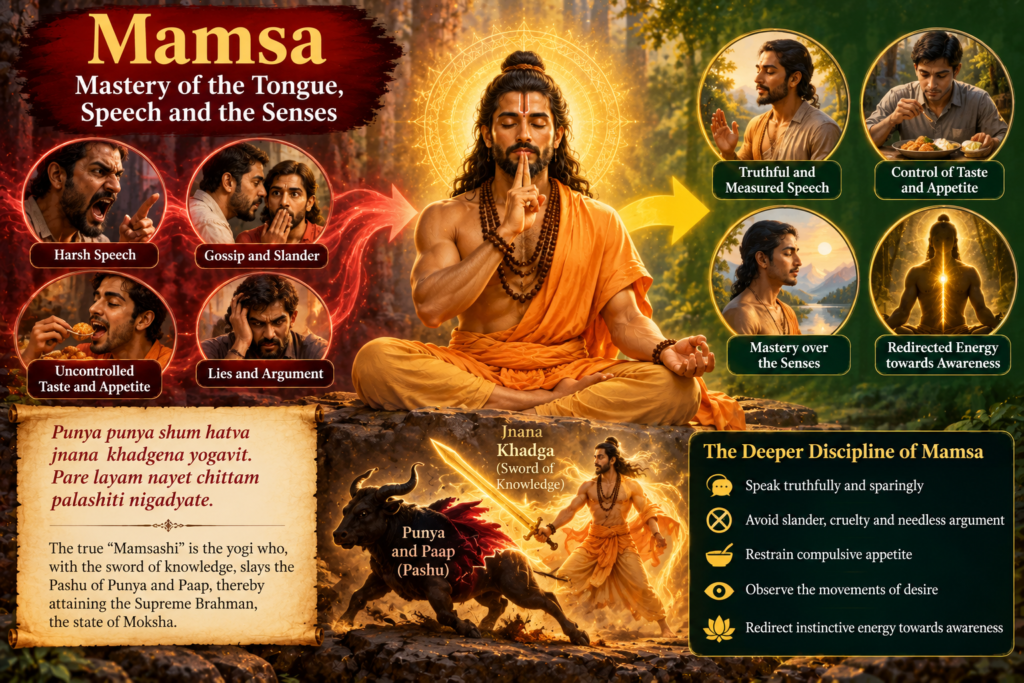
In common understanding, ‘Mamsa’ means the flesh . Such an interpretation is presented in the article as contrary to the compassionate and non-violent character of Tantra. Tantra does not support violence against living beings. The deeper question, therefore, is the meaning of Mamsa-sadhana in the Tantric texts.
The tongue is described as one of the most powerful and difficult-to-control senses. The pleasures of taste, together with harsh speech, criticism, gossip and falsehood, can become major sources of wrongdoing.
The Meru Tantra and the Kularnava Tantra, in the Fifth Ullasa, state that the embodied being is bound by the fetters of the body through ignorance. In the inner meaning of Tantra, Mamsa signifies bringing the forces of the mind, Prana and senses under control and gaining complete mastery over the tongue.
Punya punya shum hatva jnana khadgena yogavit.
Pare layam nayet chittam palashiti nigadyate.
The true “Mamsashi” is the yogi who, with the sword of knowledge, slays the Pashu (the bound being) of Punya and Paap (merit and sin), thereby attaining the Supreme Brahman, the state of Moksha.
The symbolic “slaying” of the animal
Tantric language often uses the “animal (Pashu)” as a symbol of instinctive and unexamined tendencies. The inner practice is not the killing of an external creature but the overcoming of one’s own animal impulses through knowledge and self-mastery.
The verse suggests that the real “meat-eater” is the practitioner who has consumed, or overcome, the tendencies that bind the mind to duality. Such a person restrains speech, disciplines desire and refuses to feed anger, vanity or sensual excess.
This interpretation also serves as a criticism of violence committed in the name of spiritual practice. From this perspective, consuming physical meat does not by itself constitute Tantric attainment. Nor does it transform violence into holiness.
The deeper discipline
The inner practice of māṃsa includes:
speaking truthfully and sparingly;
avoiding slander, cruelty and needless argument;
restraining compulsive appetite;
observing the movements of desire;
redirecting instinctive energy towards awareness.
Thus, māṃsa is not a celebration of physical consumption. It is a discipline of speech, appetite and self-command.
The Third Makara: Matsya – Regulation of the Pranic Currents of Ida and Pingala
A common misconception surrounding the word ‘Matsya’ is that eating aquatic creatures is an essential part of Tantric practice. In the Agama texts and Yogic literature, however, its inner and philosophical meaning is connected with the science of Prana.
The Scriptural Verse and Its Tantric Meaning
The Meru Tantra and Kularnava Tantra explain the yogic meaning of Matsya in the following verse:
Manasa chendriyaganam samyojyatmaniyogavit.
Matsyashi bhaved Devi, sheshadhivara vrittayah॥
O Devi! The practitioner who knows how to unite the entire group of the senses with the Self through the mind is the true ‘Matsyashi’. Those who merely eat physical fish are described, by contrast, as people of the lowly occupation of the fisherman.
The verse shifts the focus from eating fish to mastering the movements of the senses.
The inner ocean
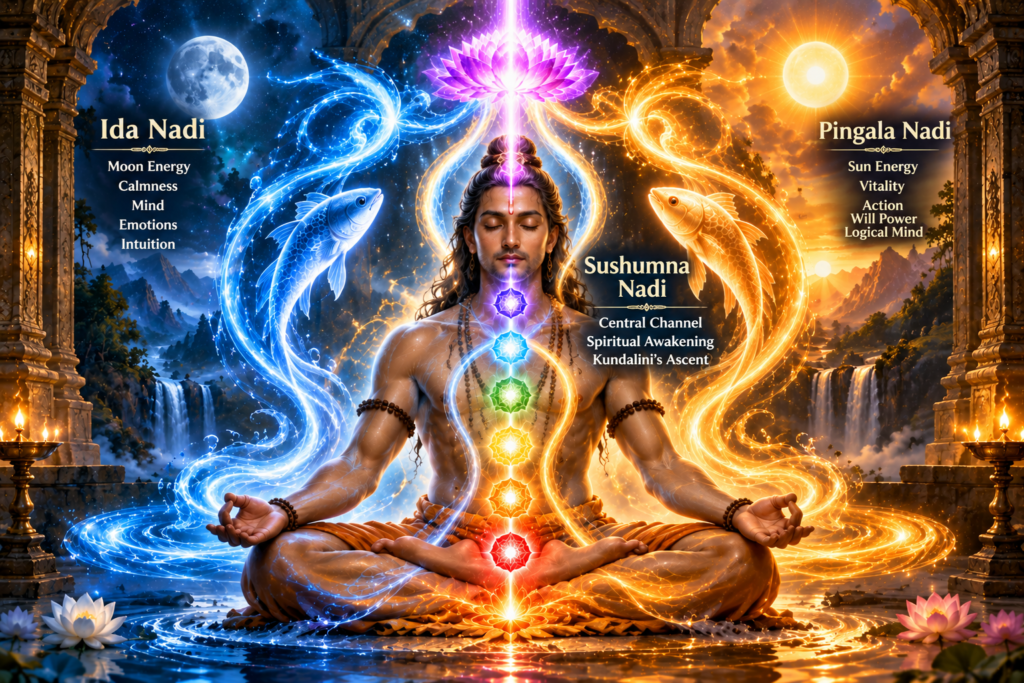
Yogic physiology speaks of iḍā and piṅgalā, traditionally associated with the lunar and solar currents of subtle energy. The breath continually moves between these channels, while the mind moves among sensory impressions, memories and desires.
In this symbolic language, the mind is like a fish moving through the waters of experience. An ordinary person remains caught in the current of external objects and emotional reactions. A disciplined practitioner learns to observe and regulate these movements.
Through breath awareness, concentration and other yogic disciplines, the practitioner is said to gather the outward-moving currents into the central channel, suṣumṇā. The aim is not to perform these practices casually or mechanically, but to stabilise attention and reduce the compulsive movement of the mind.
The fish therefore represents the restless mind and the moving currents of prāṇa. To master matsya is to learn how not to be swept away by them.
This interpretation should not be presented as modern anatomy or physiology. Terms such as nāḍī, prāṇa and suṣumṇā belong to traditional yogic models of the body and consciousness. Their significance is spiritual and experiential rather than identical with the structures described by contemporary biomedical science.
The Fourth Makara: Mudra – The Subtle Science of Containing Pranic Energy
Sealing and Directing Inner Energy
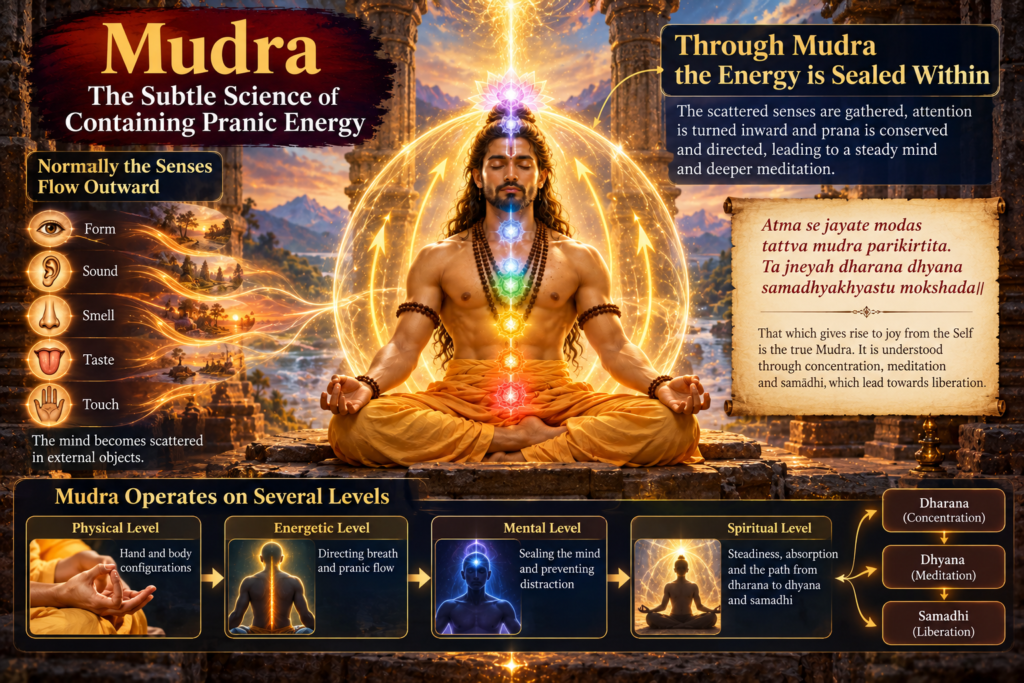
The word mudrā can refer to a gesture, seal, posture or symbolic configuration. In Tantric and yogic practice, it may refer to physical gestures, bodily techniques, mental attitudes or ritual signs, depending on the text and lineage.
It is therefore too narrow to translate mudrā simply as a hand gesture. At the same time, it would be misleading to describe it as a scientifically proven “energy circuit” or as a form of established neuroscience. The language of subtle energy belongs to the traditional vocabulary of yoga and Tantra.
A verse cited in discussions of inner mudrā states:
Atma se jayate modas tattva mudra parikirtita.
Ta jneyah dharana dhyana samadhyakhyastu mokshada॥
The meaning given is that the constant arising of bliss from one’s own Self is the true Mudra. This Mudra unfolds further as Dharana, Dhyana and Samadhi, which lead the practitioner towards liberation (or that which gives rise to joy from the Self is known as the true mudrā. It is understood through concentration, meditation and samādhi, which lead towards liberation).
Mudrā as inward orientation
In its broader spiritual sense, mudrā is the sealing of consciousness within its source. The senses normally flow outward towards sound, touch, form, taste and smell. Through meditation and discipline, the practitioner gathers this scattered attention and turns it inward.
A mudrā may therefore operate on several levels:
as a physical configuration of the hands or body;
as a method of directing breath and attention;
as a seal that prevents the mind from dissipating itself in distraction;
as an inner attitude of steadiness and absorption.
The purpose is not to “trap bio-electricity” in a manner established by modern science. Rather, traditional Tantric language describes the practice as conserving and directing prāṇa so that attention becomes steadier and meditation deepens.
In this sense, mudrā is a key to the transition from concentration to meditation and, ultimately, to samādhi.
The Fifth Makara: Maithuna – The Supreme Yogic Union of Shakti with Shiva in Sahasrara
Maithuna is the most sensitive, profound and frequently distorted subject among the Panchamakara. Those who remain confined to its literal meaning can reduce Tantra to a very different idea, whereas the higher Tantric texts cited here—the Kularnava Tantra, Yogini Tantra and Meru Tantra—present it as a highly secret yogic process (many Tantric and yogic texts give the term an internal meaning. In this interpretation, maithuna signifies the union of Śiva and Śakti within the practitioner).
The non-duality of Shiva and Shakti is central to Tantric philosophy. Shiva represents consciousness, while Shakti represents Mul Prakriti and the dynamic power / energy. In the Muladhara Chakra at the base of the body, Kundalini Shakti is described as lying dormant and is regarded as a form of the Divine Mother. At the crown of the head, in Sahasrara, resides Paramashiva.
The Great Message of the Meru Tantra
The Meru Tantra states:
Ida Pingalayoh pranan Sushumnayam pravartayet.
Sushumna Shaktir uddishta, jivo ‘yam tu punah Shivah.
Tayos tu sangatamodah, suratam nama kirtim.॥
When the group of Pranas is drawn from Ida and Pingala and directed into the Sushumna Nadi, Sushumna is designated as Shakti, while the individual being in the form of Prana is Shiva. Their union is called Surata, the true divine Maithuna.
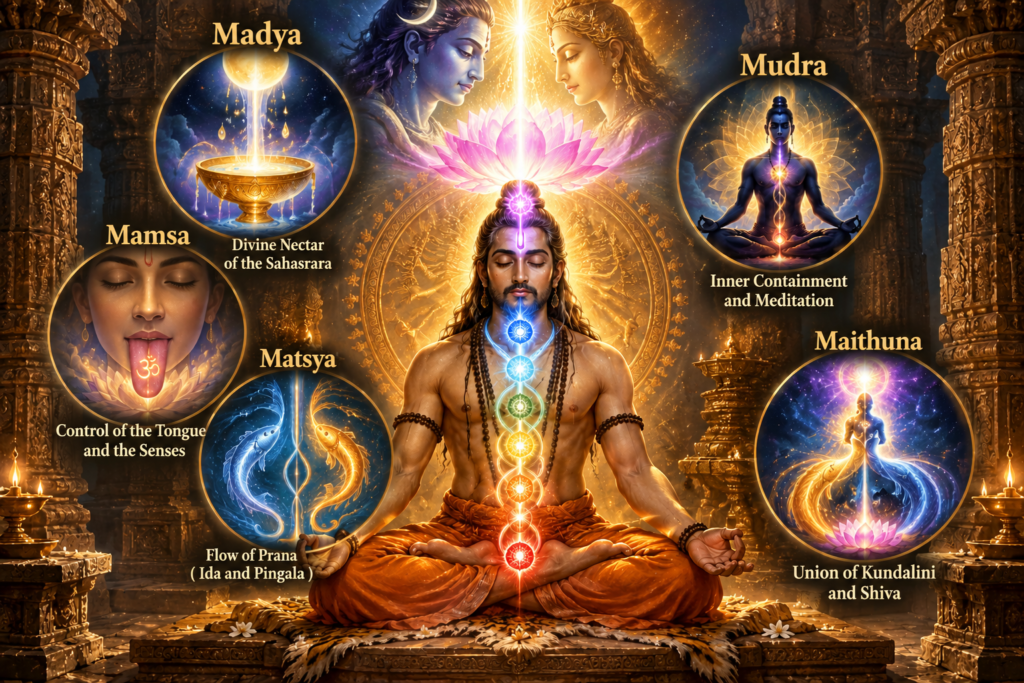
The meaning of Kuṇḍalinī’s ascent
In traditional language, Kuṇḍalinī rises through the central channel and unites with Śiva at the sahasrāra. This union symbolises the culmination of spiritual practice: the reconciliation of energy and awareness, embodiment and transcendence, Śakti and Śiva.
The resulting bliss is described as immeasurably greater than ordinary sensory pleasure. It is not dependent upon another person’s body and should not be confused with sexual gratification.
However, the metaphor should be handled responsibly. A person who claims that all sexual relationships are inherently inferior, impure or spiritually destructive is not necessarily presenting a balanced account of Tantra. Different Tantric lineages have treated sexuality in different ways, ranging from complete renunciation to carefully regulated ritual practice and purely internal symbolism. What they share is the insistence that desire must not be confused with liberation.
In the inner yogic interpretation, maithuna is the union of Śiva and Śakti within consciousness.
The Living Principle of Tantra
The deeper significance of the five makaras lies in the transformation of the literal into the symbolic, the external into the internal and instinct into awareness.
Tantra does not become profound merely because it uses secret terminology. Nor does a person become a practitioner by adopting the outward appearance of a Tantric. The tradition repeatedly places emphasis on discipline, initiation, ethical preparation, control of the senses, guidance from a competent teacher and the transformation of consciousness.
When the language of the five makaras is reduced to alcohol, meat, fish and sexual indulgence, it becomes an excuse for appetite. When it is understood only as a rigid rejection of all physical life, it becomes another form of denial. Its deeper purpose is to transform the forces that ordinarily bind the individual—desire, speech, sensation, breath, instinct and attachment—into instruments of awareness.
The body, in this vision, is not an obstacle to spiritual life. It is the field in which spiritual awakening takes place. The senses are not merely enemies to be destroyed; they are energies to be understood and governed. Desire is not automatically liberation, but neither can it be overcome through hypocrisy.
The five makaras therefore point towards a movement from the outer to the inner:
from intoxication to spiritual absorption;
from consuming flesh to mastering speech and instinct;
from following the currents of the mind to regulating prāṇa;
from external signs to inward concentration;
from sensual union to the integration of Śiva and Śakti within consciousness.
This is the inner message of the five makaras: Tantra is not a licence for indulgence. It is a demanding path of transformation in which the body, breath, senses and mind are gradually brought into alignment with higher awareness.
Panchamakara: Gross Misconception and the Inner Tantric Meaning
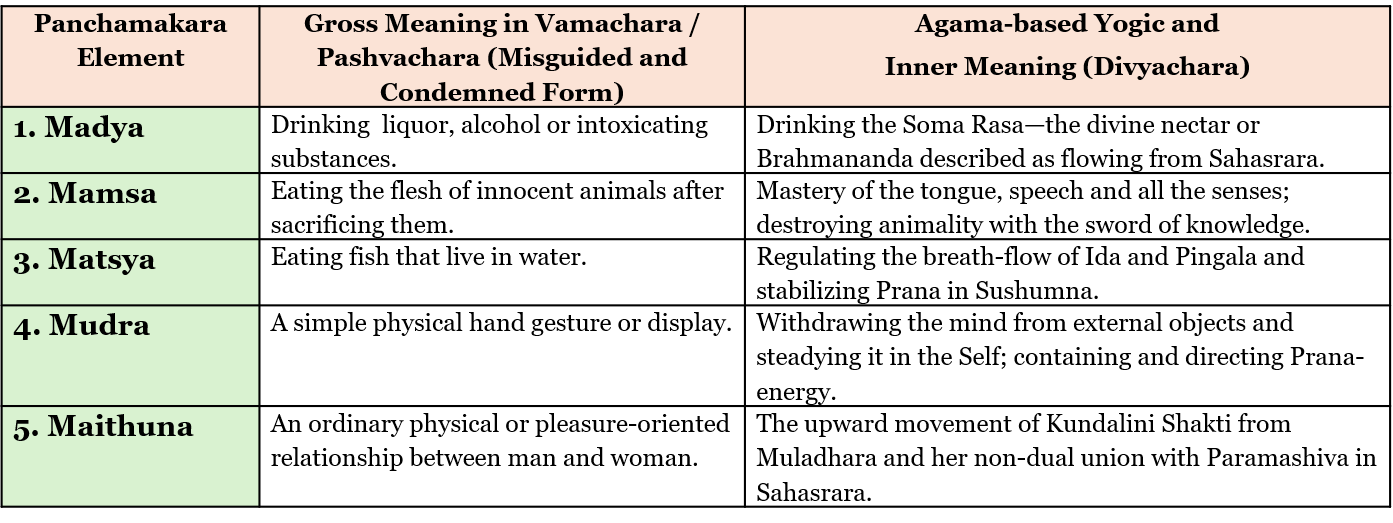
This table presents one important interpretive tradition. It should not be taken to mean that every Tantric text uses the five terms in exactly the same way. Tantra is not a single uniform system; its texts, rituals and interpretations vary across Śaiva, Śākta, Kaula, Buddhist and regional lineages.
=========================
Refarences :
Mahayog Vigyan by Yogananad Brahmachari (current name: Yogendra Vigyani), published by Smt. Annapurna Devi, Ashiyana, 84-Ganga Nagar, Rishikesh (Dehradun), Uttarakhand (Fifth Edition: 2008, First Edition: 1938).
Kularnava Tantra — An authentic text of Sanatan Tantra literature, from which the core Panchmakar verses and internal yogic meanings of the 10th and 2nd Ullasa are derived.
Meru Tantra — A prominent Tantra Shastra text detailing the yogic secrets of Ida, Pingala, Sushumna, and the inner meanings of Surat and Mamsa-Sadhana.
Yogini Tantra — A primary Shakta Agama text detailing the nectar (Soma Rasa) flowing from the Sahasrara and Divyachara.
Srimad Bhagavatam — Eleventh Canto, referenced for the historical and scriptural antiquity of worship according to Tantric injunctions.
Anupam Trivedi has spent over three decades studying and reflecting upon Sanatan scriptures, including the Vedas, Upanisads, Itihāsa, and Purāṇas. He writes on cultural philosophy and ancient literature to present traditional insights with accuracy and clarity. Read full bio →