
If You have not read What is Tantra Part 1 Please Click – [What is Tantra Part 1]
We All Practice Tantra Without Realizing It: The Truth Behind Everyday Rituals
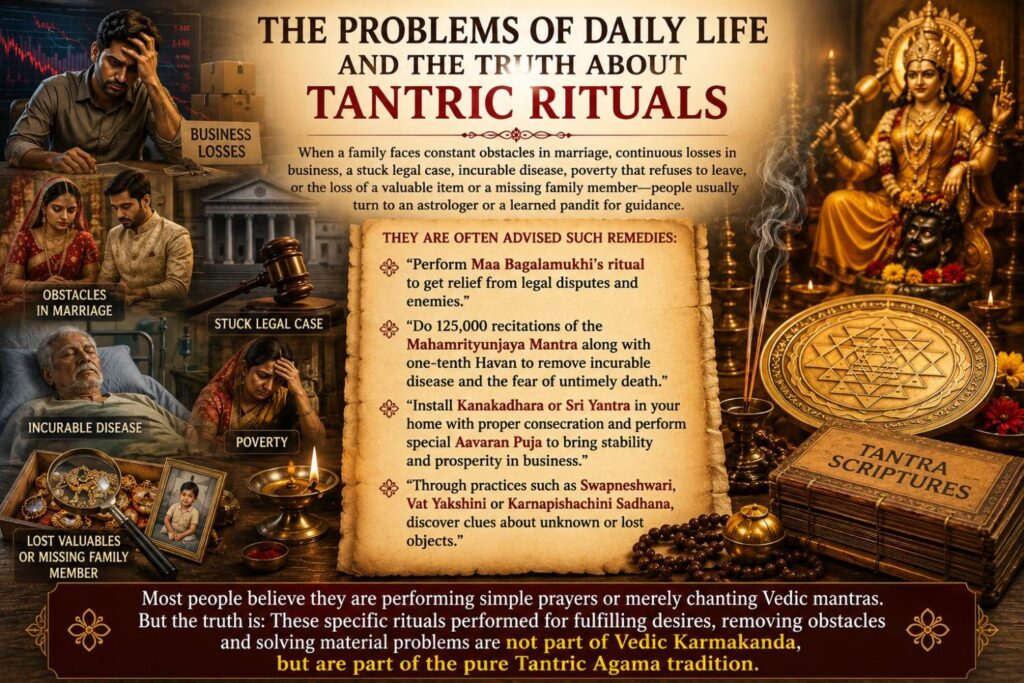
When a family faces persistent delays in marriage, continuous business losses, protracted legal disputes, chronic illness, financial distress, or even the loss of a valuable heirloom or a missing family member, people typically consult an astrologer or a learned pandit.
The remedies prescribed often sound like this:
“Perform an anushthana of Maa Bagalamukhi to overcome legal battles and neutralize adversaries.”
“Undertake a Mahamrityunjaya Japa (125,000 recitations) followed by Dashamsha Homa to avert life-threatening illness and untimely death.”
“Consecrate a Kanakadhara Yantra or Sri Yantra in your home with specialized Avarana Puja to stabilize wealth and prosperity in your business.”
“Employ specific traditional sadhanas-such as Swapneshwari, Vata-Yaskshini, or Karnapishachini – to discover the whereabouts of lost valuables or missing persons.”
Most people assume they are merely participating in standard devotional worship or Vedic chanting. The reality, however, is quite different: all these specialized rituals meant for fulfilling specific desires, overcoming crises, and resolving tangible afflictions are drawn directly from the applied tradition of the Tantra Agamas.
“Almost every single time you perform a specialized ritual, remedial prayer, or anushthana to resolve a real-life crisis, you are actively practicing Tantra.”
Tantra as a Process-Driven Science: Precise and Reproducible Results
The defining hallmark of Tantra Shastra is that it is strictly process-intensive.
Consider a modern physics or chemistry laboratory. If an experiment maintains the exact temperature, the precise ratio of compounds, the correct orientation, and the stipulated duration, the result is guaranteed and entirely reproducible. If that ratio is altered even slightly, the experiment fails or risks causing a hazardous reaction.
The exact same principle governs authentic Tantric sadhana:
Assured Outcomes through Scriptural Precision: when a sadhana strictly follows canonical rules, correct meter (Chhanda), presiding seer (Rishi), deity (Devata), seed syllable (Bija), vital potency (Shakti), protective pin (Kilaka), limb placements (Anga Nyasa and Kara Nyasa), directional alignment, seating (Asana), and complete five-fold Purashcharana (Japa, Homa, Tarpana, Marjana, and Brahmana-Bhojana) the result is bound to follow.
The Peril of Procedural Deviations (Karma-Vaigunya): If an unqualified person attempts desire-driven (Kamya) rites out of greed, without competent guru guidance or by improvising procedural steps, Mantra Mahodadhi (25.73–74) warns that the misapplied mantra turns hostile rather than granting the desired fruit (Tasyāritvaṃ vrajenmantrastasmānna tatparo bhavet).
Because of this exacting, scientific nature, our ancient acharyas preserved Tantric knowledge within strict guru-disciple lineages (Guru-Shishya Parampara) rather than opening it to indiscriminate experimentation.
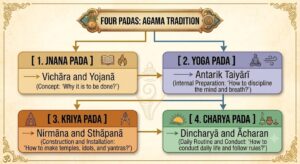
The Four Foundational Pillars of Agama Literature: The Chatushpada Framework
Every comprehensive Agama text is organized into four pillars (Padas). This architecture can be understood using the analogy of designing and living in a home:
1. Jnana Pada (Philosophy & Conceptual Blueprint):
Just as one first envisions the purpose and layout of a house before laying the foundation, Jnana Pada explains foundational metaphysics—the nature of the Divine, the individual soul (Jiva), the mechanics of cosmic manifestation, and how human consciousness liberates itself from suffering and bondage.
2. Yoga Pada (Internal Discipline & Preparation):
Before undertaking construction, one must prepare physical and mental stamina. Yoga Pada provides the practical methodology to calm the fluctuations of the mind, regulate the vital breath (Pranayama), tune into the inner unstruck sound (Nada), and awaken the latent chakras and Kundalini along the spinal axis.
3. Kriya Pada (Sacred Architecture, Sculpting, and Consecration):
This is the engineering and architectural core of the tradition. It details site selection for temples, the sacred mathematics of geometric Yantras, the sculpting of stone and metal murtis, and the precise rites required to anchor living divine presence into those forms through Prana Pratishtha.
4. Charya Pada (Daily Conduct, Ethics, and Ritual Living):
Once a house is built, daily routines and rules keep it harmonious. Charya Pada establishes the daily disciplines of a practitioner—from morning ablutions and ethical conduct to personal worship (Shodashopachara), festival observances, and duties toward family and society.
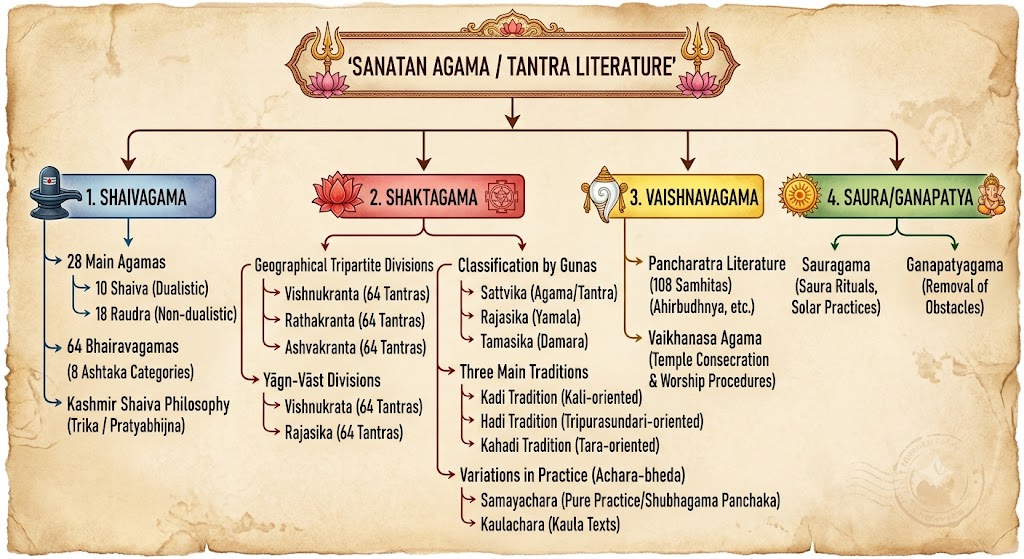
Broad Classification of Tantra Literature: The Agama Tree
The entire corpus of Sanatana Dharma’s Agama and Tantra literature is structured across distinct traditions, geographical streams, and lineages:
Major Agama Traditions: Practical Utility, Contents, and Canonical Texts
(A) Shaivagama Tradition: Overcoming Fear, Mortality, and Psychological Bondage
Primary Purpose and Applications:
Shaivagama is invoked when confronting chronic illness, the fear of premature death, deep-seated anxiety, grief, and the psychological limitations of the ego.
Core Subject Matter:
The Triad of Pati, Pashu, and Pasha: God is Pati (the Lord), the human being is Pashu (the soul bound by worldly attachments), and ignorance or karmic impressions are Pasha (the tether). Through disciplined practice, the tether is severed, transforming the bound soul into liberated Shiva consciousness.
Mahamrityunjaya and Rudrabhisheka Frameworks: The 16th chapter (Taranga) of Mantra Mahodadhi delineates precise procedures for Mahamrityunjaya Japa, Mrita-Sanjivani rites, and practices for vital longevity.
The 112 Contemplative Techniques: The Vijnana Bhairava Tantra presents 112 practical meditation methods—centering on breath pauses, sound absorption, and perceptual shifts—offering direct and immediate access to deep mental stillness.
Spiritual Fruits: Complete removal of the fear of death, vibrant health, fearlessness, self-realization, and ultimate liberation (Kaivalya Moksha).
Foundational Scriptures:
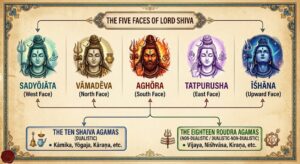
10 Shaivagamas (Dualistic): Kamika, Yogaja, Chintya, Karana, Ajita, Dipta, Sukshma, Sahasra, Anshuman, and Suprabha.
18 Rudragamas (Qualified Non-Dualistic): Vijaya, Nishvasa, Svayambhuva, Agneya, Bhadra, Raurava, Makuta, Vimala, Chandrahasa, Mukhabimba, Prodgita, Lalita, Siddha, Santana, Narasimha, Parameshvara, Kirana, and Vatula.
64 Bhairavagamas (Non-Dualistic, across 8 Octads): Bhairavashtaka (including Svacchanda, Kapalisha), Yamalashtaka (including Brahmayamala, Rudrayamala), Matashtaka, Mangalashtaka, Chakrashtaka, Bahurupashtaka, Vagishashtaka, and Shikhashtaka.
Kashmir Shaivism (Trika Lineage): Shiva Sutras (revealed to Vasugupta), Spanda Karika, Tantraloka (by Acharya Abhinavagupta), and Vijnana Bhairava Tantra.
(B) Shaktagama Tradition: Energy, Sovereignty, Attraction, and Total Protection
Primary Purpose and Applications:
Shaktagama addresses persistent business setbacks, poverty, competitive opposition, legal entanglements, relationship discord, lack of personal vitality, and the aspiration to harmonize worldly prosperity with inner spiritual ascension.
Core Subject Matter:
The Ten Mahavidyas: Texts like Mantra Mahodadhi and Sharadatilaka detail how each Mahavidya governs a specific dimension of human experience: Bagalamukhi for neutralizing litigation and hostility, Tara and Matangi for eloquence and intellect, Kali for dismantling fear and negativity, and Tripurasundari (Sri Vidya) for supreme sovereignty and spiritual harmony.
Sound-Matrices (Matrikas) and the Six Applied Rites (Shatkarma): Harnessing the primal vibrations of the fifty Sanskrit syllables to awaken inner vital centers, accompanied by ethical protocols for neutralizing harmful influences.
Sri Chakra (Sri Yantra) Sadhana: Meditating upon the nine interlocking triangles converging at the central Bindu, channeling macrocosmic creative energy into the home and the human body.
Spiritual Fruits: Simultaneous attainment of worldly fulfillment (Bhoga) and spiritual liberation (Moksha), charismatic presence, speech potency (Vak-Siddhi), and the eradication of chronic financial distress.
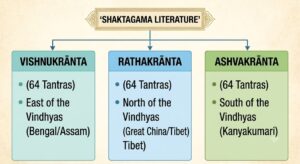
Geographical Classification (The 192 Tantras Across Three Krantas):
Vishnukranta (Vindhyas to the Eastern Sea / Bengal and Assam – 64 Tantras): Kalitantra, Kularnava, Jnanarnava, Nilatantra, Phetkarini, Varahi, Yogini, Mundamala, Tantraraja, Lalita, Malinivijaya, and others.
Rathakranta (Vindhyas Northward toward Tibet / Mahachina – 64 Tantras): Matsyasukta, Mahishamardini, Merutantra, Mahanila, Mahanirvana, Bhutadamara, Bijachintamani, Taravilasa, Prapanchasara, Dakshinamurti, and others.
Ashvakranta (Vindhyas Southward to Kanyakumari – 64 Tantras): Bhutashuddhi, Guptadiksha, Brihatsara, Varnasara, Kriyasara, Shivatantra, Yogatantra, Kamini, Samayachara, and others.
The Three Doctrinal Schools:
Kadi Tradition: Centered on Bhagavati Dakshina Kali (Scriptures: Tripura Upanishad, Kalikopanishad).
Hadi Tradition: Centered on Bhagavati Tripurasundari (Scriptures: Tripuratapini Upanishad, Bhavanopanishad, Kamakalavilasa).
Kahadi Tradition: Centered on Bhagavati Tara / Nila Saraswati (Scriptures: Tararahasya, Tarapradipa).
Samayachara (The Shubhagama Panchaka): Vasishta, Sanaka, Sanandana, Shuka, and Sanatkumara Samhitas—which emphasize pure internal meditation within the heart lotus, setting aside external ritual accessories.
(C) Vaishnavagama Tradition: Family Harmony, Stability of Wealth, and Total Surrender
Primary Purpose and Applications:
Vaishnavagama resolves chronic domestic conflict, emotional instability, financial volatility, and the need for divine protection, while nurturing unconditional devotion and surrender to the Divine.
Core Subject Matter:
The Five Manifestations of the Supreme (Pancha-Vyuha): Para (the Transcendent Divine), Vyuha (cosmic emanations: Vasudeva, Sankarshana, Pradyumna, Aniruddha), Vibhava (incarnations), Antaryami (the indwelling witness), and Archavatara (the consecrated temple murti).
Sudarshana Mahamantra and Lakshmi Sadhana: Ahirbudhnya Samhita and Lakshmi Tantra provide systematic rites invoking the Sudarshana Chakra to dissolve psychic distress and planetary afflictions, alongside Lakshmi rites to stabilize sustainable wealth.
Sacred Temple Engineering: Premier historical temples throughout India (such as Tirupati Balaji and Srirangam) were designed, consecrated, and maintained entirely through Vaishnava Agamic protocols.
Spiritual Fruits: Lasting domestic peace, enduring prosperity, comprehensive spiritual protection, and supreme absorption into the Divine presence (Vaikuntha-Prapti).
Foundational Scriptures:
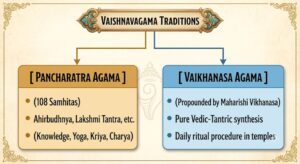
Pancharatra Agamas (108 Samhitas): Ahirbudhnya Samhita, Lakshmi Tantra, Ishvara Samhita, Jayakhya Samhita, Satvata Samhita, Paushkara Samhita, Parashara Samhita, and Vishnutilaka.
Vaikhanasa Agama: The canonical aphorisms and worship manuals established by Sage Vikhanas, representing a seamless synthesis of Vedic Shrauta sacrifices and Agamic deity consecration.
(D) Sauragama and Ganapatyagama Traditions: Vitality, Health, and Removing Obstacles
Sauragama (Worship of Bhagavan Surya):
Applications & Fruits: Alleviating ocular disorders, chronic skin afflictions, physical debility, and bone weaknesses; enhancing vitality, personal radiance, confidence, and mental clarity.
Subject Matter: Recognizing Surya as the living soul of the cosmos (Sūrya ātmā jagatastasthuṣaśca), solar energy absorption techniques, morning Gayatri upasana, and the transformative rites of the Surya Patala.
Key Scriptures: Sauragama texts, Surya Patala, and Suryopanishad Bhashya.
Ganapatyagama (Worship of Bhagavan Sri Ganesha):
Applications & Fruits: Clearing unseen blockages, delays, and obstacles in new ventures, businesses, architectural construction, or spiritual undertakings.
Subject Matter: Purifying the root energy center (Muladhara Chakra), opening the initial gateway for Kundalini awakening, and sharpening discriminative intellect.
Key Scriptures: Ganesha Vimarshini, Ucchishta Ganapati Tantra, and Ganesha Purvatapini Bhashya.
What Have We Really Discovered So Far in What is Tantra?
If you have stayed with this exploration till here, give yourself credit. Tantra and Agama literature is vast, deeply layered, and often obscured behind centuries of misunderstandings. Navigating its real scope is no small feat.
Looking back at this vast scriptural landscape, the true picture of our living tradition begins to reveal itself:
You Discover That Your Everyday Pujas Are Actually Tantra:
Most of us grew up believing that the special rituals our families perform—whether seeking a suitable marriage alliance, overcoming legal entanglements, averting serious illness, or stabilizing family finances—are simple, generic prayers. In truth, almost every remedial ritual (Anushthana) and temple ceremony we practice is guided directly by the applied methods of the Tantra Agamas.
You Realize Tantra Is as Vast as the Vedas—The “Fifth Veda”:
Far from being a collection of obscure fringe rituals, the Agamas form a massive body of classical literature spanning Shaiva, Shakta, Vaishnava, Saura, and Ganapatya traditions. They preserve the foundational rules for our sacred temples, consecrated murtis, spiritual disciplines, and everyday ethics.
You Now Understand Why Some Rituals Never Brought Results:
Perhaps the most vital realization is understanding why past rituals may have felt ineffective. Tantra is an exact, process-intensive science. Just like a delicate chemistry experiment, every step—the Vidhi, direction, sound vibration, and mental discipline—must align with scriptural standards. When procedures are altered or attempted without competent guidance, the outcome fails to manifest.
Having established the foundational definitions, the triad of Mantra-Tantra-Yantra, and the vast architecture of the classical Agamas across Parts 1 and 2, we are ready to move into the deepest layer in Part 3.
======================
References:
Āgamarahasyam (Part 1) – Paramahamsa Sri Saryuprasad Dwiwedi (Ed. & Commentary by Dr. Sudhakar Malaviya), Chowkhamba Sanskrit Series Office, Varanasi.
Tantra-Mahavijñāna (Vol. 1) – Pt. Shriram Sharma Acharya & Dr. Chamanlal Gautam, Sanskriti Sansthan, Bareilly, 1969.
Mantramahodadhi – Mahīdhara (Commentary by Dr. Sudhakar Malaviya), Chaukhamba Sanskrit Pratishthan, Delhi.
Kalyan: Dharma-Shastra Ank (pp. 200–201), Gita Press, Gorakhpur.
Discourses of Jagadguru Shankaracharya Swami Nishchalananda Saraswati Ji, Govardhan Math, Puri.
Anupam Trivedi has spent over three decades studying and reflecting upon Sanatan scriptures, including the Vedas, Upanisads, Itihāsa, and Purāṇas. He writes on cultural philosophy and ancient literature to present traditional insights with accuracy and clarity. Read full bio →
Pingback:What Is Tantra? Understanding Tantra Shastra — Part 1 | Mantra, Tantra & Yantra
Pingback:What is Tantra? Part 3: Sacred Science or Spiritual Trap?
Pingback:What Is Tantra? Part 4: Mudras, Samputa and Yajna-Havana Connection with Tantra - Bhavam Bhavaani
Pingback:What is Tantra? Part 5: panchmakar-secrets