
If you have not read the earlier articles of What is Tantra? series, here is a brief overview of what was covered:
What Is Tantra? Part 1: Mantra, Tantra and Yantra
We explored the foundational meaning of Tantra Shastra and the relationship between Mantra, Tantra and Yantra.
What Is Tantra? Part 2: Common applied Tantric procedures
We examined the Agama literature of the Shaiva, Shakta and Vaishnava traditions, along with Jnana, Yoga, Kriya and Charya and their connection with practical Tantric worship.
What Is Tantra? Part 3: Mantra, Devata and Sadhana
We explored the relationship between Mantra, Devata and Sadhana through traditional accounts and practices associated with the Tantric tradition.
What Is Tantra? Part 4: Mudra, Samputa and Yajna-Havana
We examined practical elements of Tantric worship, including Mudra, Nyasa, Digbandhana, Samputa and Yajna-Havana.
In What Is Tantra? Part 5: We discussed Panchamakara: Madya, Mamsa, Matsya, Mudra and Maithuna, one of the most misunderstood subjects associated with Tantra.
In this Part 6 of What Is Tantra? series we will understand about siddhis, their types and many examples in different Yugas and in Kaliyuga as well
The Meaning of Siddhi — Its Literal, Scriptural and Spiritual Significance
In Sanatan traditions of Yoga and Tantric literature, Siddhi is a profound, multidimensional and far-reaching concept. From everyday language to the highest teachings of Vedanta and the Agama texts, its meaning changes according to the context.
In modern society, siddhi is often reduced to miraculous powers—such as flying through the air, becoming invisible, or controlling ghosts and spirits. Yet India’s seers and Acharyas understood it in a far nobler, more practical, and more spiritual sense. In this first section, we examine the literal meaning of siddhi, its scriptural context, and its supreme spiritual importance.
The Literal and Common Meaning of Siddhi
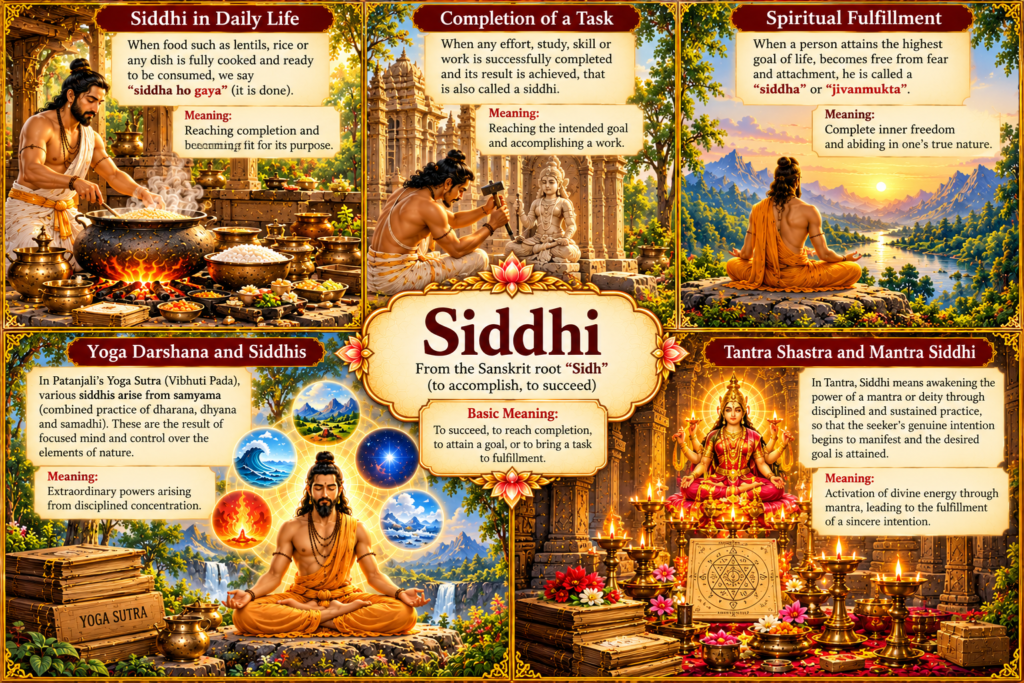
The word siddhi is derived from the Sanskrit root sidh, which means to succeed, to attain completion, to reach a goal or destination, or to accomplish a task.
On this literal basis, siddhi is not connected only with supernatural miracles. It refers to the perfection or fulfilment that can arise in every field of life and spiritual practice.
This can also be understood from the practical language used in the world of sadhus and saints. As the renowned saint and speaker Acharya Raghavacharya Ji and Shri Rajendra Das Ji repeatedly emphasise in their discourses, in the Sanatana ascetic tradition, when dal, rice, or any other food is fully cooked and becomes fit to be eaten, it is said to have become siddha—“accomplished” or “perfected.”
Here, becoming siddha means having attained one’s complete state, maturity, and original purpose. In the same way, when a human being attains the highest goal of life, becoming completely free from fear and delusion, he or she is called siddha or jivanmukta (liberated while living).
In the narrative of the Srimad Bhagavata Mahapurana, when King Parikshit hears the discourse of Shukadeva Ji, he becomes “kritakritya” – one whose purpose has been fulfilled. He declares, “Siddho’smi” – “I have become siddha.” The meaning is that his fear and ignorance have been completely destroyed and he has matured into his true nature.
The Scriptural and Yogic Meaning of Siddhi
When we turn to scriptural and philosophical texts, two principal dimensions of siddhi emerge:
Yogic and Tantric power (vibhuti)
Spiritual fulfilment (Brahma-siddhi)
Yogadarshana and the Vibhutis
In the Vibhuti Pada of Maharishi Patanjali’s Yoga Sutras, the various powers that arise through saiyama (Practicing Restraint) –the combined practice of dharana, dhyana, and samadhi are called siddhis.
Puri Shankaracharya Ji Maharaj explains in his discourses that siddhis such as Anima and Mahima are the results of the seeker’s concentrated mind and control over the elements of nature – earth, water, fire, air, and space.
Yoga Sutra 3.37 clearly states that these capacities are called siddhis in ordinary states, but on the path of samadhi they can become obstacles or upasargas for the seeker if he becomes entangled in them.
Tantra Shastra and Mantra-Siddhi
In the field of Tantra and Mantra Shastra, siddhi means awakening the energy of a particular mantra, deity, or method of sadhana through continuous and disciplined japa and ritual practice. Through this, the seeker’s resolve begins to bear fruit and he attains his desired objective.
In Tantric sadhana, the mantra is regarded as the ground upon which the deity or divine energy descends. Tantric authors have described mantra-samskara, utkilana, and the rigorous methods of japa as the means of attaining mantra-siddhi.
The Highest Spiritual Significance of Siddhi
In Indian philosophy, spiritual fulfilment – Brahma-siddhi is regarded as superior to any miraculous power or material attainment.
In the fiftieth verse of the eighteenth chapter of the Bhagavad Gita, Lord Krishna tells Arjuna:
“Siddhim prapto yatha brahma tathapnoti nibodha me.
Samasenaiva kaunteya nishtha jnanasya ya para.”
Here, Lord Krishna makes it clear that the culmination of knowledge and the highest steadfastness is the true siddhi. By attaining it, the seeker directly realizes Brahman.
This means that material or yogic siddhis may come and go; they may be temporary and conditioned. But the true and eternal siddhi is the one that unites the individual soul with its original nature – Sachchidananda Brahma.
Renowned saints repeatedly emphasise that those who chase minor siddhis or mere magical feats such as reading minds, flying, or producing metal, miss the true purpose of life: God-realization and supreme divine love.
In contrast, the seeker who immerses himself in the chanting of God’s name, listening to sacred discourses (Bhagwaan Katha) and selfless devotion experiences an inner peace that remains undisturbed amidst the burning turmoil’s of worldly existence.
Types of Siddhis – Scriptural Classifications and Others
The scriptural literature, Yoga Darshana, Puranas and Tantric texts do not present one single, uniform classification of Siddhis. Different traditions describe different types based on levels of spiritual practice, Mantra-Vidya and Yogic experiences. It is important not to mix these traditional classifications indiscriminately, but to understand them separately in the context of their respective sources.
In this section, we will examine the types of Siddhis described in the Shrimad Bhagavata Mahapurana, the Yoga Sutras of Patanjali and Tantric practice.
Siddhis Described in the Shrimad Bhagavata Mahapurana — The Eighteen Siddhis
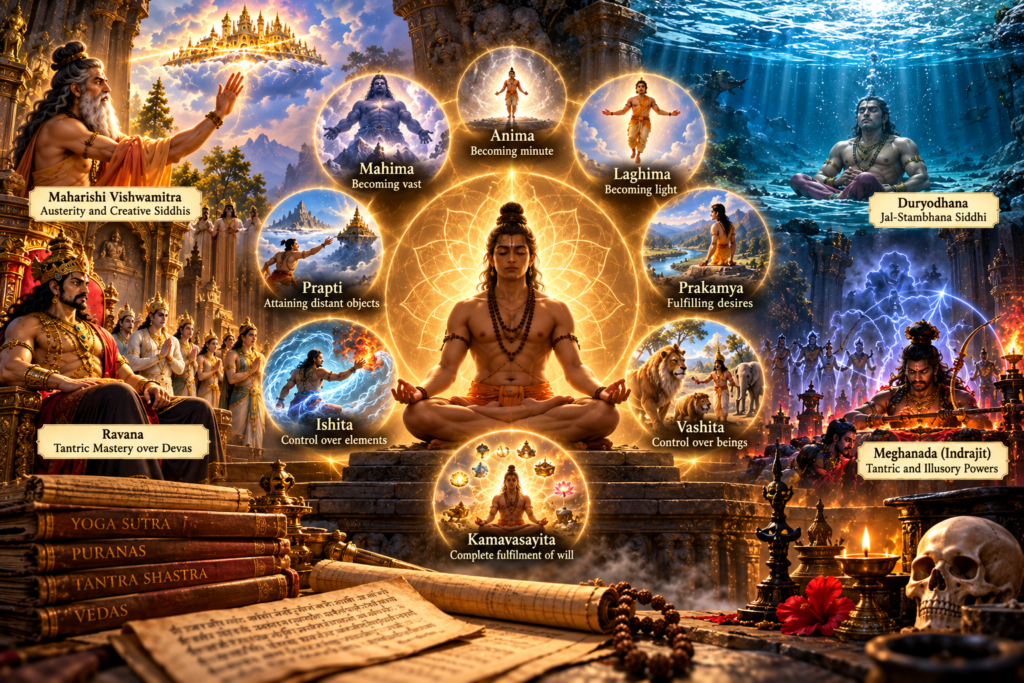
In the Fifteenth Chapter of the Eleventh Skandha of the Shrimad Bhagavata Mahapurana, Lord Shri Krishna gives Uddhava a systematic and detailed account of eighteen Siddhis that may arise through Yoga and spiritual practice. These comprise eight principal Siddhis and ten secondary Siddhis. The text also mentions certain additional Yogic abilities.
The Eight Principal Siddhis – Ashta Siddhis
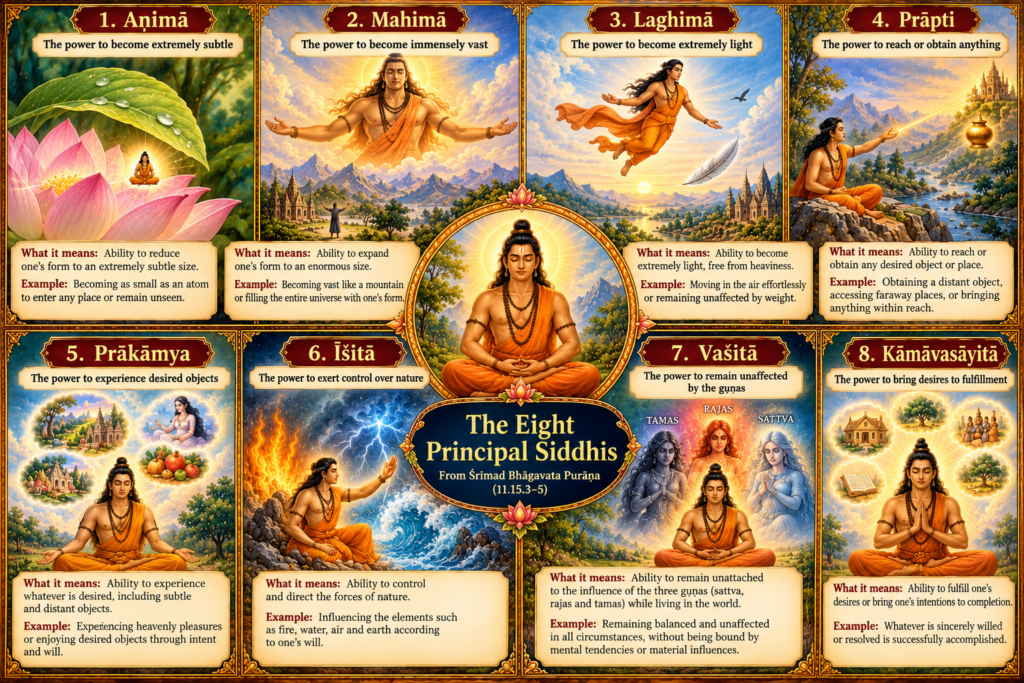
According to the Bhagavata Purana (11.15.3–5), the eight principal Siddhis are as follows:
- Anima: The ability to make one’s body or form as minute as an atom, enabling the practitioner to enter extremely small or subtle spaces.
- Mahima: The power to expand one’s form to an immense or vast size.
- Laghima: The ability to make the body extraordinarily light, like air or cotton, so that it is no longer affected by ordinary physical weight.
- Prapti: The ability to attain or access objects and places, even those located far away, through extraordinary mastery of the senses.
- Prakamya: The power to make one’s desires or resolves come to fruition and to experience whatever one wishes.
- Ishita: The supreme ability to exercise authority over nature and the fundamental elements.
- Vashita: The power of mastery and control over living beings, creatures and the senses.
- Kamavasayita: The ability to bring desires and intentions to complete fulfilment, so that whatever is truly willed may become attainable.
Note: Some other commonly circulated lists include Garima — the ability to become extremely heavy. However, the specific list of eight given in this passage of the Bhagavata Purana contains the eight Siddhis mentioned above.
The Ten Secondary Siddhis
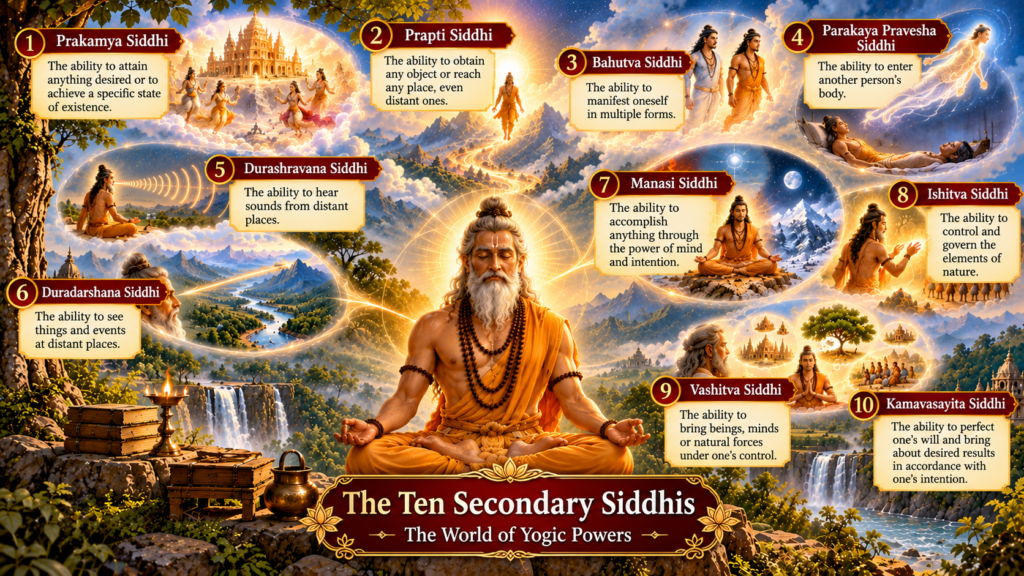
The Bhagavata Purana (11.15.6–7) also describes ten secondary Siddhis that may become accessible to a Yogi who has attained a high level of spiritual practice.
- Anurmitattva: Freedom from hunger, thirst and other bodily or environmental conditions, such as heat and cold.
- Dura-Shravana: The ability to hear sounds and voices clearly, even from extremely distant places.
- Dura-Darshana: The ability to see distant events, places or objects with clarity.
- Manojava: The ability to travel from one place to another with the speed of the mind, reaching a destination almost instantaneously.
- Kama-Rupa: The ability to assume any desired form or appearance.
- Parakaya-Pravesha: The Yogic ability to enter another body, whether living or dead.
- Svachchhanda-Mrityu: The ability to relinquish one’s life at a chosen time, according to one’s own will.
- Sura-Krida-Darshana: The ability to witness the divine pastimes and activities of celestial beings and Apsaras in the heavenly realms.
- Sankalpa-Siddhi: The ability to make whatever one resolves in the mind become reality in the intended form.
- Ajnā-Apratihatagati: The ability to issue commands or declarations that encounter no obstruction and are carried out without hindrance.
In addition, the Bhagavata Purana (11.15.8–9) mentions further Yogic accomplishments, such as Trikalagyata (knowledge of the past, present and future); the ability to know the thoughts of others; immunity from the effects of fire, water, the sun and poison; and the ability never to be defeated in battle or in Sadhana.
How Should Understand These Siddhis?
The eight principal Siddhis primarily describe mastery over the body, nature and one’s resolve. They include the ability to assume minute or giant forms, control one’s body weight, access distant objects, fulfil desires and exercise control on the 5 elements.
The ten secondary Siddhis are more closely associated with the senses, movement and transformation of form. They include distant hearing and vision, travelling at the speed of the mind, assuming different forms and choosing the time of one’s death.
What Are the Nine Nidhis?
The famous line in the Hanuman Chalisa mentions the nine Nidhis alongside the Siddhis:
“Ashta Siddhi Nava Nidhi Ke Data, Asa Bar Deen Janaki Mata.”
the Nidhis are the nine divine treasures associated with Kubera: Padma, Mahapadma, Shankha, Makara, Kachchhapa, Mukunda, Kunda, Nila and Kharva. Different texts and traditions sometimes give variations in their names and order; in certain lists, for example, Nanda appears in place of Kunda. Their individual descriptions also vary across traditions. Generally, they are understood as representing different forms of wealth, prosperity and abundance.
In simple terms, Siddhis represent extraordinary abilities, whereas Nidhis represent treasures or wealth. Hanuman Ji is described as the bestower of both.
The word Nidhi has deeper meanings
The word Nidhi itself means a treasure or storehouse of wealth. Traditionally, the nine Nidhis are regarded as being under the authority of Kubera and are therefore associated with material prosperity and abundance. However, in the interpretations of saints, the idea of a Nidhi is not limited to external wealth. It may also symbolize a state of completeness in which the seeker experiences no sense of deprivation.
One who is Sharnagat to God (complete surrender ) regards worldly riches as secondary, whereas those pursuing such riches lose the essence of spiritual practice.
The Yoga Sutras of Patanjali and the Siddhis of the Vibhuti Pada
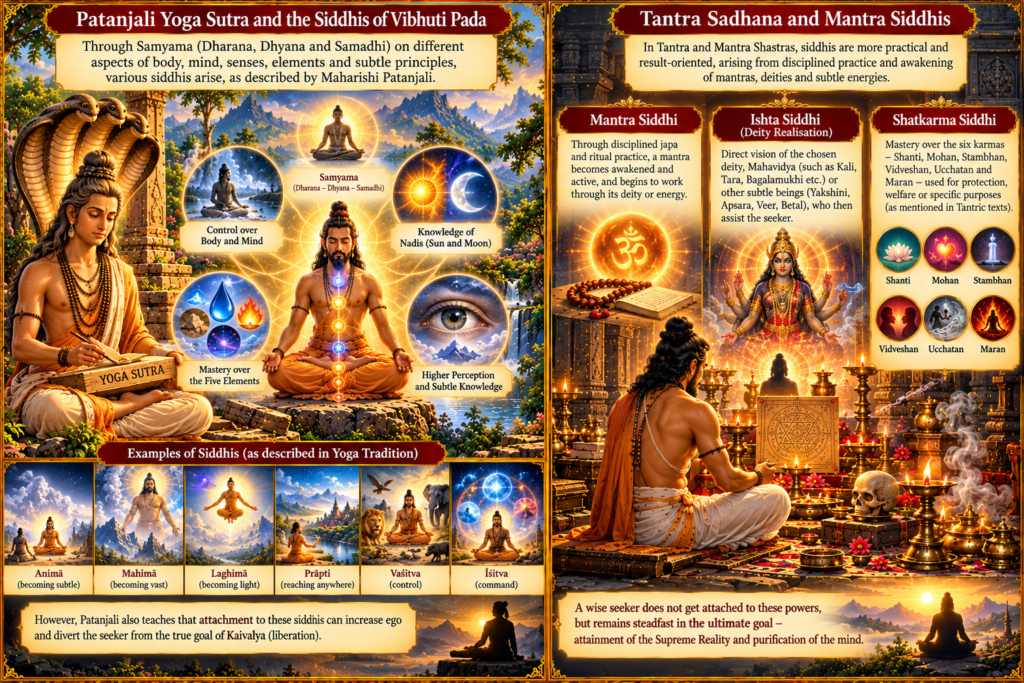
In the third section of his Yoga Sutras, known as the Vibhuti Pada, Maharishi Patanjali describes numerous extraordinary abilities that arise through the practice of Ashtang Yoga …Dharana, Dhyana and Samadhi.
Referring to this Yogic tradition in his discourses, Puri Shankaracharya Ji explains how the mysteries of nature are approached through various Yogic disciplines, Pranayama and Saiyam (Restraint). According to the Yoga Sutras, when a practitioner develops mastery through Yogic practices, various extraordinary perceptions, Anima-like abilities and knowledge of subtle realms may arise.
However, the central message of Yoga Darshana is that these Siddhis must not be the goal of a Yogi. These powers can elevate ego and lead the seeker away from the path of the ultimate goal of human life – Moksha.
Siddhis in Tantric Practice and Mantra-Vidya
In Tantric and Mantra Shastra, as discussed in works such as Tantrik Siddhiyan by Dr. Narayandutt Shrimali and Paravigyan Ki Sadhana Aur Siddhiyan by Tantrik Behl, Siddhis are presented in a more specific and result-oriented manner.
Within the Tantric tradition, they are broadly understood through the following categories:
Mantra-Siddhi: The attainment of mastery over a particular mantra through prescribed ritual observance and disciplined chanting, awakening its power so that it is believed to function through its presiding deity or divine energy.
Ishta-Siddhi / Deity Realisation: The direct vision or manifestation of one’s chosen deity, a Mahavidya — such as Kali, Tara or Bagalamukhi — or a particular spiritual entity, such as a Yakshini, Apsara, Vira or Baitala, at an advanced stage of spiritual practice. Traditional accounts describe such beings as appearing before the practitioner and offering assistance.
Shatkarma-Siddhi: Tantric texts describe six principal ritual operations: Shanti (pacification), Mohana (enchantment), Stambhana (immobilisation), Vidveshana (creating discord), Uchchatana (driving away or displacing), and Marana (destructive rites).
Their use is described in Tantric literature in connection with public welfare, self-protection or the management of particular circumstances. However, their misuse is traditionally regarded as a cause of spiritual downfall.
The extensive range of Siddhis described in the scriptures makes it clear that the path of spiritual practice contains many stages and extraordinary capacities. Yet, the truly discerning seeker is one who rises above the distractions of such powers and remains firmly committed to the ultimate goal: the realization of the Supreme or the complete purification of consciousness.
The Necessity of a Qualified Guru and Spiritual Discipline
The most Essential Condition for any Tantric Practice is – The Guidance and Protection of a Guru. They should never be experimented by reading in any book or watching videos online.
In Tantra, procedures such as Mantra-Utkilana, the removal of ritual impediments and Prana-Pratishtha require strict adherence to the procedure and under the supervision of a distinguished Guru, else it can lead to ineffective or potentially harmful results and also many a times loss of mental balance.
Tantric Siddhi’s – Examples from the Treta and Dvapara Yugas
In the history of Sanatana culture, the Treta and Dvapara Yugas were periods in which material, mental, and spiritual energies had reached their peak maturity. The siddhis attained in these ages through sadhana, tapasya, yogic power, and the Guru-shishya tradition were not mere fictional tales, but living and eternal realities.
In this section, we examine the major narratives, great souls, and historical examples of the Treta and Dvapara Yugas that establish the authenticity of siddhis.
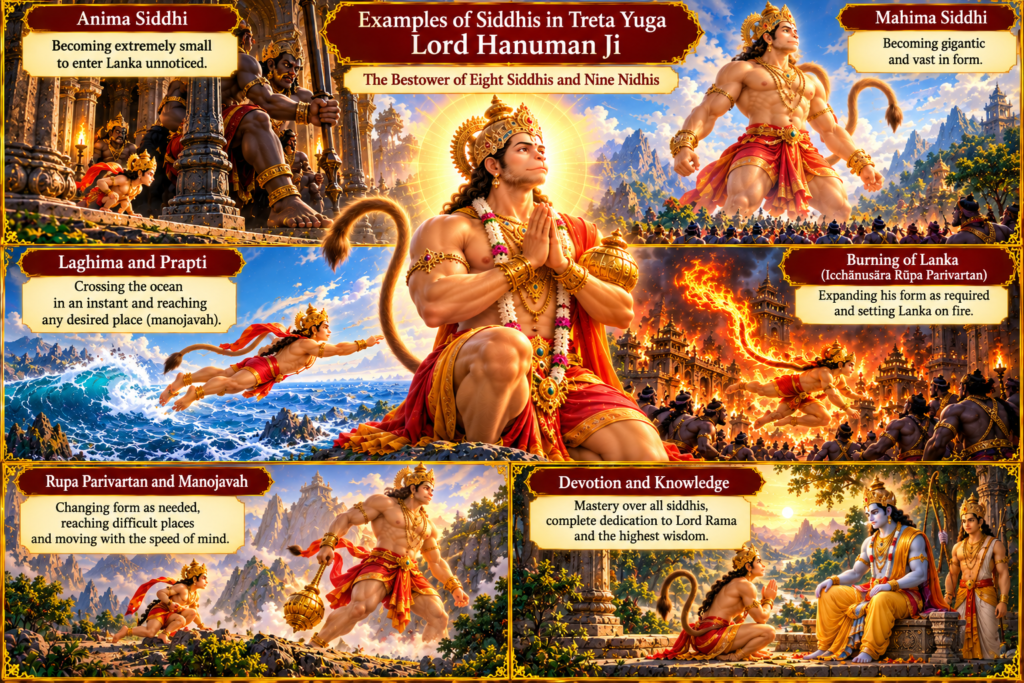
Treta Yuga: Hanuman Ji – Bestower of the Asht Siddi & Nav-Nidhi
Whenever the Siddhis of the Treta Yuga are remembered, the name of Sankatmochan Bhagwan Hanuman Ji is invoked with the highest reverence. Goswami Tulsidas Ji highlights this greatness in a famous line of the Hanuman Chalisa:
“Ashta Siddhi Nava Nidhi Ke Data, Asa Bar Deen Janaki Mata.”
Here it is essential to understand that Hanuman Ji is himself the bestower of the eight siddhis and nine nidhis—that is, he is their master.
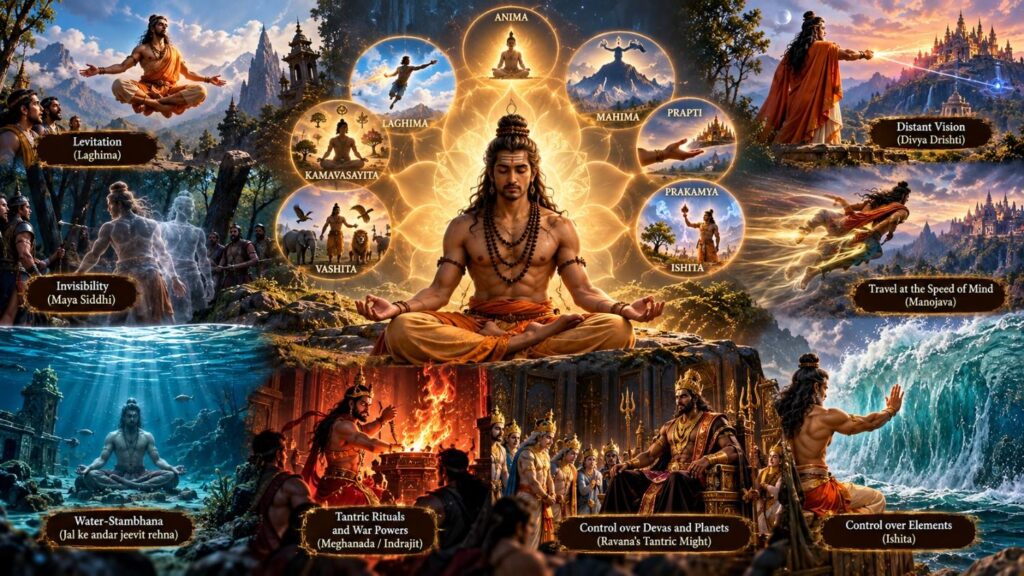
The nature of Anima and Mahima: While burning Lanka or crossing the ocean, Hanuman Ji assumed an extremely subtle form through Anima to enter Lanka unnoticed by the demons. When necessary, he also assumed a vast form like a mountain through Mahima.
Laghima and Prapti: He crossed the great ocean in the blink of an eye and reached the other shore—an supreme example of the Manojavah and Prapti siddhis.
Other Great Souls and Maharishis of the Treta Yuga
Historical and Puranic Context: The Bala and Atibala Vidyas Bestowed by Maharishi Vishvamitra
The history and epic narrative of the Ramayana provide a unique example of rare siddhis and vidyas received from the mouth of the Guru.
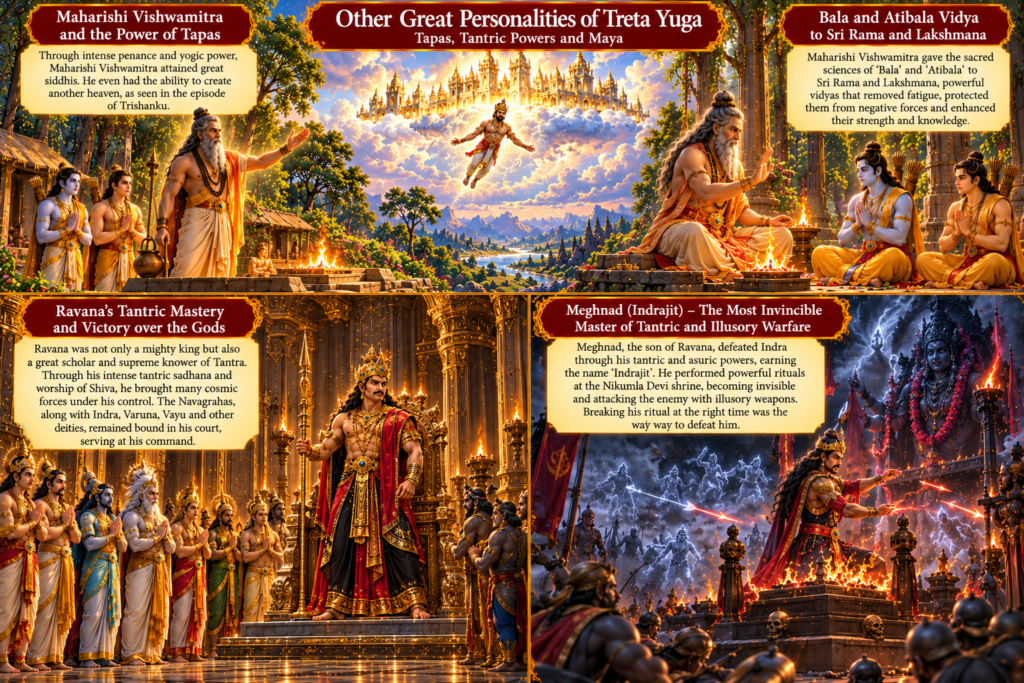
When Maharishi Vishvamitra took the young Shri Rama and Lakshmana into the forest for the slaying of Tataka and the protection of his sacrifice, he bestowed upon the two princes two extremely rare and secret vidyas – Bala and Atibala.
The special quality of these vidyas was that once they were mastered, the seeker would never feel fatigue, hunger, thirst, or the domination of sleep. Nor could any nocturnal being, demon, or illusory power in the three worlds defeat him through deceit or battle.
This episode is evidence that in ancient times, Gurus, through their yogic power and the worthiness of their disciples, bestowed direct energy-siddhis that fulfilled the great purposes of their lives.
Maharishi Vishvamitra and his tapas-siddhi:
In the Treta Yuga, Maharishi Vishvamitra, through rigorous tapasya and yogic power, attained such siddhis that he possessed the capacity to create new worlds—as seen in the episode of Trishanku’s ascent to heaven, where he attempted to create another heaven. He also bestowed upon Shri Rama and Lakshmana the great secret vidyas of Bala and Atibala.
While the Treta Yuga was the age of establishing dharma and righteousness, the asura side also possessed a vast store of Tantric, mantric, and illusory siddhis.
The Tantric Dominance of Ravana, King of Lanka, and His Victory over the Gods
According to the Valmiki Ramayana and the Puranas, Ravana, King of Lanka, was not merely a powerful king but a profound scholar and supreme master of Tantra Shastra.
Through his rigorous Tantric sadhanas, worship of Shiva, and the power of mantras, he had brought many forces of nature under his control.
It was the influence of his Tantric and yogic siddhis that the nine planets—Surya, Chandra, Mangala, and others—stood in his royal court like servants, bound by his command. Ravana had established his fear and influence across the worlds through his Tantric powers, demonstrating the extent to which control over the material world could be attained through Tantra and mantra.
The Tantric and Illusory Siddhis of Meghnad (Indrajit)
In the Treta Yuga, the greatest example of Tantric and illusory warfare was Ravana’s son Meghnad, also known as Indrajit.
Through his Tantric and asuric sadhanas, he had defeated even Indra, the king of the gods—hence his name Indrajit, “conqueror of Indra.”
During the war, Meghnad’s Tantric powers were so immense that he would perform special Tantric rituals and havans in the courtyard of Nikumbhila Devi and become invisible. Firing illusory arrows while remaining unseen and attacking the enemy army was one of his Tantric siddhis, which was impossible for ordinary soldiers or warriors to penetrate.
This is why Maharishi—rather, Lakshmana—had to specially interrupt the Tantric ritual midway and follow extremely strict rules in order to defeat him.
B. The Dvapara Yuga: Water-Stilling, Yogic Illusion, and Tantric Experiments
In the Dvapara Yuga, Tantra, yoga, and maya were openly employed in diplomacy, warfare, and the struggle for survival. The Mahabharata provides many examples of this.
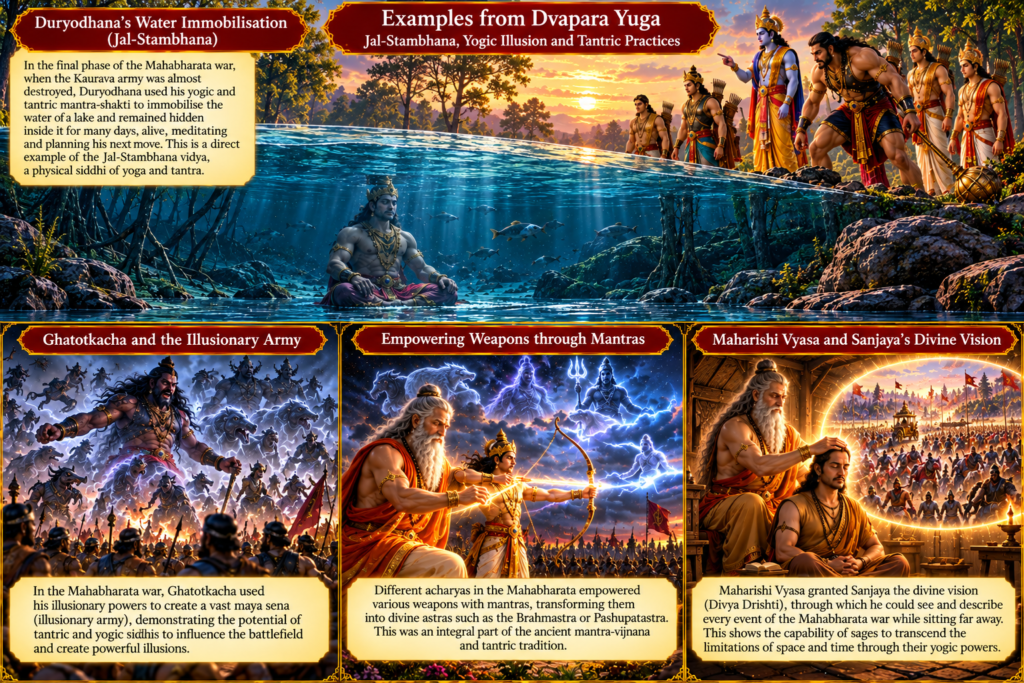
Duryodhana’s Jalastambhana — The Siddhi of Hiding Within Water
In the final phase of the Mahabharata war, when nearly the entire Kaurava army had been destroyed and Duryodhana was left alone, he employed the vidya of jalastambhana through his yogic and Tantric mantra-power.
Duryodhana caused the water of a lake in Kurukshetra to become solid or still through his yogic power and remained hidden within it for many days. Sitting within the water, holding his breath, he contemplated his defeat and future strategies.
This is a direct example of that material siddhi of yoga and Tantra by which a seeker can remain safe within water by controlling his pranas. When the Pandavas and Lord Krishna discovered this, only after a dialogue and challenge from Bhima was he compelled to come out.
Other Tantric and Yogic Dimensions of the Mahabharata Era
In the Mahabharata war, the use of illusory asuras, the army of Ghatotkacha, and the mantric consecration of weapons by various Acharyas transforming them into Brahmastra or Pashupatastra were all part of that ancient science of mantra.
Even the divine vision bestowed by Maharishi Vyasa upon Sanjaya demonstrates that the rishis, through their yogic power, could transcend the limits of space and time and see everything happening at a distance.
Siddhis in the Kali Yuga: Claims, Reality, Miracles, Superstition, and the Test of Truth
In the present age – “the Kali Yuga”, the field of dharma, spirituality, Tantra, and siddhis has become the most contested, filled with superstition, deception, and commercial hypocrisy.
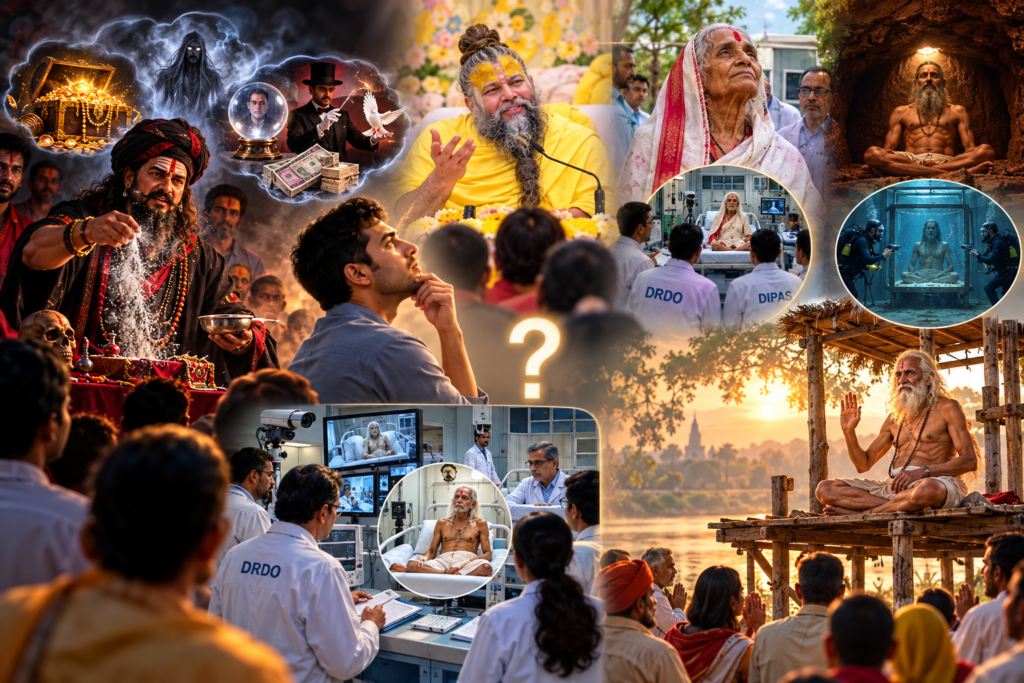
Today, from neighbourhoods to social media, there is a flood of so-called tantriks, babas, and miracle-workers who claim to remove ghosts in moments, reveal hidden treasure, predict the future, or perform magical feats.
In this section, we examine the claims of siddhis in the Kali Yuga from a logical, scriptural, and scientific perspective, distinguishing the true principles of the scriptures from popular rumours and pure hypocrisy.
A. Claims of Miracles in the Kali Yuga versus Reality
Today, when someone goes to a so-called tantrik, he may show a “miracle” by waving ashes, giving a talisman, or producing ash from the air.
As Rajendra Das Ji and Premanand Ji Maharaj repeatedly warn in their discourses, showing a miracle and being siddha are two completely different things.
A skilled magician can produce flowers or money from a handkerchief, make objects disappear into thin air, or even draw milk or water from his finger on stage.
If we were to consider anyone who shows a miracle as “siddha,” then a skilled magician would prove to be a greater “siddha” than any saint or tantrik. But the magician’s purpose is to collect money to make his living by displaying his art, whereas the life of a true siddha is free from worldly desires and he is selfless.
B. The Limits of Science and the Extraordinary Mahapurushas of the Modern Age – Living Evidence
While hypocrisy and pretence abound, there have also been many great saints and yogis on the soil of India whose way of life and physical capacities have challenged all the laws of modern medical and physical science. Science still does not have answers to many of these questions.
Here we mention at least four to five revered Mahapurushas whose life events have been undeniably miraculous and subjects of scientific curiosity.
1. Shri Premanand Ji Maharaj (Vrindavan)
Scientific wonder: Premanand Ji Maharaj has been suffering from severe and end-stage kidney failure for many years. Both his kidneys stopped functioning years ago.
According to the normal laws of medical science, no person can survive more than a few weeks or months without dialysis or a kidney transplant.
Reality: In contrast, Maharaj Ji conducts satsang for hours every day, guides thousands of devotees, and remains fully active and energetic. Doctors and nephrologists themselves are astonished at how his body continues to function smoothly solely through the japa of God’s name, inner yogic consciousness, and boundless spiritual power.
This is the supreme siddhi of name-japa and constant devotion that surpasses even material medicine.
2. Shrimati Prahlad Jani, “Chundriwali Mataji” (Gujarat)
Scientific wonder: This is a case that was formally examined by scientists of India’s Defence Research and Development Organisation (DRDO) and the Defence Institute of Physiology and Allied Sciences (DIPAS), under the supervision of a team of doctors.
Prahlad Jani claimed that through yogic practices and the grace of Amba Mata, he had not consumed a single morsel of food or drop of water for over seventy years.
Results of the examination: In 2010, scientists kept him in a hospital in Ahmedabad under strict CCTV surveillance and medical observation for fifteen days. During these fifteen days, he neither ate nor drank anything, nor did he pass stool or urine.
The entire team of doctors was astonished that no negative biological effect appeared in his body. This was a profound example of high-level yogic and prana-control (urdhvaretas) siddhi over the human body, which science still considers an unsolved mystery.
3. Ram Bahadur, “Bahadur Baba” / Pilot Baba
Scientific testing: India and the Himalayas have seen many saints who have demonstrated states of samadhi in which they were buried several feet underground or placed in water samadhi, and when removed months later, their bodily functions were completely regulated.
Scientists have monitored such yogis on several occasions. This is the real siddhi of samadhi and prana-samyama described in the Yoga Sutras, in which the body becomes free from the ordinary material bonds of nature.
4. Devraha Baba (the Baba of Vrindavan)
Scientific wonder: Devraha Baba, who lived on a platform on the banks of the Yamuna in Uttar Pradesh, could not be reliably aged by anyone, because the country’s great freedom fighters, presidents, and prime ministers had seen him in the same age and same form for what seemed like centuries.
He lived without food, sustained only by milk and Ganga water, and great diseases and mental anguish were said to be removed merely by his darshan.
His life was proof of how tapobala can halt the ageing of the body and the decay of its cells.
C. What Is True Siddhi in the Kali Yuga? — The Final Teaching of the Saints
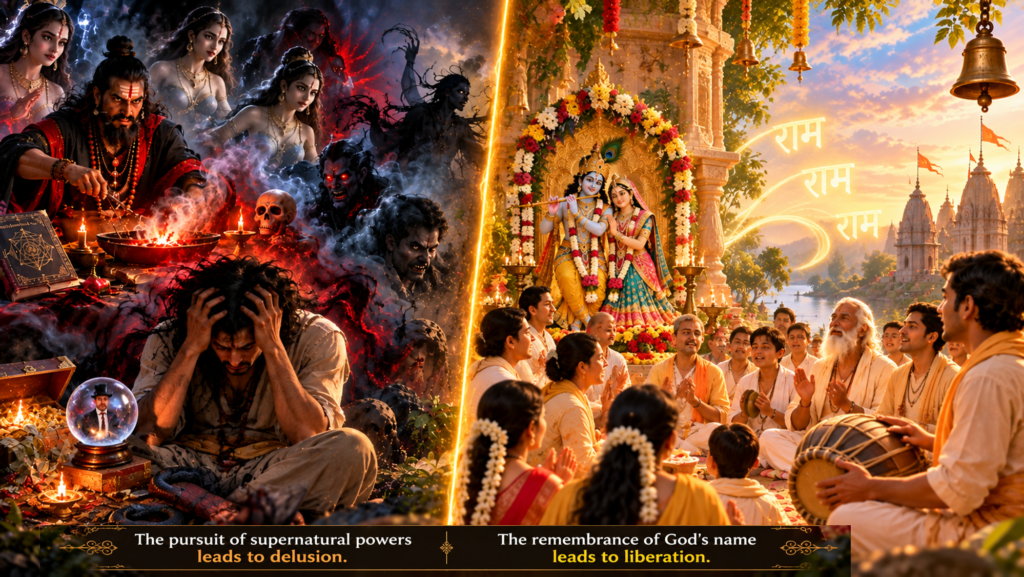
Premanand Ji Maharaj, Puri Shankaracharya Ji, and Rajendra Das Ji, all authentic saints – explain in one voice that chasing Tantric siddhis involving Yakshinis, Apsaras, Vetalas, or acts of marana and mohana in the Kali Yuga is like cutting off one’s own feet with an axe.
If even the slightest error occurs in these Tantric sadhanas, the seeker’s mental balance is disturbed, he may become insane, or he may meet an untimely death.
In contrast, for the Kali Yuga, the Vedas, Puranas, and saints have prescribed only one safest, simplest, and infallible siddhi: the japa of God’s name and Harinam Sankirtan.
Tulsidas Ji stated this very clearly in the Hanuman Chalisa:
*“Bhoot pishach nikat nahin aavai,
Mahavir jab naam sunavai.
Nasai roga hare sab peera,
Japat nirantar Hanumat beera.”
Where tantriks and ojhas across the world deceive people in the name of removing ghosts and spirits—and themselves remain fearful—the person who constantly chants the name of Ram or Krishna finds that no negative energy or Tantric affliction can remain near him.
Premanand Ji narrates an episode in his discourse: once, a person was afflicted by a ghost and was terrified even of name-japa. When Premanand Ji forcibly made him chant the name and listen to katha, the evil spirit and affliction fled forever.
Conclusion
This detailed and profound article on Tantra, Yoga, and Mantra-sadhana makes one truth entirely clear: siddhi is not merely the name for showing miraculous feats or bending the laws of nature to one’s will.
In the modern age, where a marketplace of hypocrisy, temporary temptation, and deception has arisen in the name of Tantra and sadhana, the vision of India’s scriptures, philosophy, and authentic Acharyas is entirely opposite and far nobler.
Literal and Philosophical Reality
We have seen that the root meaning of siddhi is the perfection of life, consciousness, and action—whether it is the cooking of food in the kitchen, the discipline of the mind through yogic sadhana, or, according to Vedanta and the Bhagavad Gita, the seeker’s attainment of the state of Brahman.
Classification and Historicity
The eight principal and ten secondary siddhis described in the Srimad Bhagavata Mahapurana, the Tantric and illusory narratives of the Treta and Dvapara Yugas—such as the exploits of Ravana, Meghnad, and Duryodhana—and the Bala and Atibala vidyas bestowed by the great Vishvamitra, all stand as undeniable evidence that this science of energy was not mere imagination, but a living and disciplined reality.
The True Path of Sadhana
Tantric practices such as Yakshini, Apsara, or fierce Aghora sadhanas may strongly attract the common people, but they are extremely complex and dangerous processes of the subtle realm. To take even a single step in them without the discipline of a capable and siddha Guru can become the cause of the seeker’s mental and spiritual downfall.
In Essence
The essence of Tantric sadhana and the spiritual path is this: the seeker who becomes trapped in the allure of minor material powers, displays, or miracles strays from the true purpose of his life.
In contrast, in the complex environment of the Kali Yuga, selfless devotion, constant japa of God’s name, a disciplined life, and the complete purification of the mind—this alone is the supreme and safest siddhi, which gives the human being the strength to cross this ocean of existence.
=================================
References
1. Shrimad Bhagavata Mahapurana, Skandha 11, Chapter 15 – Description of the eight principal and ten secondary Siddhis.
https://www.vedabase.net/sb/11/15/index.htm
2. Patanjali Yoga Sutras, Vibhuti Pada, especially Sutra 3.37 – Siddhis and their relation to Samadhi.
https://www.siva.sh/patanjali-yoga-sutra/3/37
3. Bhagavad Gita, Chapter 18, Verse 50 – The path to spiritual perfection.
https://www.gitasupersite.iitk.ac.in/
4. Hanuman Chalisa, Goswami Tulsidas – Reference to Ashta Siddhi and Nava Nidhi.
5. Tantrik Siddhiyan – Dr. Narayandutt Shrimali.
6. Paravigyan Ki Sadhana Aur Siddhiyan – Tantrik Behl.
7. Tantra Vigyan Aur Sadhana – Acharya Sitaram Chaturvedi.
8. Shri Premanand Ji Maharaj – Discourse on Tantra, Mantra and Siddhis:
https://www.youtube.com/watch?v=xM0QrGigeRU
9. Shri Premanand Ji Maharaj – Discourse on Siddhis and Bhagavat-Prapti:
https://www.youtube.com/watch?v=FIqL9NZfZ-U
10. Acharya Raghavacharya Ji – Meaning of Siddhi:
https://www.youtube.com/watch?v=H1gKe5r5VMA
11. Shri Rajendra Das Ji – Who is a true Siddha?
https://www.youtube.com/watch?v=ubqIaN0-xyU
12. Puri Shankaracharya Ji – Yogic Powers and Jivanmukti:
https://www.youtube.com/watch?v=PzbS_yNKblo
13. Puri Shankaracharya Ji – Dakini, Shakini and Yogini:
https://www.youtube.com/watch?v=Pk57_VCVdDc
14. Puri Shankaracharya Ji – How to identify a Siddha Purusha:
https://www.youtube.com/watch?v=JmNR6qHJtRc
