If you have not read the earlier articles of What is Tantra? series, here is a brief overview of what was covered:
We examined the foundational meaning of Tantra Shastra and addressed common misconceptions surrounding it. We explored its scriptural status as the Fifth Veda (Panchama Veda) and explained the relationship within the sacred triad of Mantra (the principle), Tantra (the process/method), and Yantra (the medium) through the simple working example (camera).
Read Part 1: https://bhavambhavaani.com/what-is-tantra/
We discussed the vast literature of the Agamas across the Shaiva, Shakta, and Vaishnava traditions. We looked at the four structural pillars of the Shastra (Jnana, Yoga, Kriya, and Charya) and showed how ordinary remedial rituals—such as the Mahamrityunjaya Anushthana, Bagalamukhi Puja, and temple consecrations—are directly rooted in applied Tantric procedures.
Read Part 2: https://bhavambhavaani.com/what-is-tantra-part-2/
What Is Tantra? Part 3:
We explored the power of Mantra and Devata, some remarkable episodes from the history and tradition of Sanatana Dharma -including accounts connected with Gautama Rishi, Goswamy Tulsidas, Adi Shankaracharya, Abhinavagupta, Shivaji Maharaj and the great Shakti traditions. These accounts reveal a side of Tantra that is rarely discussed in ordinary conversations about the subject- including Prana Pratishtha, Dashamahavidya, Pancha Devata worship, Guru-Gamya Sadhana and Sharanagati.
Read Part 3: https://bhavambhavaani.com/what-is-tantra-part-3/
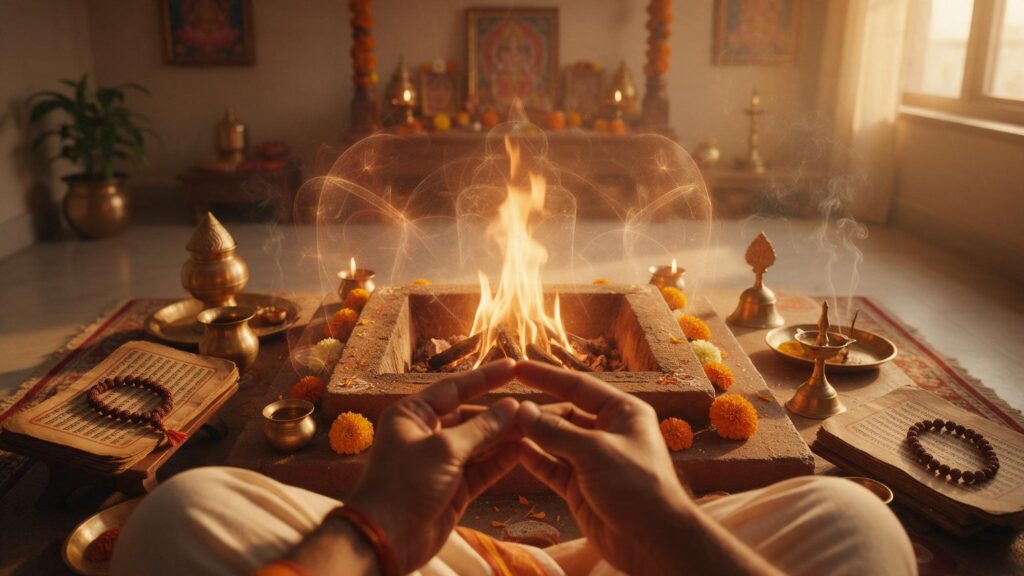
In Part 4 we discuss practical procedures that are woven into everyday Sanatana worship.
This is where Tantra becomes visible in the actual performance of Yajna and Havan, Mudra, Nyasa, Digbandhana and Samput—procedures that give structure, precision and completeness to many forms of Puja and Anushthana.
==========================
Tantra – An Essential Part of Our Daily Worship
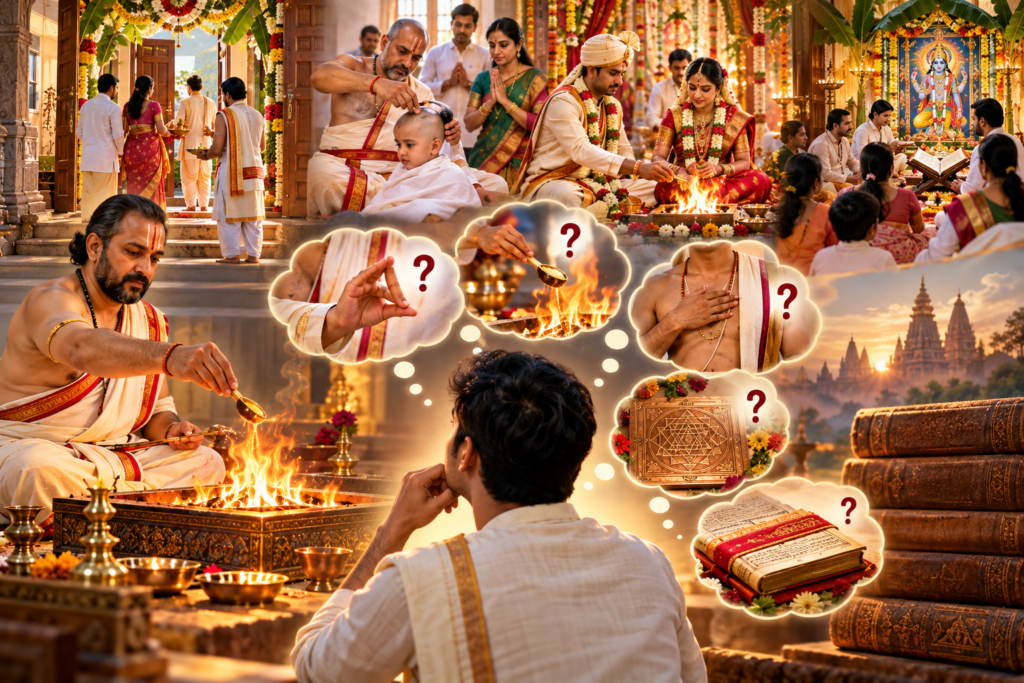
Whenever any auspicious event takes place in our homes, whether it is a housewarming ceremony, a child’s mundan, a marriage, or Satyanarayan Katha- fire holds a special and prominent place in the ritual. During worship, the priest or acharya forms special gestures with their fingers. Whether it is the recitation of Durga Saptashati during Navaratri or an Akhand Ramayana at home, many families also follow the tradition of applying a Samputa (a specific protective or amplifying mantra, verse, or quatrain) to the recitation for a particular resolve.
We have been observing all these practices since childhood and follow them out of reverence, but do we sometimes try to explore why do we do this – in this way… Why is a mantra chanted in a specific way? Why is a specific mantra recited while making an offering? Why does the acharya form specific hand mudras at particular moments? Why are mantras laid down (nyasa) on different parts of the body before worship? And why is there a need to repeatedly attach a mantra or quatrain before and after a specific text during a special recitation?
A massive misconception prevails in society that Tantra is related to cremation grounds, black magic, subjugation (vashikaran), or things that generate fear. However, when we look at the vast tradition of Tantra in its comprehensive form, an entirely different picture emerges. In many daily worships, rituals and spiritual practices in Sanatana Dharma, we see strict procedure-oriented pujan in which mantras, deities, fire, mudras, nyasa, yantras and samputas are engaged in a structured ritual according to a prescribed order – this is guided by Tantra Shastras.
The Vedas reveal and preserve the foundational knowledge and sacred principles of Sanatana Dharma, while the various Agamic and Tantric traditions provide detailed methods for their ritual and spiritual application. Through prescribed procedures, mantras, worship, purification, meditation, and other forms of practice, these traditions give practical structure to many aspects of ritual life. Without understanding this relationship, reducing Tantra to merely secretive or terrifying practices gives an incomplete picture of its place within Sanatana Dharma.
A famous saying by Maharishi Harit is:
Shrutistu dvividha prokta vaidiki tantriki tatha.
(Shruti is said to be of two kinds—Vaidiki and Tantriki).
Therefore, in this fourth milestone of our series, we will understand many worships that we do in our home temples, behind which lie the deep methodological frameworks of Agamic and Tantric traditions. Among these, Yajna-Havana, Mudra, Nyasa, Digbandhana, and the Samputa are particularly significant on present subject.
Yajna and Havana: The Expansion of the Subtle Cosmic Process onto the Terrestrial Plane
The place of Yajna is extremely expansive in Sanatana Dharma. Yajna is not merely a religious rite, but a great system expressing the mutual relationship between deities, nature, humanity, and creation.
In the Bhagavad Gita, Shri Krishna says:
Annadbhavanti bhutani parjanyadannasambhavaḥ.
Yajñadbhavati parjanyo yajَñaḥ karmasamudbhavaḥ.
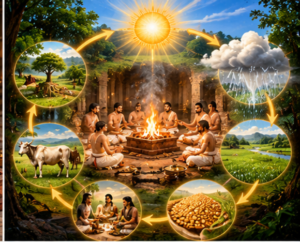
All living beings are born from food, food is produced from rain, rain comes from Yajna, and Yajna is born from prescribed action – To understand the deeper scriptural meaning of – “Yajñaḥ karmasamudbhavaḥ” (Yajna is born from prescribed action) – we must look into the original background of this Bhagavad Gita verse. Here, the word ‘Karma’ does not mean a casual job or ordinary work, but rather “Vihita Karma” (prescribed duties assigned to human beings by the Vedas and scriptures, such as the selfless discharge of one’s social, familial, and moral responsibilities).
How is Yajna born from Karma?
When a human being performs their prescribed duties (Karma) in daily life with complete sincerity, discipline, and a spirit of service, their ego begins to dissolve. The realization awakens within them that they are not isolated, but an integral part of this nature and society. From this elevated and sattvic state of mind, a feeling of surrender toward the collective welfare (samashti) arises, which scriptures call ‘Yajna’. In other words, until a person performs the right and dutiful ‘Karma’ in their life, a true ‘Yajna’ (surrender or welfare-oriented ritual) cannot be born through them.
The Cosmic Cycle Bhagwat Gita:
Lord Krishna explains the complete cycle of creation in this very chapter:
All living beings are sustained by food (Anna).
Food is produced from rain (Parjanya).
Rain is produced from Yajna (because Yajna maintains the balance and purity of nature).
And how is that Yajna born? From the prescribed duties (Karma) of human beings.
In simple terms, this means that if humanity stops performing righteous actions, the sacrificial balance of nature collapses. Therefore, at the root of every dedicated and dutiful lifestyle, a form of ‘Yajna’ is hidden.
From a Sanatan Dharm perspective, the entire creation has also been viewed as a cosmic Yajna. The sun gives away its rays, the earth bears the seed to provide food, and the Vaishwanara fire within living beings digests food. The ritualistic form of this cosmic Yajna vision is seen in the actions like havana and agnihotra performed by a householder.
In Sanatan Dharma, the Supreme Being Bhagwan is called Yajnapurusha. Thus, the connection of Yajna is not merely with fire and offerings, but with the entire system of creation.
Fire also holds a special place in the sacraments (samskaras) of Sanatana Dharma. In the tradition of the sixteen sacraments, from conception to cremation, every sacrament has its own scriptural framework, and fire rituals and oblations are prescribed in all of them.
From Laukik Fire to Chidagni
The fire that appears in daily life from the burning of wood, cow dung cakes, ghee, or other fuel is called laukika agni (fire ).
In a Yajna, this very fire needs purification according per scriptural rules. After the Purification of the fire, the rites (samskaras), havan are performed, and it is consecrated for the ritualistic work through prescribed mantras. This very fire-consecration is a significant example of the procedure-oriented nature of Tantra.
In the Tantric-Agamic tradition, an elaborate framework for the consecration of fire is found. Fire is purified through various rites and made fit for ritualistic work through mantra methodology.
In the Jnana-vati Hindi commentary of the Kamakhya Tantra, various procedures related to fire consecration, altar (kunda) geometry, and oblations are described. The fire purifications include various cleansing and establishment procedures.
A popular prayer regarding fire is:
Agnim prajvalitam vande jatavedam hutashanam.
Suvarnavarnamamalam samiddham vishvatomukham.
(I bow to that blazing Jataveda fire, which is golden-hued, spotless, perfectly kindled, and facing all directions).
When the fire consecrations are completed, it is established as a ritualistic fire. This consecrated fire is called Chidagni (Consciousness Fire). Here, fire becomes the medium for divine work, and through mantras, oblations (havis), and offerings, the entire ritual establishes a connection with the deity.
Thus, the journey from Laukik fire to consecrated sacrificial fire itself demonstrates the highly procedure-oriented nature of Tantra.
The Geometry of the Havana Kunda
The Havana Kunda is the foundation of Yajna, and its construction is also done according to rules defined in Sanatan Dharm scriptures. Various types of Kunda arrangements are found for different purposes:
Chaturasra (Square Kunda): Associated with stability, householder-related tasks, and nourishment (pushti).
Vritta (Circular Kunda): Used for expansive and public welfare purposes.
Padmakara (Lotus-shaped Kunda): Described for specialized worship of deities and spiritual pursuits.
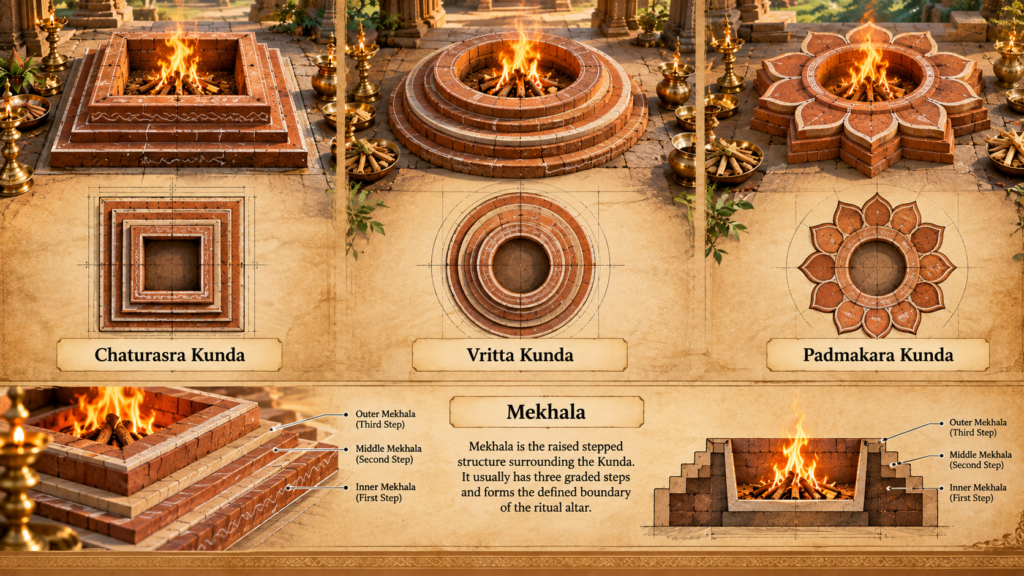
The steps (mekhalas) of the Kunda, its shape, construction method, and its alignment according to the ritual—all of these have their own scriptural importance. Therefore, the Kunda itself is an active part of the ritual in a Yajna.
The Complete Process of Havana
To understand Havana, it is essential to view its entire structure together:
Sankalpa → Kunda → Agni-Samskara → Mantra → Havis → Ahuti → Devata → Purnahuti
Sankalpa determines the purpose of the ritual.
Kunda becomes the foundation of the ritual.
Agni gets consecrated.
Mantras establish the relationship between the deity and the action.
Havis represents the prescribed substance.
Ahuti is dedicated to the deity along with the mantra.
Purnahuti is the framework for the completion of the entire Yajna act.
This is where the methodical nature of Tantra becomes especially clear. Tantra provides a structured framework for ritual action—prescribing, according to the particular tradition and rite, the appropriate mantra, substance, mudra, sequence, preparation, and ritual procedure..
Mudra-Vijnana: Regulation of Pranic Energy and Neurological Control
During worship, at the times of achamana, kalasha worship, or arati—the acharya forms specific alignments with their fingers. This is a profound science of neurology that concentrates the body and mind. You must have certainly seen the acharya joining their fingers in specific ways during worship. Sometimes the thumb touches a specific finger, sometimes the structure of both hands changes, and sometimes a specific mudra is formed during offerings.
These mudras are an extremely important part of Tantra. There are numerous worship rituals and daily duties where spiritual practice (sadhana) remains fruitless without mudras.
Scriptural proofs cited in Brihat Tantrika Mudra Vijnana explain the necessity of mudras:
Mudra vina tu yajjapyam pranayama surarcanam.
Yogyodhyanasanam capi nishphalani tu bhairava.
(Kaika Purana)
Meaning: O Bhairava! Japa, pranayama, deity worship, yoga, meditation, and asana performed without mudras – all these actions become fruitless.
Modanat sarvadevanam dravanat papasantateh.
Tasmanmudreyamakhyata sakamartha sadhinim.
(Yamala Tantra)
Meaning: That which gladdens the minds of the deities (modana) and dissolves and destroys the accumulated sins and mental impurities of the sadhaka (dravana) is called a ‘mudra’.
The law of physics states that the dissipation of energy is generally greater from sharp points (terminals). The subtle pranic energy generated within a sadhaka during japa and meditation can be dissipated into the external environment through open fingers and fingertips. A mudra connects these terminals together, creating an internal closed energy circuit so that the accumulated life-force remains stable within the sadhaka’s own body.
The Physical Abode of the Five Elements (Pancha Mahabhuta)
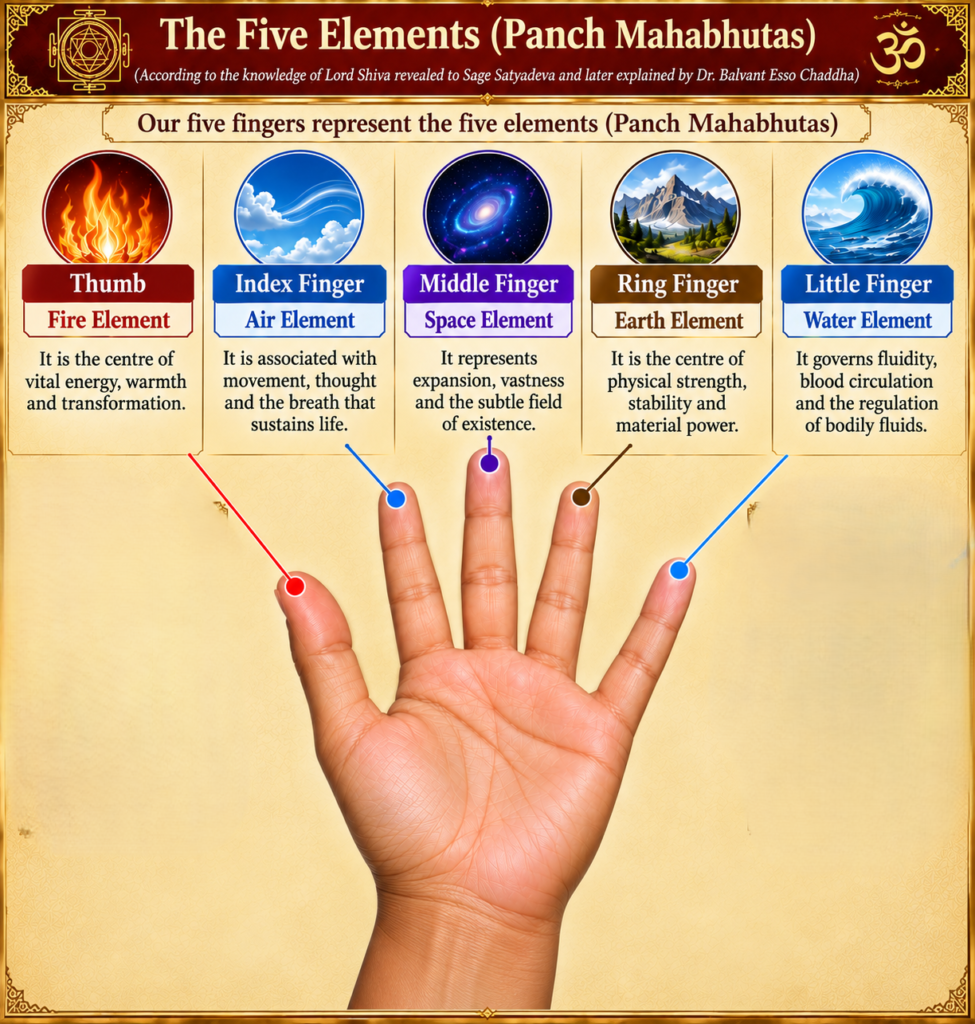
According to Brihat Tantrika Mudra Vijnana, the five fingers of our hands represent the five great elements:
- Angushtha (Thumb): Fire Element — Represents pranic radiance, warmth, and transformation.
- Tarjani (Index Finger): Air Element — Associated with the mobility of the nervous system and the regulation of breathing.
- Madhyama (Middle Finger): Space/Ether Element — Governs subtlety, expansion, and the movement of the heart region.
- Anamika (Ring Finger): Earth Element — The center of physical firmness, stability, and material strength.
- Kanishthika (Little Finger): Water Element — Regulates physical fluidity, blood circulation, and the essence of fluids (rasa-tattva)
The root of the thumb on the palm is called Atma-tirtha and the tips of the fingers are called Deva-tirtha. When these fingers are touched to one another with a specific angle and pressure, the balance of elements within the body is achieved.
Major Mudras and Their Usage
Dhenu Mudra (Surabhi): When fingers of both hands are intertwined over a water kalasha or naivedya in such a way that they form the shape of a cow’s udder. In the Agama method, this is a yogic procedure to ‘amritify’ (consecrate) ordinary water.
Shankha Mudra: Enclosing the left thumb in the right fist and touching the right thumb to the tips of the left hand’s fingers forms a conch shell shape. This is considered useful for the sound element (nada-tattva), the throat region, and concentration.
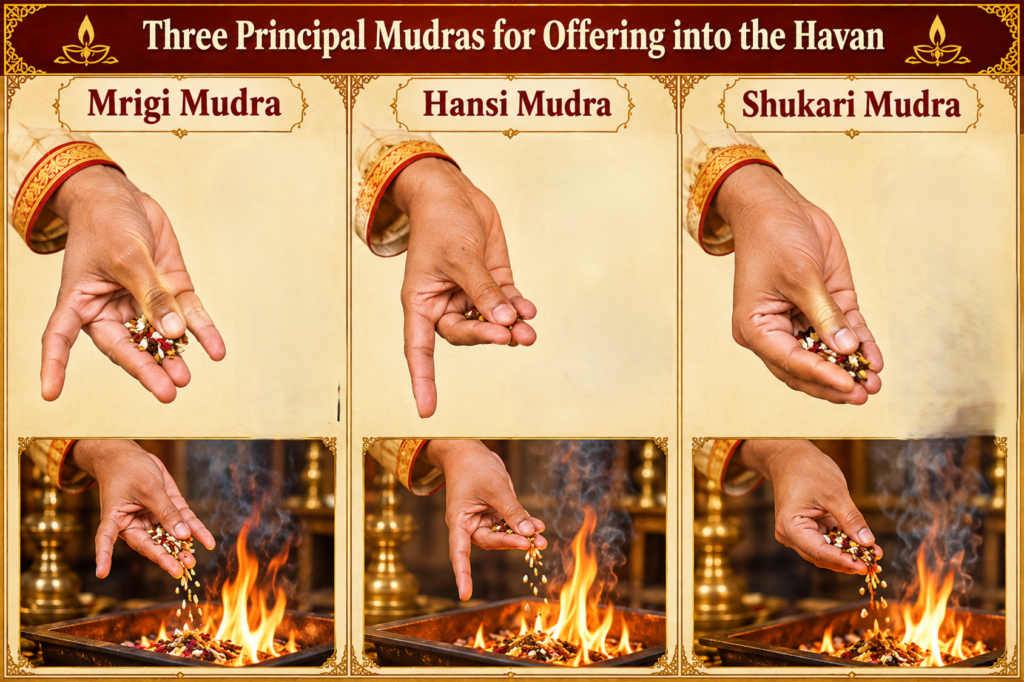
Three Mudras are used in Havan: While making offerings into the fire, Tantra Shastra prescribes three mudras—Mrigi Mudra (offering made with thumb, middle, and ring fingers, used in peace and nourishing rites), Hansi Mudra (for knowledge and attainment of learning), and Shukari Mudra (for crisis mitigation).
Sandhya Vandanam: The Essential Daily Ritual of Sanatana Dharma and the Tantric Science of Mudras
In Sanatana Dharma, Sandhya Vandanam performed during the three junctures of the day (morning, noon, and evening) is a mandatory daily prayer (for Brahmin, Kshatriya and Vaishya Varn Males) . Instead, it is a highly potent applied science rooted in the Vedas and Agamas. Scriptures clarify that without performing Sandhya Vandanam, the daily duties and the repetition (japa) of the Gayatri Mantra cannot attain completeness. This entire ritual incorporates strict Tantric scriptural methodologies executed by knowledgeable acharyas, including prana-pratishtha (infusing life-force), marjana (sprinkling purifying water), adhamarshana (dissolving sins), Shap Vimochan (releasing the mantra from ancient karmic/rishidic constraints), and the essential application of specific hand mudras.
Sandhya Vandanam and the Secret of Shap Vimochan
Before commencing the recitation of the Gayatri Mantra or other Maha-mantras, scriptures prescribe the process of Shap Vimochan (the ritual removal of curses or restrictions on mantras). According to scriptural narratives, mantras often carry metaphysical seals or protective locks placed by ancient sages to preserve their potency and to discourage the misuse of mantras. To unblock this spiritual energy, specific Tantric methodologies and Vedic verses must be employed. Until a practitioner completes the process of Shap Vimochan and utkeelan (unlocking), the true energetic frequency of the mantra remains dormant.
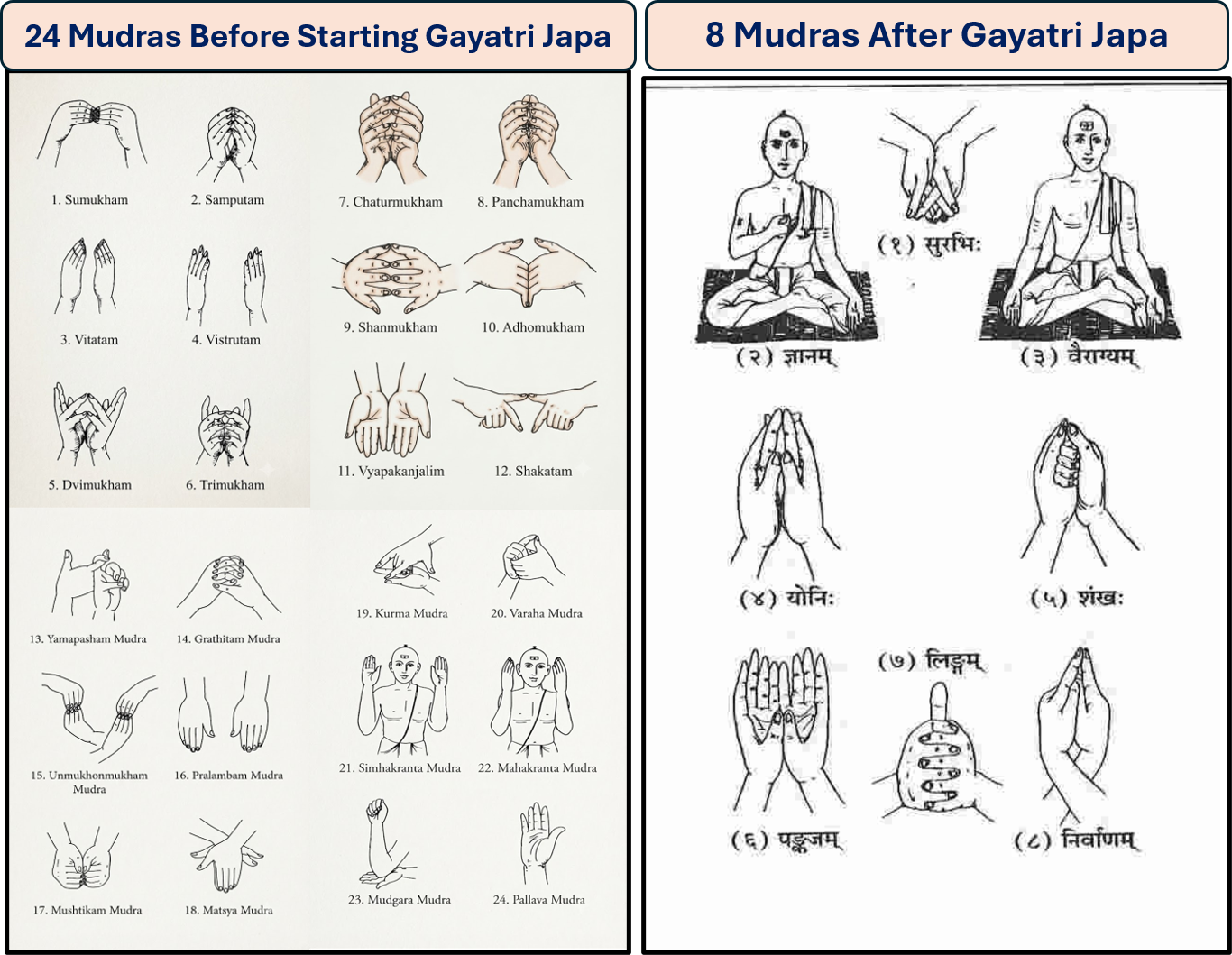
The 24 Mudras Before Japa and the 8 Mudras After Japa
During Sandhya Vandanam and Gayatri Japa, specific geometrical shapes and locks are formed using the fingers, known as Mudras. Ancient Tantric and Agamic texts explicitly state that japa performed without these mudras is rendered fruitless:
“Chaturvimshati mudra vai gayatrayam supratishthitah… Eta mudra na janati gayatri nishphala bhavet”
Meaning: A practitioner who does not know these twenty-four mudras during Gayatri Japa finds their entire spiritual practice rendered fruitless.
Poorva Mudras (24 Mudras – Before Japa): Before beginning the Gayatri Japa, 24 pre-mudras (such as Sumukham, Samputam, Vitatam, Visritam, Dvimukham, Trimukham, Pasham, Shaktim, etc.) are displayed.
Uttara Mudras (8 Mudras – After Japa): After the japa is completed, 8 post-mudras (such as Surabhi, Jnana, Chakra, Yoni, Kurma, Linga, etc.) are performed.
Spiritual and Health Benefits
The regular, daily practice of these 32 mudras (24 pre-mudras and 8 post-mudras) not only paves the way for spiritual advancement, mental concentration, and divine grace, but from the perspective of modern yoga and holistic science, it is also exceptionally beneficial for nadi-shodhana (nervous system purification), alleviation of mental stress, memory enhancement, and overall neuromuscular stability.
Nyasa and Digbandhana: “Devo Bhutva Devam Yajet”
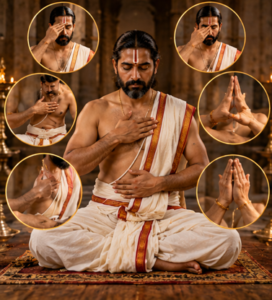
At the beginning of worship, touching the head, eyes, nose, heart, and arms with water is called Nyasa.
A clear rule of Tantra Shastra is—“Nadevo devamarchayet” or “Devo bhutva devam yajet”—meaning, until the sadhaka themselves is established in the divine state, they are not entitled to worship the deity. The physical body of flesh and bones remains laden with daily worldly impurities. Through Karanyasa and Anganyasa, the sadhaka mentally establishes the conscious seed-letters (bijaksharas) of the mantra onto various organs of their body. Through this action, the sadhaka’s own body is established as a pure, vibrating temple.
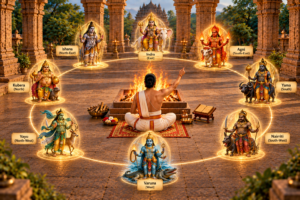
Clapping three times with the right hand on the palm of the left hand at the beginning of worship and snapping fingers in all ten directions is called Digbandhana. Its purpose is to witness the guardians of the ten directions (dikpalas) and establish a subtle spiritual protective barrier around the worship place, so that mental concentration is not broken and external distractions cannot weaken the effect of the sadhana.
Samputa Vidhana: The Scriptural Shield to Prevent Mantra Scattering
Whenever any extraordinary crisis arises in families, consultation is often given to perform ‘Samputa Patha’ instead of regular recitation. What is the real meaning of Samputa and what is its necessity?
The Meaning of Samputa
The direct meaning of ‘Samputa’ is an enclosure or casket in which two parts are joined together to completely secure the valuable object kept inside. In Mantra Shastra, when a special seed-letter, mantra, or fruitful quatrain is added at the beginning (adi) and end (samapti) of every verse, shloka, or quatrain of a root text or stotra and then recited, it is called ‘Samputikarana’.
Why Samputa ?
According to Tantra-Mahavijnana and Tantra-Mahodadhi, ordinary recitation has a natural tendency to dissipate. It increases expansive merit and sattva in the sadhaka’s life, but when a ritual is performed for a definite objective (such as the cure of an incurable disease or the mitigation of a grave crisis), it becomes necessary to bind that energy into a single direction.
Applying a Samputa prevents the power of the root recitation from scattering here and there; instead, bound from both sides, it applies itself toward fulfilling that specific resolve of the sadhaka.
Samputa in Sri Durga Saptashati: The seven hundred verses of the Saptashati are extremely powerful. When the Navarna Mantra or a special welfare verse from the Argala Stotra is added before and after each of its verses, the impact of the entire recitation becomes concentrated in that single direction.
Samputa in Sri Ramcharitmanas: During the nine-day (navahna) or continuous (akhanda) recitation of the Manas, when the crisis-relieving quatrain (“Dinadayal biridu sambhari…” or other Doha, or Shri Ram Jai Ram Jai Jai Ram”…) is added before and after every couplet and quatrain, the entire accumulated impact of the twenty-four thousand verses of the text concentrates on resolving that crisis.
Samputa is essentially a Tantric covering that prevents the letters of a mantra from scattering and ensures the attainment of results.
Tantra Shastra as Applied Vedic Science is practiced by us everyday
The consecration of fire in the Havana Kunda, the disciplined use of Mudras, the ritual preparation of the practitioner through Nyasa, and the structured application of Mantras through Samputa all illustrate the highly systematic nature of Tantric and Agamic practice. These are not random additions to worship; they belong to established ritual frameworks preserved through the Shastric traditions.
At this fourth milestone of our What Is Tantra? series, we can now see how deeply procedural frameworks are woven into many forms of Sanatana Dharma worship -from daily Puja and larger Anushthanas to Samskaras and other ritual observances. Understanding these procedures helps us see Tantra not merely as something secret or mysterious, but as a body of traditions concerned with the precise performance and structure of spiritual practice.
In the upcoming parts of the series, we will study other profound aspects of Tantra.
==================================
Primary Shastric Sources
Kamakhyatantram (Jnanavati Hindi Commentary):
Prof. Radheshyam Chaturvedi, Chowkhamba Surabharati Prakashan, Varanasi (Introduction pp. 11, 17–18, 71–74; Fire Consecration, Kunda Arrangement, Panchamahabhuta, and Shadanga Nyasa).
Brihat Tantrika Mudra Vijnana:
Acharya Pt. Rajesh Dixit, Deep Publication, Agra (pp. 11–16, 87–90; Mudra Praise, Panchamahabhuta Symbols, Oblation Mudras, and Sapta-Jihva Mudras).
Tantrika Sahitya (Descriptive Bibliography):
Mahamahopadhyaya Pt. Gopinath Kaviraj, Hindi Samiti Granthmala – 200, Uttar Pradesh Government, Lucknow (pp. 28–32; Samputa and Vinyasa framework in Mantra-Mahodadhi, Sharatilaka, and Agamatattvavilasa).
Tantra-Mahavijnana (First Part):
Vedomurti Taponishtha Pt. Shriram Sharma Acharya & Dr. Chamanlal Gautam, Sanskriti Sansthan, Bareilly (pp. 30–48, 367–375, 440–470; Scientific Basis of Tantra, Mantra Power, Yajna Sacrifice explanation).
Agama Aur Tantrasastra (Philosophical and Cultural Discussion):
Pt. Vrajvallabha Dwivedi, Parimal Publications, Delhi (pp. 1–6, 27–34; Scriptural Authenticity of Agama-Tantra and the “Devo bhutva devam yajet” framework).
Srimad Bhagavad Gita and Srimad Bhagavata Mahapurana:
Gita Chapter 3, Verses 14–15 (Yajnic Creation Cycle) and Bhagavata Mahapurana (Yajna-Purusha exposition).
Anupam Trivedi has spent over three decades studying and reflecting upon Sanatan scriptures, including the Vedas, Upanisads, Itihāsa, and Purāṇas. He writes on cultural philosophy and ancient literature to present traditional insights with accuracy and clarity. Read full bio →