Yoga in Sanatan Dharma’s Most Revered Granth: The Bhagavad Gita
Every chapter’s Concluding Verse of Bhagwat Geeta Defines Geeta as Upanishad, Brahma-Vidya, and Yoga-Shastra
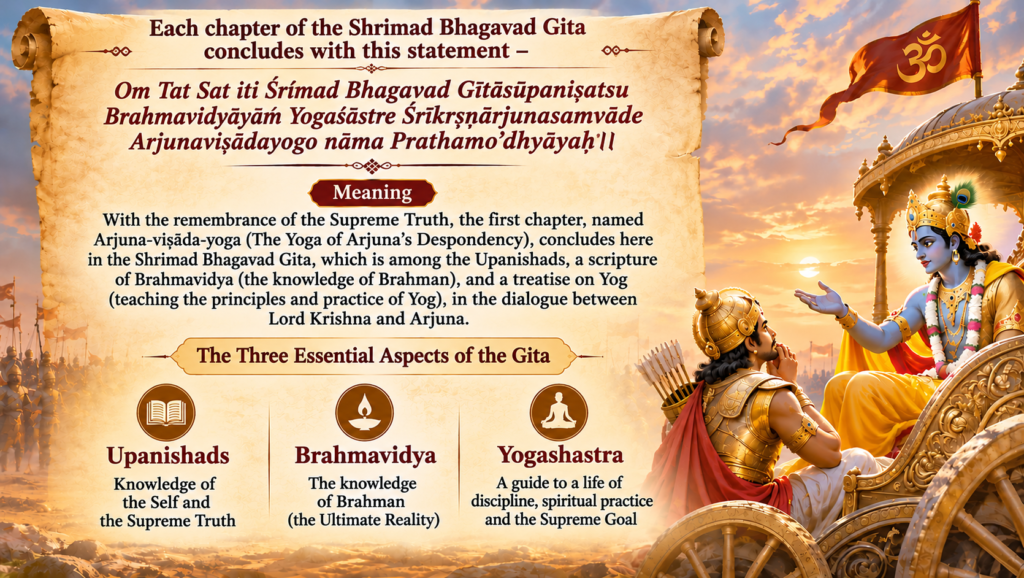
At the end of every chapter of the Shrimad Bhagavad Gita, we find a special concluding verse. In it, the Gita is addressed as an Upanishad, as Brahma-Vidya (the science of the Absolute), and as Yoga-Shastra (the scripture of Yoga). At the close of the first chapter, this complete verse appears:
“Om tatsaditi Srimadbhagavadgitasupanishatsu brahmavidyayam yogashastre srikrishnarjuna samvaade vishadayogo nama prathamo’adhyayah॥”
Meaning: With the remembrance of the Supreme Truth, within the Upanishads of the Shrimad Bhagavad Gita, in the science of the Absolute (Brahma-Vidya), and in the scripture expounding the principles and practice of Yoga (Yoga-Shastra) – under the dialogue between Sri Krishna and Arjuna, the first chapter titled Arjuna Vishada Yoga concludes.
This concluding verse brings forth three vital dimensions of the Gita: the Upanishad, Brahma-Vidya, and Yoga-Shastra. Across its eighteen chapters, the Gita offers an extensive exposition on subjects such as action (karma), knowledge (jnana), devotion (bhakti), meditation (dhyana), the individual soul, nature, spirit, and liberation (moksha). Thus, yoga connects deeply with numerous profound facets of life and spiritual practice.
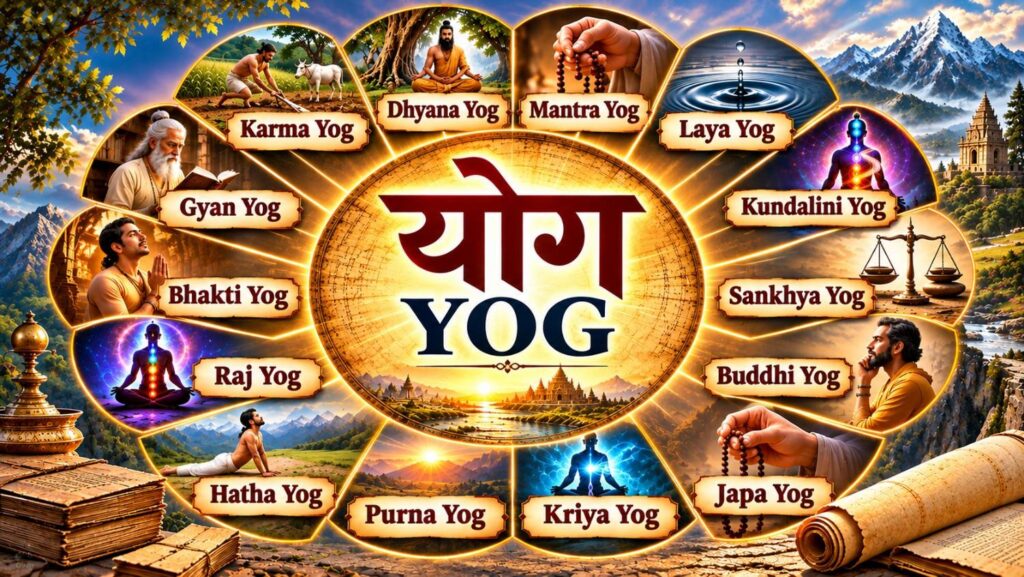
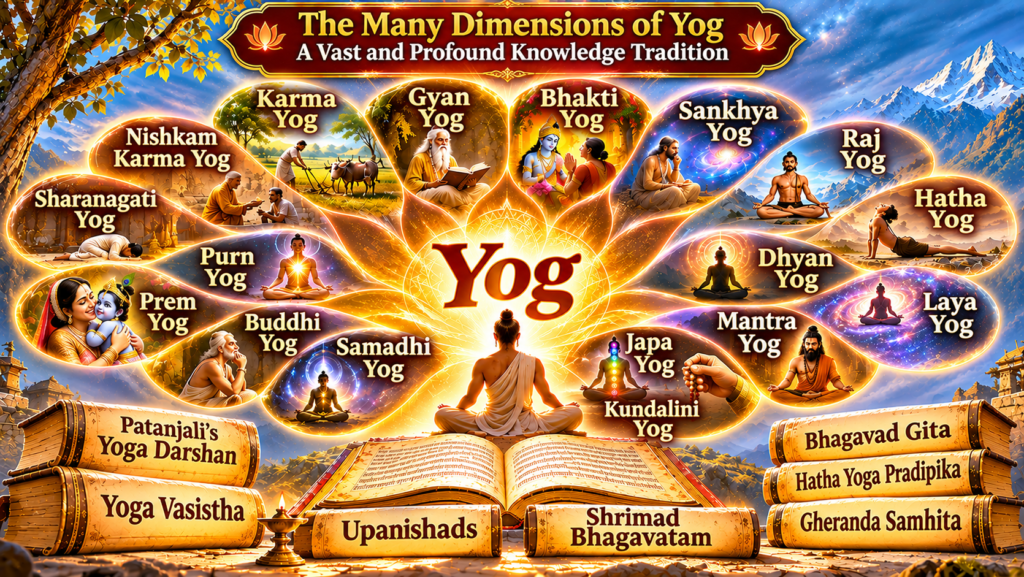
In the scriptures, we encounter a multitude of names: Karma Yoga, Jnana Yoga, Bhakti Yoga, Sankhya Yoga, Raja Yoga, Hatha Yoga, Dhyana Yoga, Laya Yoga, Mantra Yoga, Japa Yoga, Kundalini Yoga, Samadhi Yoga, Buddhi Yoga, Prema Yoga, Purna Yoga, Sharanagati Yoga, and Nishkam Karma Yoga. Patanjali’s Yoga Sutras, the Yoga Vashistha, the Upanishads, the Srimad Bhagavata, and various other texts describe these diverse forms and methodologies of yoga. In some places, yoga is related to skill in action; in others, to equanimity (samatva); elsewhere, to the cessation of mental modifications (chitta-vritti-nirodha); to the restraint of the senses; and ultimately, to self-realization and the attainment of the Supreme.
When we examine all these dimensions, a vast and profound tradition of yoga comes to light. It encompasses everything from human action and conduct to the mind, inner consciousness, spiritual awakening, and the ultimate spiritual goal. These varied names and definitions highlight different aspects of the same subject.
Therefore, to understand Yoga we must begin with its original meaning and the definitions the scriptures give. What does the word Yoga mean? What is the context and spiritual significance of many definitions of Yoga ? …
So Many Names for the ‘types of Yoga’, Yet an Incomplete Introduction
With so many names, so many texts and so many methods of Yoga sadhana, the introduction to Yoga today has largely shrunk to a few postures and a little pranayama. Ask yourself: how many of the names above had you heard before?
The purpose here is not to condemn this view. It is to show how incomplete this introduction to Yoga is. What follows is even more astonishing. Among so many names, the definitions of Yoga also differ: in one place “the cessation of the modifications of the mind”, in another “evenness”, in another “skill in action”, in another “the union of the individual self with the Supreme”. At first glance these appear to contradict one another. This article’s aim is to make it clear by the end that they are all spoken from different standpoints, looking at one and the same goal.
The Meaning of Yoga word: Two Roots
The word “Yoga” is derived from the Sanskrit root yuj, and in the grammatical tradition there are two roots named yuj:
- Yujir yoge: to join, to unite.
- Yuj samadhau: samadhi, that is, the state of a concentrated, composed mind.
So two meanings are present in the very root of the word: union and samadhi. Maharshi Vyasa states plainly in his commentary on the Yoga Sutras: “Yogah samadhih” (Yoga is samadhi). In modern times Swami Satyananda Saraswati also explained Yoga as “unity” or “oneness”, that is, the union of individual consciousness with universal consciousness. One way of expressing Samadhi is “Communion with God”- the ultimate goal of human life – Moksha.
The variety of definitions is therefore not the result of any inconsistency. It lies in the nature of the word itself.
When a Jagadguru Said: These Definitions of Yoga Need To Be Reconciled
In the Yogank of Kalyan, published by Gita Press, there is a scholarly article by Jagadguru Swami Bharatikrishna Tirthaji Maharaj, the 143rd Shankaracharya of Govardhan Peeth (1925–1960; author of “Vedic Mathematics”). It is titled “Shrimad Bhagavad Gita and the Reconciliation of the Principles of Yoga.” In it he notes a difficulty facing seekers: confusion appears even in the definition of Yoga.
Maharshi Patanjali gave a simple definition, “yogash chitta-vritti-nirodhah”. Other teachers gave different explanations, and the Gita alone contains many definitions. These appear to contradict one another or, at the very least, to be unrelated. Hence the need for their reconciliation.
In this article we will do just that: first place all the definitions side by side, then see how they are reconciled.
Three Divisions of the Veda, Three Definitions of Yoga
The Yogank also carries another article, written by a mahatma of the Bharat Dharma Mahamandal, which contains a discussion that rarely appears in talk about Yoga. The Veda is divided into three kandas: Karmakanda, Upasanakanda and Gyankanda. According to this article, each of the three kandas has its own definition of Yoga:
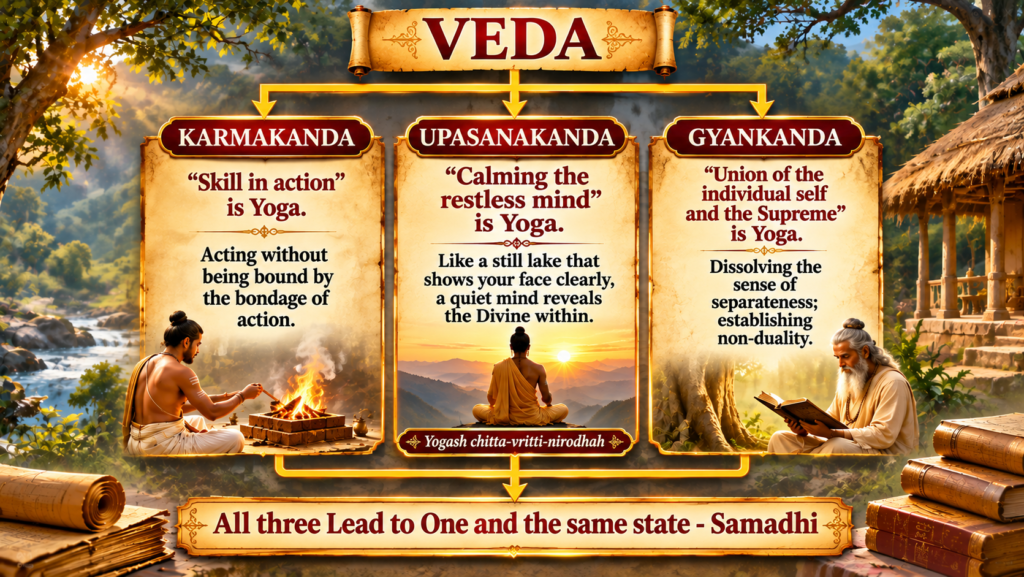
The means of the three kandas differ, but the state they bring about is the same. In this way the three kandas of the Veda all expound Yoga, and each defines it from its own standpoint. This is one fundamental reason for the variety in the definitions of Yoga.
The Definitions of Yoga: A Table
Now let us look at all the definitions together. The last column shows which stage of the spiritual journey each definition points to.
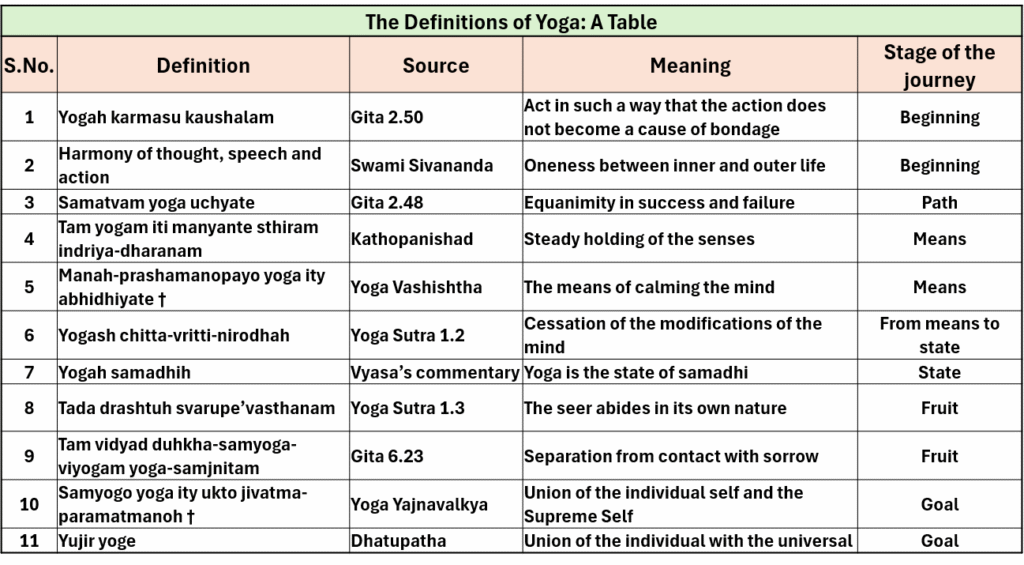
There are eleven definitions, and reading them in order, a map of the path begins to emerge.
Reconciliation: Many Stages of One Journey
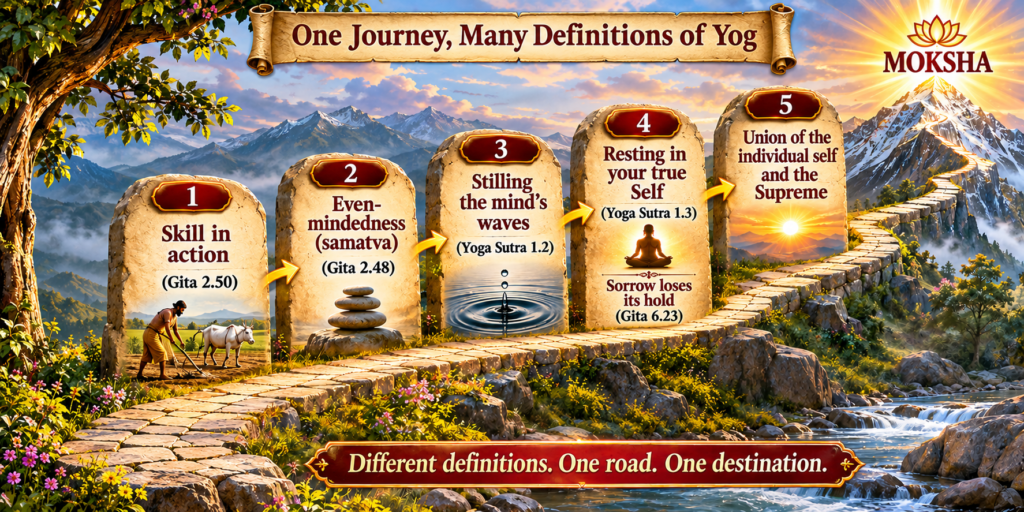
These definitions do not contradict one another. Each was taught according to the seeker’s stage. The beginner was told of skill in action. The one walking the path was told of equanimity (even mindedness). The one going deep into sadhana was told of the cessation of the stilling the mind’s waves. And the one near the goal was told of resting in your true Self and union with the Supreme (Moksha).
Why This Order Makes Sense
This sequence is not random. Each step prepares the next, and the logic is easy to follow.
Why is the mind restless? Think of a pond. If you keep throwing stones into it, the water never settles. The mind is like that. Attachment (clinging to things and outcomes), desire (always wanting something more) and ego (the constant thought “I, me, mine”) keep throwing stones into the mind. The result is waves of thought that never stop.
Now look at the five steps again:
- Skill in action. We cannot stop acting, and the Gita does not ask us to. It asks us to act well, doing our duty without clinging to the result. This stops throwing new stones into the pond.
- Even-mindedness. When we no longer cling to results, success and failure stop shaking us. The mind stays steady in gain and loss, in praise and blame.
- Stilling the mind’s waves. A steady mind can finally settle. The waves of worry, craving and restlessness begin to calm, which is what Patanjali calls chitta-vritti-nirodha.
- Resting in your true Self. When the water is still, you can see your own face in it, and a calm mind shows the Self within. The Yogank puts it just this way: in a still lake a person sees his own face clearly, and when the mind’s waves are stilled, the Divine within becomes visible.
- Sorrow loses its hold. Much of our suffering comes from clinging and restlessness. When the mind is still and rests in the Self, that cause falls away. This is the Gita’s meaning of Yoga as freedom from contact with sorrow (Gita 6.23).
So these definitions of Yoga are not rivals. They describe one process from different stages: the earlier steps prepare the mind, and the later ones are its result.
One clarification. The great philosophies describe the final goal in different words. Sankhya-Yoga calls it Kaivalya, the Self standing alone in its own nature. Vedanta calls it oneness with Brahman. We will look at these differences later in this series. But they agree on the basic direction: Yoga turns the mind from outward, chasing the world, to inward, toward the Self.
Primary Yoga and Secondary Yoga
Why So Many Names? And Which Yoga Is “Real” Yoga?
After the definitions, a second question arises: why are there so many kinds of Yoga?
Shankaracharya Bharatikrishna Tirthaji gives a simple answer. People are different. Some are drawn to action, some to knowledge, some to devotion, some to quiet meditation. Their temperaments and abilities differ, so the same path cannot suit everyone. Think of travelling to one city: some people go by road, some by train and some by air, depending on where they start and what they can manage. The destination is the same, but the route differs. In the same way, the scriptures describe many paths of Yoga, so that every seeker can find one that fits.
He then makes a second point, which is rarely heard. Not everything called “Yoga” is Yoga in the same sense.
- Anything that takes a person even one step closer to God can be called “Yoga.” In this wide sense, many practices qualify.
- But Yoga in the true, primary sense is the path that takes a person all the way, from an ordinary human being (nar) to the Divine (Narayan).
- Everything else is secondary. These practices are helpers. They support the journey, but they are not the journey’s end.
Consider shoes for a mountain climb. Good shoes help, and without them the climb is hard. But nobody would say that wearing good shoes is reaching the summit. A practice that keeps the body healthy is like that. It may help in many ways, but it is not the goal of Yoga.
Another author also complains that the word “Yoga” is being misused. In his time, people called conjuring tricks, charms and amulets, and displays of miracles “Yoga”, and treated anyone who performed them as a yogi. He wrote this long ago, yet it applies just as well today.
The Gita: Eighteen Chapters, Sixteen Divisions of Yoga
According to the Yogank (GeetaPress), through the reconciliation of the three kandas, Shri Krishna taught sixteen divisions of Yoga: four from the Karmakanda, six from the Upasanakanda and six from the Gyankanda. Before these, the first chapter describes Arjuna’s despair, and the second chapter states the essence of the entire Gita in brief.
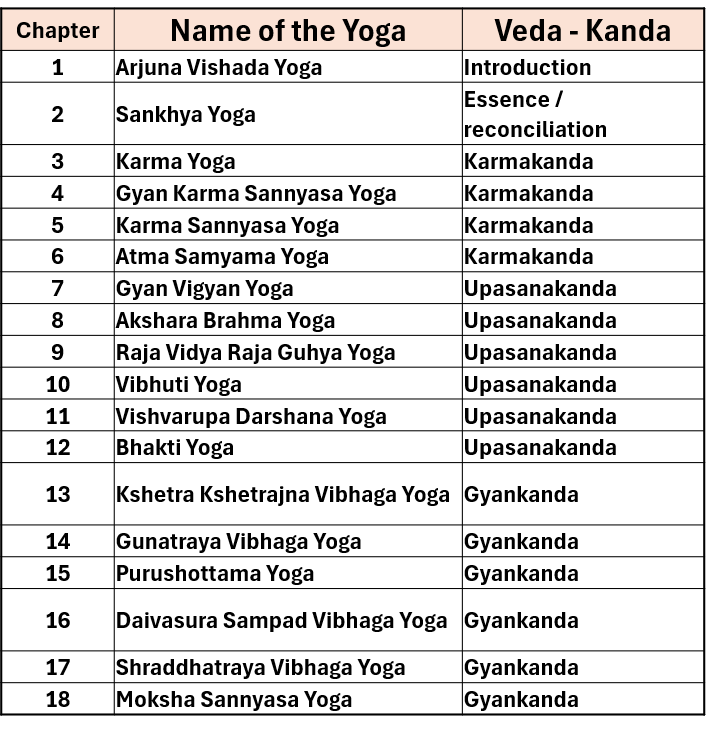
The eighteen chapters begin in despair and end in renunciation leading to liberation. The entire journey from despair to Moksha is what the Gita calls “Yoga”.
Other Lists of Yoga , Apart From Bhagwat Geeta
And that is only the Gita. In the same article the Shankaracharya gives a long list of Yogas beyond it: Kriya Yoga, Samadhi Yoga, Mantra Yoga, Japa Yoga, Laya Yoga, the ancient (Markandeya) Hatha Yoga and the newer (Matsyendranath) Hatha Yoga, Kulakundalini Yoga, Akulakundalini Yoga, Vag Yoga, Shabda Yoga, Asparsha Yoga, Sahasa Yoga, Shunya Yoga, Shraddha Yoga, Bhakti Yoga, Prem Yoga, Prapatti (Sharanagati) Yoga, Nishkaam Karma Yoga, Abhyasa Yoga, Dhyan Yoga, Sankhya Yoga, Gyan Yoga, Raj Yoga, Rajadhiraj Yoga, Maha Yoga and Purn Yoga, and many more.
After this he lists the complex technical processes of Yoga: The six chakra Bhedan, the network of nadis, the secret of the tenth door, the cave of the bees, the piercing of the three knots, the many kinds of samadhi, the eight great siddhis and many other such subjects. At the end he writes that he will not go into these complex subjects here, and that this has been offered only as an indication, to make the reconciliation of the different kinds of Yoga clear.
When a Jagadguru himself says that a list of this subject is only a glimpse, one can easily imagine how vast the subject is.
The Four Styles of Yoga and the Foundation of Ashtang Yoga
Another discussion in the Yogank hints at the direction of this series. It describes four independent styles of sadhana: Mantra Yoga, Hatha Yoga, Laya Yoga and Raj Yoga. And at the root of all four lies the method of Ashtang Yoga, joined with devotion to God.
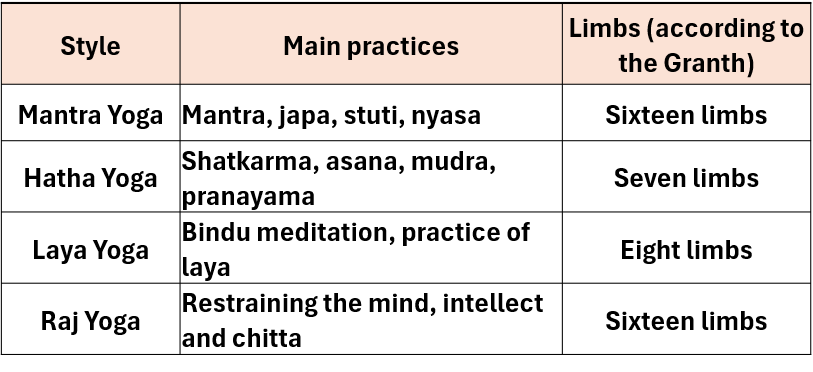
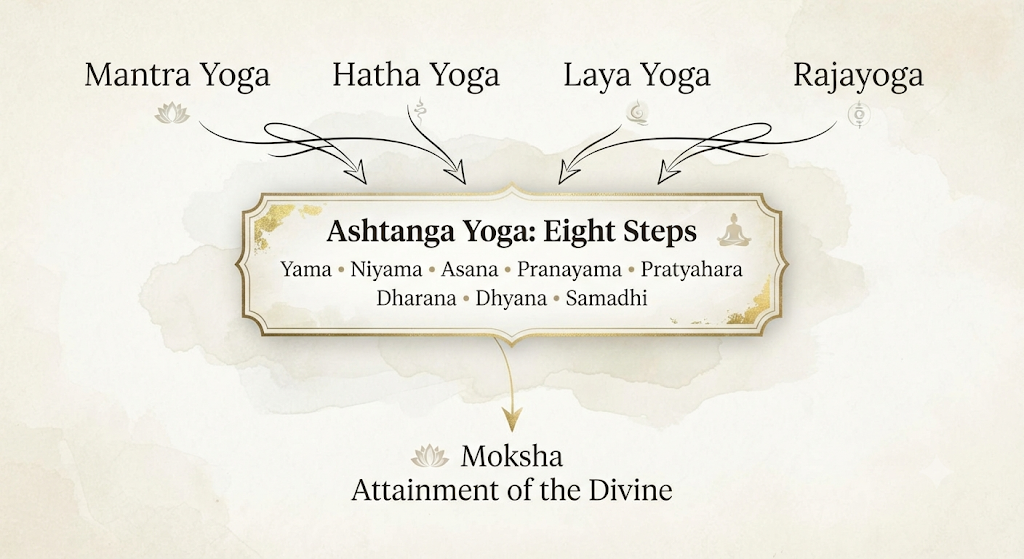
The same source summarises these limbs as follows:
- The means that give mastery over the outer senses are Yama.
- The means that give mastery over the inner faculties are Niyama.
- The means that make the body fit for Yoga are Asana.
- The means that make the prana fit for Yoga are Pranayama.
These four are the outer (bahiranga) means. Beyond them, Pratyahara, Dharana, Dhyan and Samadhi are the inner (antaranga) means.
Now consider: when the same sequence of practice lies at the root of all four styles, and the first two steps of that sequence are Yama and Niyama, how much of this sequence remains in the Yoga that is popular today?
What Lies Ahead in This Series
This series will try to understand Yoga through its original meaning, its many paths and its little-known traditions. In this part we saw that although the definitions of Yoga are many, they all point toward one goal.
But the vastness of Yoga is not limited to names and definitions. Yoga’s own technical vocabulary is so profound that many of its terms have never been heard by the ordinary seeker.
In the next two parts we will open the door to this vocabulary. Many have heard of the six chakras, but what are the nine chakras of Yoga? What are the sixteen adhars? Where are the three knots, and why? What are the ten forms of prana? How are the four levels of speech, Para, Pashyanti, Madhyama and Vaikhari, connected to Yoga? What are the five kleshas and the eight great siddhis, and are they a help or a hindrance to the seeker?
After learning these terms, you will feel that the introduction to Yoga you had until now was only the doorway to this vast tradition.
Carry one question with you for today. If all the definitions of Yoga, from “evenness” to “union with the Supreme”, are stages of one journey, then where does a practice that stops at the body stand on that journey?
=========================
References:
Modern and compiled sources
- Swami Satyananda Saraswati. Asana Pranayama Mudra Bandha (Hindi edition). Munger, Bihar: Yoga Publications Trust. Introduction (“Bhumika”), pp. 1–6.
Used for: Yoga as “unity” from the root yuj; the Sivananda definition (harmony of thought, speech and action), which Satyananda quotes in this introduction. - Kalyan, Yogank (योगांक), Special Issue of the 10th Year. Gorakhpur: Gita Press.
- “Shrimad Bhagavad Gita aur Yogatattva-samanvaya-mimamsa”, by Jagadguru Shankaracharya of Govardhan Peeth, Swami Bharatikrishna Tirtha, from p. 21.(the need to reconcile the definitions; why Yoga has many forms; primary and secondary Yoga; the list of Yogas and technical terms; the Gita’s eighteen chapters and sixteen divisions of Yoga).
- “Yoga”, by a mahatma of Shri Bharat Dharma Mahamandal, pp. 195–196. (the three kandas of the Veda and their three definitions of Yoga; the four styles (Mantra, Hatha, Laya, Raj) and their limbs; the Ashtang Yog sequence at their root; the summary of Yama, Niyama, Asana and Pranayama).
- “Yoga ki kuchh avashyak baten” (Some Essential Facts about Yoga), pp. 110–112 .
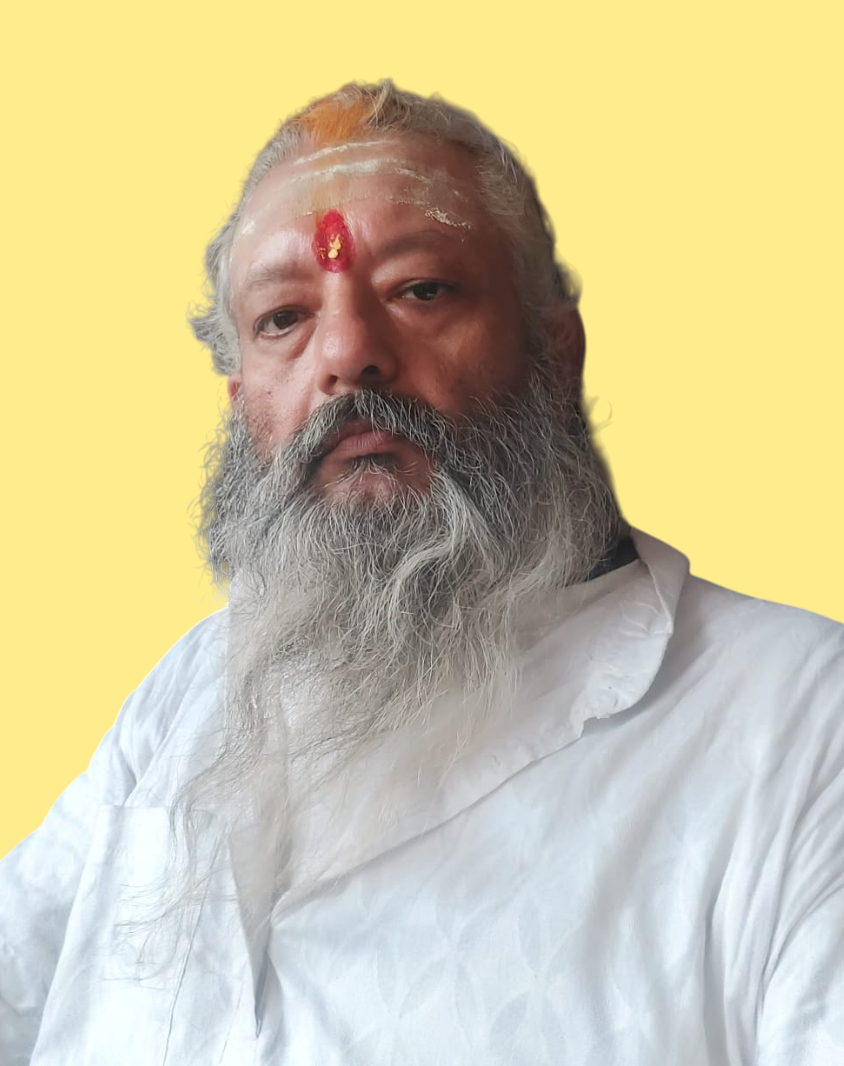
Anupam Trivedi has spent over three decades studying and reflecting upon Sanatan scriptures, including the Vedas, Upanisads, Itihāsa, and Purāṇas. He writes on cultural philosophy and ancient literature to present traditional insights with accuracy and clarity. Read full bio →
🙏 सनातन धर्म में योग का महत्व बहुत सुंदर बताया गया है। योग शरीर, मन और आत्मा को जोड़ने का दिव्य मार्ग है। हर हर महादेव! 🕉️