
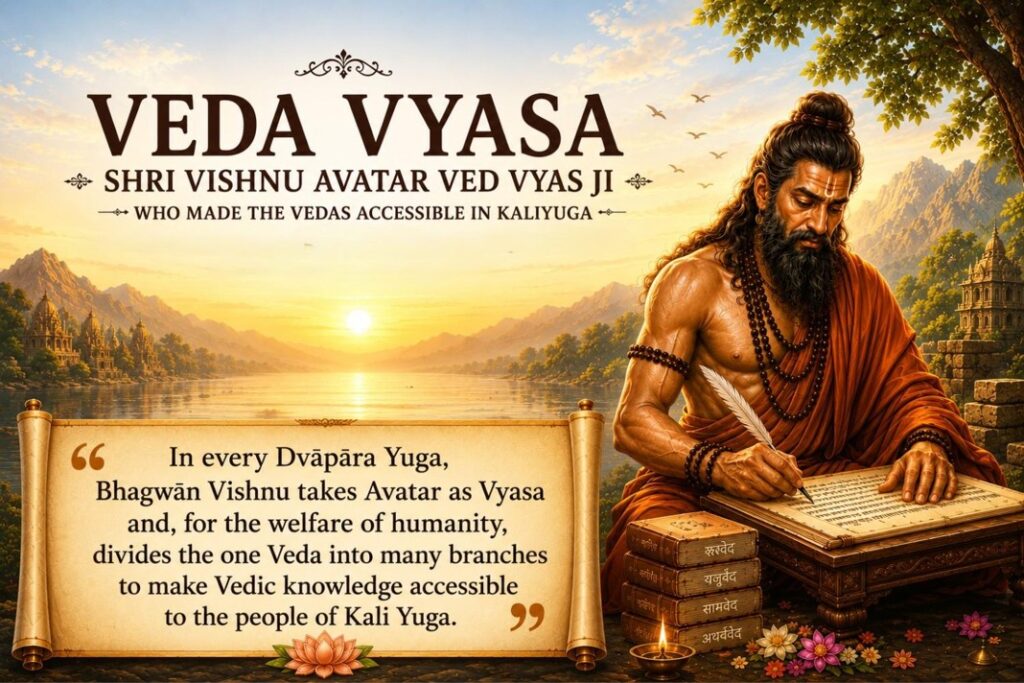
Bhagwaan Vishnu’s Vyasa Avatar
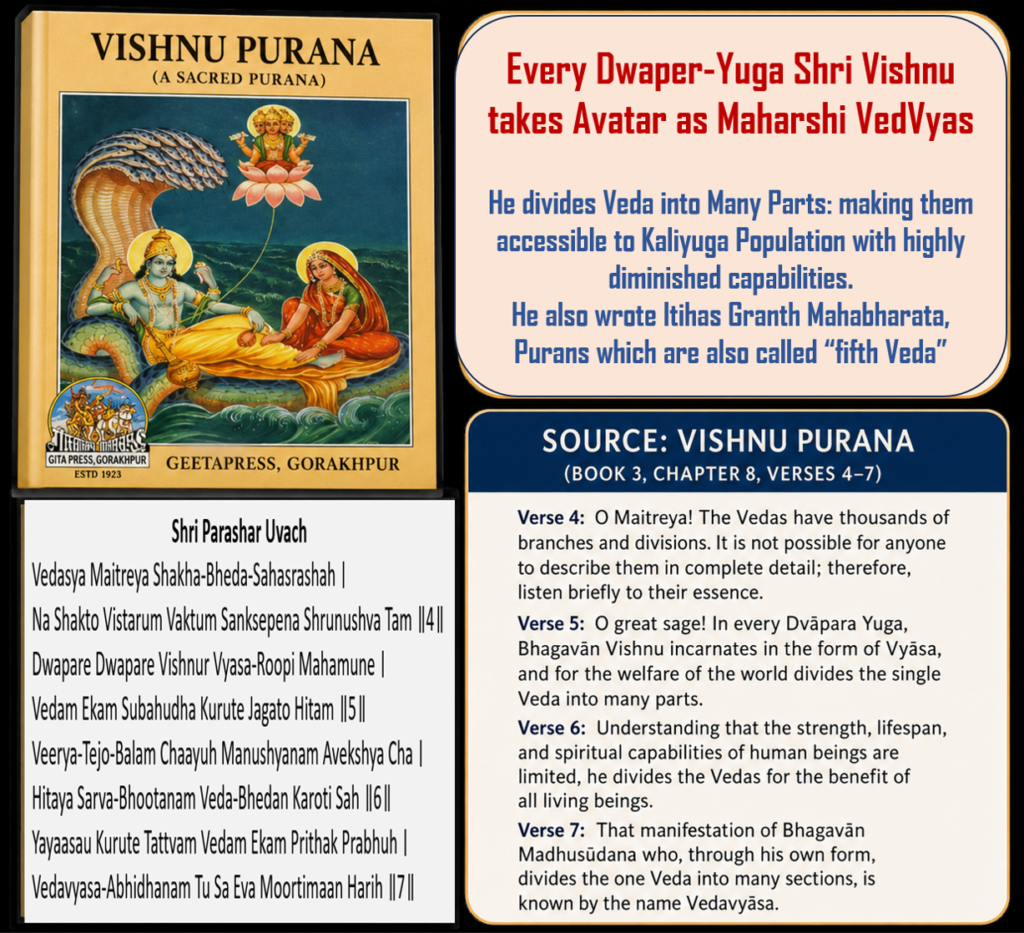
Taṁ namāmi maheśānaṁ muniṁ dharmavidāṁ varam।
Śyāmaṁ jaṭākalāpena śobhamānaṁ śubhānanam ॥
Munīn sūryaprabhān dharmān pāṭhayantaṁ suvarcasam।
Nānāpurāṇakartāraṁ vedavyāsaṁ mahāprabham॥
(Brihaddharma Purana 1.1.24-25)
“I repeatedly bow to that Maheshan Ved Vyas, who is the best among those who know the deepest secrets of Dharma, whose complexion is dark (Shyama), whose auspicious countenance is adorned with Jata Jut (matted hairs), who teaches the scriptures of Dharma to sages who possess the brilliance of the sun, who is luminous, intensely radiant, and the creator of all the Puranas and Up-Puranas.”
The Decline of Human Capabilities as Yuga’s Progress
Throughout the vast cycles of time described in Sanatan Dharma scriptures, human capabilities do not remain spiritually, intellectually, or physically constant.
The ancient scriptures describe a gradual decline in human capability as the Yugas progress from Satya Yuga to Treta Yuga, from Treta to Dwapara Yuga, and finally into Kaliyuga. With each successive age, memory weakens, spiritual discipline diminishes, lifespans become shorter, and the ability to comprehend profound spiritual truths gradually declines.
This decline presents a serious challenge. The Vedas, which constitute the highest source of revealed spiritual knowledge in Sanatan Dharma, were originally preserved through an extraordinarily disciplined oral tradition. Their study required years of rigorous Gurukul residential training for several years, strict Brahmacharya, immense memory power, purity of conduct, and the direct guidance of accomplished Gurus. Such a system was possible during earlier Yugas when human beings possessed exceptional mental and spiritual capabilities.
In Kaliyuga such capabilities are at their lowest level, and it is absolutely impossible to comprehend the Vedas (as compared to previous Yugas).
Bhagwan Vishnu takes Vyasa Avatar during every Dwapara Yuga. Purpose of Vyasa Avatar is to preserve the Vedic knowledge in simpler form so that its accessible for the population of Kaliyuga.
In Vishnu Purana, Maharshi Parashara explains that Bhagwan Vishnu repeatedly manifests in the form of Vyasa during every Dwapara Yuga for the welfare of humanity. Observing the diminishing strength, memory, lifespan, and intellectual capacity of human beings, He divides the Vedas into multiple branches so that sacred knowledge may continue to survive and flourish.
He also Authors 18 Maha Puranas (and Up-Purans), Purans are also called 5th Veda and Vedic knowledge is told in a very easy way through stories, and can be read and understood by all common men and women.
Why Puranas and Mahabharata
Even after dividing the Vedas, Maharshi Ved Vyas recognized another challenge. While the Vedas had become more manageable, they still required disciplined study and prolonged stay in Gurukul under the guidance of Distinguished Guru. Large sections of society would remain unable to access the deeper teachings of the Vedas directly.
Maharshi Ved Vyas through Puran’s wrote profound spiritual Vedic truths through narrative literature, historical accounts, dialogues, biographies, and stories. He expressed eternal principles through forms that ordinary people could understand and remember.
This effort eventually gave rise to the Puranic tradition and culminated in the composition of the Mahabharata.
The Puranas preserved theology, cosmology, ethics, devotion, pilgrimage traditions, spiritual practices, and philosophical teachings through engaging narratives. They transformed complex metaphysical concepts into stories capable of inspiring people from every background.
Similarly, the Mahabharata describes Vedic teachings through human relationships, political conflicts, moral dilemmas, family obligations, and spiritual struggles…
Maharshi Ved Vyas: The Bhagiratha of Vedic Knowledge
Maharshi Ved Vyas is often regarded as the Bhagiratha of India’s river of sacred Vedic knowledge. Just as King Bhagiratha brought the celestial Ganga down to Earth for the welfare of humanity, Maharshi Ved Vyas, through his uninterrupted spiritual contemplation at Badarikashrama in the Himalayas, first realized within himself the threefold stream of Adhyatma (spiritual wisdom), Dharmaniti (righteous conduct), and Puranic knowledge. Thereafter, through his unparalleled literary endeavour, he sanctified the vast corpus of India’s sacred literature and gave enduring direction to the intellectual and spiritual life of the people.
As a worshipper of the Infinite, Maharshi Ved Vyas, through his immense literary and spiritual achievements, became an eternal symbol of India’s boundless wisdom. He is a Maharshi endowed with extraordinary genius and divine insight. Works such as the Srimad Bhagavatam, regarded as a touchstone for the highest scholarship, the Mahabharata, a treasure-house of sublime spiritual and emotional jewels, together with the Brahma Sutras and the eighteen Mahapuranas, stand as powerful testimony to his unparalleled greatness.
For this reason, in praise of Maharshi Ved Vyas’s extraordinary brilliance, it has been said that whatever knowledge pertaining to the four goals of human life—Dharma (righteousness), Artha (prosperity), Kama (rightful desires), and Moksha (liberation)—exists elsewhere can be found within the Mahabharata. Conversely, whatever is not found in the Mahabharata is found nowhere else:
धर्मे चार्थे च कामे च मोक्षे च भरतर्षभ । यदिहास्ति तदन्यत्र यन्नेहास्ति न तत् क्वचित् ॥
“O best of the Bharatas, whatever concerns Dharma, Artha, Kama, and Moksha that exists here may be found elsewhere; but whatever is not found here is found nowhere at all.”
The Sacred Lineage of Maharshi Ved Vyas
The extraordinary mission of the Vyasa Avatar unfolded through an equally extraordinary lineage.
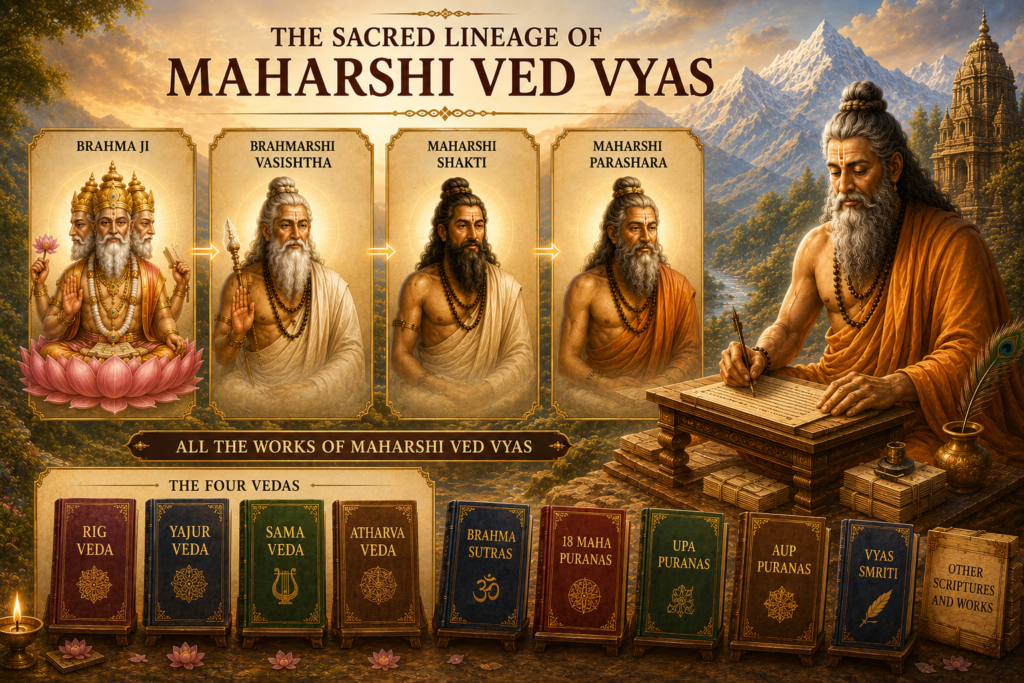
Maharshi Ved Vyas was born into one of the most revered spiritual lineages in the Sanatan Dharma tradition. He was the great-grandson of Brahmarishi Vasistha (Manas Putra of Brahma Ji), one of the Saptarishis and among the most celebrated sages of Vedic civilization. His grandfather was Maharshi Shakti, and his father was the renowned Maharshi Parashara, whose contributions to spiritual literature, Jyotisha, and Puranic tradition continue to influence Hindu thought even today.
He was born to Devi Satyavati, a woman whose life itself forms one of the most fascinating narratives in the Itihas Grantha Mahabharata, where she becomes the reason for the Bhishm Pratigya, the birth of Kaurav and Pandava’s and finally the Mahabharata War.
The Mahabharata, Brahmasutras, 18 Mahapuranas, 18 Upapuranas, 18 Aup Puranas, Vyasa Smriti and the systematic arrangement of Vedic knowledge are all traditionally associated with Maharshi Veda Vyasa. Through these works, he ensured that the essence of Vedic wisdom would remain available not only to Vedic scholars and ascetics (Sanyasi’s) but also to common men and women living in future KaliYuga.
For this reason, generations of Saints, Acharyas, and spiritual seekers have regarded Maharshi Ved Vyas with extraordinary reverence.
All the Smriti Grantha’s by Various Rishi’s such as DharmShatras, Vedang, Vedant, Darshan Shastra, ashtang yoga etc., are all created from Maharshi Veda Vysa’s work.
Achaturvadano Brahma, Dvibahur Aparo Harih,
Abhalalochanah Shambhur Bhagavan Badarayanaḥ.
- (Mahābhārata Tātparya Nirṇaye)
“Salutations to Bhagavan Badarayana (Maharshi Ved Vyas), who, though not possessing four faces, is verily Brahma; who, though not possessing four arms, is truly Hari (Vishnu); and who, though not bearing the third eye upon his forehead, is indeed Shambhu (Shiva).”
(Mahābhārata Tātparya Nirṇaya is a celebrated work of Madhvacharya (Śrī Ānandatīrtha), in which he explains the deeper meaning and significance of the Mahabharata. This verse is often quoted to express the extraordinary reverence accorded to Maharshi Ved Vyas within the Sanatan tradition).
================================
References:
- Shrimad Devi Bhagwat Mahapuran
- Vishnu Puran
- Puranika Rahasyom ka Samikshatmak ANusheelan; Authour-Shri Dr Krishnamni Tripathi, Acharya, MA, PH.D., D.Lit, Edited By Dr Ramesh Mishra, Acharya; Chawkhamba Krishnadas Academy, Oriental Pulishers and Distributors Varanasi.

Anupam Trivedi has spent over three decades studying and reflecting upon Sanatan scriptures, including the Vedas, Upanisads, Itihāsa, and Purāṇas. He writes on cultural philosophy and ancient literature to present traditional insights with accuracy and clarity. Read full bio →