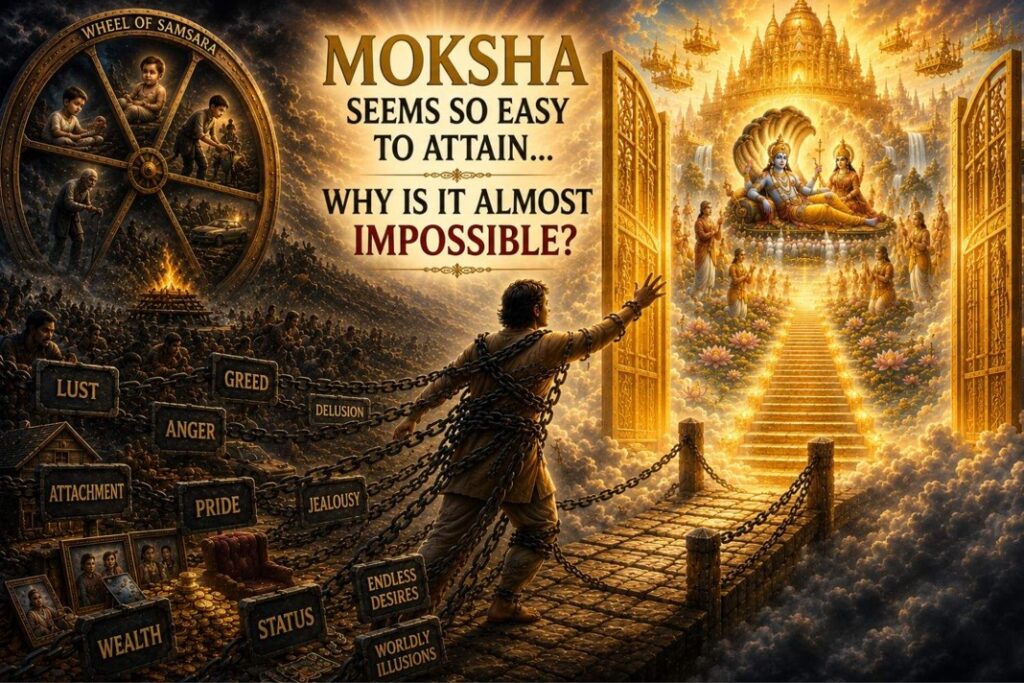
Why Moksha is Impossible to attain? despite the simple shortcuts described in the scriptures!
First, we will understand the true meaning of Moksha. Following that, we will discuss the numerous easy means to achieve Moksha mentioned across our sacred texts. If attaining Moksha is so effortless according to the scriptures, why do we assert that ‘Moksha Is Impossible’? Let us look deeper into this spiritual paradox.”
Moksha What we understand currently is …
In sanatan dharm (Hinsuism) Moksha is also known by names – Kaivalya (Kapil Bhagwan saankhya yog), Nirvana (Baudh) salvation, freedom, emancipation, enlightenment in English…
The simple meaning of salvation or liberation that we understand is: Freedom (get rid off) from all kinds of suffering, bondages, desires and lusts, But this is very definitive and philosophical term to be freed from the bondage of unbearable pain of being born again and again and dying again and again…..
which means – to be free from the cycle of birth and death forever,
In other words, liberation or freedom from all suffering is possible only when our cycle of birth and death ends…and as per this definition, salvation is possible only when one attains God!
Why its so difficult to understand is Moksha?
- The language used in explaining this subject from those distinguished scholars (vidwaan pundits) is very difficult to comprehend by normal people like us. For example, an excerpt from an article on moksha-
“In the Indian philosophical tradition, salvation has been the ultimate goal, but there is no consensus among them about the nature of salvation, Some people consider it to be the ultimate state of knowledge, while others call it a state of bliss beyond happiness and sorrow, Some consider it to be a state of Abhayam, Ajaram, Amrutyupadam, free from the cycle of existence, while some call it eternal and omnipresent, free from the chain of cause and effect … ”.
When we do not understand a topic or have doubts or mistrust….like the afterlife, heaven, hell, reincarnation etc. then we should have faith and trust in the statements written in the scriptures as truth. Above all, the essence of the scriptures is the words of Shri Krishna, The God himself. The Bhagavad Gita first and the second most reliable is Shrimad Bhagwat Puran, which is Krishna himself. So we too will understand salvation from the words of scriptures / saints only
2. The second reason for not understanding salvation is lack of faith, ignorance about the scriptures, and there is no example of anyone coming after death and telling that he has attained salvation.
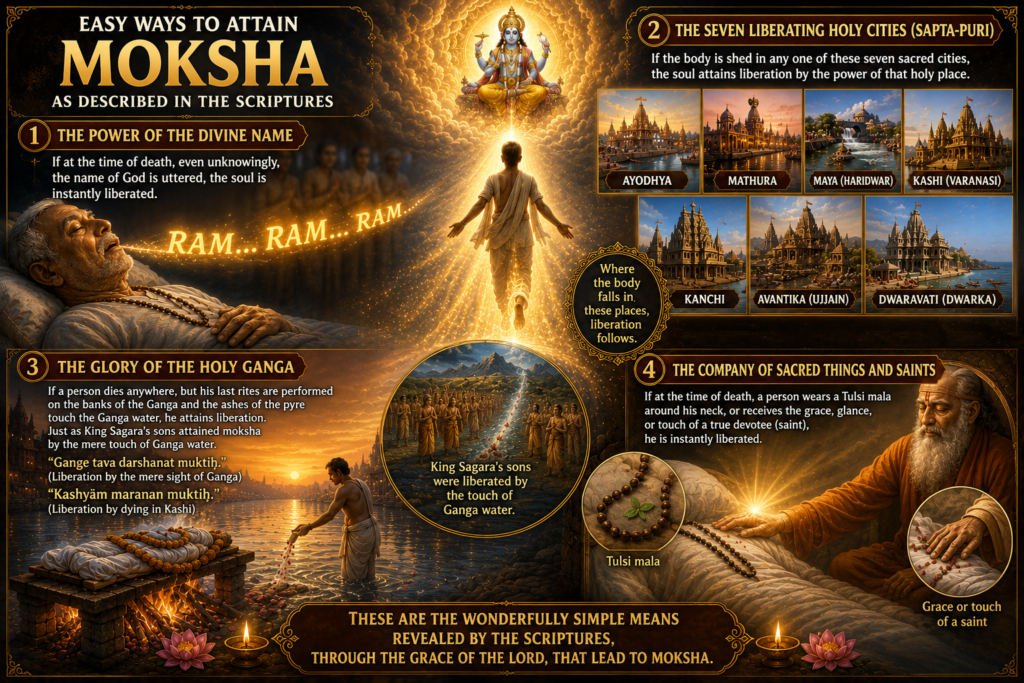
Seemingly Effortless Means to Attain Salvation as Described in the Scriptures
The Power of the Divine Name: If the holy name of the Supreme Lord inadvertently slips from one’s lips at the moment of Death, the soul is instantly liberated.
The Sacred Sapta-puris : If anyone dies within the boundaries of any of the seven holy cities—Ayodhya, Mathura, Maya (Haridwar), Kashi, Kanchi, Avantika (Ujjain), and Dwaravati (Dwarka)—Moksha is secured.
The Glories of the Purifying Ganges: Regardless of where a person passes away, if their final rites are performed on the banks of the Ganges and the ashes from their funeral pyre mingle with her sacred waters, they attain ultimate liberation. A prime scriptural example is that of the incinerated sons of King Sagara, who were granted salvation merely through the touch of the celestial river. The scriptures explicitly proclaim: “Gange tava darshanaat muktihi” (Liberation is attained by the mere sight of the Ganges) and “Kashyam maranaat muktihi” (Liberation is attained by shedding the mortal frame in Kashi).
Sacred Associations and the Blessings of Saints: If a person passes away with a Tulsi mala adorned around their neck, or if the merciful glance or touch of an exalted devotee of the Lord (a true Saint) falls upon them at the final moment, the soul is instantly released from all bondage.
There is a kind of Moksha (salvation) like this too!
You cease to exist! That is, for example, suppose you (the soul) is a drop of water, and if you are put into the ocean, then a kind of Kaivalya (oneness, sayujya) Moksha / salvation is achieved. Now, no one other than God can bring you back into existence.
Would you like to attain salvation in which you will cease to exist, you will not have any Existance, No body NO Senses?

Do you want salvation after death? Or do you want salvation while alive?
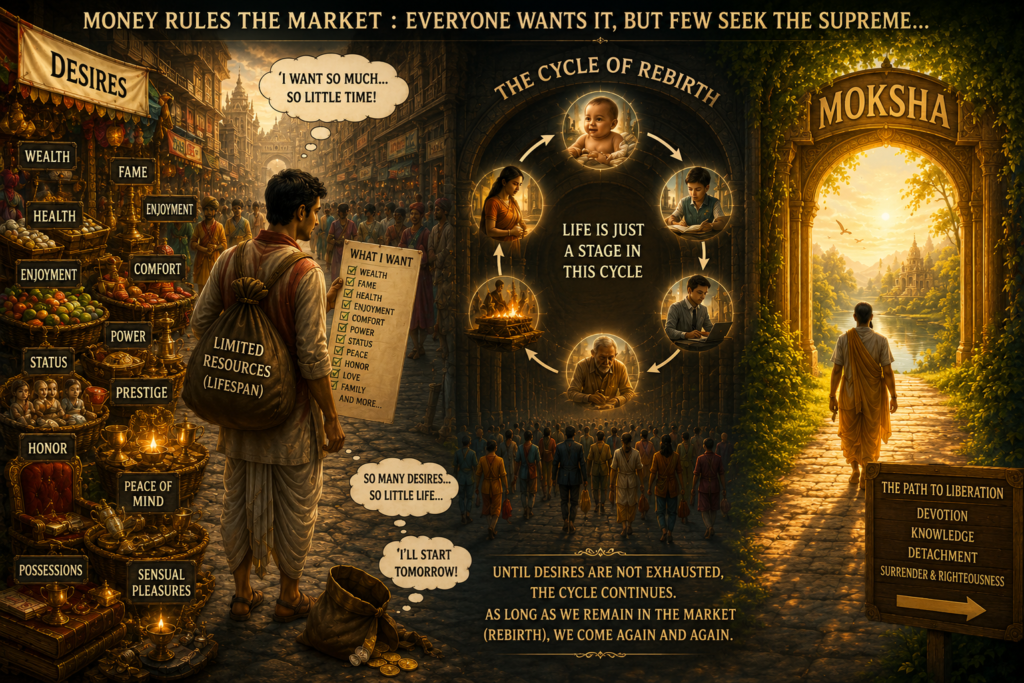
If one dies with many desires/wishes are still alive, it is “death”, he /she will have to take birth again.
If one doesn’t have any desires while he is alive he has attained Moksha (liberation)
Understand this from an example-
If you go to the market to buy things and the money runs out and you are unable to buy all the things, then you will have to come to the market again… (will have to take rebirth), you have money but there is nothing left to buy, then why come to the market again?
one who is not free from desires while living is never free even after death. The person who believes that salvation has not been achieved now but will be achieved after death, deceives himself
– Swamy Sharnanand
Moksha means freedom from bondage, so what is bondage?
Cycle of repeated births, repeated deaths, repeated sleeping in the womb of a mother again and again, it is very difficult to cross this world, O Krishna, kindly protect me. Worship Govinda, take the name of Govinda, love Govinda. Because there is no other way to cross this ocean of existence except chanting the name of the shri krishna.
That is, death is certain for one who is born, and birth is certain for one who is dead. Freedom from the cycle of birth and death can be achieved only by the grace of God….
The goal of human life? – Four Purusharthas
Dharma, Artha, Kama and Moksha
When a man does any work with the desire of getting the result, it is called Purusharth. There are four Purusharths – Dharma, Artha, Kama and Moksha. Dharma is at the root of these four Purusharths. In the scriptures, attainment of Moksha is considered to be the ultimate goal of man, for this reason Moksha is called the ultimate Purusharth.
The four purusharthas (Dharma, Artha, Kama and Moksha) are divided into two parts, first is Dharma and Artha and second is Kama and Moksha.
Kama means desire for worldly pleasures and Moksha means freedom from worldly desires, bondages and sorrows.
The means of achieving these two goals of life, desire and salvation are Dharma and Artha
Kama is achieved through Artha and Moksha is achieved through Dharma. Also, money (Artha) should be earned in accordance with Dharma,
desires are not fulfilled with money earned through unrighteous means.
Four Purusharthas –Dharma, Artha, Kama and Moksha
Dharma: Dharma is at the root of all four Purusharthas. All Purusharthas can be achieved only by following Dharma. Varna is also important, some Dharma are different in different Varna’s (Brahmin, Kshatriya, vaishya and Shudra are 4 varnas). Unfortunately many people don’t know their Varna – dharma, all knowledge about varna – dharma is vanished primarily due to foreign education system adopted
Artha – To attain material happiness and prosperity, it is necessary to have wealth. Before entering the household life, there is instruction in the scriptures that everyone should make a good arrangement for earning money as per principles of Varna – dharma. fulfilment of basic needs and material desires are possible only with money.
Kama: All the pleasures of the world come under desire. God has said that desires are the biggest hurdle in attaining God and getting salvation, Desires are the reason for bondage. If they are fulfilled, they increase greed and give temporary happiness but in the end they give only sorrow. If these are not fulfilled then anger arises which destroys wisdom and the person behaves un-righteously and falls into new bondages.
Moksha: The destruction of attachment is salvation, because attachment is the cause of bondage, and the literal meaning of salvation is liberation… or freedom from bondage. Freedom from bondage is not easy, and not possible without the grace of God. Thats why, if one wants to attain salvation, he/she must make efforts and strive to please God. Its only love that can please God, the true love for god…once God is realized ,moksha (salvation) is attained.
The Classifications of Moksha (Types of Liberation)
Our sacred scriptures delineate several distinct forms of attaining Moksha. Upon liberation, a soul secures eternal release from all worldly bondages and miseries, receives a transcendental, divine body (Aprakrit Divya Deh), and resides blissfully in the supreme realm of the Divine. For loving devotees (Premi-Bhaktas), there are four primary classifications of Moksha:
Salokya: Attaining the privilege to reside eternally within the divine realm of the Supreme Lord.
Samipya: Attaining the privilege to live in the immediate, close proximity and presence of the Supreme Lord.
Sarshti: Attaining the same divine opulences, majestic splendors, and dwelling rights as the Supreme Lord Himself within His realm.
Sarupya: Attaining a divine spiritual form that completely resembles the beautiful countenance of the Supreme Lord.
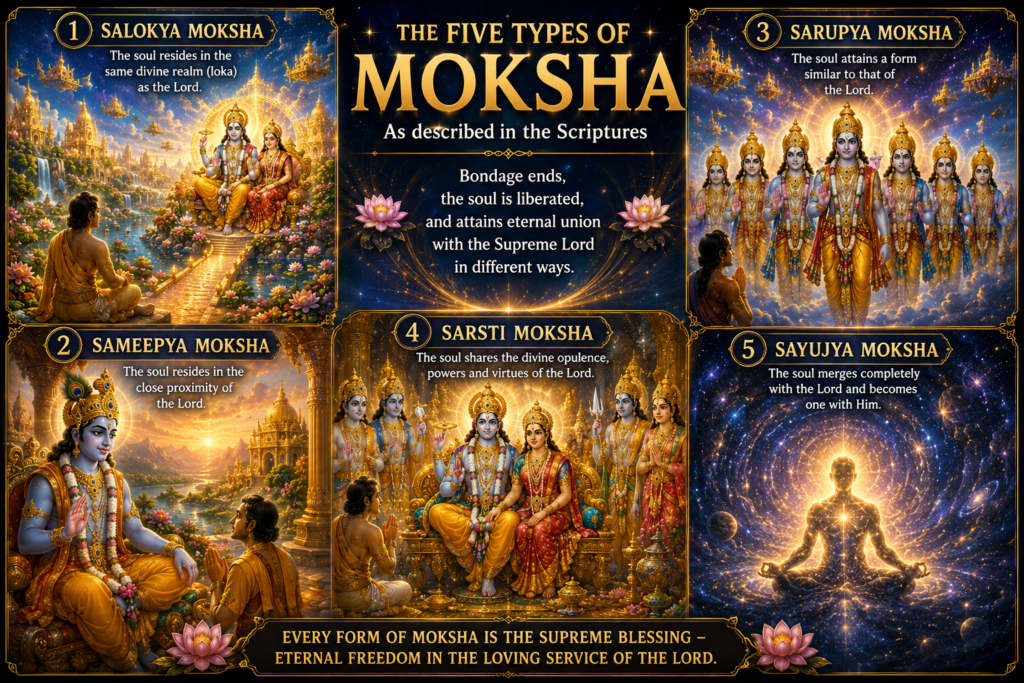
Beyond these, there exists another form of liberation known as Sayujya, wherein the individual soul merges completely into the absolute being of the Divine. This form of liberation is generally sought after by certain spiritually wise seekers (Gyani Bhaktas). In Sayujya Moksha, because the soul becomes entirely devoid of any spiritual body or senses, the individual identity of the Jivatma ceases to exist as a separate entity.
================================
Anupam Trivedi has spent over three decades studying and reflecting upon Sanatan scriptures, including the Vedas, Upanisads, Itihāsa, and Purāṇas. He writes on cultural philosophy and ancient literature to present traditional insights with accuracy and clarity. Read full bio →
Pingback:What is Fate or Destiny – Prarabdh