
Please click here If you have not read part 1 of What is Yoga in Sanatan Dharma?
In Part 1 – (What is Yoga in Sanatan Dharma? – Countless Names, Dimensions, and a Vast Tradition of Sadhana) we explored the vast and intricate world of Yog: its many names, diverse definitions, different disciplines and profound spiritual objectives. The number of paths and practices described in the scriptures can initially seem overwhelming. A natural question therefore arises: among so many forms of Yoga, how does a seeker understand their relationship and identify the path suited to their spiritual inclination?
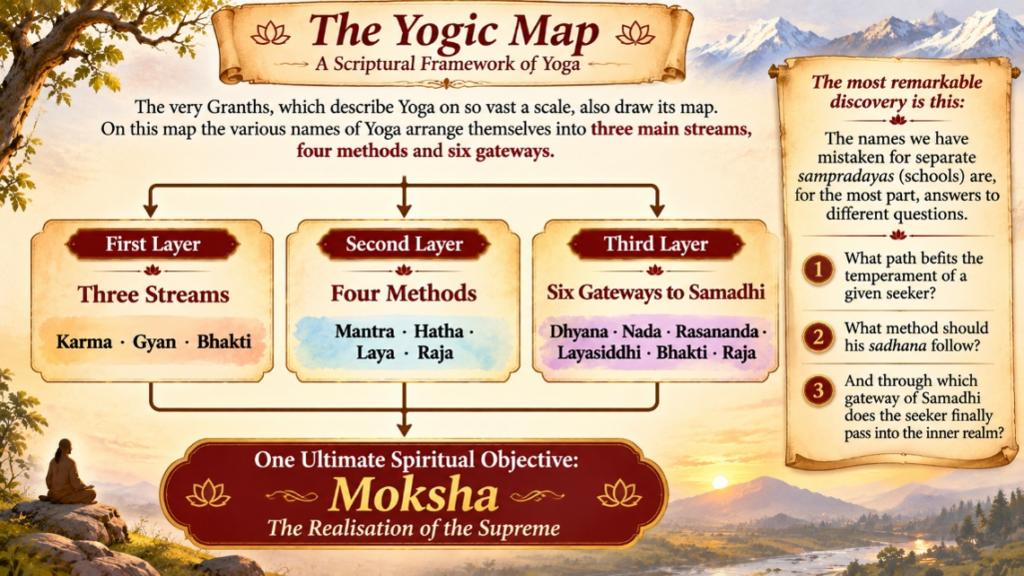
The answer is that the Granths themselves provide a framework for understanding this diversity. The various names of Yog do not necessarily represent entirely separate schools or unrelated spiritual systems. Many of them describe different dimensions of the same spiritual pursuit.
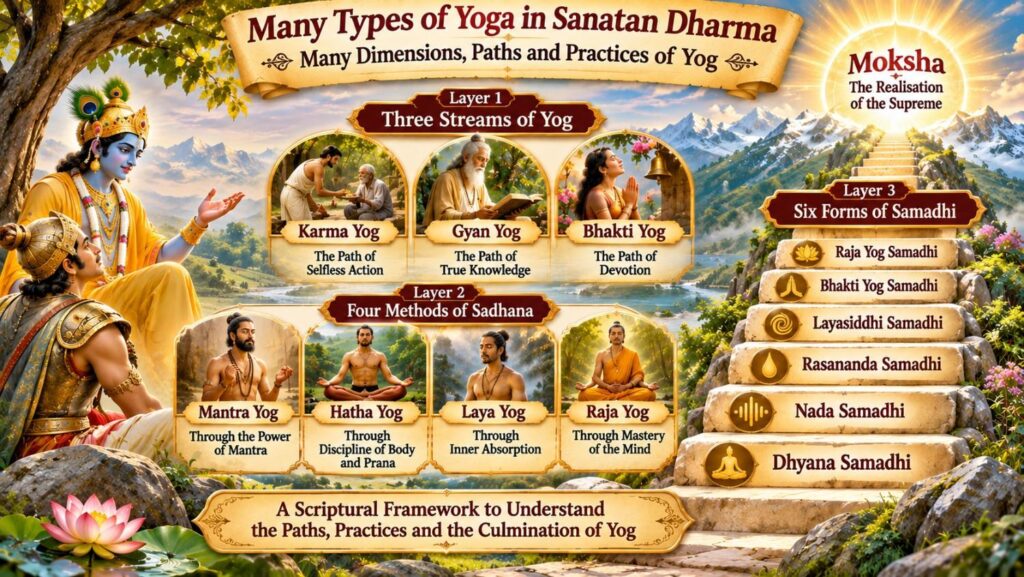
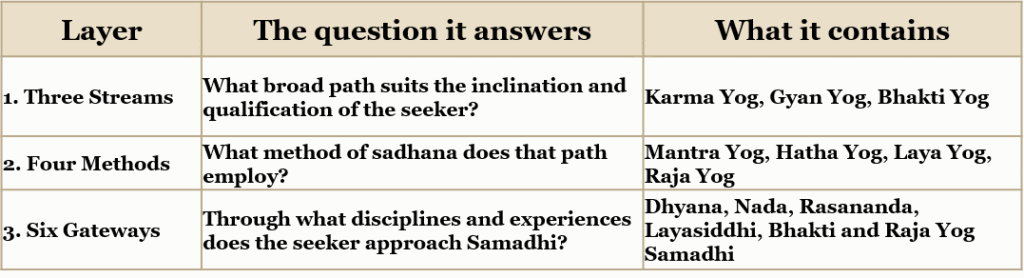
The scriptural descriptions can be understood through three broad layers: three principal streams, four methods of sadhana and six distinct forms of Samadhi. Together, these classifications help us understand Yog through three questions:
- What broad path is suited to the inclination and qualification of a seeker?
- What method of sadhana does that path employ?
- Through what disciplines and experiences does the seeker approach Samadhi?
Layer 1: Three Streams of Yog
The passage titled “Types of Yoga” in the Yogank (the special Yoga issue of Kalyan, published by Gita Press) says that the methods of Yoga have been divided into several parts to suit the interests and abilities of different seekers.
Many experts on Bhagwat Gita and the great teachers of recent times have generally Classified Yoga into three principal streams: Karma Yoga, Gyan Yoga and Bhakti Yoga.
These represent three broad approaches to spiritual realisation: action, knowledge and devotion.
The ancient texts also describe Hatha Yog, Laya Yog and Raja Yog as distinct methods. Some traditions understand these and other disciplines within the broader framework of Karma, Gyan and Bhakti. According to this interpretation, even practices such as Ashtanga Yog (with its asana, mudra, pranayama, dhyana, dharana and samadhi), Mantra Yog and Japa Yog can be understood within Trividha Yog (Karma, Gyan and Bhakti).
The same passage recalls the example of Rajarshis and Rishis such as Janaka and Yajnavalkya, who became renowned for their remarkable synthesis of Karma, Gyan and Bhakti.
The three streams can be understood through their central principles:
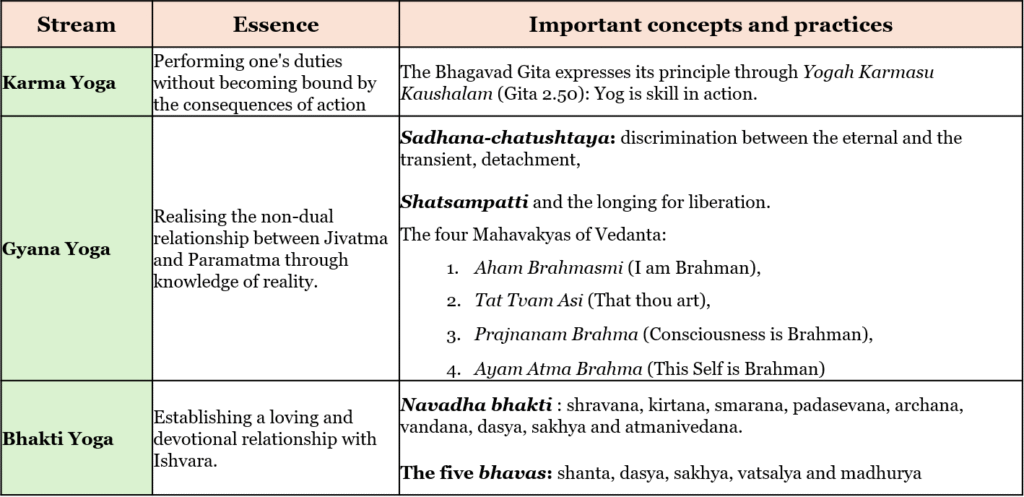
These three streams provide a broad understanding of the seeker’s approach to spiritual life. Karma Yog emphasises the right relationship with action, Gyan Yog the pursuit of true knowledge, and Bhakti Yog loving devotion to the Divine.
Who is a Karm Yogi ?
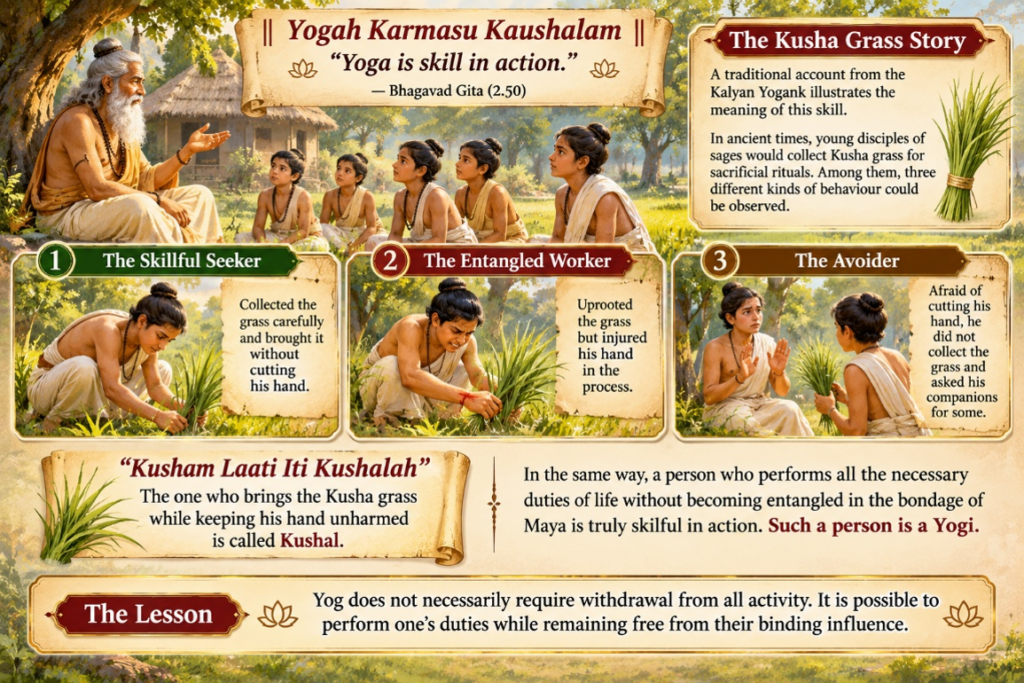
Understand with a Parable of Kusha Grass: What Does Yogah Karmasu Kaushalam Mean?
The Bhagavad Gita declares:
“Yogah Karmasu Kaushalam” — Yoga is skill in action.
But what does this skill actually mean? A traditional account presented in the Kalyan Yogank offers an interesting illustration.
In ancient times, young disciples of sages would collect Kusha grass for yagya Havan and many rituals. Among these young boys, three different kinds of behaviour could be observed.
- Those who collected the grass so carefully that they could uproot it without cutting their hands.
- The second group managed to uproot the grass but injured their hands in the process.
- The third group, afraid of cutting their hands, avoided collecting the grass altogether and simply asked their companions to give them some.
The expression “Kusham Laati Iti Kushalah” is used to describe the one who successfully brings the Kusha grass while keeping his hands unharmed. Such a person is called Kushal.
The account uses this example to explain the deeper meaning of skill in action. A person who performs all the necessary duties of life without becoming entangled in the bondage of Maya is truly skilful in action. Such a person is a Yogi.
The passage contrasts this with those who become entangled in worldly attachments through their actions, as well as those who avoid action altogether out of fear of worldly suffering and dependence on the efforts of others.
The lesson conveyed through this story is that Yog does not necessarily require withdrawal from all activity. It is possible to perform one’s duties while remaining free from their binding influence.
Layer 2: The Four Methods of Yog
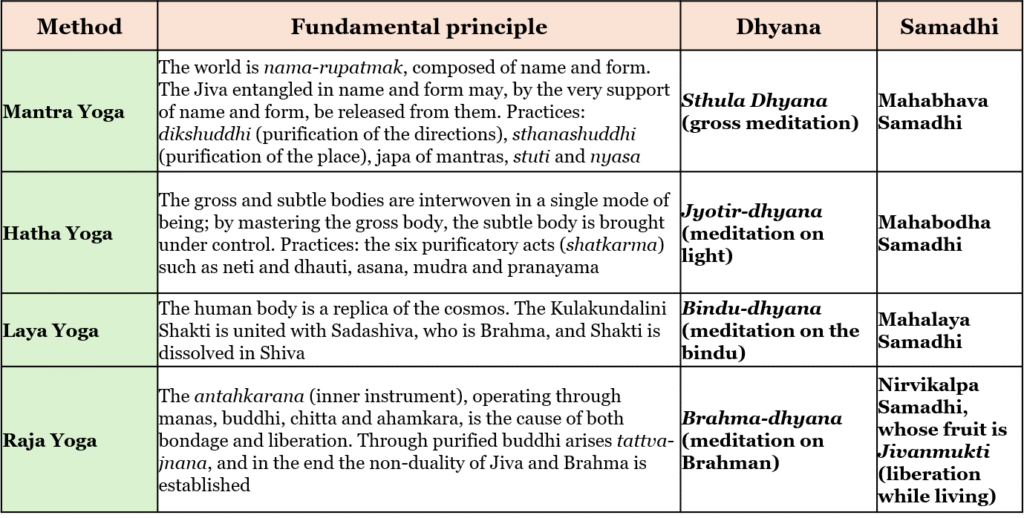
Alongside these three broad streams, the Yogic texts also describe four principal methods of Sadhana: Mantra Yoga, Hatha Yoga, Laya Yoga and Raja Yoga.
Each Yoga is assigned with its own principle, meditation and Samadhi.
Each of these methods is presented with its own underlying principle, form of meditation, and corresponding state of Samadhi.
Mantra Yoga
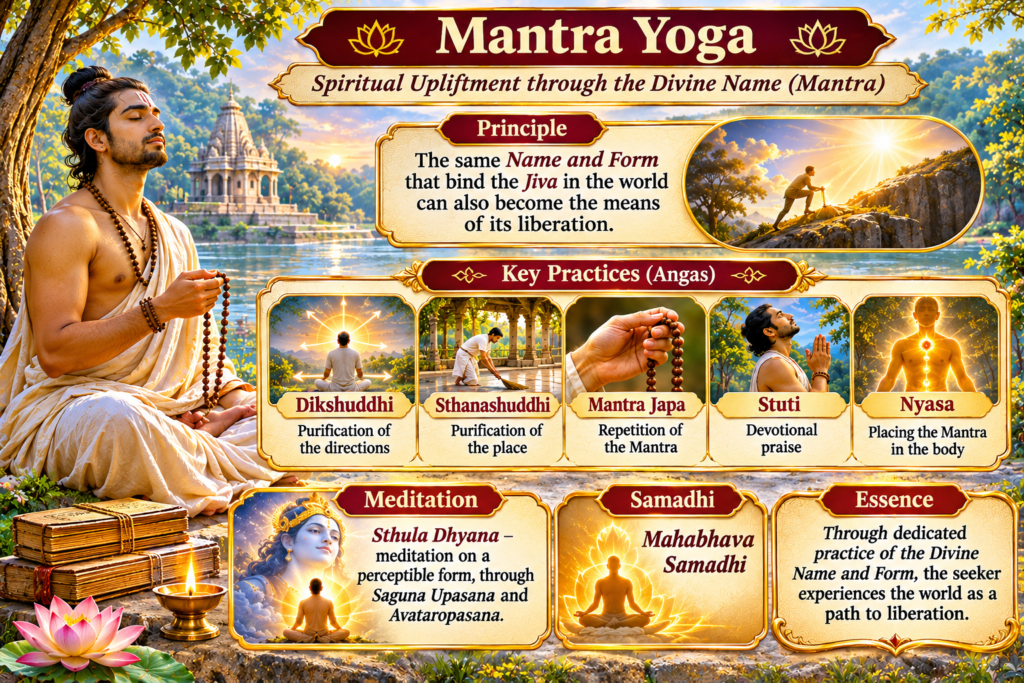
Principle. The world is Nama-Rupatmak, composed of name and form. Through attachment to name and form the Jiva remains entangled in Avidya. A person who falls upon the earth rises again by leaning on the same earth; in the same way, the Jiva bound through name and form can be freed through the support of sacred name and form.
Practices. Revered Acharyas who knew Mantra Yog divided its means into sixteen parts, among them Dikshuddhi (purification of the directions), Sthanashuddhi (purification of the place of practice), Mantra Japa (repetition of the mantra), Stuti (devotional praise) and Nyasa (the prescribed placing of the mantra in the body) are a few important angas.
- Dikshuddhi — purification of the directions.
- Sthanashuddhi — purification of the place of practice.
- Mantra Japa — repeatedly Chanting of the Mantra.
- Stuti — praise or devotional glorification.
- Nyasa — the prescribed placement of Mantra in the specified parts of body.
Meditation and Samadhi. The meditation of Mantra Yog is Sthula Dhyana, meditation upon a perceptible form. It takes many forms according to Saguna Upasana and Avataropasana, the worship of the Divine with attributes and in its incarnations. Its Samadhi is Mahabhava Samadhi.
The central principle of Mantra Yog is particularly interesting: the very Nama and Rupa through which the Jiva becomes bound can also become instruments of spiritual freedom. The means of practice are therefore connected to the principle through which the seeker experiences the world.
Hatha Yoga
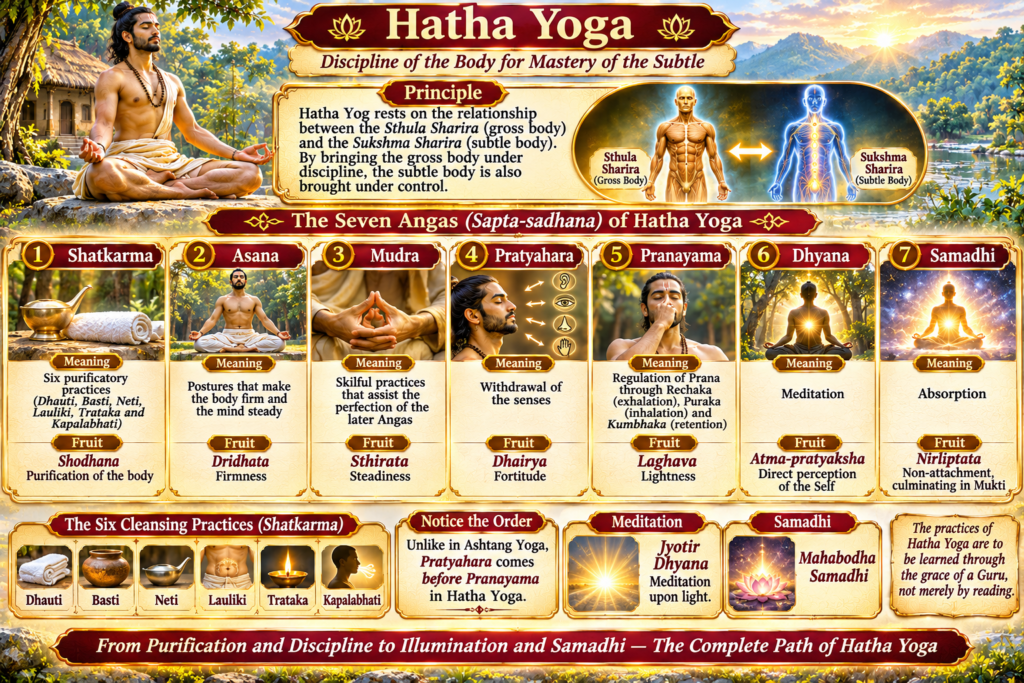
Principle. Hatha Yog rests on the relationship between the Sthula Sharira (gross body) and the Sukshma Sharira (subtle body). The two are interwoven, and the state of one acts upon the other. By bringing the gross body under discipline, the Yogi brings the subtle body under control.
The seven Angas. The Yogank, in agreement with another account, Vedon mein Yog, describes seven Angas of Hatha Yog. They are the Sapta-sadhana, the seven means taught in the Gheranda Samhita (1.9–11), where each limb is paired with its own fruit:
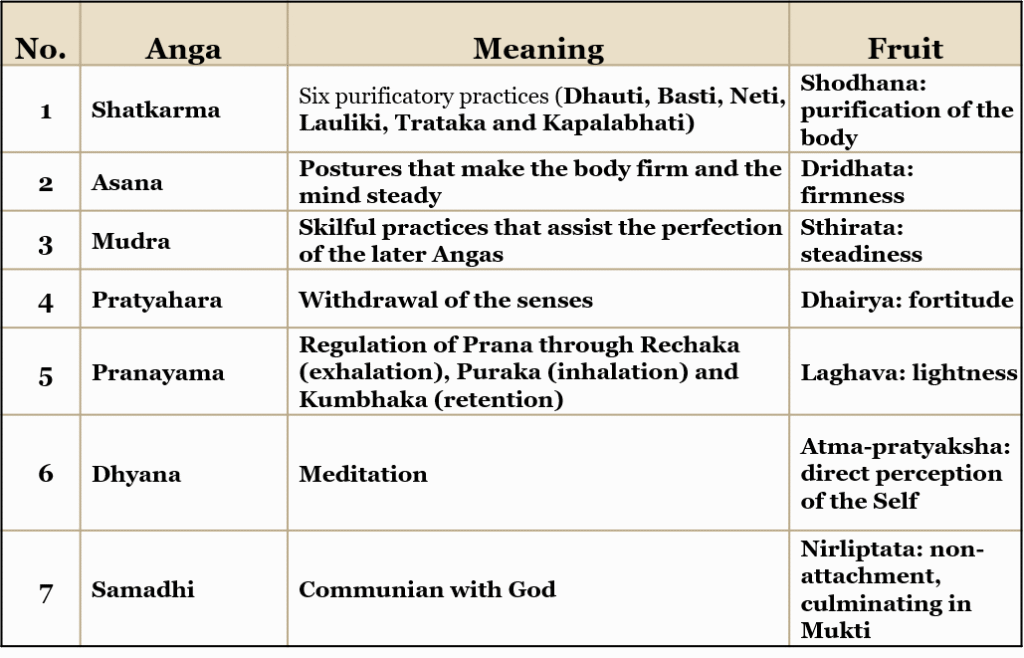
Notice the order: In Hatha Yoga, Unlike in Ashtang Yoga Pratyahara comes before Pranayama. The six cleansing practices of Shatkarma are Dhauti, Basti, Neti, Lauliki, Trataka and Kapalabhati. The texts add that they are to be learned through the grace of a Guru, and not merely by reading.
Meditation and Samadhi. Hatha Yog’s meditation is Jyotir Dhyana, meditation upon light, and its Samadhi is Mahabodha Samadhi. Hatha Yog is therefore far more than physical posture. Its structure begins with purification and ends in Samadhi.
Laya Yoga
Principle. Laya Yog regards the human body as a replica (prakriti) of the cosmos. As Brahman and Brahma-Shakti display themselves in the universe, so they do in the human body; the planets, the stars and the fourteen worlds have their seats within it as well.
At the base of the body the Brahma-Shakti called Kulakundalini lies dormant. Laya Yog carries her upward to the thousand-petalled Sahasrara in the head and unites her with Sadashiva, who is Brahman. The dissolution (laya) of Shakti in Shiva is the means to liberation.
Angas. The Yogank’s account of the four methods speaks of eight Angas of Laya Yog. Another passage, Vedon mein Yog, enumerates nine: Yama, Niyama, Sthula Kriya, Sukshma Kriya, Pratyahara, Dharana, Dhyana, Laya Kriya and Samadhi. It also connects Sukshma Kriya with Swarodaya sadhana, Pratyahara with Nadanusandhana (attending to the inner sound) and Dharana with Shatchakra-bhedana (the piercing of the six chakras). The two sources count differently, and both are given here as they stand.
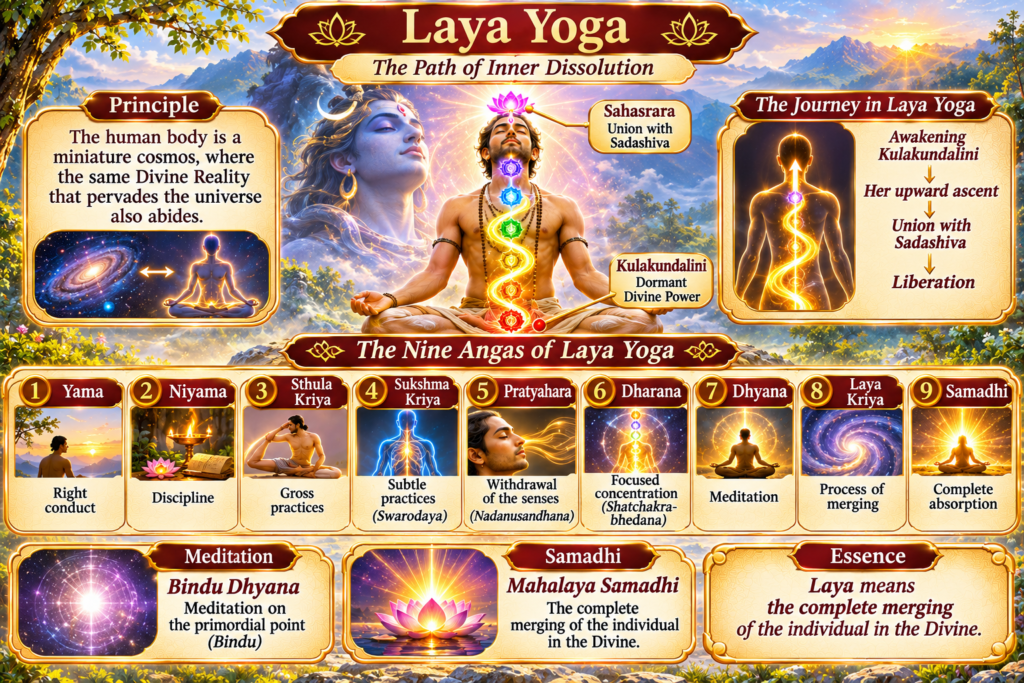
Meditation and Samadhi. The meditation of Laya Yog is Bindu Dhyana, meditation upon the Bindu, and its Samadhi is Mahalaya Samadhi. The word Laya means dissolution or absorption.
Raja Yoga
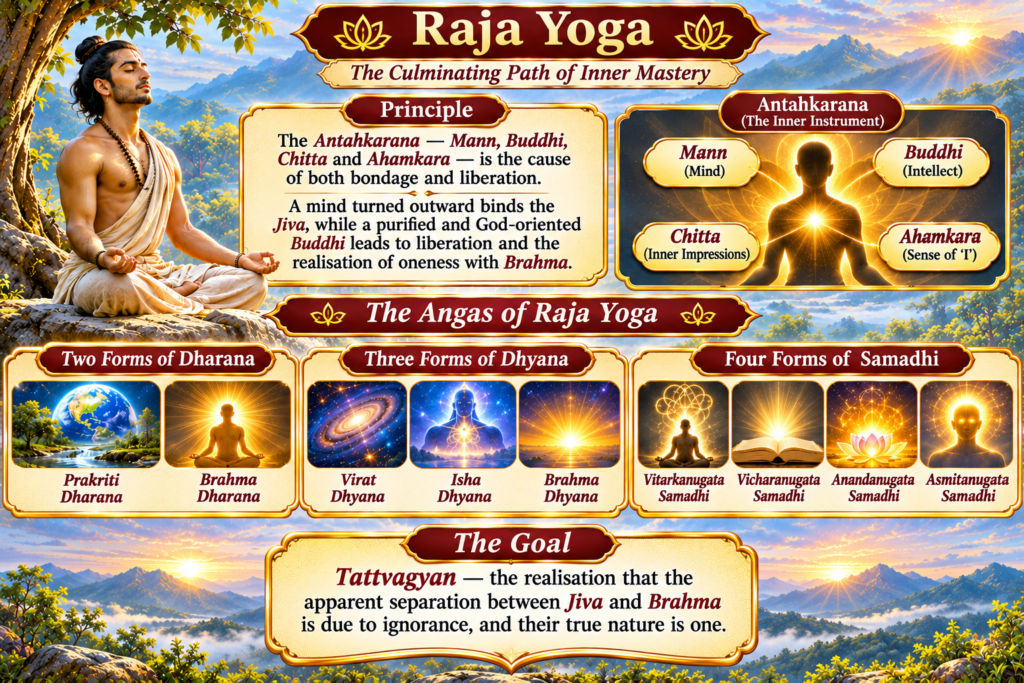
Principle: Raja Yog is the culmination (charamasima) of the other three. Its principle is that the Antahkarana, the inner instrument composed of Mann, Buddhi, Chitta and Ahamkara, is the cause both of the Jiva’s bondage and of his liberation.
As an impure mind drags the Jiva down and a pure mind lifts him up, so an intellect (Buddhi) given to the senses binds him, while an intellect turned toward Brahma leads him to the ground of liberation. With the help of a purified Buddhi the Raja Yogi attains Tattvagyan. Understanding the supposed separation of Jiva and Brahman as the work of ignorance, he is freed through the establishment of their non-duality.
The sixteen Angas. In the Article “Vedon mein Yog” from ‘Yogank’ explains the sixteen Angas as seven principal Angas, which it describes as thought-oriented (vichar-pradhan), together with two forms of Dharana, three of Dhyana and four of Samadhi:
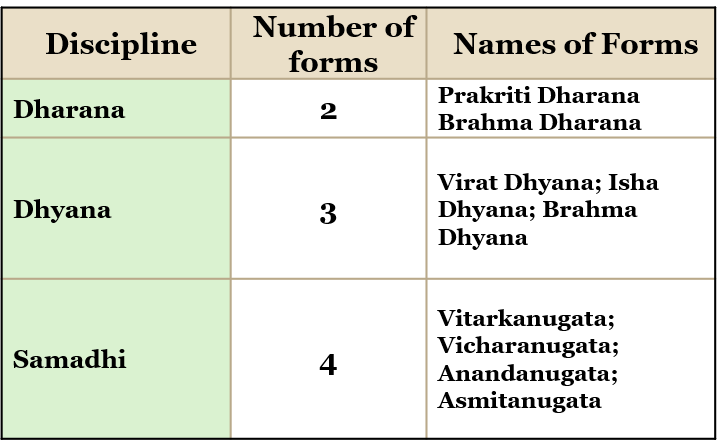
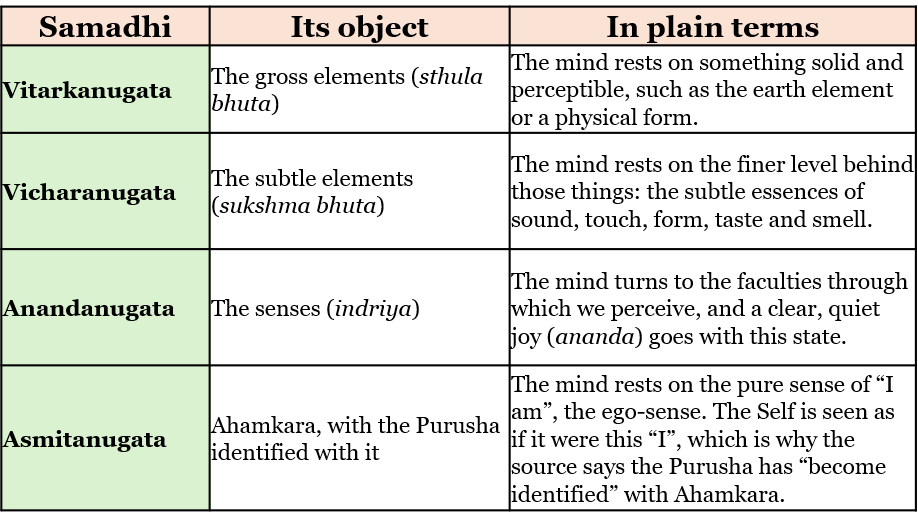
Four forms of Samadhi in Raja Yog rest on:
The four Samadhis are Vitarkanugata, Vicharanugata, Anandanugata and Asmitanugata.
Each of the four Samadhis rests on its own object, moving from the gross to the subtle: Vitarkanugata on the gross elements, Vicharanugata on the subtle elements, Anandanugata on the senses, and Asmitanugata on Ahamkara, the sense of “I”, together with the Purusha who has become identified with it.
Meditation, Samadhi and fruit. The meditation of Raja Yog is Brahma Dhyana, meditation upon Brahman. Its Samadhi is Nirvikalpa Samadhi, and its fruit is Jivanmukti, liberation while living.
The Four Methods Share a Common Foundation
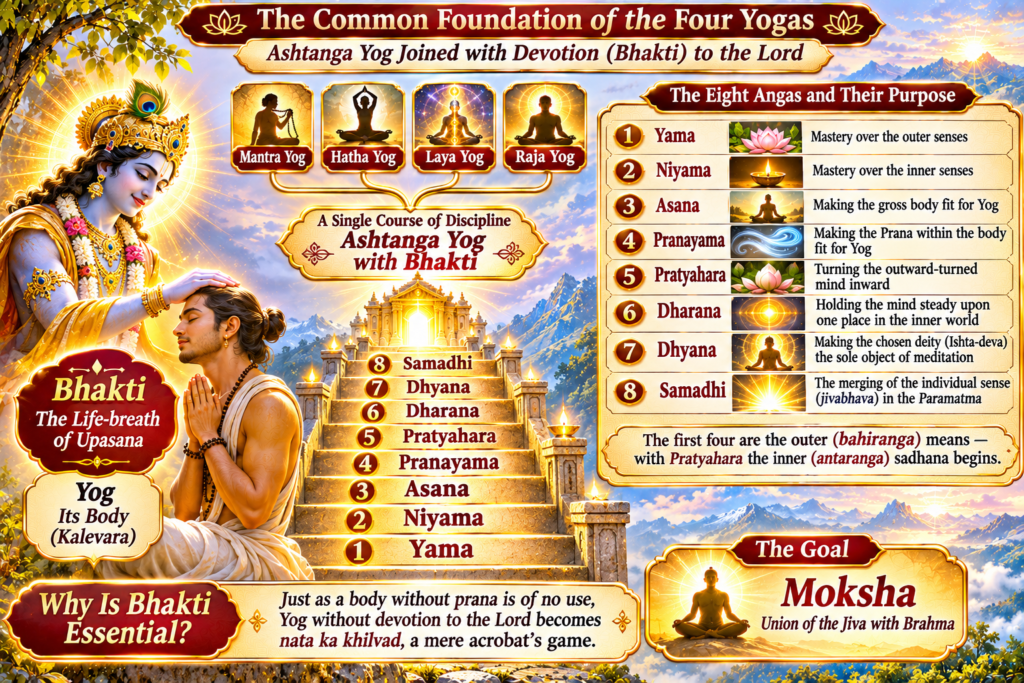
Mantra, Hatha, Laya and Raja Yog differ in principle and in practice. Yet, according to the Rishi’s, one course of discipline lies at the root of all four: Ashtanga Yog joined with devotion (Bhakti) to the Lord (bhagavad-bhakti-yukta Ashtanga Yog). The Maharshis, who behold the gross and subtle realms as clearly as a fruit held in the palm, divided Yog into these four classes and eight steps so that every limb and sub-limb of the path would be contained within them.
The Yogank describes the eight Angas as eight rungs by which one climbs to the highest terrace of the palace that is Brahma- The Almighty God, The Moksha. It summarises them as follows:
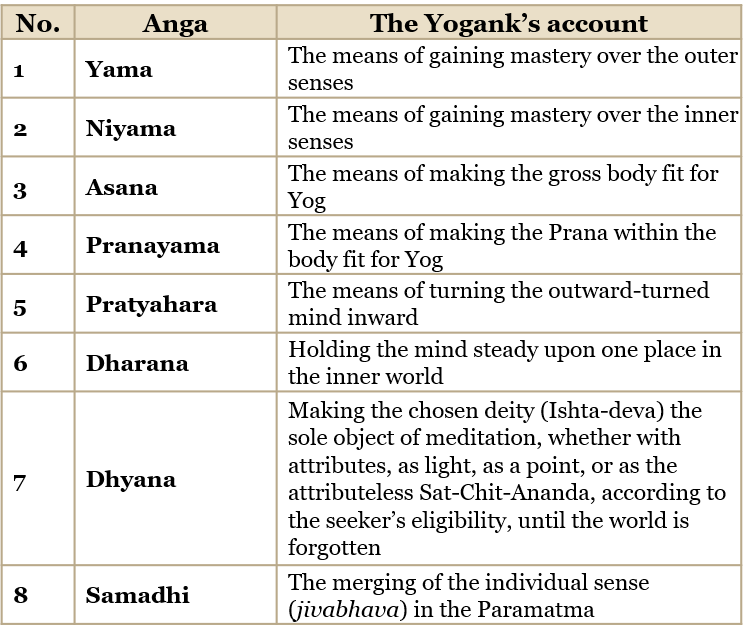
The first four are the outer (bahiranga) means – with Pratyahara the inner (antaranga) sadhana begins.
Why all Dharm Granths insist on devotion? Its answer is striking. The life-breath (prana) of Upasana is Bhakti, and its body (kalevara) is Yog. Just as a body without prana is of no use, Yog without devotion to the Lord becomes nata ka khilvad, a mere acrobat’s game.
These eight Angas of the common foundation should not be confused with the separate counts that the Granths assign to each method. They are different arrangements within one discussion of Yogic practice.
The Changing Scope of the Term “Hatha Yog”
An interesting observation concerning Hatha Yoga is attributed to Swami Satyananda Saraswati.
According to his explanation, in ancient texts the term Hatha Yoga was associated specifically with the six cleansing practices known as Shatkarma. In later usage, Asana, Pranayama, Mudra and Bandha also came to be included within the broader meaning of Hatha Yoga.
Consequently, the scope of the term as commonly understood today is broader than the particular meaning attributed to it in those earlier texts.
The Yogatattva Upanishad: Different Paths, Stages of Practice and the Seeker’s Preparedness
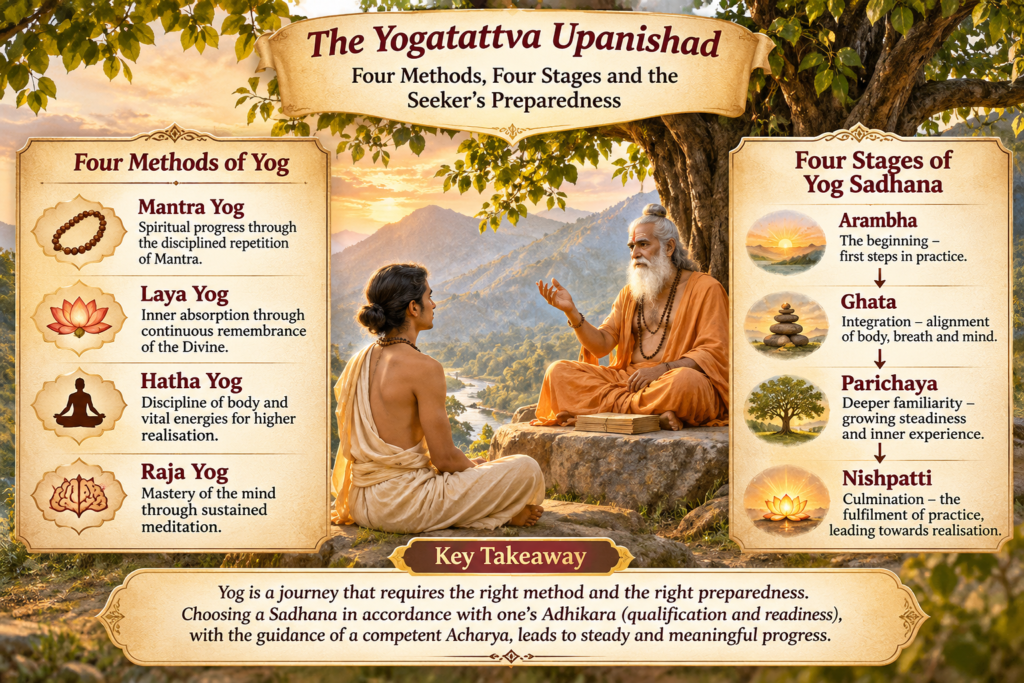
The Yogatattva Upanishad, in its dialogue between Lord Vishnu and Brahma, describes four methods of Yog: Mantra Yog, Laya Yog, Hatha Yog and Raja Yog. It further identifies four stages in the progression of Yog Sadhana: Arambha, Ghata, Parichaya and Nishpatti. While the four methods represent distinct approaches to Yog, these four stages indicate the progression of practice. Its description of Hatha Yog also presents an eight-limbed discipline, showing that different texts may arrange and explain Yogic disciplines in different ways.
This brings us to an important consideration discussed in the Yogic tradition: Adhikara, or the qualification and preparedness of the seeker. Every path has its own discipline and demands a certain degree of readiness. A practice should not be adopted merely because it is popular or appears attractive. The seeker’s temperament, capacity, discipline and understanding must also be considered. Self-assessment, together with the guidance of a competent Acharya, helps prevent the choice of a Sadhana for which one may not yet be prepared.
The deeper lesson is that Yog is not simply about choosing a path; it is about approaching that path with the right preparation. The suitability of the seeker is as important as the nature of the Sadhana undertaken.
Layer 3: Six Forms of Samadhi
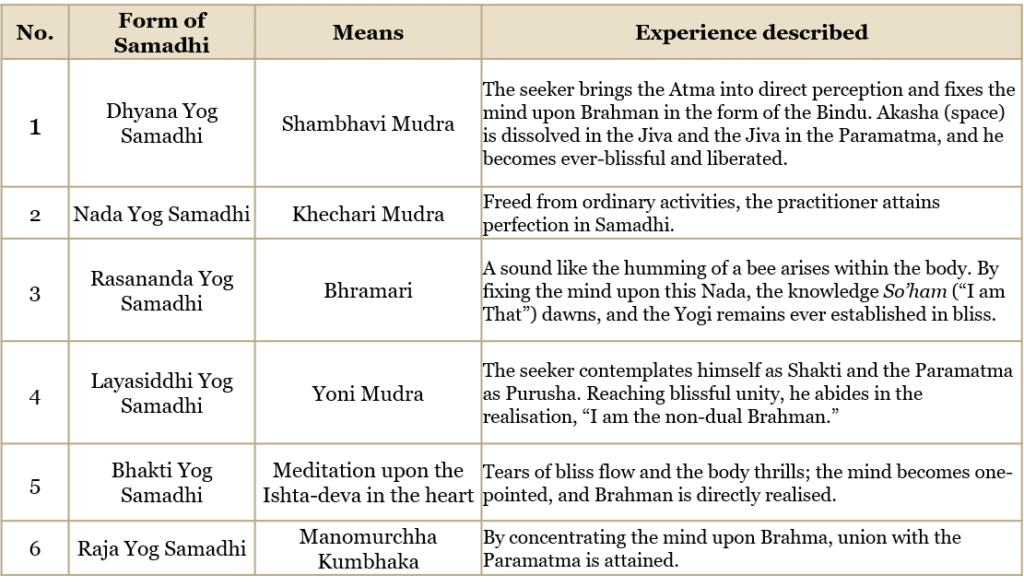
We now come to the innermost layer of the map. The first two layers describe the broad streams of Yog and the methods through which sadhana is undertaken. The seventh Upadesha of the Gheranda Samhita, called Samadhi Yog, goes further. It describes six forms of Samadhi, each bearing the name of a Yog and each associated with a particular means.
At the very outset Maharshi Gheranda declares Samadhi to be the highest Yog. It is gained only through great good fortune, by the grace of the Guru and devotion to him.
Who Is Qualified to Practise Samadhi?
Gheranda lays down a criterion. The seeker in whom, day by day, there grow faith in sacred knowledge (Vidya), faith in his own Guru, faith in the Atma, and the awakening of the mind is the one qualified for Samadhi.
What Is Samadhi?
In Gheranda’s words, to separate the mind from the body and unite it with the Paramatma is Samadhi. In that state the seeker’s realisation is:
“I am Brahman, and none other. I am free from sorrow. My nature is Sat-Chit-Ananda, and I am eternally liberated.”
This accords with the definition we met in Part 1, where Vyasa’s commentary says: “Yogah samadhih.”
The Six Forms of Samadhi
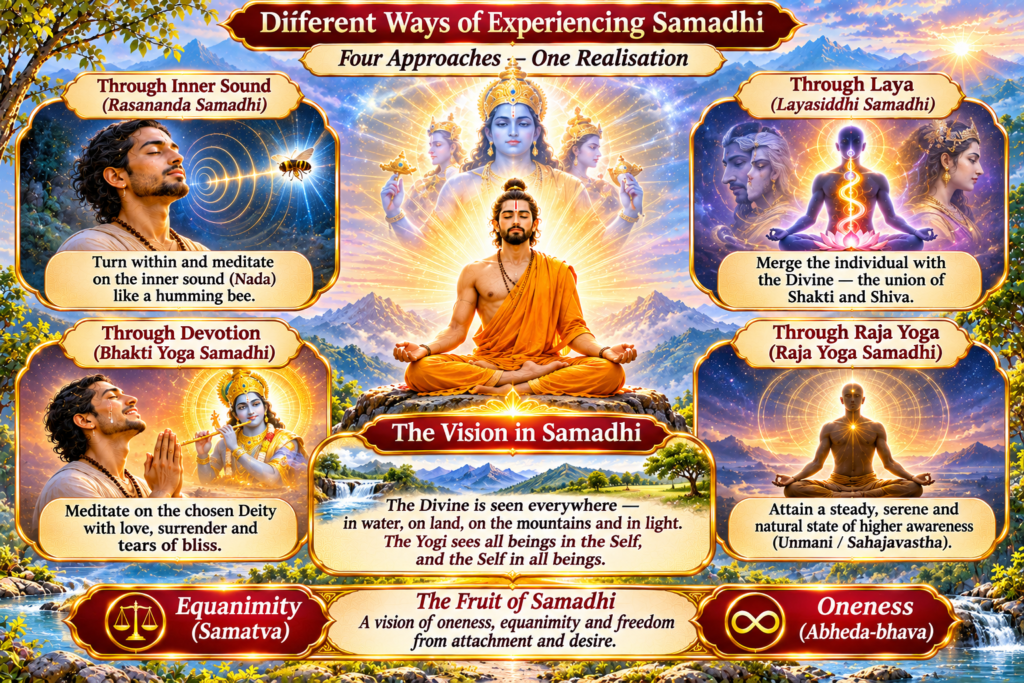
Different Ways of Experiencing Samadhi
The Gheranda Samhita describes different ways through which a Yogi may attain Samadhi. These are not unrelated goals, but different approaches to deep absorption of the mind and spiritual realisation.
Through Inner Sound — Rasananda Samadhi
In this practice, the seeker turns attention away from external sounds and concentrates upon an inner sound resembling the humming of a bee. This inner sound becomes the support for meditation. It is an example of how the mind can be drawn inward through subtle experience.
Through Laya — Layasiddhi Samadhi
Laya Yog is associated with the absorption of the mind and the union of Shakti and Shiva. The Gheranda Samhita describes Yoni Mudra and contemplation of this union as its means. The Yogatattva Upanishad, however, describes another approach: continuous contemplation of the attributeless Divine during every activity, whether walking, sitting, eating or sleeping. The methods differ, but both descriptions concern the inward absorption of the seeker in the Divine.
Through Devotion — Bhakti Yoga Samadhi
Here, the seeker meditates upon the chosen deity in the heart. The text describes tears of bliss, spiritual ecstasy and deep concentration of the mind, culminating in the realisation of Brahman. This is a devotional expression of Samadhi, in which love and contemplation become the means of spiritual absorption.
Through Raja Yoga — Raja Yoga Samadhi
The Gheranda Samhita uses several names for this state, including Rajayoga Samadhi, Unmani and Sahajavastha. These expressions refer to the same state of spiritual absorption.
The Vision That Emerges Through Samadhi
Beyond the different methods, the Gheranda Samhita describes a profound transformation in the Yogi’s vision. Vishnu is perceived everywhere—in water, on land, upon mountain peaks and in light. The entire universe appears pervaded by the Divine.
The text further describes the Yogi seeing all beings in the Self and the Self in all beings. Having recognised the Self as distinct from the physical body, the seeker becomes free from attachment and desire.
This vision connects directly with the idea of Samatva, or equanimity, discussed in Part 1. The Bhagavad Gita (6.29–33) also describes the vision of seeing the Self in all beings and all beings in the Self.
Thus, the different descriptions of Samadhi lead the discussion beyond individual practices to a deeper spiritual vision: the recognition of the Divine presence throughout existence.
An Important Caution About These Practices
The Gheranda Samhita repeatedly emphasises the importance of the Guru. It states that Samadhi is attained through the Guru’s grace and that the seeker must demonstrate growing understanding and devotion towards the Guru.
The practices described here should therefore not be treated as instructions to be attempted independently merely by reading about them. They have been introduced in this article to help readers understand the wider map of Yog and the different forms described in the scriptures.
The text itself does not assign each gateway to a particular category of seeker. The principle of selecting a method according to the seeker’s qualification is discussed in the wider Yogic tradition, although the Gheranda Samhita does not assign each of these six forms to a particular category of seeker..
The six forms described by Gheranda reveal something remarkable: Dhyana Yoga, Nada Yoga, Rasananda Yoga, Layasiddhi Yoga, Bhakti Yoga and Raja Yoga are presented here as six distinct forms of Samadhi. Their names describe different means and experiences associated with the attainment of that state.
Yoga: Understanding Its Many Dimensions- one destination
The different names of Yog can now be viewed through a clearer framework.
The three broad streams describe approaches to spiritual life Karma, Gyan and Bhakti. It also describes four methods: Mantra, Hatha, Laya and Raja Yoga. The Gheranda Samhita introduces six forms of Samadhi, each associated with a distinct name and means of practice. These classifications answer different questions; they are not rival schools.
The texts do not all arrange these systems in exactly the same way. The Yogatattva Upanishad, for example, presents a different relationship between Hatha Yoga and the eight limbs, while the Kalyan Yogank describes a common Ashtanga foundation for the four methods.
These differences are important. They show that the scriptural understanding of Yog is extensive, with different texts examining its disciplines, methods and spiritual experiences from their own perspectives.
What emerges is a tradition in which the seeker encounters many names, methods and descriptions, yet the ultimate spiritual aspiration remains the realisation of the Supreme.
The map is now clearer. But it also reveals how much remains to be explored within the inner disciplines of Yog—the subtle centres of the body, the Nadis, the Kundalini principle and the deeper dimensions of meditation and Samadhi.
These subjects open another fascinating dimension of the Yogic tradition, exploration of which will continue in this huge series “What is Yoga in Sanatan Dharma”
=======================================
References: –
- Kalyan, Yogank (Special Yog Issue, tenth year), Gita Press, Gorakhpur: the passages “Yog ke Prakarbhed” (Types of Yog) on the three streams and the four methods; “Yog”, by a mahatma of Shri Bharat Dharma Mahamandal, pp. 194–196, on the four methods, their principles, Dhyana and Samadhi, and the eight Angas; and the article by Jagadguru Shankaracharya Swami Bharatikrishna Tirtha on eligibility and the choice of means.
- Vedon mein Yog, p. 133: the Angas of Hatha Yog, Raja Yog and Laya Yog. [add book and volume details]
- Gheranda Samhita (Hindi translation edition, Pitambara Peeth, Datia): 1.9–11 (Sapta-sadhana) and Seventh Upadesha, 7.1–20 (Samadhi Yog and its six forms).
- Yogatattva Upanishad, verses 16–29, in Upanishat-sanchayanam (Hindi translation), vol. 3, Chaukhamba Sanskrit Pratishthan, Delhi, pp. 354–355.
- Yogachudamani Upanishad, verses 2–4, in the same collection.
- Bhagavad Gita50 (Yogah karmasu kaushalam) and 6.29–33 (seeing the Self in all beings and all beings in the Self).
- Swami Satyananda Saraswati, Asana Pranayama Mudra Bandha (Hindi), Yoga Publications Trust, Munger: Introduction, on the changing scope of the term Hatha Yog.
- Maharshi Vyasa’s commentary on the Yoga Sutras: Yogah samadhih.
Anupam Trivedi has spent over three decades studying and reflecting upon Sanatan scriptures, including the Vedas, Upanisads, Itihāsa, and Purāṇas. He writes on cultural philosophy and ancient literature to present traditional insights with accuracy and clarity. Read full bio →