
Ten Days of Deafening Noise
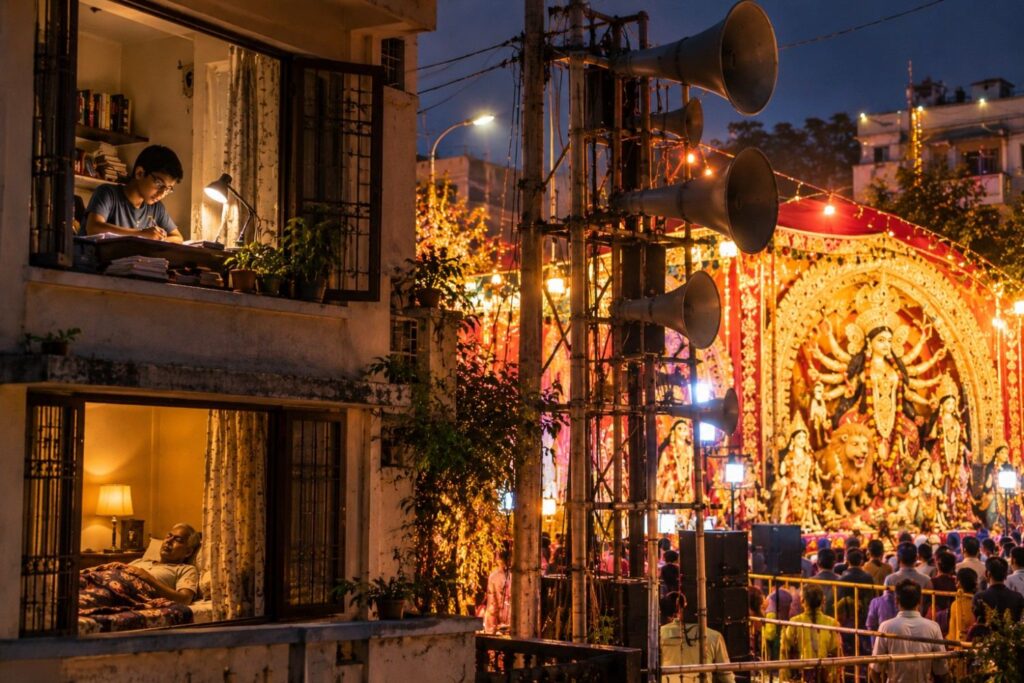
Navratri is the festival of worship of the Divine Mother Durga Ji. In many towns and neighbourhoods today, though, it looks like something else entirely. Enormous Durga Puja pandals stand every few hundred metres. Committees compete over taller idols and costlier décor. DJs and loudspeakers play for ten days without rest. Roads are blocked and ordinary life comes to a halt. To call this a festival is unfair to the word, and to call it worship of the mother of the Universe is an insult to her.
When two pandals stand close together, a second contest begins: whose sound is louder, we need to really ponder for whom so loud announcements, music is played, who like to hear that do you really feel Ma Durga likes?, Neighbours cannot speak to one another. Students cannot study, the elderly and the sick cannot rest, small children cannot sleep. The person who returns home after a day’s work finds no peace in his own house. Which shastra prescribes subjecting an entire neighbourhood to ten days of sound as punishment? No organiser has yet said.
The question of the roads is no different. Pandals, décor, crowds and processions make it hard for people to reach their homes, offices, schools, hospitals or shops. A road is not the private property of a committee. To treat a citizen going out for medicine as an enemy of the puja is a convenient fiction of the organisers. Blocking public passage for ten days is not a religious achievement. It is an arrangement imposed on everyone for the convenience of a few.
The Contest of Pandals
Another event has now attached itself to the worship. Whose pandal is biggest? Whose idol is tallest? Whose décor cost the most? Where did the largest crowd gather? Which committee won the prize? The Goddess’s name does not appear in any of these questions.
The skill of artists and the labour of craftsmen deserve respect. But art and worship are different things. A pandal may be beautiful, and its beauty does not make every activity within it scripturally sanctioned. The décor budget, the height of the idol, the glare of the lights and the trophy on the shelf are not measures of devotion. When the centre of the event slides away from worship and settles on the committee’s prestige and the defeat of the neighbouring pandal, it is an exhibition, even if the Goddess’s idol stands at the gate. In which Purana is it written that to please Bhagavati one must build a bigger pandal than the neighbouring committee’s? If it is written anywhere, let the organisers produce the proof.
Immersion

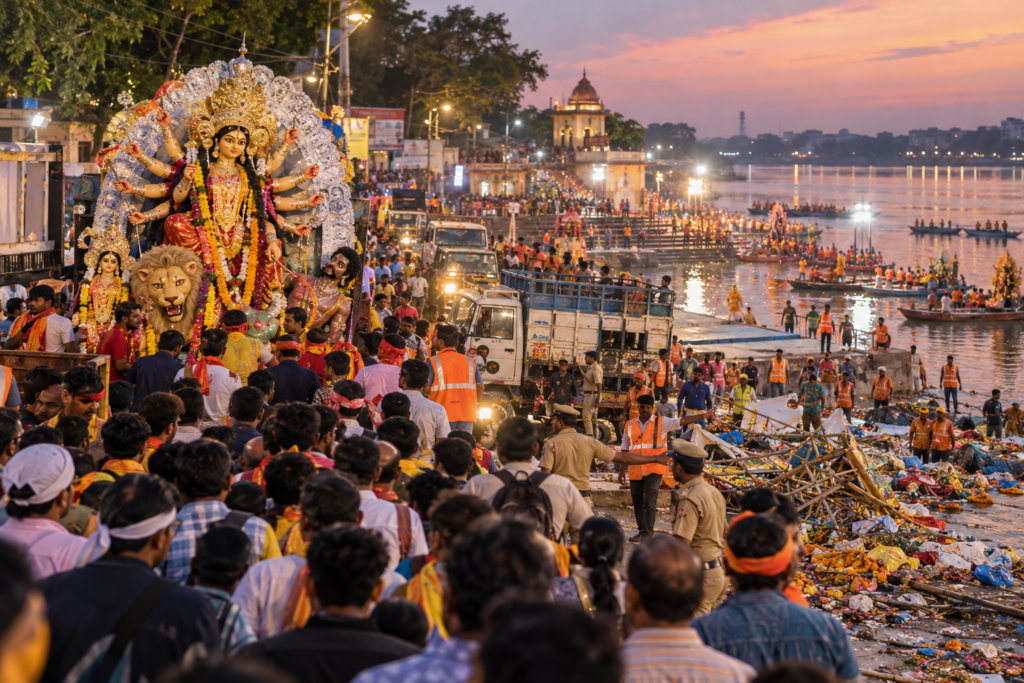
On the day of immersion the whole arrangement is exposed. Long, disorderly processions fill the roads. The music tears at the ears, there is jostling, traffic stops, and many people, in intoxication or frenzy, forget all discipline. Meanwhile the idol is treated in a way that would be unbecoming even for an ordinary object. The image that was installed with so much display of devotion falls in the crowd, is dragged along, and is thrown into the water amid the uproar. It is hard to call this devotion. It is the same devotion that stood before the cameras on installation day and is nowhere to be seen on immersion day.
Decorations, plastic, paint and other unsuitable material also pollute the water bodies. The tradition of immersion itself is a separate matter for discussion. But public obstruction, filth and disrespect to the idol committed in its name should be unacceptable to any thinking person. The plan for the pandal, the décor and the publicity is made months ahead. For the safety, cleanliness and dignity of immersion, nobody has a plan.
What the Scriptures (Dharma Shastras) Say
The twenty-sixth chapter of the third Skandha of the Shrimad Devi Bhagavata Mahapurana describes the Navratri rites. It covers the pavilion and altar, installation of the image of Bhagavati or of a yantra, the kalasha, the materials of worship, the rules of fasting, the havan, daily worship and the worship of Kumaris. The entire chapter centres on sadhana and ritual practice. Pandal contests, the race for prizes, commercial sponsorship, the blocking of roads, ten days of noise pollution and the disorder of immersion are not described there as any part of worship of the Goddess.
Those who claim these modern activities are scripturally sanctioned need only name the text and the chapter. Crowds, popularity, long-standing habit or a committee’s reputation cannot take the place of scripture. It should also be clear that the absence of a modern practice from one chapter does not prove that every public puja is forbidden. But neither can that chapter be used to call competitive pandals and their disorder an ancient ordinance.
How Old Is This Tradition?
Today’s giant public pandal is not an event that has come down unchanged since antiquity. Its history spans only a few generations, in these stages.
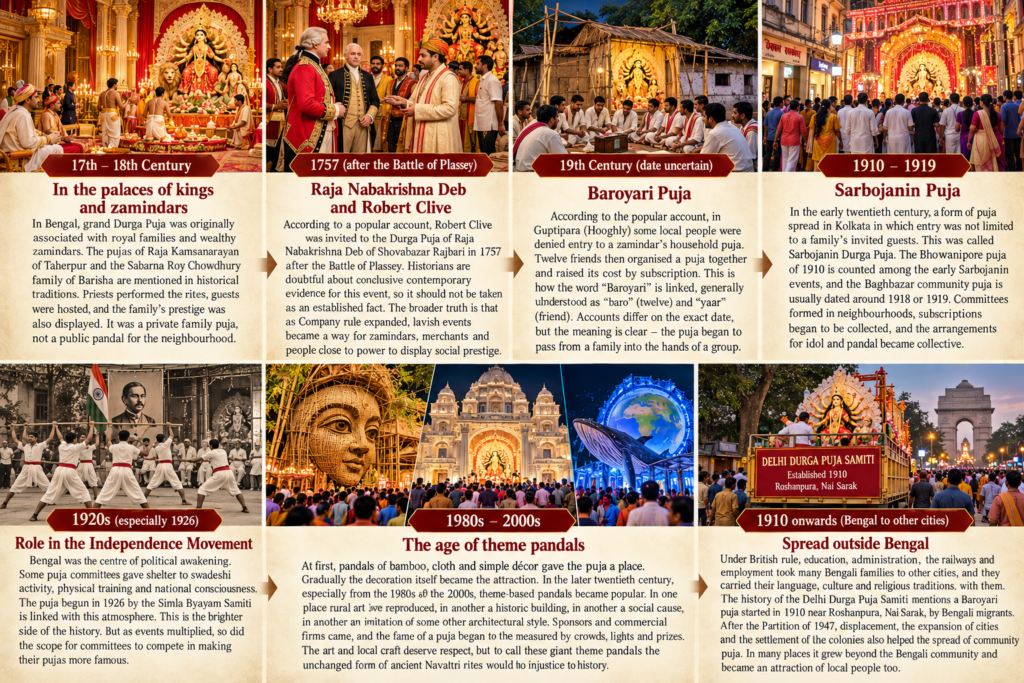
The homes of kings and zamindars. The grand Durga Puja of Bengal was originally associated with royal families and wealthy zamindars. The pujas of Raja Kamsanarayan of Taherpur and of the Sabarna Roy Chowdhury family of Barisha are mentioned in Bengal’s historical traditions, though historians do not agree on the early dates and some details. Priests performed the rites, guests were hosted, and alongside worship of the Goddess the family’s standing was also on display. It was one family’s worship, not a pandal raised for a neighbourhood.
Plassey and the story of Nabakrishna Deb. In the history of Kolkata’s Durga Puja, the story of Raja Nabakrishna Deb of Shovabazar Rajbari and Robert Clive is often told. According to the popular account, Clive was invited to the puja in 1757 after Plassey. Historians are doubtful about conclusive contemporary evidence for this event, so it should not be taken as established fact. The broader truth is that as Company rule expanded, lavish events became a way for zamindars, merchants and people close to power to display social prestige.
Baroyari. According to the popular account, in Guptipara in Hooghly some local people were denied entry to a zamindar’s household puja. Twelve friends then organised a puja together and raised its cost by subscription. This is how the word “baroyari” is linked, generally understood as “baro” (twelve) and “yaar” (friend). Accounts differ on the exact date, but the story’s meaning is clear: the puja began to pass from a family into the hands of a group.
Sarbojanin puja. In the early twentieth century a kind of puja spread in Kolkata in which entry was not limited to a family’s invited guests. This was called Sarbojanin Durga Puja. The Bhowanipore puja of 1910 is counted among the early Sarbojanin events, and the Baghbazar community puja is usually dated around 1918 or 1919. Committees formed in neighbourhoods, subscriptions began to be collected, and the arrangements for idol and pandal became collective.
The independence movement. Bengal was then the centre of political awakening. Some puja committees gave shelter to swadeshi activity, physical training and national consciousness. The puja begun in 1926 by the Simla Byayam Samiti is linked with that atmosphere. This is the brighter side of the history. But as events multiplied, so did the scope for committees to compete in making their pujas look more famous.
The age of theme pandals. At first, pandals of bamboo, cloth and simple décor gave the puja a place. Gradually the decoration itself became the attraction. In the later twentieth century, especially in the 1980s to 2000s, theme-based pandals became popular. In one place rural art was reproduced, in another a historic building, in another a social cause, in another an imitation of some other architectural style. The pandal changed from a temporary structure to hold the idol into an exhibition in itself. Sponsors came, commercial firms came, and the fame of a puja began to be measured by crowds, lights and prizes. The art and local craft deserve respect, but to call these giant theme pandals the unchanged form of ancient Navratri rites would do injustice to history too.
Outside Bengal. Under British rule, education, administration, the railways and employment took many Bengali families to other cities, and they carried their language, culture and religious traditions with them. Where enough families settled, people began to gather for the puja, then committees formed, subscriptions were collected and public pandal arrangements developed. The history of the Delhi Durga Puja Samiti mentions a Baroyari puja started in 1910 near Roshanpura, Nai Sarak, by Bengali migrants. After the Partition of 1947, displacement, the expansion of cities and the settlement of new colonies also helped the spread of community puja. In many places it grew beyond the Bengali community and became an attraction for local people too.
It is useful to know this history. But history in itself is not scriptural proof for any custom. A practice can be a hundred years old and still be found nowhere in the scriptures.
What Should Be Done
If we truly believe that ten days of noise, closed roads, pandal contests and the disorder of immersion are improper in the Goddess’s name, it is not enough to read an article and nod. Committees should be asked: what is the scriptural basis for this expense, this noise, this obstruction and this contest, and why was no thought given to the peace and mobility of those around?
If you wish to worship Bhagavati, do so at home and in the temple as the scriptures prescribe, with discipline, devotion and propriety. None of it requires neighbourhood-to-neighbourhood display, a deafening DJ, ten days of traffic crisis or the chaos of immersion day. Gathering crowds, burning money and making the event grand is not proof of dharma.
This practice returns every year because people put up with it as normal and keep supporting it. Stop giving subscriptions, ask organisers for proof and accountability, and raise your voice lawfully and peacefully against noise and road blockage. Treating everything done in the Goddess’s name as automatically sacred is not called faith. It is giving one’s discernment a holiday.
=================================
References
- Indian Express, “How Durga Puja emerged in British-ruled Bengal”: https://indianexpress.com/article/explained/explained-history/how-durga-puja-emerged-in-british-ruled-bengal-9611987/
- Indian Express, “The humble origins of Kolkata’s first community Durga Puja”: https://indianexpress.com/article/cities/kolkata/the-humble-origins-of-kolkatas-first-community-durga-puja-where-little-has-changed-8186233/lite/
- Pujo Parikrama, “History of Durga Puja in Bengal”: https://pujoparikramaguide.in/durga-puja/history/
- Delhi Durga Puja Samiti: https://en.wikipedia.org/wiki/Delhi_Durga_Puja_Samiti
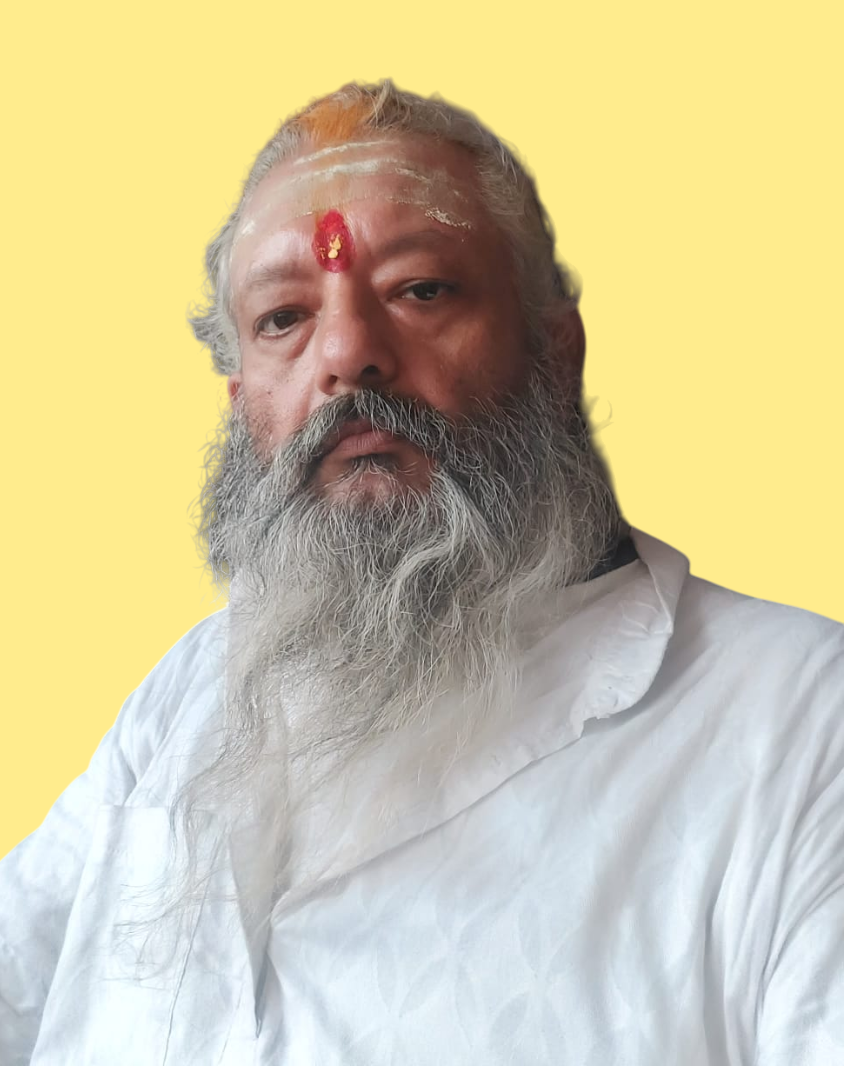
Anupam Trivedi has spent over three decades studying and reflecting upon Sanatan scriptures, including the Vedas, Upanisads, Itihāsa, and Purāṇas. He writes on cultural philosophy and ancient literature to present traditional insights with accuracy and clarity. Read full bio →