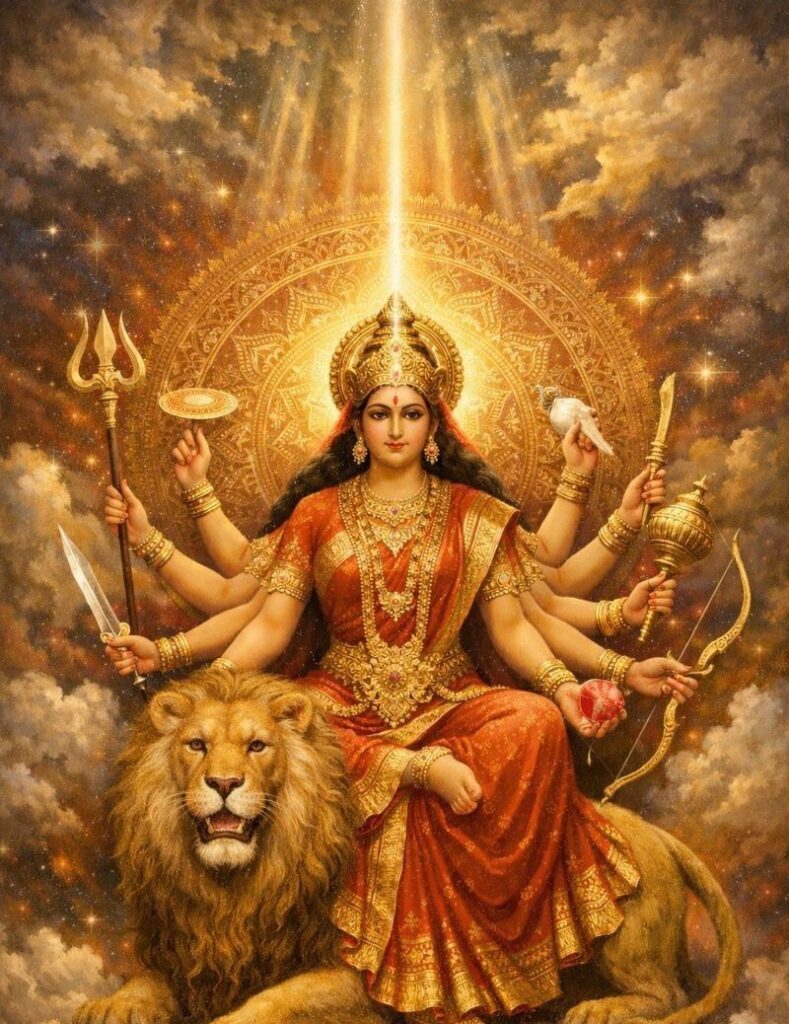
Who is Maa Durga? – Parabrahma Swarupa, Mahakarunya Rupini, Bhukti-Mukti Pradayini Bhagwati ! Part 2
If you have not read Part 1, click here: [Link to Part 1]
Srimad Devi Bhagavata Mahapurana
Many seekers ask, Who is Maa Durga? According to the Srimad Devi Bhagavata Mahapurana, She is not just a deity but the Primordial Nature (Moola Prakriti) itself.
In Part 1, we learned that the Mother of the Universe, Mahashakti, is the Supreme Brahman (Parabrahma) who performs various divine plays (Leelas) in different forms. It is by Her power that Brahma creates the world, Vishnu sustains it, and Shankar performs the dissolution. She is the Adya (first) Parashakti responsible for creation, preservation, and destruction. We previously discussed the five Great Powers: Shri Durga, Mata Lakshmi, Saraswati Ji, Savitri Ji, and Shri Radha.
While Part 1 explained Her primary forms, this article explores how She expands into various divine manifestations—we will learn about the numerous Manifestions of Maa Durga from these five goddesses—classified as Ansh, Anshansh, Ardhaansh, Kala (creative energy), Kalansh, Kalashansh, and Kala Shatansh—based on the Srimad Devi Bhagavata Mahapurana
Lord Shri Hari Narayana says to Narada Ji in the 9th Skandha of the Mahapurana: “Moola Prakriti has many forms through her portions. All women in the world are considered her forms. These five goddesses are most complete (Shri Ganesh’s mother Durga, Bhagwati Lakshmi, Vanidevi Saraswati, Savitri Gayatri, and Shri Radha); hence they are called the personification of Vidya (knowledge). O Sage! Listen carefully as I describe the primary manifestations of these goddesses”.
The Prime Ansh of Moola Prakriti – Ganga Ji!
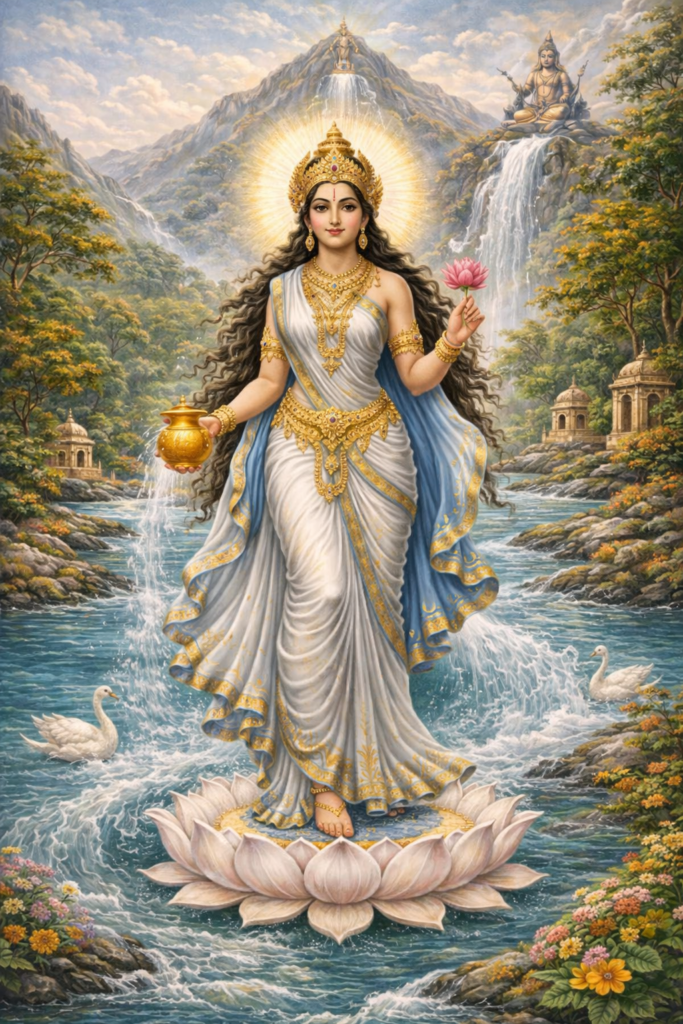
Lord Narayana, in the Ninth Skandha of the Devi Bhagavata Mahapurana, says to Sage Narada that from the divisions of the Primordial Nature arise countless forms, and all women in the world are considered manifestations of these very forms. These five goddesses—Durga, Lakshmi, Saraswati, Savitri (Gayatri), and Radha—are complete and perfect, and therefore they are called embodiments of knowledge itself. O great sage! I shall now describe their principal manifestations—listen carefully.
The foremost manifestation of the Primordial Nature is Goddess Ganga, who sanctifies all three worlds. She is eternal and composed of divine waters, and her origin is said to be from the toenails of Lord Vishnu. She is like a blazing fire that burns away the sinful deeds of sinners. By touching her, bathing in her, or drinking her waters, human beings become eligible for liberation. She is considered like a blissful pathway leading to Goloka, and among all sacred places and rivers, she is regarded as the most supreme.
When she descended from the realm of Vishnu (the heavens), she was first held in the matted locks of Lord Shiva on Mount Kailasa. From there, she eventually emerged and flowed into Bharatvarsha, as though her auspicious arrival was meant to grant quick success to ascetics engaged in penance. Her waters are pure, nectar-like, and of the highest sattvic nature. She is as pure as the moon, the white lotus, and milk, and there is not even the slightest trace of impurity or arrogance in her. This supremely pure and chaste Goddess Ganga is exceedingly dear to Lord Vishnu.
‘Tulsi Mata’ – The Manifestation (Ansha-Avatar) of Prakriti Devi
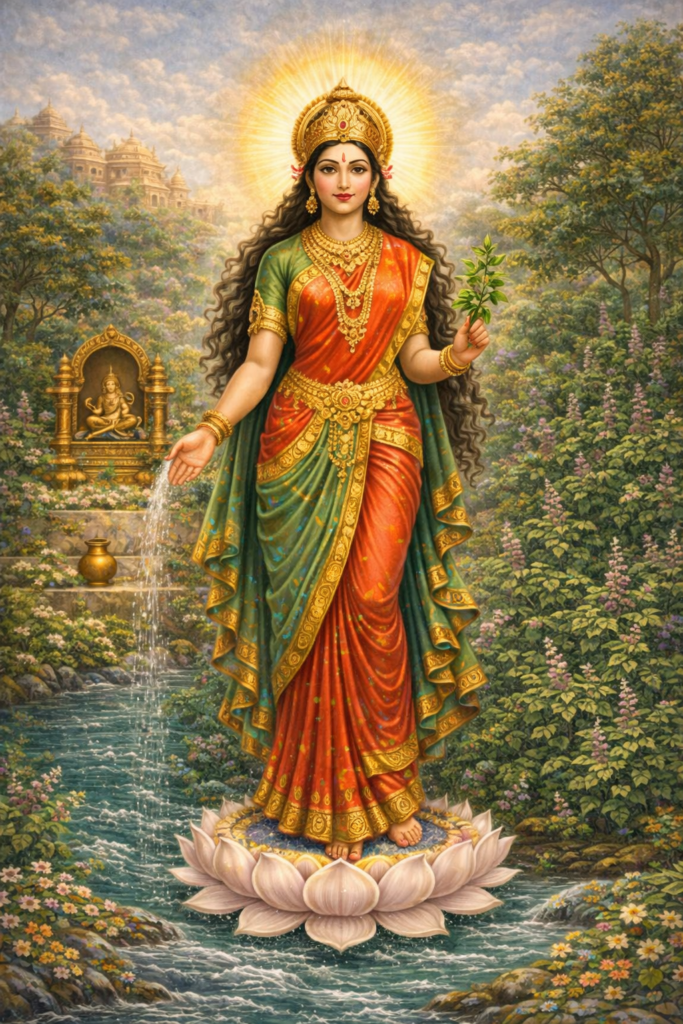
Next is ‘Tulsi’, the manifestation of Prakriti Devi. She is Vishnu-Priya (Beloved of Vishnu); remaining as an adornment for Vishnu is Her natural attribute. She always resides at the feet of Lord Vishnu. O Narada! All auspicious acts like penance (Tapasya), solemn vows (Sankalp), and worship (Puja) are perfected only by the grace of Shri Tulsi Devi. Therefore, She is considered the foremost among vegetation. She is supremely holy and meritorious; Her sight and touch quickly make humans worthy of the Supreme Abode. Especially in the Kali Yuga, She is like a blazing fire to ash the dry wood of sins.
Tulsi Devi is the Empress of Vegetation (Vanaspati-Ishwari) by whose foot-touch this earth was instantly purified, and even pilgrimages seek to be purified by Her sight. Without Her, all rituals in the world become fruitless, and by Her grace, seekers of liberation attain Moksha. She is like a Kalpavriksha (Wish-fulfilling tree) in Bharatvarsha, fulfilling all desires.
‘Manasa’ Devi-Another principal manifestation of the liberating Divine Mother
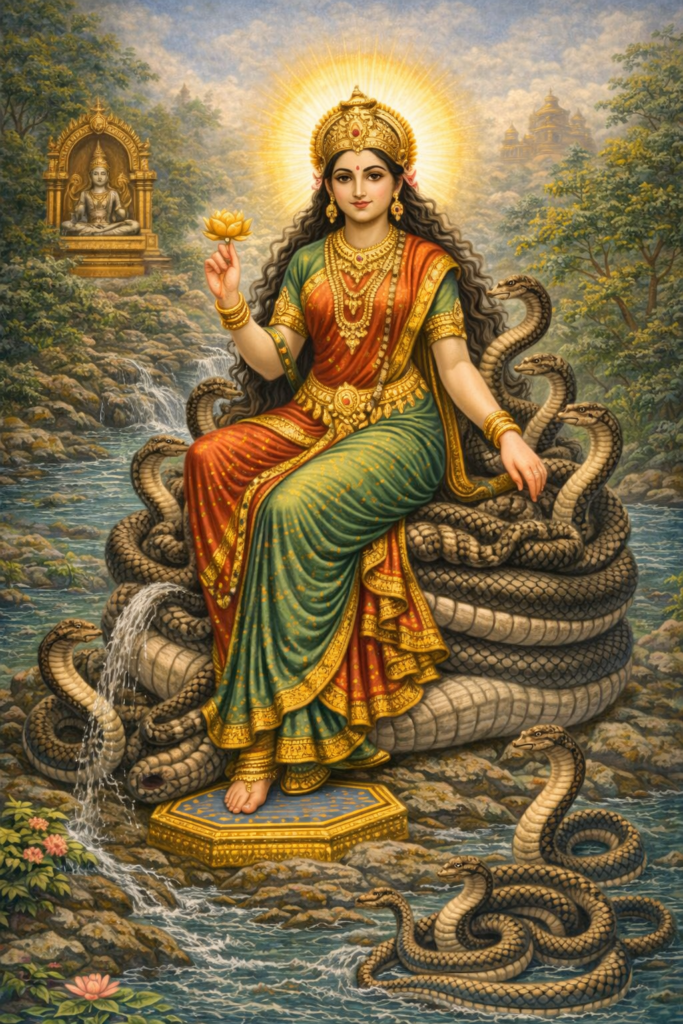
She is the daughter of Sage Kashyapa and is a disciple of Lord Shiva. She is highly learned and is also the sister of the serpent king Shesha, and therefore is greatly revered among serpent beings. Riding upon serpents, this extremely beautiful goddess is also called Nageshwari and Nagamata.
She is always adorned with serpents, and even the serpent king constantly praises her. She is the embodiment of yogic powers, and serpents themselves form her resting place. She is of the nature of Vishnu and possesses unwavering devotion toward Lord Hari. She remains constantly engaged in his worship. Being a great ascetic, she is highly skilled in granting the fruits of penance to devotees.
She herself is an extremely great ascetic and performed penance for three lakh divine years in devotion to Lord Vishnu. Among all ascetics in Bharatvarsha, she is considered the greatest, because she presides over all mantras and her body radiates divine spiritual brilliance. She is always absorbed in contemplation of Brahman and is therefore also called Parabrahman-svarupa. She is the wife of Sage Jaratkaru and the mother of the great sage Astika (Astik muni saved the Serpent Species from becoming extinct due to the wrath of King Janmejaya. King Janmejaya did a yagna to kill all serpents because his father King Parikshit was bitten by Takshak Snake as a result of a curse).
‘Devasena’ or ‘Shasthi’ Devi – The Sixth Part (Ansh)
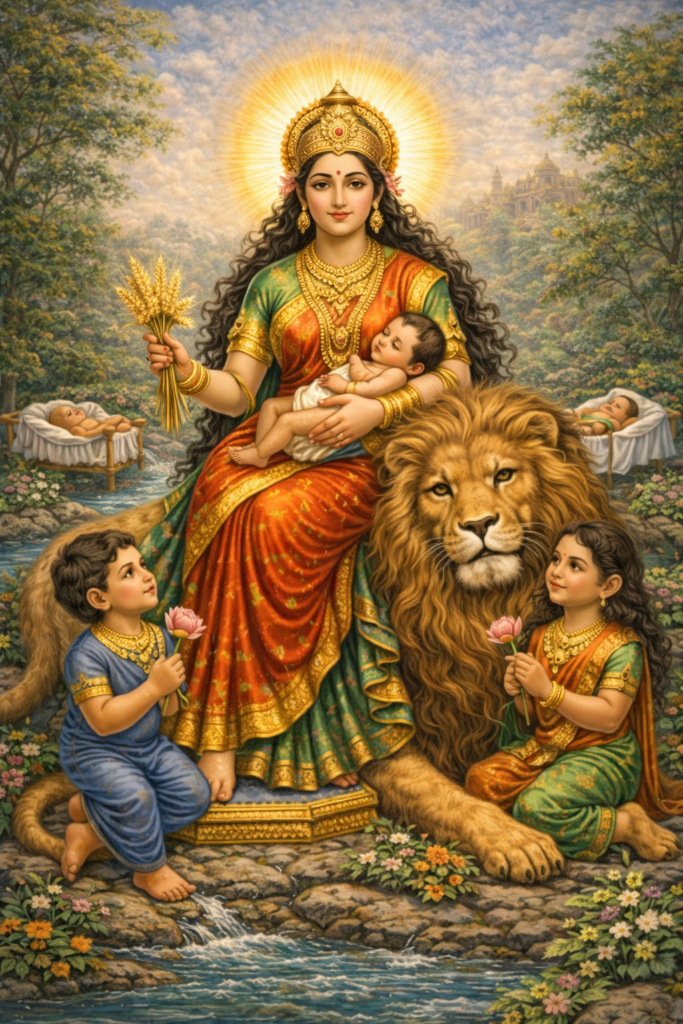
A primary expansion of Prakriti Devi is called ‘Devasena’. She is famous and worshipped in the world as ‘Shasthi’ Devi, the best among Matrikas. She grants sons and grandsons and is the sustainer of the whole world. Her name is Shasthi because She represents the sixth part (Shasthaansha) of Moola Prakriti. Her worship is prescribed for prosperity during childbirth; thus, She is worshipped throughout the twelve months.
According to ancient tradition, Her worship is performed on the sixth day after birth in the maternity room. Furthermore, those seeking welfare also worship Her on the twenty-first day. One of Her names is ‘Matrika’ because She is the embodiment of mercy and a protector like a mother. Always worshipped by sages, She grants all desires; hence She is considered a supreme goddess. She is always ready to protect every living being—in water, land, sky, and home—especially newborn infants.
Kali Devi – Manifested from Maa Durga’s Forehead
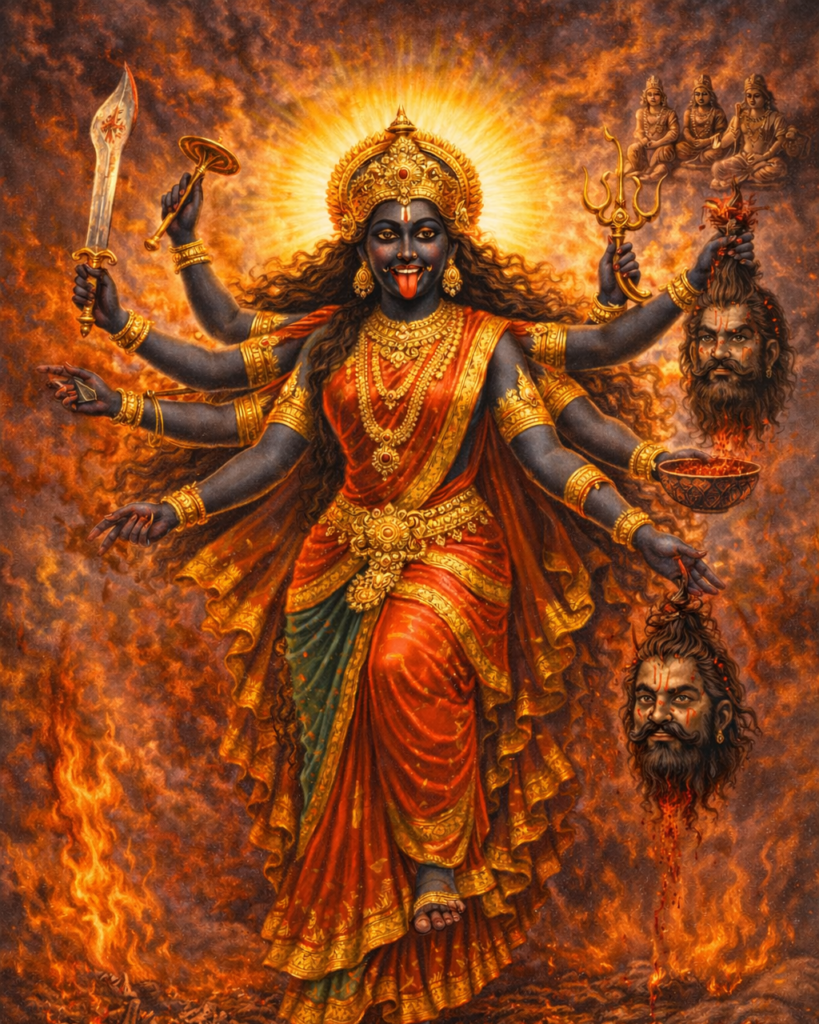
Goddess Kali, who is a principal manifestation of the Divine Mother and who emerged from the forehead of Goddess Durga. Her eyes shine like lotuses, and when she becomes angry, she can destroy the entire universe in a moment. When the demons Shumbha and Nishumbha stood before Chandika in battle, at that very moment Kali manifested from the forehead of Durga. She is considered a half-manifestation of the original Prakriti-born Durga and is equal to her in qualities and brilliance.
Her radiant body shines like millions of suns. Among all powers, she is the greatest, and no power is stronger than her. She grants all kinds of siddhis and is a perfected great yogini. She is a supreme devotee of Lord Krishna and possesses all divine qualities similar to him. Her entire time is spent in contemplation of Lord Krishna, and she is dark in complexion like him and eternal in nature. If she wishes, she can dissolve the entire universe in a moment.
Her battles with demons are merely divine play and meant for the instruction of the world. As Mahakali, she is capable of granting all four aims of life—dharma, artha, kama, and moksha—and is worshipped even by all gods. Brahma, sages, and great kings also constantly worship her.
Bhagwati ‘Vasundhara’ (Mother Earth)
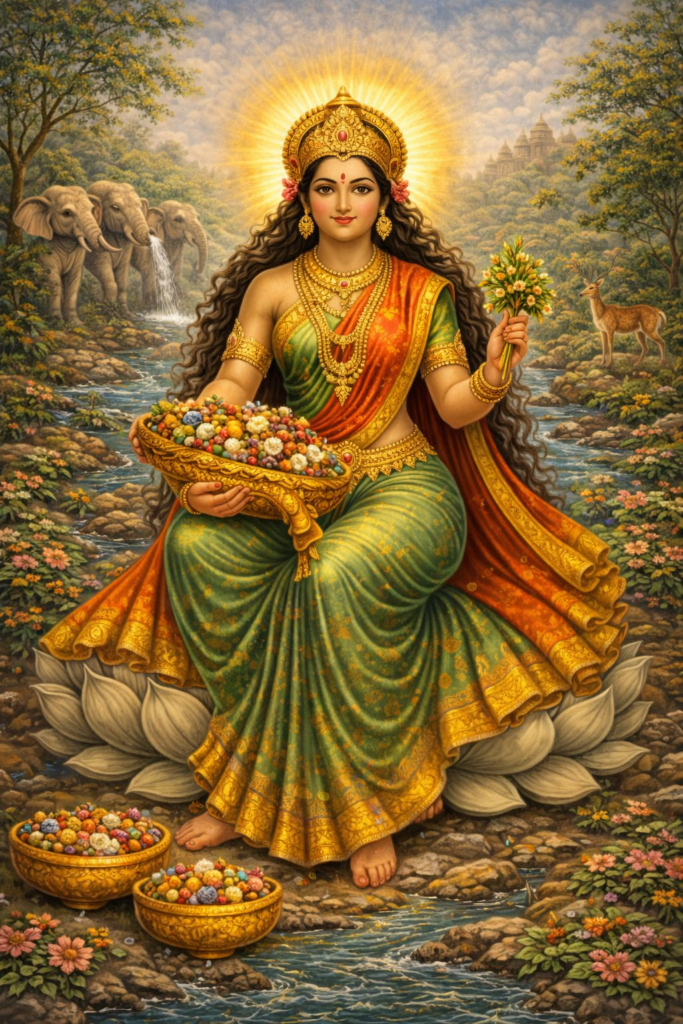
Goddess Vasundhara is also a principal manifestation of Prakriti. The entire earth rests upon her. She is also called Sarvasasya and is known as Ratnagarbha or Ratnakara because all treasures exist within her. She is worshipped and served by both kings and subjects and has assumed this earthly form to provide livelihood to all beings. She is the giver of all prosperity.
O sage! Without this great power, the entire moving and unmoving world cannot exist even for a moment. Now listen carefully as I describe the various manifestations and the deities to whom they are related.
The Divine Energies (Kalas) and their Roles
Swaha is the wife of Agni, and without her, offerings made in fire cannot reach the gods. Dakshina (also called Diksha) is the consort of Yajna, and without her, all sacrifices become fruitless. Swadha is the wife of the ancestors, and without her invocation, offerings made to the ancestors do not reach them. Thus, for the gods “Swaha” and for the ancestors “Swadha” are essential.
Swasti is the wife of Vayu, and without her, all exchanges in the world become fruitless. Pushti, the wife of Ganesha, is worshipped by all, and without her, both men and women become powerless. Tushti, the wife of Ananta, is praised by all, and without her, no one can ever feel satisfied. Sampatti is the wife of Ishana, and without her, all beings become poor. Dhriti is the wife of Kapila, and without patience, all beings become restless.
Sati is said to be the consort of Truth and is highly honored. Without her, the world becomes devoid of relationships. Daya, the wife of Moha, is worshipped everywhere and benefits all beings; without compassion, life becomes meaningless. Pratishtha is the wife of merit, and without her, even a victorious person is considered lifeless. Kirti is the wife of righteous action, and without fame, life feels incomplete. Kriya is the wife of effort, and without her, no work in the world can be accomplished.
Shri Vishnu said – O Sage! I will now tell you about the various Kalas (Divine Energies) of Moola Prakriti and whose wives they are. Pay attention !
The Deities and their Divine Energy Consorts
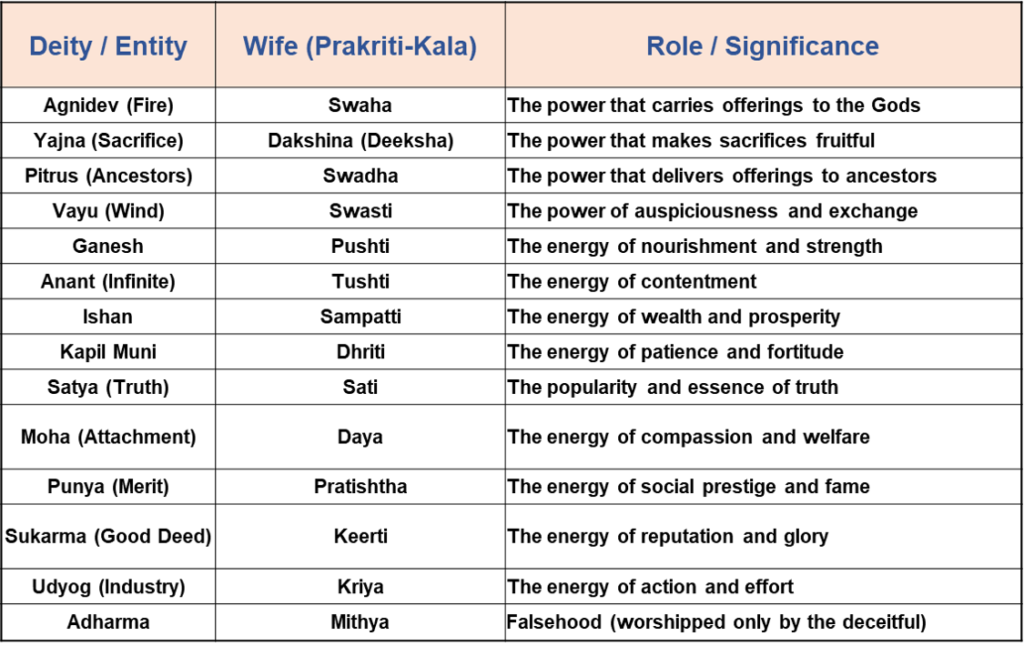
Energies of Wisdom, Religion, and Time
Consorts of Intellectual and Cosmic Principles
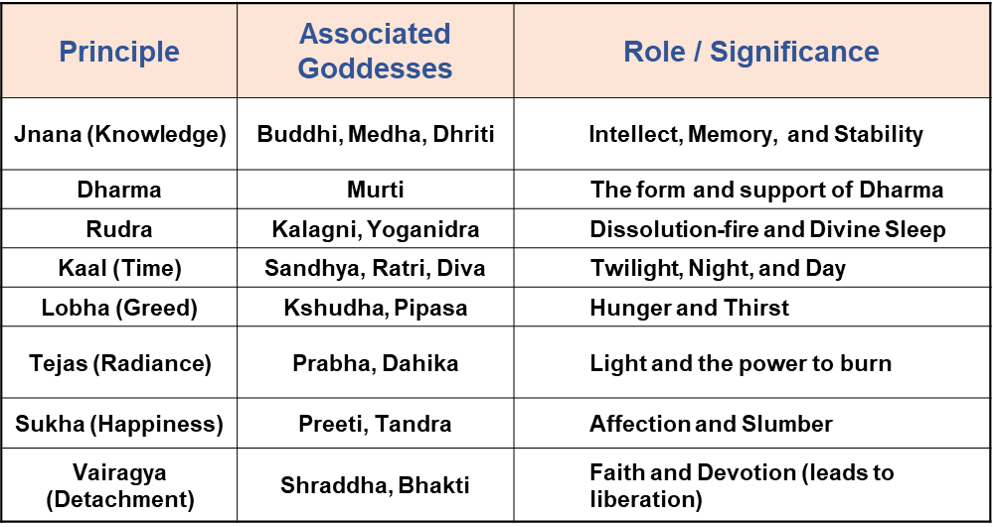
Other Famous Divine Manifestations
Here is a list of other notable divine wives and expansions: Sages, Kings, and Deities with their Wives
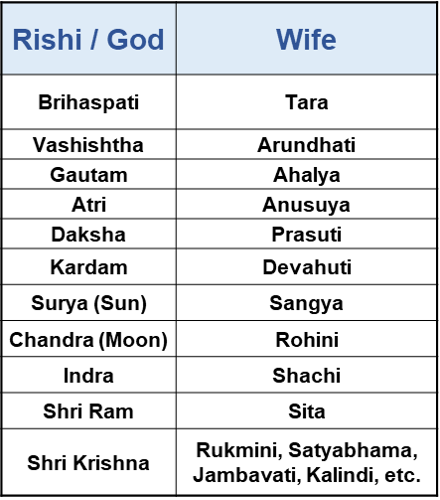
Other famous names include Menaka (mother of Parvati), Lopamudra, Kunti, Vindhyavali (wife of King Bali), Damayanti, Yashoda, Devki, Gandhari, Draupadi, Satyavati, Radhika’s mother, Mandodari, Kausalya, Subhadra, Revati, Usha, Chitralekha, and Renuka (mother of Parshurama).
All village deities (Gram-Devis) and all women in the world are sub-expansions of Prakriti-Kala. Therefore, insulting a woman is an insult to Prakriti Devi herself. Respecting an eight-year-old girl (Kumari) with clothes, ornaments, and sandalwood is equivalent to worshipping the Divine Mother.
The Three Categories of Manifestations in Women
Sattva-Ansha: Women of excellent conduct and devotion; they are superior and worthy of worship.
Rajas-Ansha: Those who prefer worldly enjoyment; they belong to the middle category.
Tamas-Ansha: Those who are deceitful, quarrelsome, or of low character; they are known as ‘Kulata’.
The Worship of Maa Durga
O Narada! This is the analysis of Mul Prakriti’s manifestations. In this holy land of Bharatvarsha, Durga is the primary goddess. King Surath first worshipped Her, followed by Shri Ramachandra for the slaying of Ravana. She first appeared as Daksha’s daughter (Sati) and later as Himalaya’s daughter (Parvati), marrying Shiva. Her sons are Ganesh (incarnation of Krishna) and Skanda (manifested from Vishnu).
Lakshmi was first worshipped by King Mangal, Savitri by King Ashvapati, Saraswati by Brahma, and Radha first in Goloka by Shri Krishna during the Raas-Mandala. On the full moon night of Kartik, Lord Shri Krishna performed the ‘Raas’ with the Gopis and Gope-kumaras, where Radha was worshipped.
In that Goloka, following Krishna’s command, Brahma and other deities worshipped Radha-Krishna with flowers, incense, and lamps. Later, King Suyagna worshipped Goddess Radha on Earth. By the instruction of Lord Shankar, everyone in Bharatvarsha worshipped Her. Therefore, all the Kalas that have manifested are and should be worshipped. O Devarshi Narada! Since then, local deities in villages and cities began to be worshipped. I have narrated to you the auspicious character of Bhagwati Moola Prakriti. All are endowed with Vedic characteristics. What else do you wish to hear?
In next part we will further discuss what pleases Mother Durga and how to worship!
यदि आप इस लेख को हिंदी में पढ़ना चाहते हैं, तो यहाँ क्लिक करें – Hindi Link
============================
Reference:
Srimad Devi Bhagavata Mahapurana; 9th Skandha (Canto), 1st Chapter; Editor and Commentator: Shri Vidya Bhaskar Pandit Saryu Prasad Shastri “Dwijendra” (Gargyamuni), Kavyatirtha, Sahityaratna, Sahityacharya. Publisher: Rupesh Thakur Prasad Prakashan, Kachauri Gali, Varanasi – 221001.