The True Meaning of Mahashivratri
Mahashivratri occupies a uniquely exalted position among the great festivals of Sanatan Dharma. However, it is deeply unfortunate that in contemporary society, several beliefs have become popular regarding this sacred observance that find no direct support in the scriptures. The most widespread misconception is the belief that Mahashivratri commemorates the divine marriage of Lord Shiva and Goddess Parvati. This belief is not only unauthentic but also entirely inappropriate from a scriptural standpoint.
Despite the scriptures clearly outlining the prescribed methods of worship, fasting, and observances associated with Mahashivratri, how such misconceptions arose remains a subject worthy of research. Nevertheless, after reading this article, readers are encouraged to awaken awareness among their relatives, friends, and fellow followers of Sanatan Dharma.
The objective of this article is to present the scripturally validated truth, so that devotion may rest not on ignorance, but on knowledge.
Mahashivratri Is Not the Day of Shiva–Parvati Vivah
A careful and comprehensive study of the Shiva Mahapurana, Linga Purana, Skanda Purana, and other major Puranic texts establishes beyond doubt that Mahashivratri is not the day of the divine marriage of Lord Shiva and Goddess Parvati. The sacred marriage (Vivah Lila) has its own distinct chronology, context, and spiritual significance, but associating it with Mahashivratri is not supported by scripture.
The scriptures describe Mahashivratri not as a celebratory wedding festival, but as a night of austerity, restraint, fasting, self-discipline, and contemplation of Brahman.
The Difference Between Shivratri and Mahashivratri
According to the scriptures, the true spiritual significance of Mahashivratri lies in the manifestation of the Jyotirlinga. Every Krishna Paksha Chaturdashi (the fourteenth lunar night of the waning moon) is known as Shivratri. However, the Krishna Chaturdashi of the month of Phalguna is uniquely designated as Mahashivratri.
The reason is profoundly philosophical and divine: on this sacred night, Lord Shiva manifested as the infinite pillar of light (Jyoti-Stambha)—the formless symbol of Saguna Brahman.
The Dispute Between Brahma and Vishnu and the Manifestation of the Jyotirlinga
The Vidyeshvara Samhita of the Shiva Mahapurana offers a majestic account of this event. In the primordial era, when the universe had not yet fully manifested, a dispute arose between Lord Brahma and Lord Vishnu regarding their respective supremacy. Brahma, as the creator, asserted his superiority, while Vishnu, as the preserver, claimed the highest status.
As the conflict intensified, both deities prepared their most destructive divine weapons—each empowered by Shiva’s own energy. Vishnu invoked the Pashupata Astra, while Brahma wielded the Maheshwara Astra. The collision of these weapons would have annihilated the entire cosmos—planets, stars, and all living beings. The gods were struck with terror.
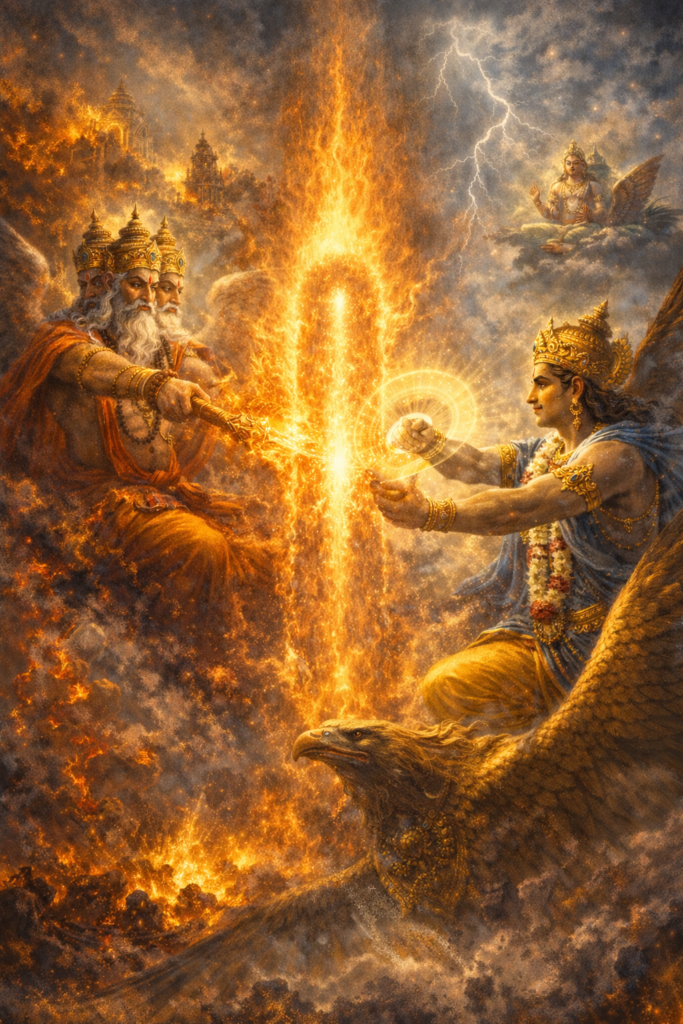
At that moment, to quell the conflict and dissolve the arrogance, a colossal, radiant pillar of fire and light manifested between them. It had neither a visible beginning nor an end. Though blazing like millions of suns, it radiated an inexplicable coolness.
The Test of Truth
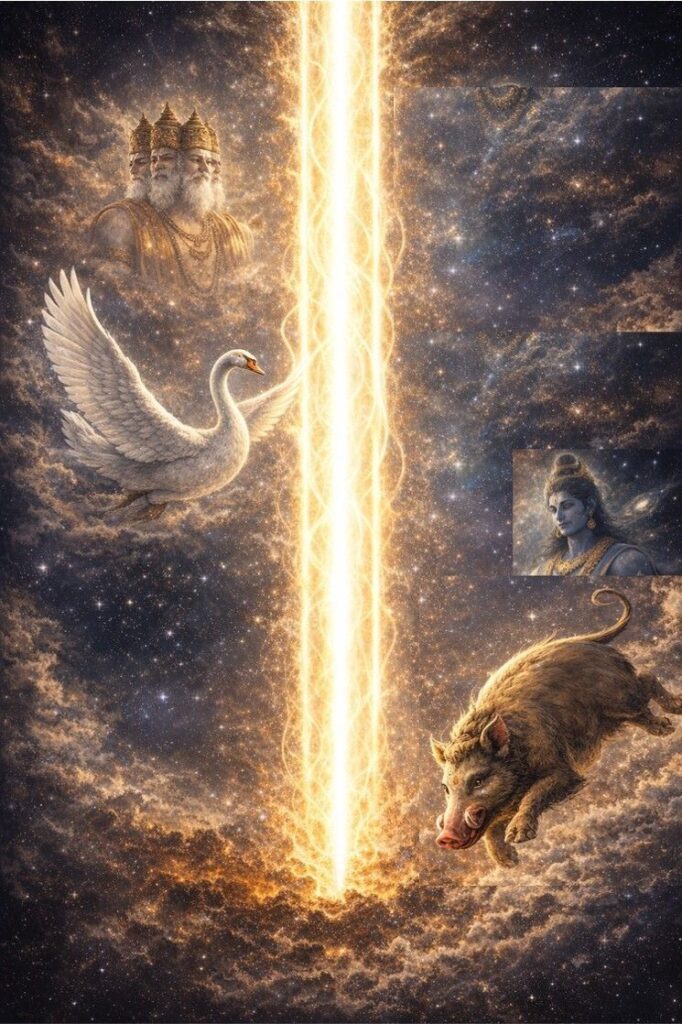
Astonished, Brahma and Vishnu agreed that whoever could find the start and/or the end of the jyotirlinga would be deemed supreme. Vishnu assumed the form of a mighty boar (Varaha) and descended into the netherworld to locate its base. Brahma took the form of a swan (Hamsa) and ascended skyward in search of its summit.
After countless years, Vishnu returned, humbly admitting his inability to find the beginning. Brahma, however, remained ensnared by the desire for superiority. On his return, he encountered a falling Ketaki flower and persuaded it to falsely testify that he had reached the summit.
The Wrath of Mahadeva and the Emergence of Kalabhairava
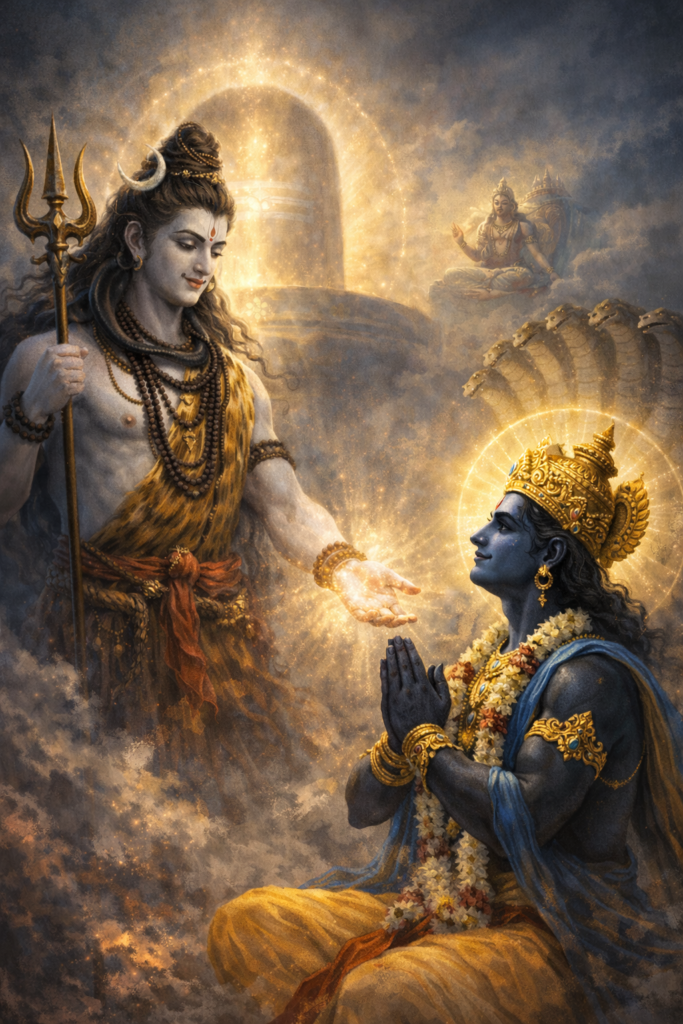
When Brahma uttered the falsehood, a thunderous roar emerged from the pillar of light, and Lord Shiva manifested in person. His eyes blazed with divine wrath that annihilates ego and falsehood. He praised Vishnu for his truthfulness and granted him equality with Himself.
Enraged by Brahma’s deception, Shiva manifested Kalabhairava from His brow. By Shiva’s command, Kalabhairava severed Brahma’s fifth head—the source of the false testimony. Brahma, stripped of his pride, trembled and fell at Shiva’s feet seeking forgiveness.
Scriptural Curses and Boons
Once His anger subsided, Shiva pronounced the consequences:
- Curse upon Brahma: Due to his deceit, Brahma would not receive independent worship in the three worlds, nor would temples be dedicated to him. (This explains the rarity of Brahma temples globally.)
- Curse upon the Ketaki flower: Since it supported falsehood, it would never be used in Shiva worship.
In contrast, Vishnu was blessed for his truthfulness and devotion. Shiva declared that worship of Shiva would remain incomplete without worship of Vishnu.
Scripturally Prescribed Worship of Mahashivratri
The scriptures prescribe Mahashivratri as a night devoted entirely to spiritual discipline—fasting, night-long vigil, ritual bathing (Abhishek) of the Shiva Linga, offering of Bilva leaves, mantra recitation, meditation, and self-reflection.
How Did These Misconceptions Arise?
Despite the clarity of scriptural injunctions, misconceptions spread gradually through folklore, poetic imagination, and emotionally driven narratives. Over time, these obscured the scriptural truth. Today, it is essential to honor both devotion and evidence.
Every follower of Sanatan Dharma has a responsibility to understand, accept, and share this scriptural truth with society.
The Spiritual and Practical Significance of the Mahashivratri Vow
The word Shiva signifies “auspiciousness,” and Ratri signifies “rest.” Mahashivratri represents the sacred union of the individual soul with the Supreme. According to revered spiritual teachers, the benefits of this vow include:
Destruction of Accumulated Karmas
The observance acts like a purifying fire, dissolving sins accumulated across lifetimes when performed with sincerity and vigilance.
Awakening of Inner Strength and Shivahood
Fasting elevates vital energy upward, enhancing willpower and discernment between truth and falsehood.
Fulfillment of the Four Purusharthas
Dharma, Artha, Kama, and Moksha are all attainable through this observance—granting both worldly well-being and spiritual liberation.
- Power of Nishita Kala Worship
Mantra japa performed at midnight yields results equivalent to millions of repetitions on ordinary days. Each of the four night watches (pahar) carries distinct spiritual fruits.
In today’s restless world, Mahashivratri rituals and worship calm the human mind and help overcome anxiety and depression.
Shiva does not require gold or silver vessels. Being Ashutosh, He is pleased even with a single pot of water and a lovingly offered Bilva leaf. When compassion toward all beings and complete surrender dwell in the heart, Mahadeva fulfills all righteous desires.
Readers who prefer the original Hindi version may read it here (हिंदी में पढ़ने वाले पाठक इस लेख को यहाँ पढ़ सकते हैं)-
https://dharmsanatan.com/mahashivratri-ka-vastavik-arth/
References:
- https://www.youtube.com/watch?v=qS44Vt0Rhfw, (mahashivaratri in not shiv Parvati viavah)
- https://www.youtube.com/watch?v=XrNFS0Yz7FI, (saakar, nirakar sagun, nirgun ke baare me)
- https://www.youtube.com/watch?v=UZD32LkLP6w&t=21s (Guru Ji on shiv ling pujan by females)
- https://www.youtube.com/watch?v=jSWqyDYaVbI (About Bhagwaan Shiv)
- https://www.youtube.com/watch?v=GBnnblGD52U,
- https://www.youtube.com/watch?v=4Hoho0isIjQ , – not vivah
- Shiva Puran
Shivratri ke bare me mahatvapurna jaankari prapt hui. Aap iso tarah bhaktjano ka gyaanvardhan karte rahen, aur shudhha sanatan parampara ko aage badhaye.
🙏 Very inspiring and informative!
This article beautifully captures the spiritual depth of Mahashivratri — a night for devotion, introspection, and inner awakening. Thank you for sharing this guide that helps devotees understand the festival beyond rituals.
Har Har Mahadev! 🔱