
Hindu Word in Vedas? Ancient Evidence You Were Never Told About”
The True Meaning and Origin of the Word ‘Hindu‘
“Hindu = derived from Sindhu mispronunciation” theory is the most circulated but least researched one online.
The meanings attributed to the word “Hindu” by various literati and historians so far are largely based on estimates and hypotheses, and are factually incorrect.
The most common explanation we hear is that people living on the eastern banks of the Sindhu River were called “Hindus” by Mleccha invaders because they could not pronounce the letter ‘S’ and replaced it with ‘H’. If this were true, why wasn’t “Isa Masih” (Jesus) called “Iha Maahih”? Why wasn’t Prophet Musa (Moses) called Muha? This logic proves that the “mispronunciation theory” is merely a hypothesis. It gained popularity only because of the prominence of the Sindhu River, which is also extensively mentioned in the Vedas.
The word “Hindu” is not a mispronunciation from Mughal invaders. Its usage predates the origin of Mughal and Christian faiths by thousands of years. It is found in several ancient texts (Puranas, Brihaspati-Agama, Vriddha-Smriti, etc.) which are essentially explanations of the Vedas. Therefore, the word “Hindu” is as ancient and eternal as the Vedas themselves.
What is the Meaning of Hindu? What are the Evidences?
Thousands of years before the rise of foreign faiths, the word “Hindu” was used and prevalent in the sense of being gentle, beautiful, adorned, a reservoir of character, self-controlled, and expert in destroying the wicked.
-
When Alexander came to India, he expressed a desire to his minister to see the Hindukush (Hindukoot) mountains.
-
The word Hindu is mentioned in the Persian scripture Shatir. Thousands of Vedic words are found in the Avesta. This word existed hundreds of years before Alexander.
-
Bhavishya Purana states:
“Sindhusthanamiti jneyam rastramaryasya cottamam.” (The nation of the Aryas is known as Sindhusthanam/Hindusthan).
-
Brihaspati Agama states:
“Himalayam samarabhya yavadindusarovaram. Tam devanirmitam desam hindusthanam pracakshate.” (The divine land stretching from the Himalayas to the Indu Sarovar is called Hindusthan. Those residing there traditionally and their descendants are called Hindus).
Defining the Characteristics of a Hindu According to Scriptures
-
Vriddha Smriti:
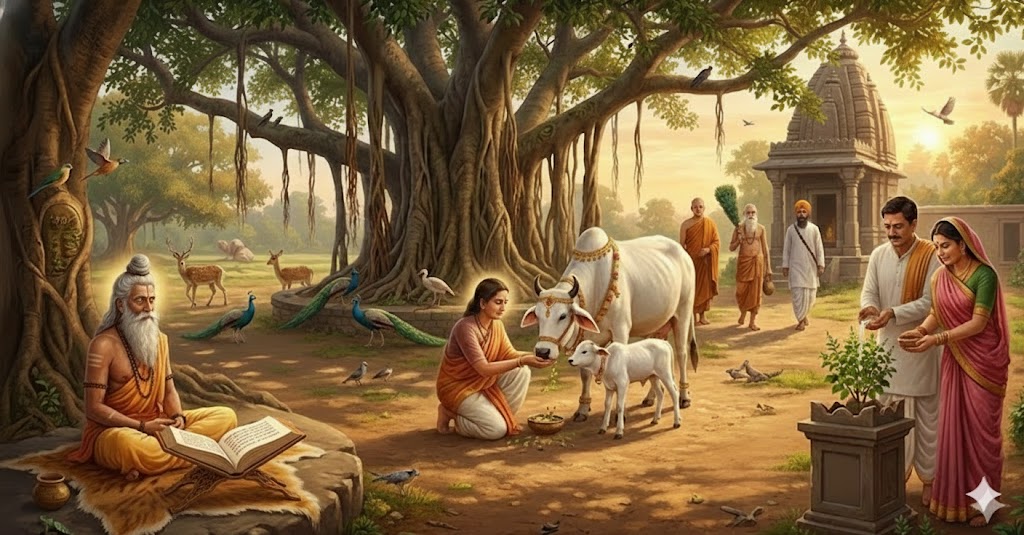
“Hinsaya duyate yasca sadacaratatparah. Vedagopratimasevi sa hindumukhasabdabhak.“ – One who is pained by violence, devoted to right conduct, and serves the Vedas, the Cow, and the Deities is to be understood as a Hindu.
-
Madhava Digvijaya:
“Omkaramulamantradhyah punarjanmadrrdhasayah. Gobhakto bharatagururhinduhinsanadusakah.” One who considers ‘Omkara’ as the root mantra, has firm faith in rebirth, is a devotee of the cow, follows the path of Indian sages, and considers violence as contemptible is called a Hindu.
-
Saint Vinoba Bhave:
“Jo varnon aur ashramon ki vyavastha mein astha rakhne-wala, go-sevak, punarjanma ko manta aur usse mukt hone ka prayatna karta hai aur jo sada sab praniyon ke anukul vartav karta hai, wahi Hindu mana gaya hai. Hinsya se uska chitt dukhi hota hai, atah use Hindu kaha gaya hai.” –
“One who has faith in the systems of Varnas and Ashramas, is a protector of the cow, believes in rebirth and strives for liberation from it, and who always conducts himself with kindness toward all living beings, is considered a Hindu. His heart is pained by violence; therefore, he is called a Hindu.”
-
Ramakosha:
“Hindurdusto na bhavati nanaryo na vidusakah. Saddharmapalako vidvan srautadharmaparayanah.” A Hindu is never wicked, never un-Aryan/uncivilized, and never a slanderer. One who protects the true Dharma, is learned, and devoted to the Vedic/Shrauta Dharma is a Hindu.
-
Parijataharana Nataka:
“Hinasti tapasa papan daihikan dustamanasan. Hetibhih satruvargam ca sa hindurabhidhiyate.” – One who destroys physical sins and mental impurities through penance, and destroys enemies with weapons, is called a Hindu.
Linguistic Logic: The Internal Evolution of ‘S’ to ‘H’
In Vedic Sanskrit grammar and the tradition of pronunciation, the sound ‘S’ (स) sometimes naturally transforms into ‘H’ (ह). This is not an external influence but a natural linguistic rule of the Vedas. For example:
-
Asmi becomes Aham (अस्मि -> अहम्)
-
Sapta becomes Hapta (सप्त -> हप्त) — (This is why Saptaah is also called Hafta).
Following this tradition, Saptasindhu appears as Haptahindu in the Iranian Avesta. This proves that the word ‘Hindu’ originated from our own Vedic linguistic forms—it is an extension of our Sanatana tradition.
Conclusion
A Hindu is one who believes in the voice of the Vedas, sees the Divine in every being, and worships the five elements (Earth, Water, Fire, Air, Space).
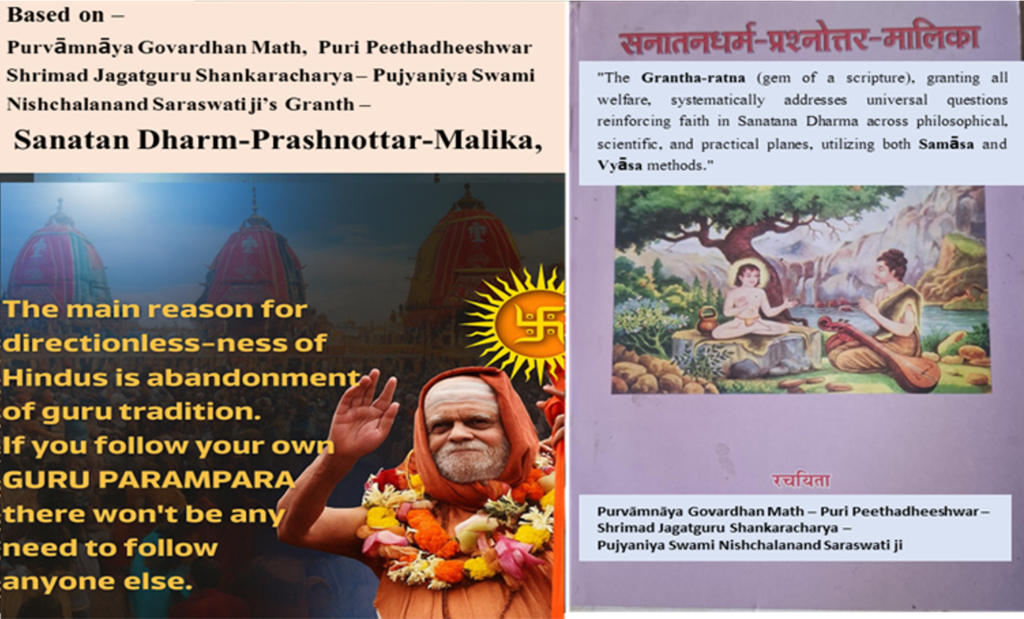
This entire article is based on the authentic views of Pūrvāmnāya Govardhana Matha Puri Peethadhishwar, Shrimad Jagadguru Shankaracharya Swami Nischalananda Saraswati Ji from his work ‘Sanatanadharma-Prashnottara-Malika’.
It is time to discard the misleading history and embrace the true, glorious, and eternal identity of ‘Hindu’.
इस लेख को हिंदी में पढ़ने के लिए यहाँ क्लिक करें”