
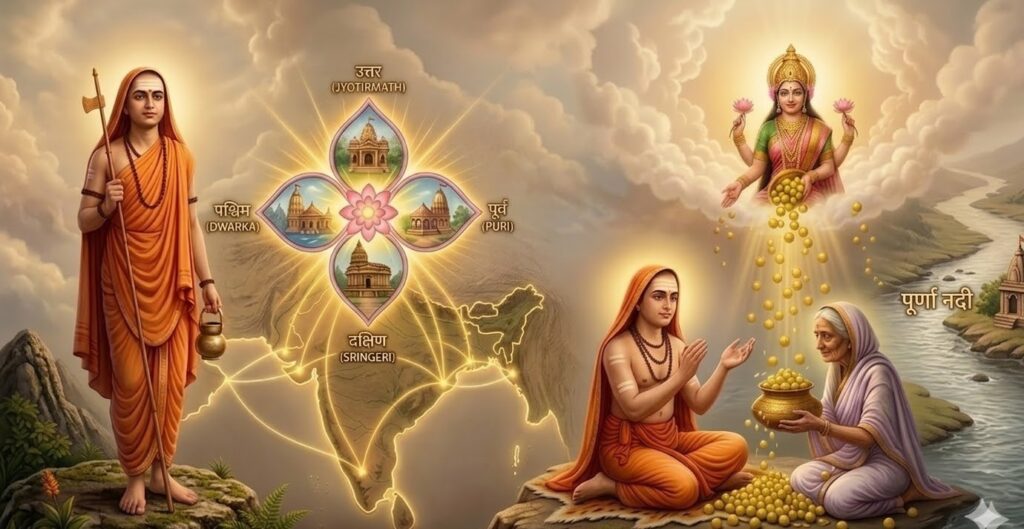
Before we begin Part 3, it is helpful to briefly recall the foundation laid in the earlier two parts:
We introduced the extraordinary life and mission of Adi Shankaracharya by presenting a concise overview of his divine purpose and monumental contributions. Within the sacred traditions of Sanātana Dharma, Shankaracharya is widely revered as an Avatar of Bhagwan Shiva who descended at a time when the profound knowledge of the Vedas had become obscured by misunderstandings, fragmented interpretations, and the rise of numerous competing philosophical doctrines.
His Avatar therefore was not merely that of an exceptional scholar, but of a divine teacher entrusted with the task of restoring the authority of the Vedas and re-establishing the true spiritual foundations of Sanātana Dharma. The article briefly outlined the major milestones of his life—his remarkable childhood brilliance, his renunciation at a young age, his search for a true Guru…
In continuation of the overview of his life’s mission, Adi Shankaracharya’s birth itself was revealed as a divine event—granted as a boon by Shiva to his deeply devoted parents, whose intense tapas and unwavering bhakti invoked Bhagavān to take birth as their son. From the very beginning, his life was marked by extraordinary signs, where divine grace and purpose were clearly evident.
His childhood was not ordinary; it was filled with brilliance, spiritual depth, and remarkable incidents that reflected his true nature. Great sages visited him, acknowledging the arrival of Shiva himself to restore Dharma. This was not an isolated descent—this period witnessed the simultaneous appearance of several exalted beings, divine manifestations, and avatars, all aligned in purpose, contributing to the larger mission that was to unfold through Shankaracharya.
These early glimpses were not merely stories of a gifted child, but clear indications of a profound divine plan taking shape—one that would soon transform the spiritual landscape of Bharat.
Part 3
Adi Shankaracharya: The Formative Years After Renunciation
Lord Sri Hari is the refuge for those seeking Moksha and the protector of their lives. He nurtures all beings and manifests as a Guru for His devotees, revealing Himself through knowledge. He protects young children and afflicted devotees in every way.
He safeguards selfless devotees like Prahlad who tread the path of peace, non-violence, and truth. Even for those filled with lust, anger, ego, and stubbornness—like Hiranyakashipu—He destroys their vices and guides them to the right path.
By the grace of such Lord Sri Hari, young Shankar resolved to take initiation. Recalling gods, village deities, sages, and path guardians, he embarked on his journey to Sannyasa with purity and firm determination.
En route, beautiful forests captivated his mind with trees like Kadamba, Kunda, Ashoka, Madhavi, and creepers enhancing the scenery.
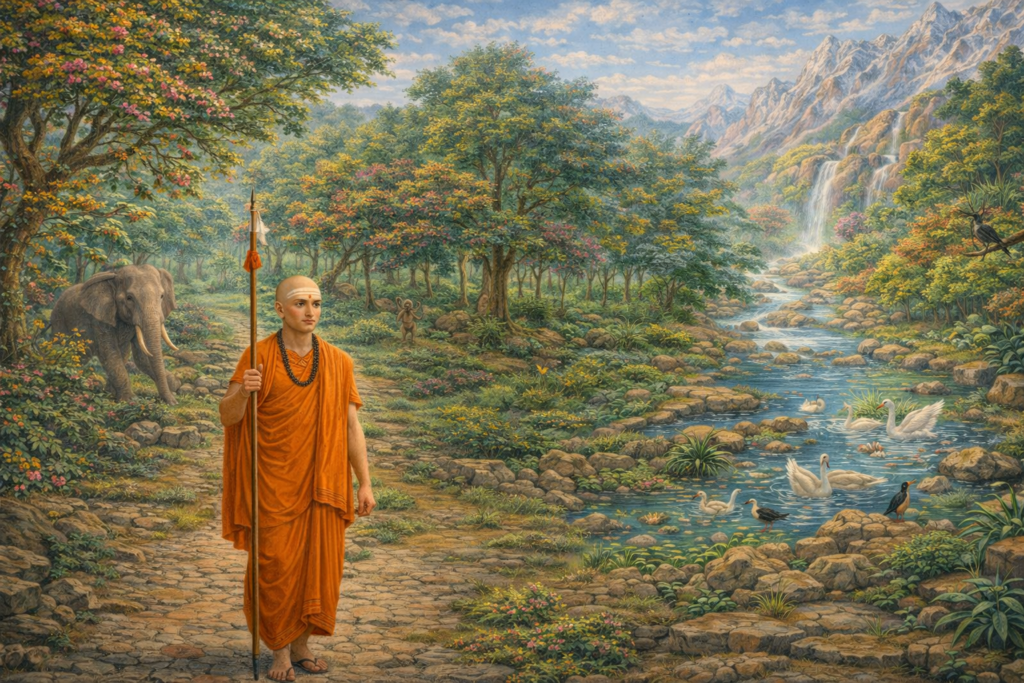
Rivers and mountains welcomed Shankar as if he were an incarnation of Lord Shiva. He rested on verdant lands, beheld Siddhas, Gandharvas, and Apsaras in caves, delighted in sweet music, and roared louder than lions in playful challenge.
The Meeting with Guru Govindapada: A defining moment in Shankaracharya’s Spiritual Journey
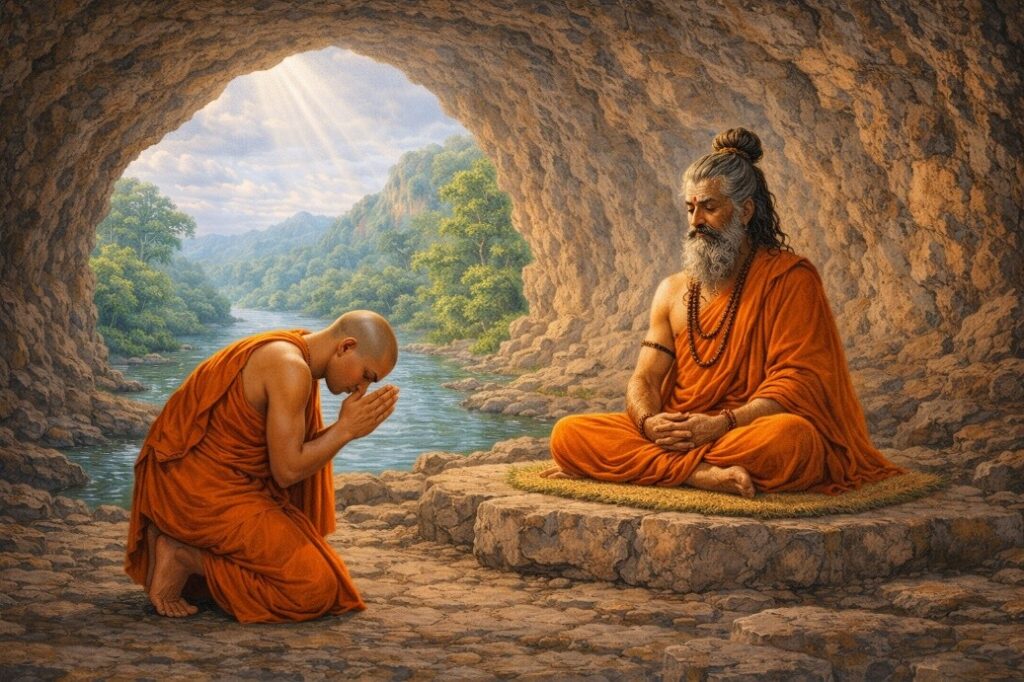
Passing various pilgrimages, he reached the Narmada riverbank at dusk and entered Guru Govindapada’s ashram.
Upon seeing the Guru, he prostrated humbly and praised: “O Lord! You are the Shesha form of Vishnu, Shiva’s ornament, and an incarnation of sage Patanjali. You master Yoga and grammar, disciple of Gaudapadacharya. I bow to you—grant me Vedanta knowledge.”
The Guru asked, “Who are you?” Shankar replied: “I am neither earth, water, fire, air, nor space. Nor body, senses, mind, or ignorance. I am the pure, tranquil, Shiva-like Atman.”
Govindapada instantly recognized his exceptional nature, declared “You are Lord Shankar Himself,” and accepted him as disciple. Shankar served the Guru and received profound Vedanta teachings, including the four Mahavakyas: 1. Prajnanam Brahma, 2. Aham Brahmasmi, 3. Tat Tvam Asi, 4. Ayam Atma Brahma.
Explaining them, the Guru taught that Jiva and Brahman are one; differences arise from body, mind, and ignorance, but all is one Truth. Thus, Shankar grasped Vedanta and Atman’s nature.
Miracle at Narmada Bank
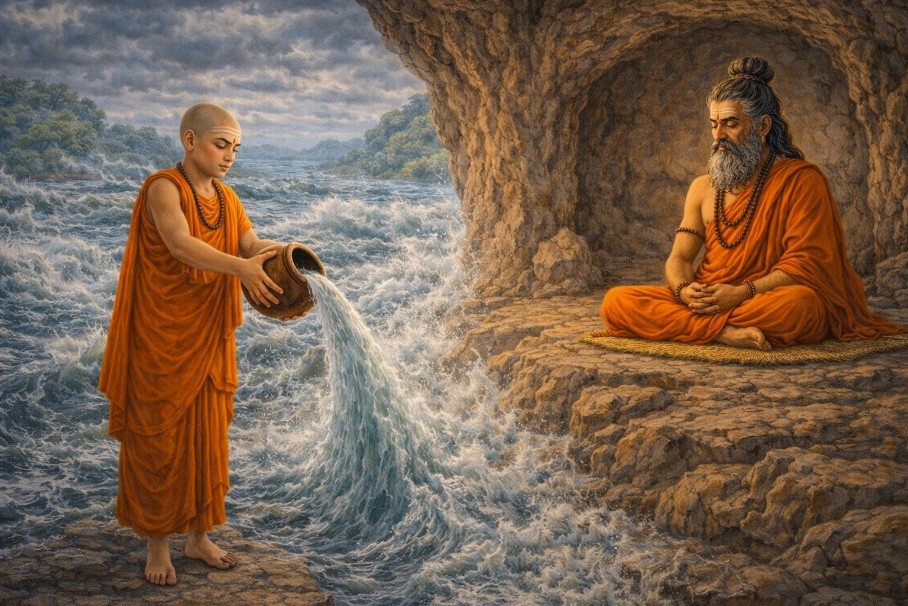
Sri Govindapada was in Samadhi in a cave when a massive Narmada flood surged, waves reaching the entrance, creating terror.
Disciple Shankar invoked his yogic power, containing excess waters in a mantra-charged pot—a testament to his siddhi and devotion.
Like Brahma controlling deluge waters or Agastya stabilizing the ocean, Shankar calmed the crisis, embedding controlling power in the pot to protect his Guru.
Upon emerging from Samadhi and hearing this, Govindapada was overjoyed by Shankar’s siddhi and bhakti.
The Guru’s Directive: A Call Towards Kashi
Shankar spent the sacred period of Chaturmasya on the banks of the Narmada under the guidance of his Guru. The monsoon season, with its relentless rains and difficult paths, naturally restrained outward movement and turned the mind inward. Surrounded by the beauty of nature—resonating thunder, flashes of lightning, dancing peacocks, cool winds, flowing streams, and lush greenery—the environment itself became conducive to deep reflection, devotion, and sadhana.
As the monsoon receded and the skies cleared, marking the return of accessible paths, Guru Govindapada knew that the time had come for Shankar to step into a greater role. One day, he addressed him with profound intent:
“O Shankar! Long ago, during a major yagya (महान यज्ञ) in the Himalayas, Maharishi Vedavyasa himself was expounding the deepest truths of the Vedas and the Upanishads. At that time, I reflected upon his immense contribution—how he had divided the Vedas, composed the Mahabharata and the Puranas, elucidated the principles of Yoga, and finally distilled the essence of all knowledge into the Brahma Sutras.”
The Guru paused, and then continued with a deeper concern:
“However, over time, many have begun to misinterpret the Brahma Sutras, deriving meanings that deviate from their true intent. Such distortions obscure the path of knowledge and create confusion among seekers. Therefore, there arises a need for a clear and authoritative commentary—one that can reveal their true essence.”
He then revealed a profound prophecy:
“At that time, Maharishi Vedavyasa had said that a महान शिष्य would one day arise, who would undertake this sacred task and restore the true understanding of the Brahma Sutras. O Shankar, you bear the signs of that destined one.”
Looking at his disciple with both affection and command, Guru Govindapada gave his final instruction:
“Go to Kashi—the eternal seat of knowledge and devotion. There, by the grace of Lord Shiva, compose the bhashyas on the Brahma Sutras and other scriptures, and re-establish the true wisdom of Sanatana Dharma.”
Hearing these words, Shankar was deeply moved. Yet, with complete surrender to his Guru’s command, he accepted this divine responsibility. With reverence in his heart and purpose in his steps, he set forth towards Kashi.
In Kashi – Arrival of first Shishya of Adi Shankaracharya (Sanandan /Padmapada)
Having received his Guru’s command, Adi Shankaracharya set out towards Kashi. Though deeply attached to his Guru, and inwardly moved by the thought of separation, he carried his Guru’s presence within his heart and continued his journey with unwavering resolve. Along the way, he invoked the Great sages – Marichi, Atri, Angira, Pulastya, Pulaha, Kratu, Vashistha, Kanva—as well as Indra, seeking their blessings as he advanced towards the sacred city.
Kashi, revered as the land of yajna, worship, and knowledge, is a place where even death is said to grant liberation. It is the eternal abode of Lord Shiva and a sanctified ground for sages and yogis across ages. Upon reaching this sacred city, Shankaracharya experienced profound joy, as though he had arrived at the very heart of spiritual awakening.
Residing on the holy banks of the Ganga, he immersed himself in a life of deep spiritual discipline. Each day was marked by sacred rituals—bathing in the Ganga, chanting the pranava (Om), contemplating the subtle truths of the Upanishads, and worshipping Lord Shiva. In this state of inner absorption, he lived in complete peace and bliss.
It was during this time that a remarkable unfolded—one that would mark the beginning of his disciple lineage.
One day, a radiant young Brahmin boy approached him. His presence was striking—calm, composed, and deeply restrained. His face reflected both vairagya (detachment) and jnana (wisdom), far beyond his age. Without hesitation, he came forward and fell prostrate at the feet of Shankaracharya.
Seeing this, Shankaracharya gently raised him and, with compassion, asked:
“Who are you? From where have you come? And what is the purpose of your arrival? Though you are young, you carry a rare depth and brilliance. There is both a quiet strength and a subtle restlessness within you. Tell me—how may I guide you?”
The boy replied with utmost humility:
“O Gurudev, I am a resident of Chola Desha in the South. I was born on the banks of the sacred river Kaveri, in a Brahmin family. My parents were blessed with my birth through the worship of Lord Narasimha.
I have come here seeking liberation from the endless cycle of birth and death. In search of a true Guru, I have journeyed all the way to Kashi. It is by the grace of the sacred Kaveri that I have been able to reach this holy place.
I surrender myself completely at your feet. Please do not consider whether I am worthy or unworthy—accept me out of your compassion and uplift me through your grace.”
With deep sincerity, he continued:
“Just as rainfall over the ocean brings little gain, but the same rain falling upon a desert holds immense value, in the same way, your grace upon someone like me—who is unworthy—would be truly Great (महान).
I do not seek the position of Indra or the pleasures of heaven. I have no desire for celestial enjoyments. I seek only a place at your feet and the attainment of Brahma-jnana. You alone are my true Guru, and you alone can free me from all suffering.”
Moved by the boy’s humility, sincerity, and deep vairagya, Shankaracharya accepted him as his disciple. In due course, he initiated him into Sannyasa and gave him the name Sanandana. In time, this very disciple would become renowned as Padmapada, one of the foremost disciples of Adi Shankaracharya.
Under the guidance of his Guru, Sanandana dedicated himself to seva (service), satsang, yogic discipline, and the worship of Lord Narasimha. Through these practices, he purified his body, mind, and intellect, gradually dissolving all traces of ego and possessiveness.
In this process, he exemplified a fundamental truth of spiritual life—that the human being is not merely a physical body, but is composed of multiple layers: the gross body, the subtle body (mind and intellect), and the causal body (ignorance). When a seeker transcends these layers and disassociates from them, the true nature of the Self is revealed.
Sanandana walked this very path. By surrendering all inner limitations and attachments, he realized the deeper truth of the Self. Through his transformation, he demonstrated that he was no longer merely a disciple, but one firmly established on the path of self-realization.
Witnessing this, Adi Shankaracharya felt deep satisfaction and joy, knowing that the light of true knowledge had begun to take root.
The Secret of Spiritual Progress
True spiritual progress lies in unravelling the layers of one’s own existence. A human being is not merely the physical form seen by the world; according to the scriptures, we are composed of three distinct dimensions:
The Physical Body (Sthula Sharira): The outer shell made of matter and sustained by food.
The Subtle Body (Sukshma Sharira): The internal realm consisting of the mind, intellect, ego, and life-force (Prana). This is the seat of our thoughts and emotions.
The Causal Body (Karana Sharira): The deepest layer of “seed-ignorance” (Avidya), which carries the impressions that lead to the cycle of birth and rebirth.
Sanandan, one of the foremost disciples of Adi Shankara, mastered the art of transcending these layers. Through intense discrimination and detachment, he severed his identification with these three bodies. He realized through direct experience that he was neither the perishable physical frame nor the restless mind, but the Pure Eternal Consciousness (Atman) that lies beyond them.
By renouncing these internal bondages, Sanandan achieved a state of profound self-realization. He demonstrated to his Guru that he was no longer just a student seeking knowledge, but a realized soul firmly established on the path of Truth. Adi Shankaracharya was deeply pleased to witness this spiritual transformation. This moment of realization served as the foundation for Sanandan’s eventual elevation as Padmapadacharya, the first head of the Govardhana Matha.
Sri Vedamurti Vishweshwara : A Divine Dialogue on Non-Duality Advait
This episode is one of the most profound and decisive moments in the life of Adi Shankaracharya. It is not merely an event but the very essence of Advaita Vedanta (Non-Dualism) in action.
The Extraordinary Encounter: Shiva and Shankara
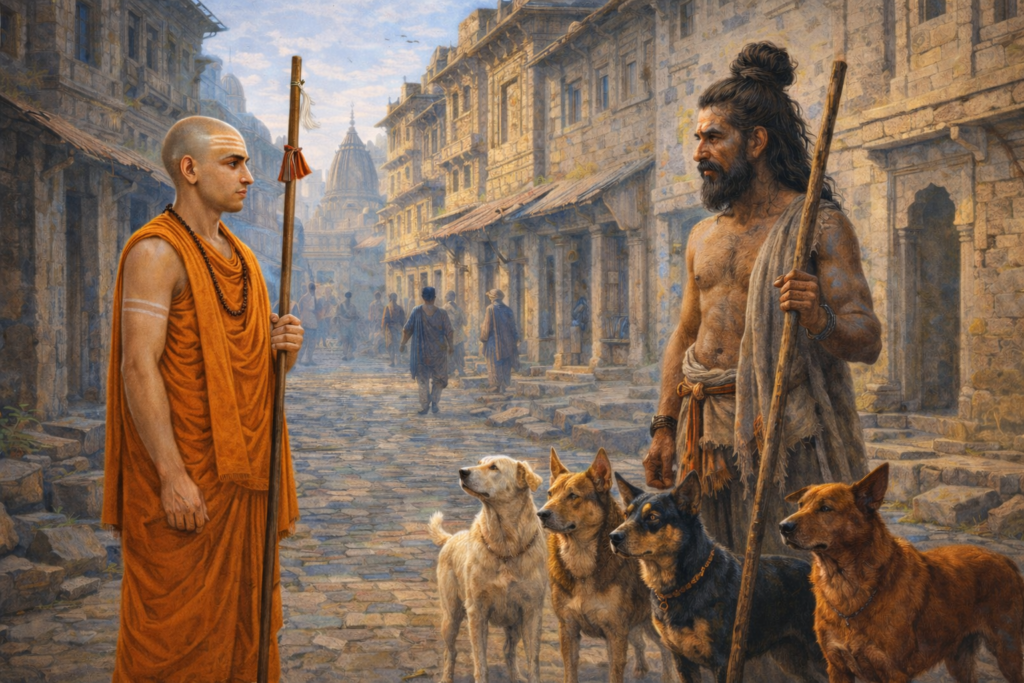
One day, while Acharya Shankara was heading to the Ganges for a holy dip with his disciples, a Chandala (outcaste) accompanied by four dogs appeared in his path. Following the social norms of the time, the Acharya asked him to move aside, saying, “Gaccha Duram” (Move away).
At that moment, the Chandala—who was actually Lord Shiva in disguise—replied with a piercing question:
“The Upanishads proclaim hundreds of times that Brahman is unique, untainted, unattached, and the very form of Truth, Consciousness, and Bliss. If so, it is surprising that you still perceive such duality and difference.”
He further challenged: “On what basis do you say ‘Move away’? If we look from the perspective of the Atman (Soul), we are one. If we look from the perspective of the body, all bodies are made of the same elements. Does the sun reflected in the holy Ganges differ from the sun reflected in a pot of liquor?”
He concluded that the notion of “I am a pure Brahmin and you are an outcaste” is a myth (Mithya), as the same Atman resides in all.
Shankaracharya’s Realization
Hearing this, Shankaracharya replied with utmost humility. He acknowledged that the Chandala’s words were the ultimate Truth of the Upanishads. He realized that a true Knower (Jnani) is one who understands they are not the body, mind, or senses, but the Satchidananda Atman—regardless of their social standing.
This realization led to the composition of the ‘Manisha Panchakam’, where he declared that anyone firmly established in this unity of consciousness is his Guru.
The Manifestation of Lord Shiva
Pleased with the answer, Lord Shiva revealed His true form. The four dogs were symbols of the Four Vedas. Shankaracharya bowed in devotion and stated:
“From the perspective of the body, I am Your servant; from the perspective of the soul (Jiva), I am a part of You; but from the perspective of the Atman, I am You.”
Lord Shiva blessed him to become the great teacher of Vedanta and propagate the Truth by writing commentaries (Bhashyas) on the Brahma Sutras and other scriptures.
The Deep Significance: Essence of the Whole Vedanta
This encounter is a masterclass in reconciling Absolute Truth (Paramartha) with Relative Reality (Vyavahara). To understand this, one must look at four foundational pillars of Sanatana Dharma:
- The Purpose of Creation and the Five Elements
Every physical form, from a blade of grass to a Creator, is composed of the five Great Elements (Pancha Mahabhuta). While forms differ, the Atman is as all-pervading as space. The division of Varna (aptitude) and Ashrama (stage of life) is not based on hatred or discrimination but is a scientific and practical system to maintain social balance and help individuals progress toward the ultimate unity.
- The Fourfold Human Aim (Purushartha Chatushtaya)
Life is organized around four goals: Dharma (Righteousness), Artha (Prosperity), Kama (Desire), and Moksha (Liberation).
- Artha is not just wealth; the ultimate Artha is God (the support of all).
- Dharma is the path to realize that Truth.
- Kama is the love for the Divine.
- Moksha is the realization of the Self. In this system, even food is not for sensory pleasure but to sustain the body as a vehicle for seeking Truth.
- Karma and the Diversity of Life
Sanatana Dharma explains that beings take birth in various forms (84 lakh species) based on their past actions (Karma). Among these, the human birth is the most precious because only a human has the capacity for conscious action, self-inquiry, and liberation.
- The Core of Spirituality: Action as Worship
When a person performs their duty (Swa-Dharma) without attachment to the results and offers it to the Divine, it purifies the mind (Chitta-Shuddhi). A pure mind eventually realizes the Non-Dual Brahman.
Conclusion: The Balance of Reality and Truth
The message of Adi Shankaracharya’s encounter with Lord Shiva is clear:
- In Relative Reality (Vyavahara), distinctions in duties and conduct are necessary for a disciplined society.
- In Absolute Truth (Paramartha), there is no “other.” All are the same Atman.
A true Sage lives in the world following social ethics but remains internally anchored in the realization that everything is Brahman. “Difference exists only in ignorance; in Knowledge, all are One.”