
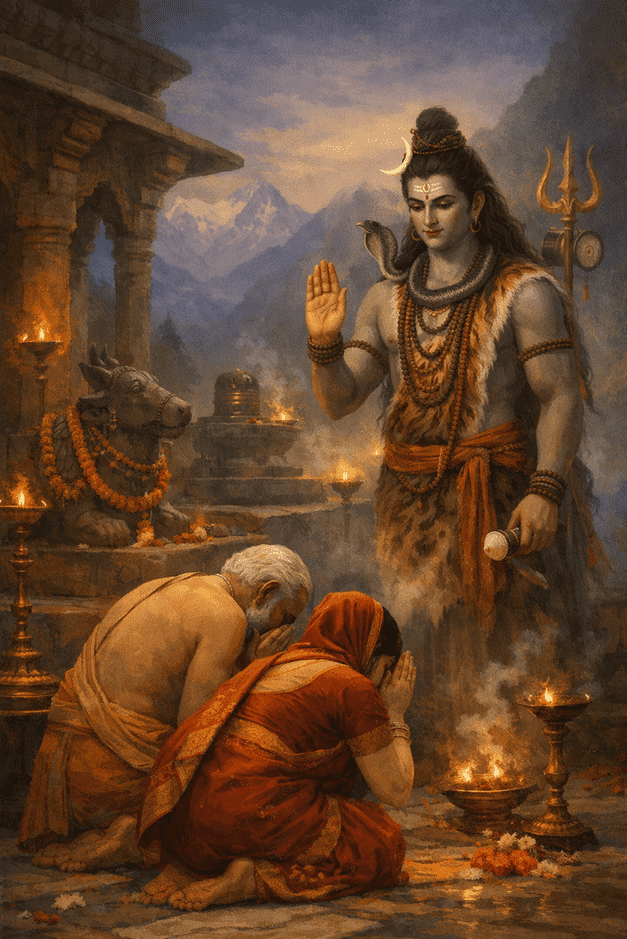
If you have not read the part-1 here is the link for part-1
The Incarnation of Adi Shankaracharya: Divine Childhood acts & Contemporary Dev Avatars
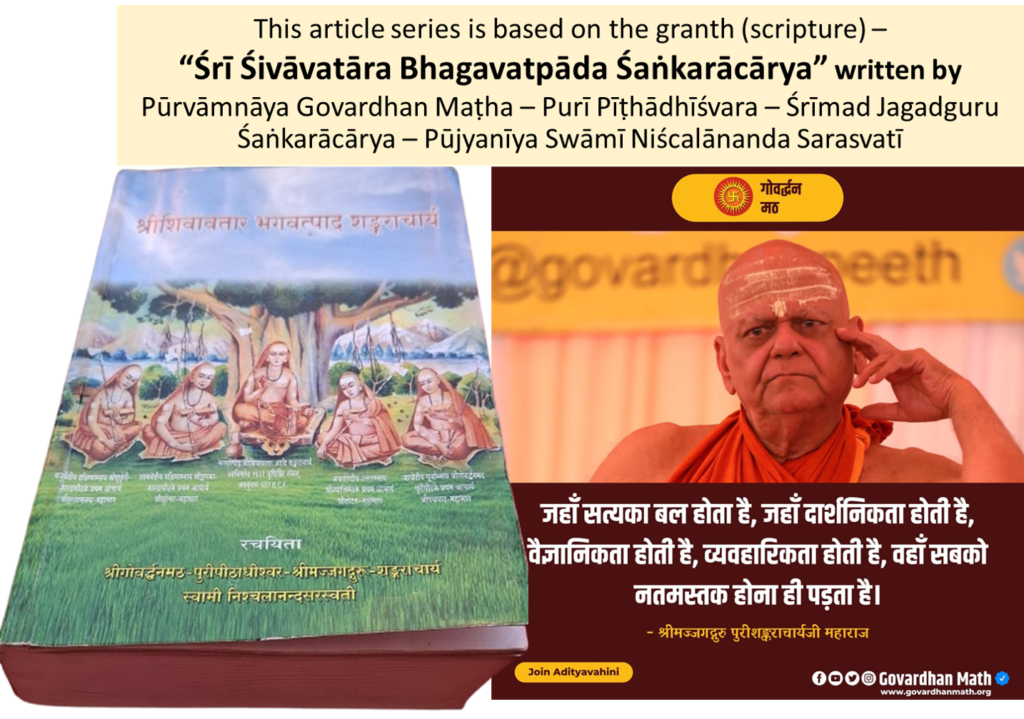
In the first part of the article, we explored in detail why Lord Shiva had to take avatar as Aadi Shankaracharya, We also briefly discussed his monumental contributions, for which all followers of Sanatana Dharma will remain eternally indebted.
In this second part, we will learn about those divine miraculous acts (leelas) of his childhood that proved he was no ordinary child. Additionally, we will delve into the details of other deities who incarnated during the same era as Adi Shankar to assist in his great mission of reviving Sanatan Dharma.
The Decline of Human Intellect and Inner Strength Across the Ages (Yugas)
As we transition from Krita Yuga (Satya Yuga) toward Kali Yuga, the progressive decline of man’s Pragna-shakti (intellectual wisdom), Prana-shakti (vital energy), and faith in Dharma and spirituality. This is an established fact in Sanatan Dharm scriptures.
- In Satya Yuga, when the inner intuition of the seeker was fully awakened, Lord Dakshinamurti (Shiva) dispelled the doubts of his disciples through ‘Silent Discourse’ (Mauna-Vyakhyanam). At that time, the intellect of the disciples was so sharp that words were unnecessary.
- In Treta Yuga, as intuition began to contract, Lord Dattatreya (an incarnation of Narayana) liberated seekers through Aphoristic statements (Sutras)—concise pointers whose profound meanings were expanded upon by the disciples themselves.
- In Dwapara Yuga, when memory and concentration further diminished, Lord Krishnadvaipayana Vedavyas divided the Vedas, composed the Mahabharata and Mahapuranas, and formulated the Brahma Sutras. He trained his enlightened shishya’s ‘Shuka’ and ‘Lomaharshana’ to keep Dharma and spirituality alive through storytelling (Bhagwaan katha vachan), scriptures, and oral traditions.
- However, the situation in Kali Yuga was even more dire. Here, there was not just ignorance, but active hypocrisy, heresy, and fallacious logic (Kutarka) that declared ignorance itself to be knowledge. Rituals (Karmakanda), Philosophy (Darshana), and Devotion (Bhakti) had all drifted from their true goals. In such an era, neither silence, nor aphorisms, nor mere stories were sufficient. This is why Lord Shiva manifested as Adi Shankaracharya in Kali Yuga.
In a brief lifespan of only 32 years, Adi Shankaracharya accomplished the feats that will guide humanity for millennia. His contributions can be seen through these key pillars:
Revival of the Scriptures: He restored the sanctity of the Shastras. He wrote profound commentaries (Bhashyas) on the Prasthanatrayi (Upanishads, Bhagavad Gita, and Brahma Sutras), composed introductory texts (Prakarana Granthas) to simplify complex philosophy, and connected the common masses to Dharma through hymns (Stotram) overflowing with devotion.
Victory in Scholarly Debates: He hoisted the flag of Vedic Dharma by defeating heretics, pretenders, and misguided Mimamsakas in Shastartha (theological debates).
Re-Consecration of Divine Deities: He retrieved and re-consecrated the sacred idols of Lord Badrinath from Narad Kund and Lord Jagannath (Darubrahma) from the depths of the earth.
Establishment of Governance and Order: To protect Dharma, he established the Chaturamnaya Peethas (four monasteries in four directions). By dedicating the royal throne to King Sudhanva Sarvabhauma, he harmonized spiritual authority (Dharma-Satta) with political authority (Raj-Satta).
He gave clear instructions to both the spiritual leaders (Dharmacharyas) of the Vyas-Peeth and the rulers protecting the Raj-Peeth (rulers). He emphasized that ethics, lineage traditions (Kulachar), Vedic rituals, worship, and knowledge must all be properly propagated and protected in their respective spheres. His message was clear: Dharma must not live only in hermitages; it must remain alive in the conduct of society and governance.
Adi Shankaracharya believed that the establishment of a Dharma-Rajya (a righteous state) is only possible when there is constant dialogue and mutual respect between the Vyas-Peeth (Knowledge and Conduct) and the Raj-Peeth (Governance and Power). He inspired a synergy between the two so that knowledge would not be detached from power, and power would not be detached from Dharma.
He maintained that the balanced cooperation of Brahmatejas (spiritual brilliance) and Kshatrabal (valor and strength) creates an auspicious era for society. With this vision, he refined both the Vyas-Peeth and Raj-Peeth, establishing a harmony of thought and conduct between them.
Thus, Adi Shankaracharya was not merely a philosopher or a monk. He was a visionary Master bhagwaan shankar himself who knew the pulse of time, and built Dharma, society, and governance into a single thread to re-establish Sanatana Dharma in the age of Kaliyuga.
Aadi Shankaracharya Avatar : His Childhood Miracles
In the sacred land of Kerala, on the holy banks of the Purna River, stands the Vrishaparvata (the Bull Mountain), where Lord Shiva manifested as a ‘Swayambhu Jyotirlinga’ (a self-manifested lingam of light). Tradition holds that Lord Shiva himself inspired King Rajashekhara in a dream, leading to the construction of a magnificent temple there. Near this sacred Jyotirlinga lay an exceptionally beautiful village (Agrahara) named ‘Kalady’, inhabited by learned Brahmanas and blessed with protection from natural calamities and the disturbances of wicked kings.
In this village lived a Brahmana named Shri Vidyadhiraja, a treasure trove of virtues. By the grace of Shiva, he was blessed with a son named ‘Shivaguru’. Shivaguru undertook a profound study of the Vedas and Vedangas at the Gurukul. His mind was so deeply steeped in renunciation (Vairagya) that he desired to remain a lifelong celibate (Brahmachari) in service to his Guru. However, his Guru, emphasizing the significance of the Grihasthashrama (the householder (married life) ), inspired him to marry. His Guru’s view was:
“The seed sown at the right time yields a bountiful harvest, whereas that sown out of season does not. Similarly, marriage and other rites performed at the appropriate time in life bear fruit; otherwise, they are in vain.“ — (Shankara Digvijaya 2.11)
Shivaguru’s Acceptance of Householder (grihast) Life and the Virtue of Aryamba
Following the auspicious timing, the father, Vidyadhiraja, arranged Shivaguru’s marriage to the virtuous Sati Arya (Aryamba), the daughter of Pandit Magha. Shivaguru established the sacred sacrificial fire and performed numerous Yagyas, satisfying the Devas, ancestors, and humanity. While he was incomparable in knowledge, beauty, and prosperity, and his wife was like Goddess Lakshmi herself, they remained childless for a long time. They began to feel their lives were as futile as a tree that bears neither flowers nor fruit.
The Penance of Shivaguru and Aryamba
On the advice of the virtuous Aryamba, the couple resolved to worship Lord Shiva for the boon of a child. They began their penance by consuming only roots and fruits, eventually renouncing even those to immerse themselves solely in the meditation of Lord Ardhanarishvara. Their bodies became extremely frail. Witnessing their intense penance on the Vrishabhachal mountain by the banks of the Churni river, Devarshi Narada appeared to them and then traveled to Kailash with Lord Brahma to intercede with Lord Shiva.
Moved by their devotion, Lord Shiva appeared one day in a dream in the guise of a Brahmana. Filling them with joy, He asked: “O noble Brahmana! What do you desire?”
Shivaguru replied: “Lord! I desire a son.”
Lord Shiva then gave them a choice: “Should I grant you one all-knowing, omniscient son possessed of all virtues, or many sons of long life but of mediocre character and little merit?”
Shivaguru chose: “Lord, grant me one all-knowing son, endowed with every virtue!”
Lord Shiva then granted the boon, declaring that He Himself would be born as their son.
Divine Pregnancy and Shaiva Tejas
From the remnants of food left by Shivaguru, Lord Shiva infused his divine radiance (Tejas). When Sati Aryamba consumed that food, the ‘Shaiva Tejas’ entered her body, and symptoms of pregnancy began to appear. Aryamba’s interests now centered solely on devotion, renunciation, and stories of the Lord. She distanced herself from worldly conversations with her friends, and her faith in pilgrimages and scriptures grew stronger. Seeing her aura that could illuminate even the sun and moon, the sages realized she was becoming ‘Shiv-Janani’ (the mother of Shiva). In her dreams, she saw herself riding a white bull, while the celestial Devas offered her hymns of praise.
Adi Shankaracharya’s Miraculous Birth (507 BCE)
In an auspicious muhurta with favorable planetary positions, Sati Aryamba gave birth to a divine son. At that time, the Sun was in Aries, Mars in Capricorn, and Saturn in Libra (all in exalted positions). According to the Bhavishya Purana, this period corresponds to Yudhishthira Samvat 2631, Kali Samvat 2595, and 507 BCE. At the moment of birth, the entire atmosphere filled with “Satyam Shivam Sundaram.”
On the twelfth day after the child’s birth, in gratitude for Shiva’s grace, he was named ‘Shankar.’ The child bore extraordinarily divine marks on his body:
mūrdhni himakaracihnaṃ niṭale nayanāṅkam aṃsayoḥ śūlam |
vapuṣi sphaṭikasvarṇaṃ prājñās taṃ menire śambhum ||
nāgenorasi cāmarena caraṇe bālendunā phālake
pāṇyoścakragadādhanaurdamarukaiḥ mūrdhni triśūlena ca ||
. (Shankara Digvijaya 2.90, 92)
- A mark of the baby moon (small crescent) on the head.
- An eye mark on the forehead.
- Trident (trishool) marks on the shoulders and a serpent mark on the chest.
- Marks of the discus, mace, bow, and damaru on the hands.
- A chowrie mark on the soles of the feet.
The scholars recognized the child as Lord Shiva himself.
Adi Shankaracharya’s Miraculous Childhood
Shankar, who delighted his maternal and paternal families as well as other close relatives from the moment of his birth, learned his mother tongue Malayalam and its script within one year of age. By two years, he became proficient in reading texts. At three years old, the child mastered poetry, history, and Puranas. Free from the blemishes of rajas and tamas gunas, Shankar acquired knowledge of various scripts and became adept at teaching lessons to his peers.
Bhagavati’s Maternal Affection and the Emergence of Poetic Talent
Shri Shivaguru daily worshipped Katyayani Devi. After offering delicious cow’s milk as bhog to Bhagavati, he would give the remnants to his son. One day, in the absence of his father, young Shankar, with his mother Aryamba’s permission, offered milk to the Devi himself. Seeing the milk in the vessel untouched, the child thought the Devi was displeased and began to cry and placate her. Then, Nagendrakanya, the mother of the universe, and the affectionate Katyayani manifested, and began drinking the milk from the golden vessel.
Not seeing any milk left for himself, the child started crying again. Overwhelmed by affection, the daughter of the Mountain King, the Mother of the Universe, and the protector of devotees—Goddess Katyayani appeared and took him in her lap, caressed him, and began breastfeeding. This brought the child immense joy. The stream of white milk from the Devi’s breast flooded young Shankar with devotion, detachment, divine wisdom, and poetic talent. The Acharya himself revealed this incident in Saundarya Lahari as follows:
tava stanyaṃ manye dharaṇidharakanye’sta hṛdayataḥ payaḥ
parāvāraḥ parivahati sārasvatam iva |
dayāvatī dattaṃ drāviḍaśiśur āsvādya tava yat
kavīnāṃ prauḍhānām ajani kamanīyaḥ kavayatā || (Saundarya Lahari 75)
Meaning: “O daughter of the mountain! I believe that the white milk flowing from your breasts is like the radiant flow of Saraswati emerging from your heart. Having tasted the milk given by you, the compassionate one, this Dravida infant has become a charming poet among the mature poets.”
Upanayana Ceremony and Mastery of Scriptures
The child’s Chudakaran sanskar was performed at the appropriate time. When the boy turned three, his father passed away before his own upanayana. At the age of five, after the yajnopavita (upanayana) sanskar, the sharp-minded child, through his superhuman genius, mastered—after pronouncing the vyahritis Bhuh, Bhuvah, Svah—the four Vedas, along with Shiksha, Kalpa, Vyakarana, Jyotisha, Chhanda, Nirukta, and the astika traditions like Vaisheshika, Nyaya, Sankhya, Yoga, Purva Mimamsa, Pashupata, and Vaishnava, as well as the nastika traditions like Charvaka, Buddhist, and Jaina agamas.
The Kanakadhara Stotram: Dispelling the Poverty of a Destitute Brahmani
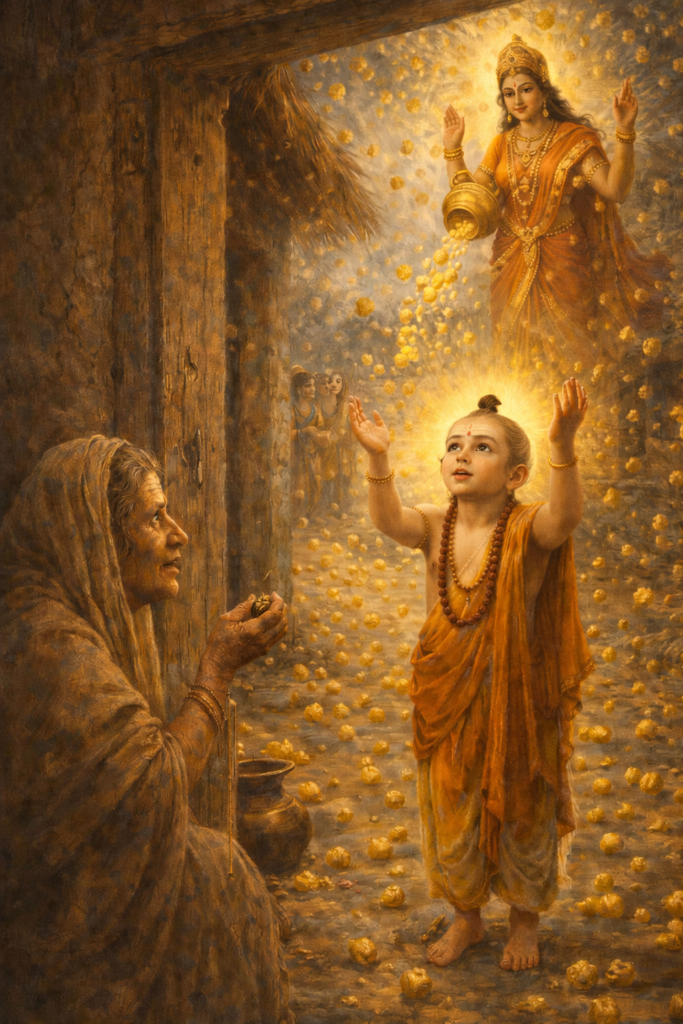
One day, as destiny would have it, the young student Shankara arrived at the home of a poor Brahmani to seek alms (Bhiksha). Beholding the child, who was as radiant as the sun, the woman began to praise her good fortune. However, finding not a single grain of food in her house, she could only offer a solitary Amla (gooseberry) while lamenting her extreme poverty.
Moved by her plight, the compassionate Shankara, with a heart overflowing with emotion, composed a hymn to Goddess Padma (Lakshmi). This prayer, composed in sweet verses rich with profound meaning and poetic elegance, became world-renowned as the “Kanakadhara Stotram” (The Stream of Gold).
Goddess Lakshmi manifested and said— “In her previous births, this woman did not perform virtuous deeds like the charity of food; therefore, she is enduring this unbearable poverty.”
Shankara, the ocean of mercy, argued— “O Mother! Nevertheless, she has offered me a single Amla with utmost faith today. She must surely receive the fruit of that devotion.”
Moved by his plea, the compassionate Goddess Rama (Lakshmi) showered the Brahmani’s house with a rain of golden Amlas. Having thus dispelled the woman’s poverty, Lord Shankara returned to the Gurukul.
“Matribhakti” (Devotion to Mother)The Devotion that Rerouted a Divine River”
By the age of seven, having become a scholar proficient in the entire gamut of Vedic literature, Shankara returned from the Gurukul to his home and immersed himself in the service of his mother. Even in his early youth, he became universally respected in his birthplace due to his vast knowledge, virtuous character, efficiency, and the gentleness of his speech and conduct.
Once, becoming anxious when his mother did not return on time from her bath in the river, Shankara reached the riverbank only to find her lying unconscious. He revived her using cool water and the breeze wafting from the lotuses, and with the help of relatives, brought her back home.
Following this, young Shankara composed a prayer to the River God in poignant and enchanting verses. Gracious for his devotion, the River granted the desired boon to the mother-devoted lad. The very next day, during the Brahma-muhurta (the auspicious pre-dawn hours), a divine river began to flow right past the Shri Vishnu Temple located near their house.
Shankara’s Initiation into Sannyasa: The Crocodile’s Grasp
The learned Shankara began teaching Grammar, Poetry, and the Vedas in his birthplace. The radiance of his knowledge began to spread in all directions. Witnessing his miraculous talent, his relatives began discussing his marriage.
One day, desiring a glimpse of this fresh incarnation of Lord Shiva, great sages like Upmanyu, Dadhichi, Gautama, Tritala, and Agastya arrived at the home of the virtuous Aryamba. The young scholar Shankara worshipped these Maharishis according to Vedic rites and humbly seated them. Aryamba praised her fortune, feeling that she and her son were blessed to behold these liberated souls in this age of Kali. Describing her son’s peerless fame, she asked the sages about his past and his future. The aged Maharishi Agastya revealed:
“O Devi! As a result of your devotion to Shiva, the Lord Himself has come to you in the form of this child for a brief duration.”
When Aryamba enquired about his lifespan, the great Agastya shared a mysterious calculation:
“His life consists of eight years in the first stage; for a special reason, another eight years in the second; and for a particular purpose, another sixteen years—totaling thirty-two years.”
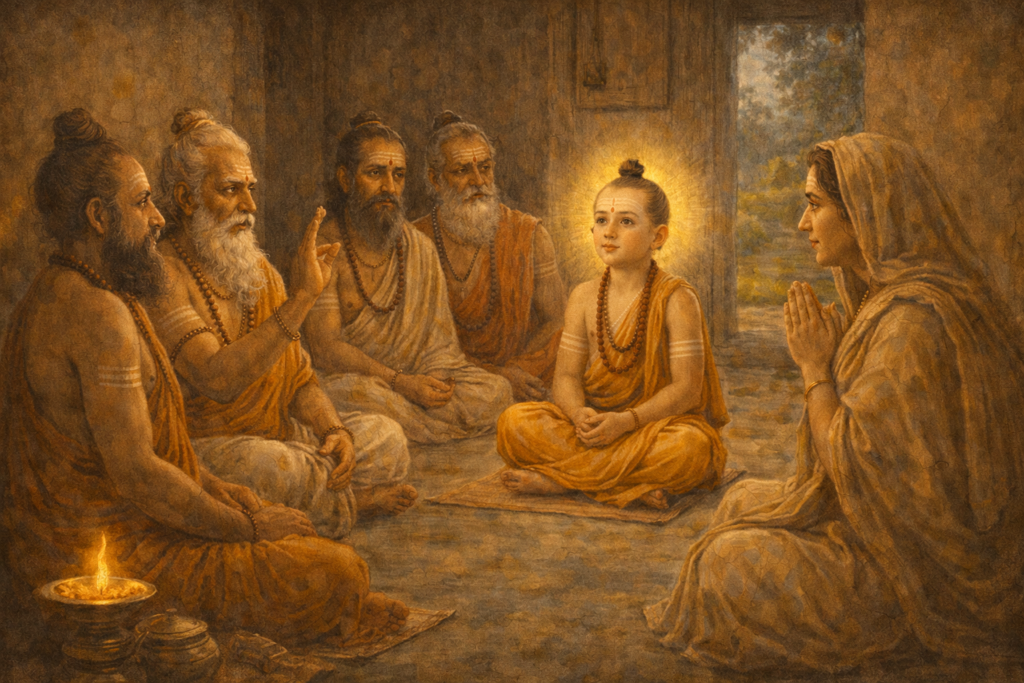
Following this, the sages held a private, secret consultation with the young Shankara and disappeared. Hearing of her beloved son’s short lifespan, Aryamba became as distressed as a female elephant scorched by a forest fire or a fish gasping for air without water.
The Philosophy of Impermanence
Comforting his mother, Shankara spoke of the reality of life: “Mother, this life moves toward death every moment. Just as a peepal or banana leaf trembles in the wind, this life is plagued by the blows of mortality. The significance of this fleeting existence lies only in the worship of God and dedication to Dharma. The body perishes, but the Soul is eternal.”
He continued: “Mother, the truth is that countless sons were raised and many women came into this world, but where are they now? Where are we? Our meeting in this world is like two travelers crossing paths for a short while. I find no happiness in the ways of this world; therefore, I shall embrace Sannyasa (renunciation) to seek liberation from the cycle of birth and death.”
The affectionate mother argued: “Son! Is serving one’s parents not a path to salvation? Can one not perform Yagyas and worship as a householder? My final peace depends on the Shraddha and Tarpan (funeral rites) performed by you. How will I survive without you? Do you not accept the scriptural law of ‘Matri Devo Bhava‘ (Treat your mother as God)?”
The Crocodile Miracle (Graha-Leela)
Shankara faced a moral dilemma. He could not disrespect his mother’s command, yet he could not abandon the primary purpose of his incarnation—the protection of Dharma through renunciation. Thus, it became necessary to orchestrate a divine play (Leela) to obtain her permission.
One day, to please his mother, young Shankara went to bathe in the nearby Purna River. Suddenly, a crocodile (Graha) seized his leg. Just as a crocodile once trapped the King of Elephants (Gajendra), Shankara was gripped firmly. He called out loudly: “Mother! Where are you? Save me! This creature has caught me; I cannot move. Only your permission can save me! Come quickly, Mother!”
Hearing his agonizing cry, Aryamba rushed to the riverbank and wailed: “Alas! I am ruined. My only support in old age is in the jaws of death. Fate kept me alive only to see this day.”
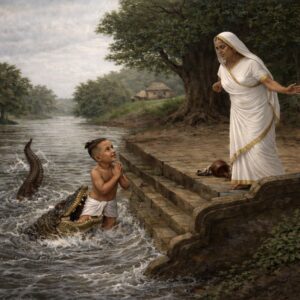
Shankara spoke in a poignant voice: “Listen, Mother! Sannyasa itself is a ‘Great Death’ (Maha-mrityu). If you wish to save me from the mouth of this crocodile, grant me permission to take Sannyasa. This renunciation is death to the outside world, but ‘Deathlessness’ (Mrityunjaya) within. If you wish to see me alive, give me your permission for Sannyasa.”
Compelled by the situation, Aryamba cried: “Son! Even as a Sannyasi, let it be—but stay alive!”
The moment these words left her mouth, the crocodile released Shankara’s leg and disappeared. Shankara emerged from the river and prostrated at his mother’s feet.
The Promise to a Mother
Though she was heartbroken by the impending separation, Shankara comforted her: “Mother, do not be restless. Your kin and servants will take full care of you. When your life’s journey is complete, they will perform your last rites properly. God will protect you because of your devotion.”
His mother then placed an emotional condition: “Son! I accept the life you gained from the crocodile through Sannyasa. But if you do not perform my funeral rites upon my death, what is the use of having you as a son?”
Balancing scriptural codes with a son’s duty, Shankara promised: “Mother, believe me. Whether by day or night, whenever you remember me, I will leave everything and come to you. Though I am a Sannyasi, I myself will perform your final rites.”
Reassured by this promise, Aryamba grew calm. When his friends tearfully tried to stop him, Shankara explained with love and wisdom that his path was that of ‘Nivritti’ (withdrawal), meant for the welfare of the entire world.
Finally, noticing the river’s current surging toward the temple, Shankara relocated the idol of Lord Krishna to a safe, consecrated spot. Bowing to his mother and his birthplace, he set forth on the path of Sannyasa.
The Incarnation of Contemporary Deities:
The manifestation of Acharya Shankara was not an isolated event but a comprehensive and well-organized mission planned by the ‘Dev-Mandala’ (the Celestial Council) for the protection of Sanatana Dharma. Just as the Devas took birth as Vanaras to assist Shri Hari during the Rama-avatar in Treta Yuga, and divine powers descended within the Yadu dynasty alongside Shri Krishna in Dwapara Yuga; similarly, during the profound darkness of Kali Yuga, all major deities took birth in Brahmana families to participate in Mahadev’s great sacrifice of religious revival.
Lord Vishnu (Shri Padmapada): The Preserver of the Universe, Lord Vishnu, took birth in the family of a noble Brahmana named ‘Vimal.’ He later became renowned as Padmapada, the first and foremost disciple of Acharya Shankara.
Lord Brahma (Shri Mandana Mishra / Sureshwaracharya): The Creator and master of the Vedas, Lord Brahma, manifested as Mandana Mishra. He represented the strongest fortress of ritualistic Karmakanda at that time. After being defeated in debate, he became the bearer of the flag of Advaita knowledge and was appointed the first Acharya of the Sringeri Peetham.
Goddess Saraswati (Shri Ubhaya Bharati): The Goddess of Wisdom, Saraswati, incarnated as Ubhaya Bharati. In the form of Mandana Mishra’s wife, she served as the divine mediator and judge during the historic scholarly debates.
Vayu Dev (Shri Hastamalaka and Shri Totaka): The Pavan God divided his divine power into two forms. One as Hastamalaka, for whom self-realization was as clear as an Amla (gooseberry) held in one’s palm. The tenth part of Vayu Dev manifested as Totakacharya, the devoted disciple.
Devguru Brihaspati and Varuna Dev (Shri Anandagiri and Shri Chitsukha): The Guru of the Devas, Brihaspati, manifested as Anandagiri. He authored commentaries on the Acharya’s works that continue to guide seekers today.
Indra Dev (King Sudhanva): The King of Devas, representing governance and power, took birth as King Sudhanva. He placed royal authority under the guidance of the Vyas-Peeth (spiritual authority), protecting Sanatana Dharma from heretics and serving as the primary protector of the Acharya’s Digvijaya (global victory) campaign.
Nandi (Udanka): Nandi, the son of Shilad, took birth in the house of a brilliant Brahmana as Udanka. A supreme scholar, he earned great fame by dismantling the arguments of vast groups of opponents.
Lord Skanda and Other Deities: Lord Kartikeya (Skanda) manifested as Bhattapada (Kumarila Bhatta) to revive the ritualistic aspect of the Vedas. Similarly, the Sun, Moon, and Agni (Fire) took birth through their divine portions as the sages who brought the mission of the Shankara-incarnation to completion.
Prophecies and Scriptural Testimonies of the Divine Incarnation
Numerous scriptures confirm that Adi Shankaracharya was an incarnation of Lord Shiva:
In the Vayu Purana:
‘Chaturbhih saha shishyastu shankaro-vatarishyati.’ “Lord Shankara will incarnate along with his four primary disciples (who were themselves incarnations of the Devas).”
In the Shiva Rahasya (9th Amsa, Chapter 16), Lord Shiva himself declares to Mother Parvati:
“O Mahadevi! In Kali Yuga, when followers of other sects distort the meaning of the Vedas with their logic, when people become irreligious by trapped in ‘Positivism’ (believing only what is visible), and when scholars claim that ‘Karma’ is everything and there is no God to bestow fruits—then, to uproot these unrighteous ideas, I shall manifest from my own portion as a Brahmana named ‘Shankara’ in a village in Kerala.”
This saga proves that the manifestation of Acharya Shankara was a divine decree, where all cosmic powers were active on this earth to re-establish Dharma.
Anupam Trivedi has spent over three decades studying and reflecting upon Sanatan scriptures, including the Vedas, Upanisads, Itihāsa, and Purāṇas. He writes on cultural philosophy and ancient literature to present traditional insights with accuracy and clarity. Read full bio →
Well narrated in crispy manner
Pingback:Adi Shankaracharya and the Chandala Story: The Truth About Equality and Oneness (Part 3) - Bhavam Bhavaani
Pingback:Adi Shankaracharya: : Appearance of Maharshi Veda Vyasa – Part 4
Pingback:Adi Shankaracharya: Kumaril Bhatt's Sacrifice & Path to Mandan Mishra (Part 5)
Pingback:Adi Shankaracharya & Mandan Mishra: The Unpleasant Confrontation Before Shastrartha
Pingback:Adi Shankaracharya & Mandan Mishra: The Epic Shastrartha That Re-established Sanatana Dharma Core Principles - Part 7 - Bhavam Bhavaani
Pingback:Adi Shankaracharya-Part 8: Shastrartha with Devi Ubhay Bharati & Mysterious Yogic Act "Par Kaya Pravesh” - Bhavam Bhavaani
Pingback:Adi Shankaracharya-Part 9, Can Rituals Alone Lead to Moksha?