
PART-1
‘Vedic Sanatan Dharma Today – The Invaluable Legacy of Shiv-Avatar Aadi Shankaracharya
Every Hindu must know this truth.
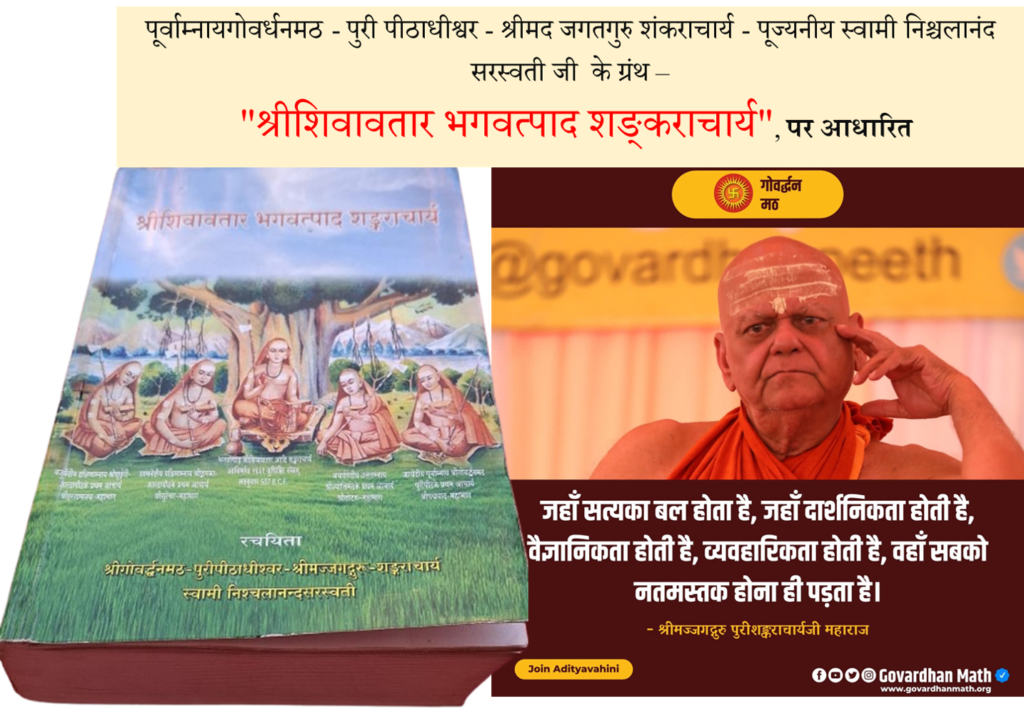
In the Sanatana tradition, the position of Bhagavatpada Adi Shankaracharya is far more than that of a philosopher or a preacher; He is the manifest (Saakshat) incarnation of Lord Shankara Himself. To appreciate the magnitude of His work, one must understand the grave spiritual crisis that preceded Him—a period where the very existence of Vedic Order / Sanatan Dharma was under threat.
The Social Crisis of Sanatan Dharma : Aftermath of the Buddha Avatar
At the beginning of the Kaliyuga, the spiritual atmosphere of India underwent a drastic shift. Lord Vishnu manifested as the Buddha avatar for a specific, restrictive purpose: to lead those with demonic tendencies away from the Vedas to prevent their misuse. This was exactly like having to separate a diseased limb to save the body.
While this “separation” was a divine strategy, its aftermath was devastating for the tradition. Those separated from the Vedic path did not merely stay away; they became active opponents and revilers of Yajna and Vedic rituals. This created a widespread anti-Vedic mentality that caused sacred knowledge to vanish and society to become directionless. It was this dark period of philosophical nihilism that created the urgent necessity for Lord Shiva to descend and reclaim the lost glory of the Vedas.
Why is Lord Buddha not worshipped despite being an incarnation of Vishnu?
The teachings of Lord Buddha are not Veda-sammat (not in accordance with the Vedas), and for this reason, there is no provision for the worship of Buddha in Sanatana Dharma. This is not opposition or an insult, but a fundamental principle of the Sanatana tradition: that which is against the Vedas and Shastras is not valid in Sanatana Dharma—even if that conduct was performed by God Himself. The purpose of the Buddha incarnation was specifically to keep certain classes separate from the Vedic path.
However, over time, a new and more serious problem arose. Those who were separated from Yajna and Vedic karma became increasingly anti-Vedic. Consequently, not only did Yajna rituals begin to vanish, but the traditions of Vedic karma, Upasana (worship), and Jnana (knowledge) also gradually weakened. This influence was no longer limited to a specific class but began to affect the entire Vedic rituals and traditions of Bharat .
To request for a solution to this Crisis Devatas approached Bhagwan Shankar
When the deities’ share of Yajna stopped due to the loss of Vedic rituals, they became extremely worried and distressed. To remedy this situation, they reached Lord Shankara’s abode, Kailas, and described the grave plight of India. The deities pleaded, “Lord, although Lord Vishnu took the Buddha incarnation for the benefit of the gods and taught non-violence and panchsheel, His followers are now becoming revilers (Opponents / Critics) of Yajna and obstructors of Vedic worship. This is disintegrating the original Vedic framework of Dharma”.
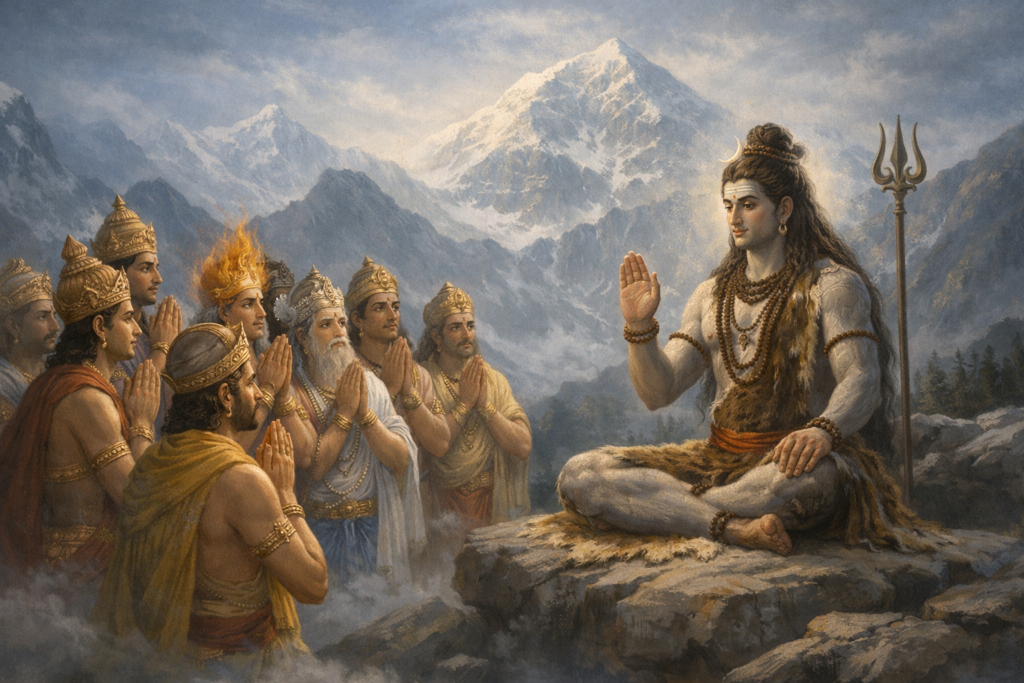
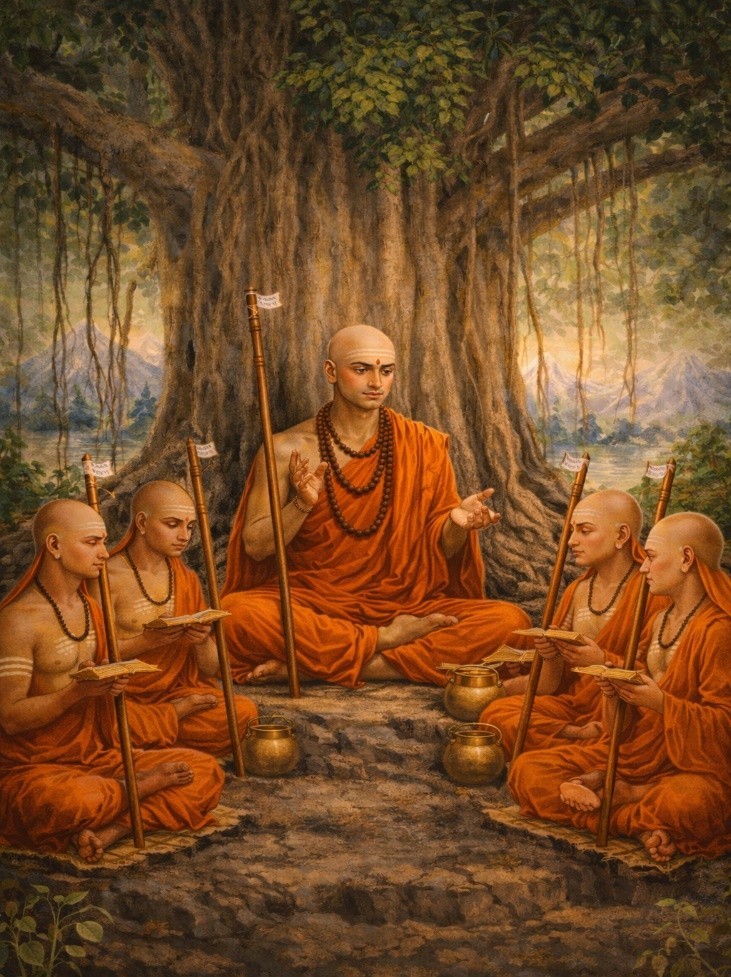
Hearing the deities’ grief, Lord Shankara assured them that He would personally incarnate for the destruction of wickedness and the restoration of righteousness (Sadachar). He declared that He would descend as the ‘Yati-Samrat’ named Shankara along with His four disciples, and would compose profound and deep Bhashyas (commentaries) on the Brahmasutras written by Vedavyasa, the Shrimad Bhagavad Gita, and the Upanishads. He asked the deities also to take human form to assist in this purpose. We will explain in detail later in this series which deity manifested as which great personality.
The Advent of Adi Shankaracharya in Kaliyuga
When Vedic knowledge began to vanish, philosophical nihilism (Shunya-vada) dominated, and society became directionless. Then, at the request of the deities, Lord Sadashiva Himself took birth as ‘Adi Shankaracharya’.
In the first phase of Kaliyuga, the situation had become extremely critical. Vedic knowledge and science were either lost or present in a distorted form. There was a need to re-establish the Vedic tradition not just on a religious level, but on philosophical, scientific, and practical grounds.
To fulfill this need, the incarnation of Shri Shivaswarupa Bhagavadadi Adi Shankaracharya took place—the one who established Rajarshi Sudhanva as the universal emperor and founded the Chaturamnaya-Chaturpeethas. His vision was not limited to philosophy; it was an infallible vision that bound governance, society, and culture into a single thread.
As expressed in the Shankara-Digvijaya (2.83):
“Sarge prathmike prayati viratim margne sthite daurgate swarge durgamatamupeyshi bhrisham durgepvarge sati. Varge dehabhritam nisarga maline jatopasargvekhile sarge vishwasrijastadiyavapusha bhargo-vatirno bhuvi.”
This means when detachment faded, the Vedic path became treacherous, heaven became difficult to attain, and liberation became inaccessible—when the nature of embodied beings became impure and the whole creation was filled with disturbances—then Lord Bharga (Shiva) Himself descended upon this earth in the form of Shankara. This incarnation was not for establishing a single sect, but to revive that Sanatana Dharma, life-philosophy where sages like Narada, Vashistha, and Vyasa were endowed with character and brilliance, and kings like Rama, Yudhishthira, and Arjuna were symbols of valor and ethics.
Most Significant Contributions of Adi Shankaracharya
The Acharya’s most far-reaching contribution was establishing Vedanta as the sole scripture of ‘Moksha’. He made the Mahavakyas of the Upanishads the central thread of philosophy and clarified that the supreme essence of the Vedas lies in the non-dual reality of ‘Brahma-Atma.
1. Ontological Restoration (तात्त्विक पुनर्स्थापना) of Upanishadic Advaita
- Realization of Mahavakyas: Through sutras like “Sarvam Khalvidam Brahma”, “Tattvamasi”, and “Aham Brahmasmi”, He established that there is no ontological difference between the Jiva (soul) and Brahma.
- Negation of Duality: The Acharya proved that while the world, the soul, and God appear distinct, they are all situated on the same substratum of Brahma. The perception of this difference is the reason for fear and conflict, while the realization of this non-difference is the Moksha / salvation.
- He clarified that Karma and Upasana are means of purification of mind and soul, while Jnana (knowledge) is the direct cause of liberation.
2. Systematic Framework of Bhashyas (commentaries), Prakarana-Granthas (treatise texts), and Sadhana (spiritual practice).
The Acharya systematically organized the nearly lost Vedantic knowledge through three mediums: Bhashyas, Prakarana-Granthas, and Stotras.
- Prasthanatrayi Bhashya: He presented the authentic meaning of Vedanta by writing commentaries on the Upanishads, Shrimad Bhagavad Gita, and Brahmasutras. he presented the true import of Vedanta in an authentic form to society for the first time.
- Prakarana-Granthas Through texts like ‘Vivekachudamani’ and ‘Aparokshanubhuti’, he described the discrimination between soul and non-soul, the necessity of the sixfold virtues {Shat-Sampatti- 1. Shama (Tranquility), Dama (Self-Control), Uparati (Withdrawal), Titiksha (Forbearance), Shraddha (Faith), Samadhana (Focus)}, and the sequential steps leading to the direct realization of liberation.
- Integration of Tantra and Worship: Through ‘Saundaryalahari’ and ‘Prapanchasara’, He eliminated the artificial division between Saguna-Nirguna and Sakara-Nirakara. He emphasized that the purification of the body, senses, breath, and mind is mandatory for Brahma-jnana.
3. Dashanami Sannyasa and Cultural-Geographical Protection
The Acharya ensured that Advaita philosophy was not confined to texts alone, thus establishing the Dashanami Sannyasa tradition. This was a well-thought-out plan for the protection of the entire Bharatvarsha:
Purva Mnaya (Puri Peeth): ‘Vana’ and ‘Aranya’ sannyasis were entrusted with safeguarding gurukulas and forest regions, as well as culturally refining the society there.
Dakshina Mnaya (Sringeri Peeth): ‘Saraswati’, ‘Bharati’, and ‘Puri’ sannyasis were appointed to protect educational institutions and ancient cities like Kashi and Ayodhya.
Paschima Mnaya (Dwarka Peeth): ‘Tirtha’ and ‘Ashrama’ sannyasis were assigned responsibilities for centers of cultural unity and purification.
Uttara Mnaya (Jyotirmath): ‘Giri’, ‘Parvata’, and ‘Sagara’ sannyasis were established as vigilant sentinels along India’s security lines (natural boundaries).
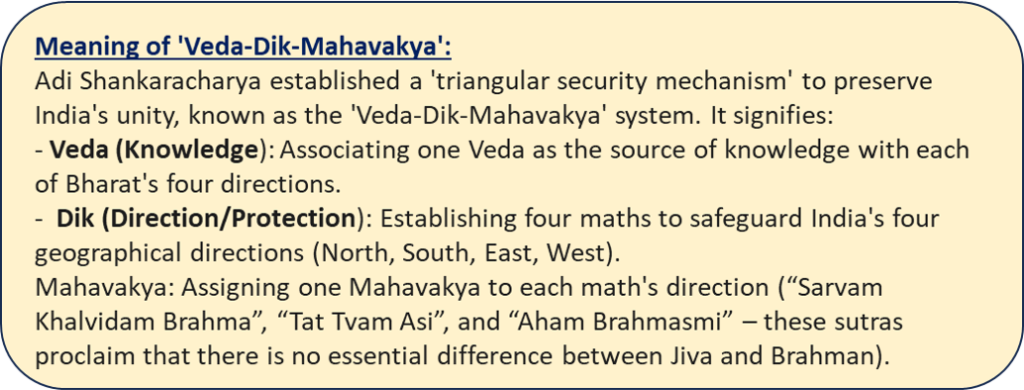
4. Ved- dik-Mahavakya System and Upaveda Integration
The Acharya envisioned Bharat as a living cultural entity in profound unity with the Aditya Mandala (solar orb). By linking the four directions (dik) with the four Vedas and their Mahavakyas, he forged an impregnable spiritual protective circle:
The Chaturamnaya-Chatushpeeth established by Adi Shankaracharya was far more than a mere geographical arrangement of four mathas. At its core lay a profound spiritual blueprint rooted in the Vedas, Upanishads, and Brahman-tattva. Shankaracharya perceived Bharatvarsha not merely as a landmass, but as a vibrant cultural power in identity with the Aditya Mandala. From this vision, he integrated the four directions with the four Vedas, their Mahavakyas, and their philosophical essences.
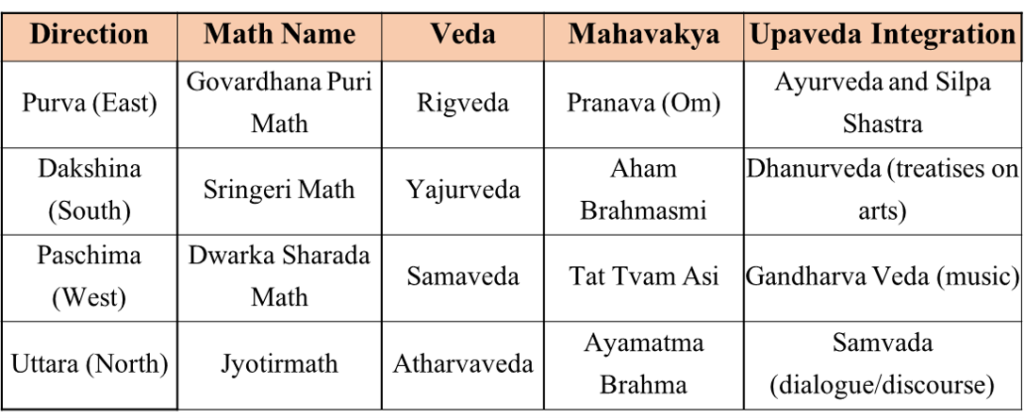
This system established perfect equilibrium between spirituality (adhyatma), science (vigyan), and worldly conduct (vyavahar). He revitalized India’s spiritual energy by reconsecrating sacred idols such as Badrinath, Jagannath, and Dwarkanath.
5.Shastrarthas with Hetrodox Schools, Philosophical Refutations, and Purification of Governance
In Kaliyuga’s challenging conditions, the Acharya refuted perverse doctrines through logic and shruti (Veda):
Sanatan tradition acknowledges that as yugas progress, human intellect, memory, and self-awareness progressively diminish. While silence sufficed in Satyuga, succinct sutras worked in Tretayuga, and elaborate texts were needed in Dwaparyuga, Kaliyuga demands organized scriptural debates, robust institutions, and direct intervention to sustain dharma and spirituality. This explains why avatars in Kaliyuga manifest in more expansive, action-oriented forms.
Yuga-Wise Avatara Forms
Satyuga: Shiva-avatar Lord Dakshinamurti resolved disciples’ doubts through silent exposition.
Tretayuga: Narayana-avatar Lord Dattatreya guided seekers via concise, sutra-like statements.
Dwaparyuga: Narayana-avatar Lord Krishna Dvaipayana Vedavyasa divided the Vedas, composed Mahabharata and Mahapuranas, and provided scriptural foundation through Brahma Sutras.
Kaliyuga: Mere texts proved insufficient; philosophy needed logical validation and direct refutation of distorted views—hence the descent of Shiva-form Adi Shankaracharya.
Shankaracharya’s Kaliyuga Interventions
He transcended commentaries and texts, touring the land for shastrarthas with heterodox schools, hypocrites, and Mimamsakas. These debates aimed not just at intellectual victory, but to demonstrate that truth fears no logic and shruti-based Vedanta withstands any philosophy.
Deeper Purpose
These shastrarthas sought more than philosophical triumph. Shankaracharya knew that without societal conviction in Vedanta’s rationality and experiential validity, people would revert to new heresies. Thus, he enshrined Upanishadic Vedanta as the sole moksha-shastra, showing that truths in other darshanas ultimately point to the same Advaita reality.
Charvaka Refutation: He exposed the limitations of the view that accepts only pratyaksha (direct perception) as pramana and established the eternality of the Atman distinct from the body.
Buddhist Refutation: Proved the inconsistencies of shunyavada and momentary consciousness theory, showing that sublation (badha) is impossible without a permanent witness.
( Buddhist Refutation Explained – In Buddhism, shunyavada (doctrine of emptiness) claims all phenomena lack inherent existence, while kshanika-vijnanavada (momentary consciousness theory) asserts consciousness arises and vanishes every instant, denying any permanent entity. Shankaracharya counters: Knowledge experiences constant bAdha (sublation or negation)—one perception negates the previous (e.g., waking disproves dream). This negation process requires a stable, unchanging sAkshi (witness consciousness) to recognize the invalidation. Without it, no coherent experience or knowledge progression is possible, exposing the theory’s self-contradiction. This upholds Advaita’s eternal Atman as the substratum behind changing experiences.)
Jaina and Other Schools: In Jaina context, he clarified that an atman limited by body dimensions, subject to accretion and attrition, cannot be eternal. Similarly, wherever Sankhya, Yoga, Vaisheshika, Nyaya, or Mimamsa treated atman as inert, prakriti, atom, or product of karma-phala, Shankaracharya fearlessly refuted it. He established that experiences of agency and enjoyment are superimposed, not essential, and Sat-Chit-Ananda Atman alone is the unchanging reality.
Nepal Episode, Divine Events, and Kailasa Departure
According to available historical and traditional evidences, in Gatkali Samvat 2578, the coronation of Suryavanshi king Vrishabhadeva took place in Nepal. About fifteen years later, in Gatkali Samvat 2593 (Yudhishthira Samvat 2531), Adi Shankaracharya’s advent occurred.
The Nepal Incident
Another significant historical event unfolded in the Nepal context. Due to the deceitful counsel of a Buddhist monk named Shantishila, in Gatkali Samvat 2600, King Vrishabhadeva converted the self-manifest Pashupatinath Linga—worshipped since Satyuga—into a chaitya (Buddhist stupa). This was a profound blow to the Sanatan tradition. However, through Adi Shankaracharya’s miraculous influence, the Nepal king’s heart transformed. He accepted discipleship under Shankaracharya, re-established faith in Sanatan beliefs, and facilitated the reconsecration of the Svayambhu Linga.
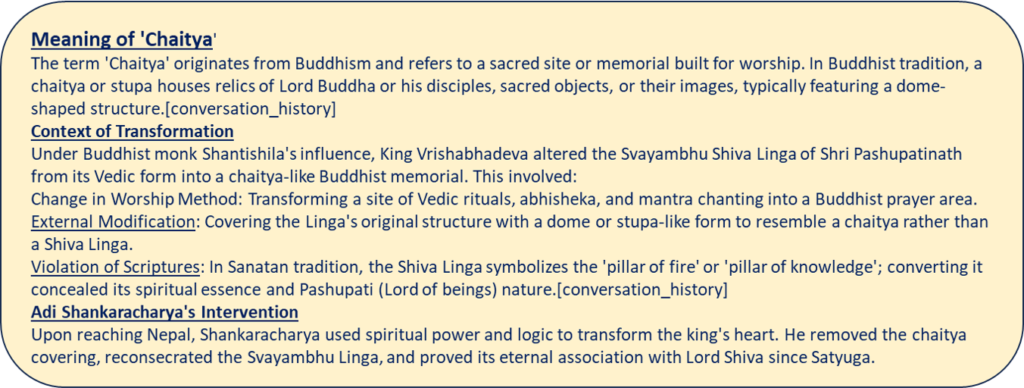
in this sequence, the childless Nepal king prayed to the Acharya for a son. Through Shankaracharya’s grace, he obtained a son, whom he named Shankardev. This event transcends a mere royal family tale, serving as direct evidence of Shankaracharya’s spiritual influence in that era.
Shankaracharya’s Disciples Tradition
The Acharya’s disciple lineage was equally robust and systematic. According to the copper plate inscription dedicated by King Sarvabhauma Sudhanva on Yudhishthira Samvat 2663, Ashwin Shukla 15, the alternate names of his four chief disciples are confirmed as:
- Shri Padmapadacharya’s other name Sannandanacharya;
- Shri Hastamalakacharya’s Prithvidharacharya;
- Shri Sureswaracharya’s Vishwarupacharya; and
- Shri Totakacharya’s Pradipanacharya.
This tradition embodied not just guru-disciple bonds, but an unbroken stream of knowledge, sadhana, and responsibility.
Kailasa Departure
At the young age of merely thirty-two, on Yudhishthira Shaka 2663 (475 CE), the auspicious Kartik Shukla Purnima day, Bhagavan Adi Shri Shiva-avatar Shankaracharya departed this world for his own abode, Kailasa. The accomplishments in this brief span proved instrumental in shaping Sanatan Dharma for millennia.
Adi Shankaracharya was not merely a philosopher, sannyasi, or acharya. He stands enshrined as the reviver of Vedic knowledge-science, founder of dharma-regulated governance, proponent of Advaita Vedanta, establisher of Chaturamnaya-Chatushpeethas, regulator of Dashanami Sannyasa tradition, and the manifest Shiva-avatar in Kaliyuga. His extraordinary saga remains the foundational pillar sustaining India’s spiritual consciousness even today.
We have briefly covered about Shiv Avatar, Aadi Shankaracharya’s in this PART-1 article in subsequent parts of the article-series we will be discussing his many contributions, that must be known to all Hindus across the world.

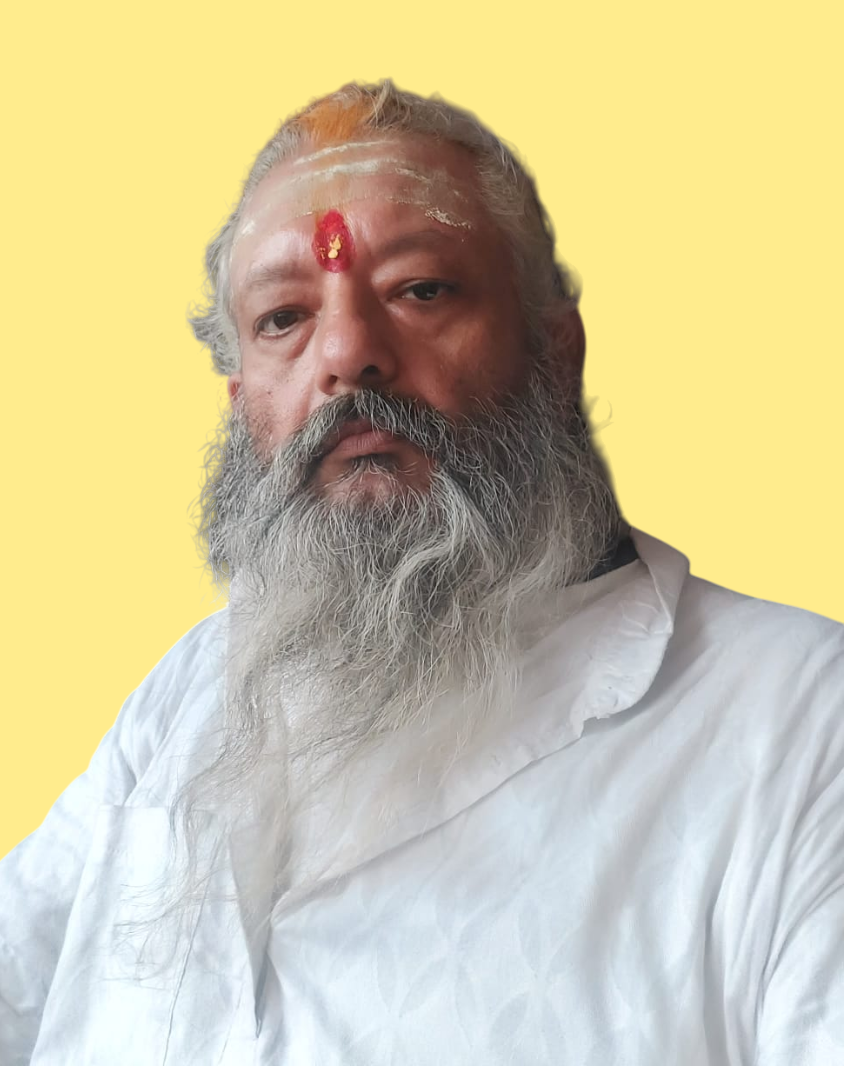
Anupam Trivedi has spent over three decades studying and reflecting upon Sanatan scriptures, including the Vedas, Upanisads, Itihāsa, and Purāṇas. He writes on cultural philosophy and ancient literature to present traditional insights with accuracy and clarity. Read full bio →
Thanks Anupam for providing such in-depth information
Pingback:Adi Shankaracharya: Jagadguru, Reviver, and Foundational Pillar of Sanātan Dharma” – Part 2 - Bhavam Bhavaani
Pingback:Adi Shankaracharya and the Chandala Story: The Truth About Equality and Oneness (Part 3) - Bhavam Bhavaani
Pingback:Adi Shankaracharya: : Appearance of Maharshi Veda Vyasa – Part 4
Pingback:Adi Shankaracharya: Kumaril Bhatt's Sacrifice & Path to Mandan Mishra (Part 5)
Pingback:Adi Shankaracharya & Mandan Mishra: The Unpleasant Confrontation Before Shastrartha
Pingback:Adi Shankaracharya & Mandan Mishra: The Epic Shastrartha That Re-established Sanatana Dharma Core Principles - Part 7 - Bhavam Bhavaani
Pingback:Adi Shankaracharya-Part 8: Shastrartha with Devi Ubhay Bharati & Mysterious Yogic Act "Par Kaya Pravesh” - Bhavam Bhavaani
Pingback:Adi Shankaracharya-Part 9, Can Rituals Alone Lead to Moksha?
Pingback:Adi Shankaracharya (Part 10): Plot to Kill Adi Shankaracharya